
Optimizing Existing Labs for New Equipment and Workflows
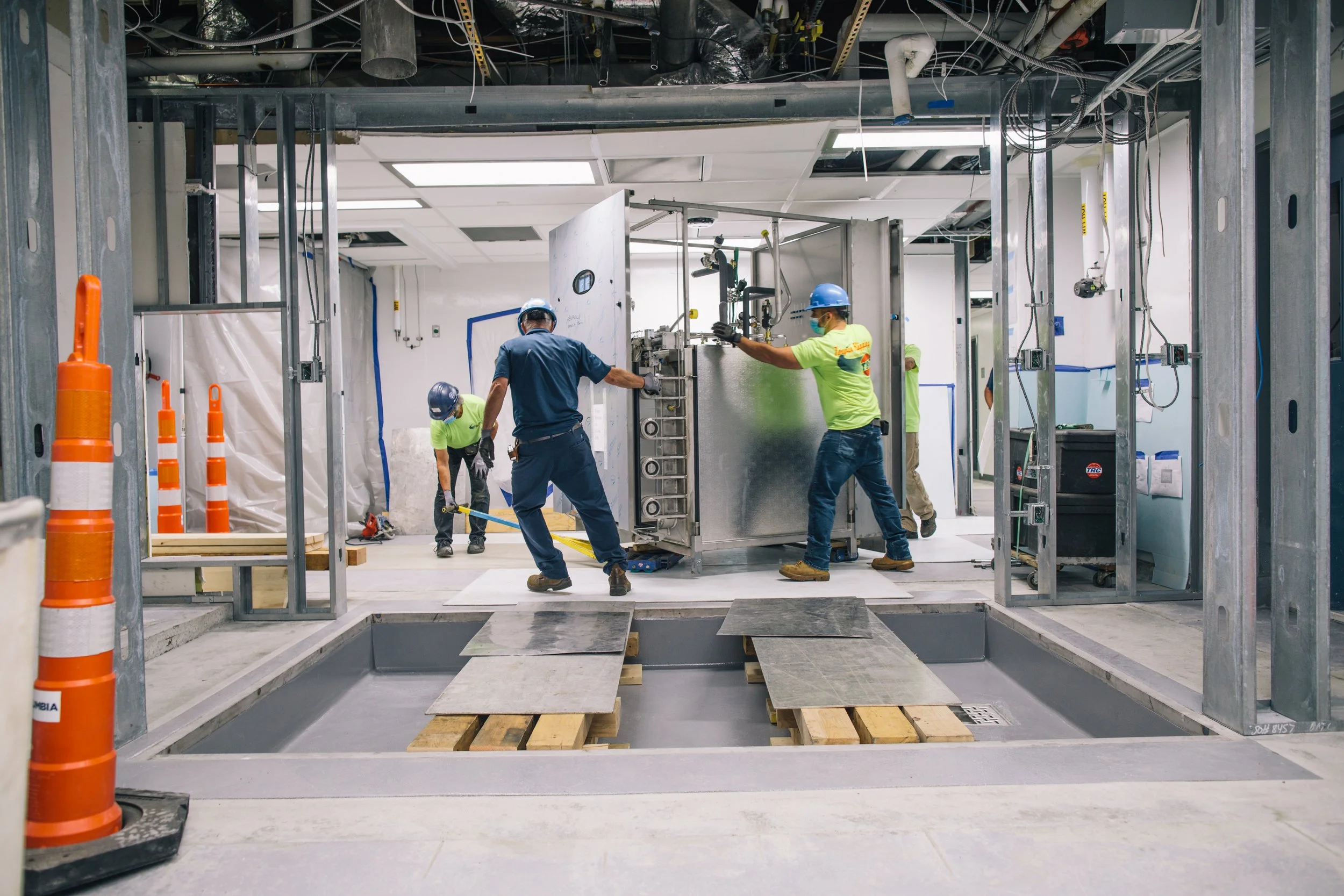
Installation of an autoclave by Columbia's adapt facility solutions team. Image: Mike Kalinowski
In many areas of the country, the life sciences building boom has slowed. But innovation doesn’t stop, and the development of new products, processes, and protocols mean that existing lab spaces are in constant need of renovation.
For leaders in the life sciences sector, the ability to swiftly reconfigure the functions of a working lab is crucially important. Changes to the layout of a space, the installation of new equipment, or the introduction of a time-saving upgrade or technical improvement has real world impact on both company profits and patient outcomes.
Working at a construction firm with a focus on Science + Technology, my colleagues and I are often called upon to adapt labs so they can accommodate new directions in research and development. Although these requests may cover a wide range of needs and requirements, they are usually driven by a sense of urgency and can come to us as a very simple bullet-pointed list or even as a back-of-the-napkin-style sketch.
Of course, accomplishing a napkin-sketch design concept successfully and efficiently requires quite a bit of understanding. Who uses the space? How do they work within it? It’s also important to understand the larger layout of a floorplan—what adjacent areas might be impacted by the work? Additionally, it’s helpful to assess possible future change requests. Are there ways that a renovation today might make coming needs easier to address?
While some of the updates required by evolving needs involve large-scale renovation, even smaller but necessary workspace fixes require careful coordination and planning. At Columbia, where I work, this realization led to the establishment of a dedicated service that could focus on adapting existing laboratory space: the adapt facility solutions team.
Since founding this team, we’ve seen a wide variety of work requests, with tasks including everything from relocating electrical outlets to switching the overall function of a lab space from, for example, vivarium to medical/chemical capabilities. Every case, large or small, has required a thoughtful approach that emphasizes efficiency, safety, and comfort.
The process should begin with a thorough cost-saving exercise conducted with the client: first, consider their specific needs and then explore and outline their options. For instance, recently a client needed to redesign their lab space to accommodate piping that would offer each of its scientists the ability to mix up to 16 different gases from their individual workspace. We knew that placing this function in so many different areas within the lab would require literal miles of tubing, and that this would, of course, be exorbitantly expensive. We instead proposed a facility layout that would deliver this gas mixing ability to a few centralized locations.
Sometimes, requests come with exceedingly short timelines. Recently, a client who needed support for a long-planned shutdown contacted us because weather conditions had changed and they realized that they would need our help with staging and shelter the very next day. Because we had been working together already, we were able to get up-to-speed on their requirements and deliver exactly what they needed.
Another client needed to introduce additional equipment at individual workspaces, which would mean dramatically increasing the number of nearby power outlets. Working with our electrical trade partner, we reviewed the layout of the space to find a solution that wouldn’t clutter every work area with wiring and realized that we could place power bars on the ceiling and run wires up to them, keeping working areas clear.
Working closely with trade partners is key to success, but so is access to in-house construction professionals. It’s always helpful to engage with colleagues overseeing mechanical, engineering, or plumbing functions or virtual planning and construction specialists to identify and finesse solutions. And of course, the most important partner for fulfilling workspace fixes are our clients themselves. Working closely with them throughout the process is essential to understanding the specifics of their evolving needs, and staying in regular contact with them afterward allows for anticipating additional changes and proactively working on the solutions that will make them happen smoothly. In fact, it’s a good idea to schedule walk-throughs with clients between projects just to touch base with leadership and chat with lab professionals about how they use their workspace and how it might better suit their needs.
Ultimately, establishing a dedicated team to work with lab managers allows everyone to focus on and anticipate evolving lab space needs, and to streamline the processes of managing, maintaining, or reconceiving lab space. And whether a client call is about moving a piece of specialized equipment or the urgent need for a complete change in how the space is configured, a timely and efficient resolution will be far more likely.