
Webinar Preview: Occupied Lab Renovations: Timing, Staging, and Installation
Renovating an active laboratory is one of the most complex challenges facing today’s research facilities. Unlike traditional construction projects, occupied lab renovations must balance aggressive schedules with uncompromising safety standards—all while ensuring that critical experiments, sensitive equipment, and ongoing operations remain protected.
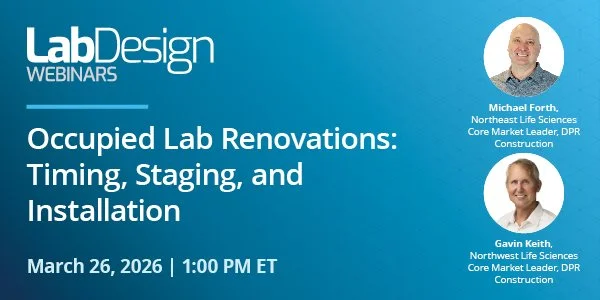
To help project teams navigate these challenges, Lab Design will host a free webinar, Occupied Lab Renovations: Timing, Staging, and Installation, on March 26, 2026, at 1:00 pm ET. The session, which is available for 1 LU/HSW credit through the American Institute of Architects (AIA), will also be available for free on demand viewing after this initial airing.
The webinar will feature industry experts Michael Forth and Gavin Keith of DPR Construction, who will share practical lessons learned from real-world occupied lab renovation projects. Their experience spans complex life sciences environments where maintaining operational continuity is just as important as completing construction on time.
Planning early and holistically
One of the most pressing challenges in occupied lab renovations is maintaining productivity and safety simultaneously. “Keeping the surrounding spaces operational and minimizing disruptions during the construction is critical,” Forth and Keith say, explaining that this balancing act requires careful coordination among all stakeholders, from lab managers and researchers to architects, engineers, and contractors.
Early planning plays a decisive role in achieving successful outcomes. According to Forth, “Early involvement from the CM (construction manager) with the design team and client to ensure the team is looking at the project wholistically. Including the logistical, safety and procurement strategies within the design decisions.” Bringing construction managers and trade partners into the process earlier enables teams to identify potential conflicts, anticipate safety concerns, and develop realistic phasing strategies before construction begins.
Mechanical, electrical, and plumbing (MEP) systems present another major risk area, particularly in aging facilities where existing infrastructure may be poorly documented or fragile. Keith emphasizes the value of proactive engagement with technical partners, noting, “We have found it extremely beneficial to bring on the MEP trade partners early to help with the validation of existing equipment and systems that will be impacted.” This approach helps prevent unexpected shutdowns, equipment failures, or compliance issues that could jeopardize research continuity.
Safety as a core planning strategy
Safety remains the central priority throughout the renovation lifecycle. Construction activities introduce hazards ranging from airborne contaminants to utility disruptions, making risk mitigation essential. “We'll talk about the importance of having safety as a critical piece of the planning process,” Keith says about the webinar. By integrating safety into every phase—from design through installation—teams can protect both construction personnel and laboratory occupants while maintaining regulatory compliance.
Equally important is fostering collaboration and communication among stakeholders. Renovation projects often require carefully timed shutdown windows, temporary relocations, and detailed coordination with lab users. “The key to a successful renovation project in an occupied facility requires having the team including the client, design team and CM on board early to make informed decisions,” Forth says. “This will allow the team to develop a proper plan that will minimize any disruptions to the facility during construction.”
Practical guidance for today’s lab teams
Designed for lab planners, architects, facility managers, and construction professionals, this webinar will provide actionable strategies for phasing, staging, installation, and risk mitigation in fully operational environments. The course is approved by the American Institute of Architects Continuing Education System for 1 LU/HSW credit, offering valuable professional development alongside practical insights.
As laboratory facilities continue to evolve, renovation projects will remain essential for supporting new technologies, improving safety, and extending building life cycles. With the right planning, coordination, and expertise, teams can modernize occupied labs while protecting the people and research that depend on them.