
Inside UWF's New AI Research Hub
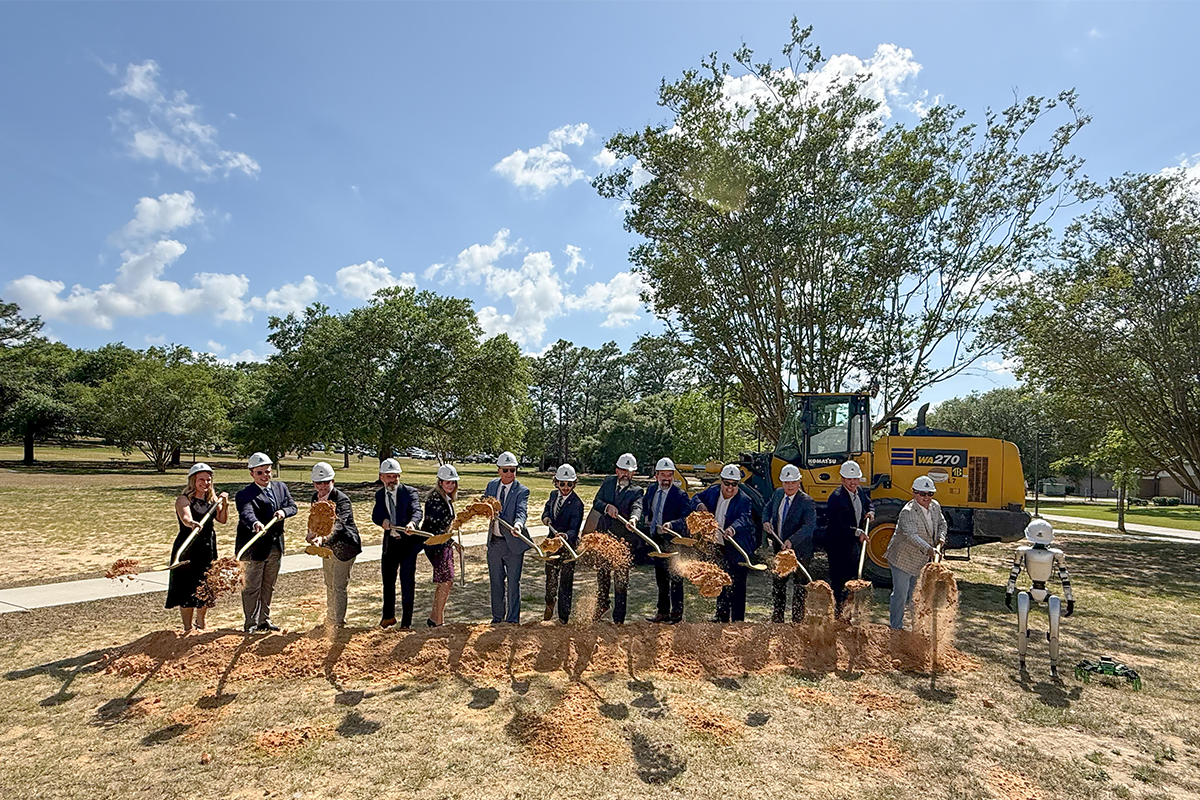
On April 23, the University of West Florida officially broke ground on a new advanced intelligence, cybersecurity and engineering research building called The Synapse. Funded by part of a $32.5 million award from Triumph Gulf Coast and more than $21 million in state funding, the 55,000-square-foot building on the Pensacola campus will house specialized labs and state-of-the-art equipment and technology to support advanced computational, AI, cybersecurity and engineering research across the University. Image: Courtesy of the University of West Florida
The University of West Florida (UWF) is investing in the future of advanced research with the construction of The Synapse, a 55,000-sf facility dedicated to artificial intelligence, cybersecurity, engineering, robotics, and computational intelligence. The building, which broke ground in April 2026, is supported by a portion of a $32.5 million award from Triumph Gulf Coast and more than $21 million in state funding.
Located on UWF's Pensacola campus south of the John C. Pace Library, The Synapse is designed to serve as a multidisciplinary research hub that brings together faculty, students, and industry partners working at the intersection of advanced computing and engineering. The facility will house the Center for Computational Intelligence (CCI) and the Center for Cybersecurity and AI, and will also support collaborative research in robotics, power systems, materials science, and civil engineering.
Designed by Caldwell Architects in collaboration with Perkins&Will, the building takes inspiration from the structure and function of the human brain. Its Y-shaped form reflects how neurons connect and communicate, while its interior organization is intended to foster the exchange of ideas across disciplines.
Designing around collaboration
From the earliest stages of planning, UWF sought broad stakeholder participation to ensure the building reflects both current and future research needs.
"We have been meeting and aligning with all internal stakeholders since the very inception of the project," says the design team, which includes Jose Bofill, Denise Gonzalez, Dave Thomas, and Angel Suarez. "In fact, some key stakeholders were part of the selection committee for both the design team and the construction manager. A large part of the selection was driven by the experience these teams brought in leading and mapping a collaborative design process to make sure the alignment is achieved for each successive level of detail; from overall programming vision at the onset, to the most intricate coordination of equipment specifics and systems integration as we start construction."
The planning effort involved university leadership, facilities personnel, IT staff, faculty researchers, operations teams, and departmental leaders. Early visioning sessions focused on establishing project goals and identifying opportunities for cross-departmental collaboration.
According to the architecture team, user group meetings brought together representatives from multiple departments to discuss both shared and unique needs. The design team also toured existing facilities used by researchers to identify successful features and areas that could be improved upon in the new building.
UWF's internal project leaders emphasized a similarly collaborative approach, says Dr. Karen Sinclair Molek, UWF professor of chemistry and associate vice president of Computational Intelligence and Student Scholars Programs. "Facilities has coordinated meetings with UWF leadership and teams and the Architects and Construction company every step of the way, starting from pre-design meetings through current 90 percent drawing meetings."
Molek notes that faculty participation has remained central throughout the process, with her, Dean Mohamed Khabou, and Dr. Eman El-Sheikh playing instrumentals role in ensuring faculty and staff attend meetings and respond to drawing reviews.
Turning research workflows into design decisions
One of the primary goals of The Synapse is to ensure that research spaces support how people actually work rather than simply look impressive on paper.
To accomplish this, the project team developed a structured review process that includes user group meetings, design reviews, cost alignment meetings, and milestone evaluations throughout programming, schematic design, design development, and construction documentation phases.
During these sessions, researchers review both floor plans and three-dimensional visualizations to evaluate room layouts, circulation paths, equipment placement, and operational workflows.
"During user meetings described above, both scaled plan views and 3D views are prepared and reviewed by the users to confirm layouts, movement sequences, clearances, and alignments," the design team explains. "There has been significant deliberation and modification of each space to tailor the labs to the desired workflow."
As the project advances toward construction, designers are also developing virtual walkthrough models to verify furniture and casework layouts before installation begins.
To further reduce risk, the team has incorporated multiple validation checkpoints throughout the project. Molek notes that the university conducted review meetings at "each point from pre-design, to 35 percent, 65 percent, and 90 percent drawings."
The design team is also planning construction mockups for representative spaces to verify quality, installation methods, and systems coordination before those elements are replicated throughout the building.
Beyond the traditional wet lab
While The Synapse will include specialized engineering laboratories, its research mission differs significantly from that of a conventional science building.
"Computer science, AI, robotics, and cybersecurity research spaces are digital, flexible, and collaboration-driven, whereas traditional wet labs are physically intensive, safety-regulated, and infrastructure-bound," the design team explains.
The facility's program is centered primarily on computational research, with only two wet laboratories dedicated to civil and mechanical engineering activities that require limited chemical use and storage.
Instead, much of the building is organized around flexible laboratory modules that can evolve as research priorities change. The modular approach allows workstations, equipment, and collaborative environments to be reconfigured without requiring extensive renovations.
"This building has more open collaborative spaces with flexibility to serve as daily research space, space for several small team meetings, or large lecture/workshop-style space," says Molek.
The emphasis on flexibility extends beyond individual rooms. Academic research increasingly depends on both formal and informal collaboration, prompting designers to create networks of interaction spaces that function as extensions of the laboratory environment.
A central atrium, interconnected circulation routes, and shared gathering areas are intended to encourage chance encounters and cross-disciplinary conversations between researchers who might not otherwise interact.
Specialized infrastructure for emerging technologies
In addition to flexible collaboration areas, The Synapse will introduce research capabilities not currently available elsewhere on campus.
"It will house computational-based facilities such as the immersive visualization spaces, not available in other buildings on campus," Molek says.
These advanced visualization environments will support data-intensive research, modeling, simulation, and computational analysis across a range of disciplines.
The building is also being designed to accommodate projects that require elevated security measures and controlled access.
"It will also boast additional infrastructure and security options designed for research opportunities, with limited users allowed, such as those with the Department of War or associated contractors," Molek says.
These capabilities are expected to strengthen partnerships with government agencies, defense organizations, and industry collaborators while supporting the university's growing role in cybersecurity and advanced computing research.
Building a platform for future discovery
As construction progresses, The Synapse represents more than a new academic building. It reflects a broader shift in research facility design toward environments that prioritize adaptability, collaboration, and interdisciplinary problem-solving.
By combining flexible laboratory modules, immersive visualization technologies, secure research infrastructure, and a highly collaborative planning process, UWF is creating a facility designed to evolve alongside rapidly changing fields such as artificial intelligence and cybersecurity.
When completed, The Synapse will provide researchers, students, and industry partners with a purpose-built environment for discovery—one intended to accelerate innovation while strengthening UWF's position as a regional leader in advanced technology research and workforce development.