
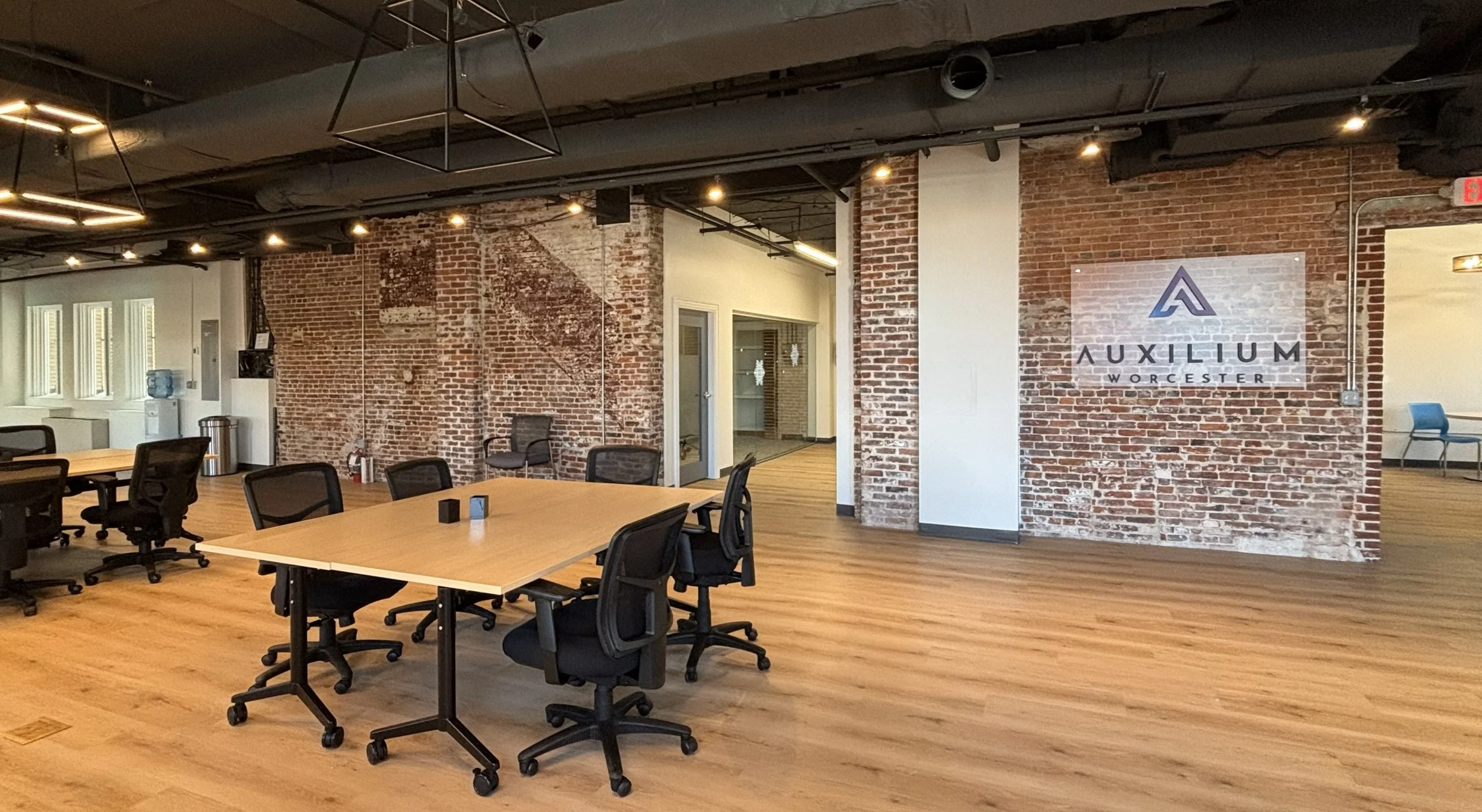
The Flexcon Lab at Auxilium will provide 3,000 square feet of flexible materials science lab space designed to support early-stage startups in downtown Worcester, MA. Image: Courtesy of Auxilium
A new materials science laboratory planned for downtown Worcester, MA, is set to expand the region’s innovation capacity by giving early-stage companies access to advanced equipment, technical expertise, and flexible research space. The Flexcon Lab at Auxilium, located at 311 Main Street, will add 3,000 square feet of dedicated lab infrastructure supporting startups across chemistry, functional materials, electronics, clean technology, and related fields.
The project is being developed through a partnership between Auxilium Worcester, Flexcon, and 44 Maple Group, combining accelerator programming with industrial manufacturing expertise to bridge the gap between early research and commercial readiness.
Expanding Worcester’s innovation ecosystem
The new lab arrives as Worcester’s innovation ecosystem continues to gain national attention, supported by increased investment in STEM industries and life sciences infrastructure. Within this context, the Flexcon Lab at Auxilium is intended to address a key gap: accessible, flexible materials science space for startups that require both instrumentation and hands-on technical support.
Rather than functioning as a traditional shared lab, the facility is designed as an integrated environment where startups can move from concept development to prototype testing in a single location, supported by experienced technicians and engineers who provide direct operational guidance alongside physical lab resources. The lab is also intended to support startups with capital, mentorship, and workspace, helping translate early-stage ideas into scalable technologies.
A central focus of the lab design is adaptability, with the space structured to accommodate evolving startup needs and shifting research priorities rather than fixed instrumentation layouts.
The design approach is grounded in workflow-driven planning and prior operational experience, according to Aaron Elman, director of technical development & lab operations at 44 Maple Group.
“To define the space, we are utilizing both this past experience as a guiding tool as well as working backwards from materials and processes to determine needs,” he explains. “This lab will predominantly focus on materials science, utilizing a variety of chemistries and materials. Because of this, we are prioritizing space for wet chemistry work and prep, as well as analytical testing areas. We are also keeping additional capacity for future expansion as the need within the space transforms and grows.”
Elman emphasizes that long-term usability depends on flexibility built into the core design. “Primary design priorities include a use of flexible space that can be flipped and altered as changing needs arise.”
This approach is intended to ensure the lab remains functional and relevant as startup programs evolve, enabling rapid reconfiguration without major infrastructure changes.
Collaboration between startup and industry partners
The development of the Flexcon Lab is shaped by close collaboration between accelerator leadership and industrial partners. Auxilium Worcester is guiding startup-facing programmatic needs, while Flexcon and 44 Maple Group contribute manufacturing expertise and operational insight.
This partnership is designed to ensure startups are not only conducting research, but also considering early-stage scalability and commercialization pathways. The lab environment is intended to support that transition by embedding industry knowledge directly into day-to-day operations.
“The collaboration is heavily influencing the design,” Elman says. “Auxilium is driving the user base side while Flexcon and 44 Maple Group bring the industry perspective, informing the design of the space to allow for efficient use and for expedient scale of prototype technologies from a minimally viable status to commercial production.”
This alignment between accelerator and industry partners is expected to strengthen technical outcomes and accelerate time-to-market for participating startups.
Adapting a historic building for modern lab use
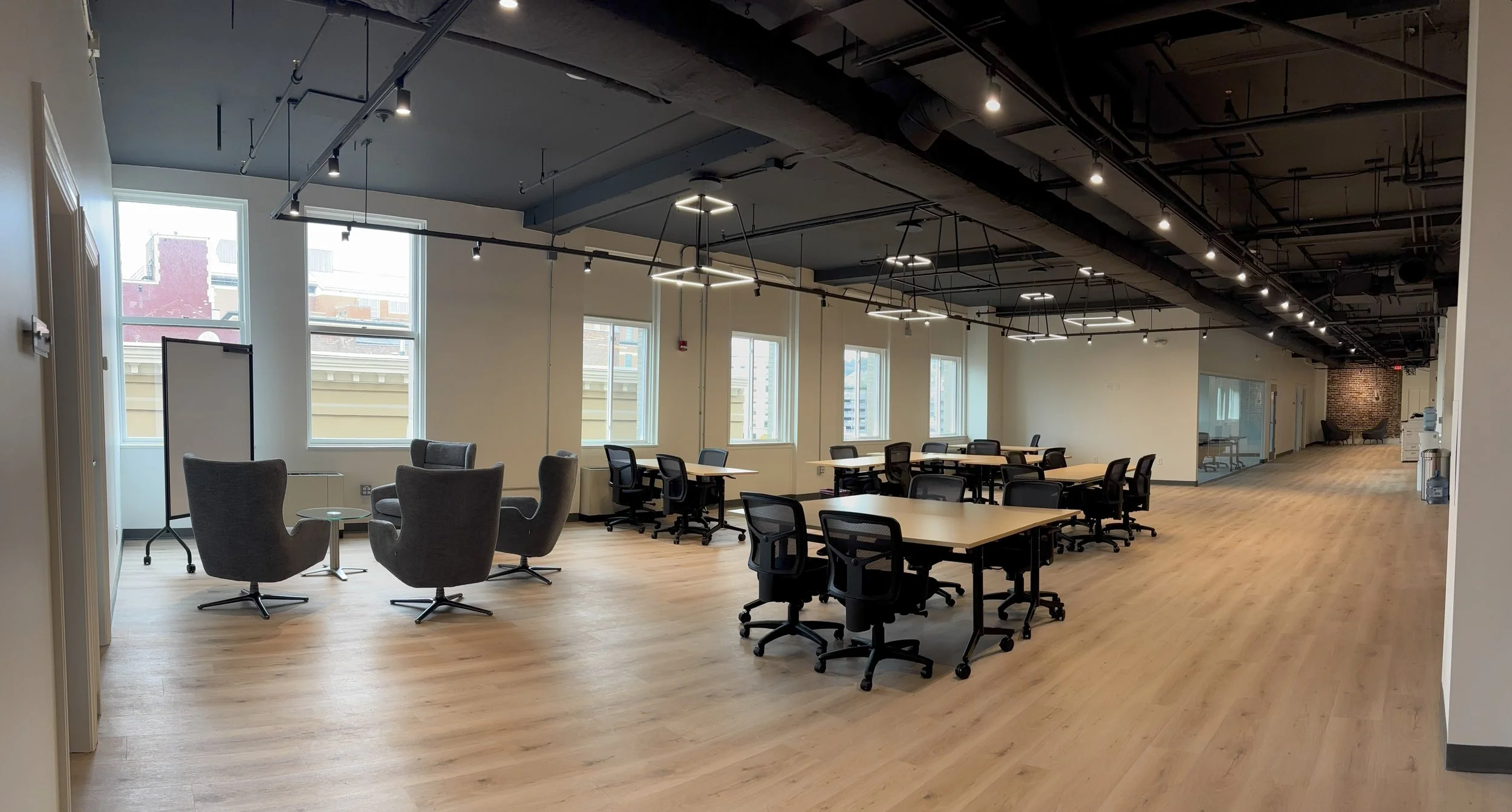
Adaptive design features, including modular workstations and reconfigurable utilities, will allow the lab to evolve alongside changing startup research needs. Image: Courtesy of Auxilium
One of the most complex aspects of the project is the adaptive reuse of a building constructed in the early 1900s. Originally designed for office and light commercial use, the structure at 311 Main Street is being transformed to accommodate modern laboratory requirements, including structural load limitations, upgraded mechanical systems, and compliance with current fire and thermal codes. In some areas, reinforcement is required to support high-performance HVAC systems and heavy analytical equipment.
Elman describes the challenge of working within an existing structure. “Since we are retrofitting an early 1900s building, we ultimately work within the confines of the space,” he says, noting constraints such as equipment vibration sensitivity and layout limitations. To address this, the design incorporates vibration isolation systems and flexible utility distribution, allowing equipment to be repositioned as needed over time.
The retrofit also requires balancing preservation with modernization. While the building’s historic brick architecture reflects its industrial past, interior modifications such as insulation upgrades are necessary to meet current performance standards.
“Overall, the layout is very flexible—power drops available throughout, modular tables, and movable equipment throughout to ensure the space is efficient now and 10 years from now,” Elman says.
Building a scalable, startup-ready lab environment
Beyond its physical design, the Flexcon Lab is intended to operate as a shared innovation environment where startups and operational staff work side by side. The space will be actively managed by the 44 Maple Group team, who will coordinate usage, support research activities, and integrate startup programming with internal development work.
Elman notes that flexibility extends into how the facility is scheduled and managed. “All of this will be managed by the 44 Maple Group team who will be managing the space and orchestrating the work schedules.”
Startups will also have access to additional non-lab space within Auxilium’s broader facility, including meeting rooms and collaborative work areas, ensuring that research activities are supported by broader business development infrastructure.
Looking ahead, the project team emphasizes process-driven design and long-term adaptability over fixed equipment planning. As Elman explains, designing for uncertainty is a central challenge—and opportunity.
“Some of the largest challenges have been designing for the unknown,” he says. “Infrastructure permanence versus adaptability has also been a challenge, as we are designing within a fixed footprint with areas where there are fixed dimensions and immovable structures. Insights are to over-engineer and allow for future expansion and changes to enable the ability to switch gears for changes in future demands. Designing for process flow is much better than designing around a list of equipment.”
When completed, the Flexcon Lab at Auxilium is expected to serve as both a technical resource and a catalyst for startup growth, strengthening Worcester’s position as an emerging hub for advanced materials innovation and contributing to the continued revitalization of its downtown innovation district.