
What Robotics-Driven Research Means for Future Laboratory Spaces
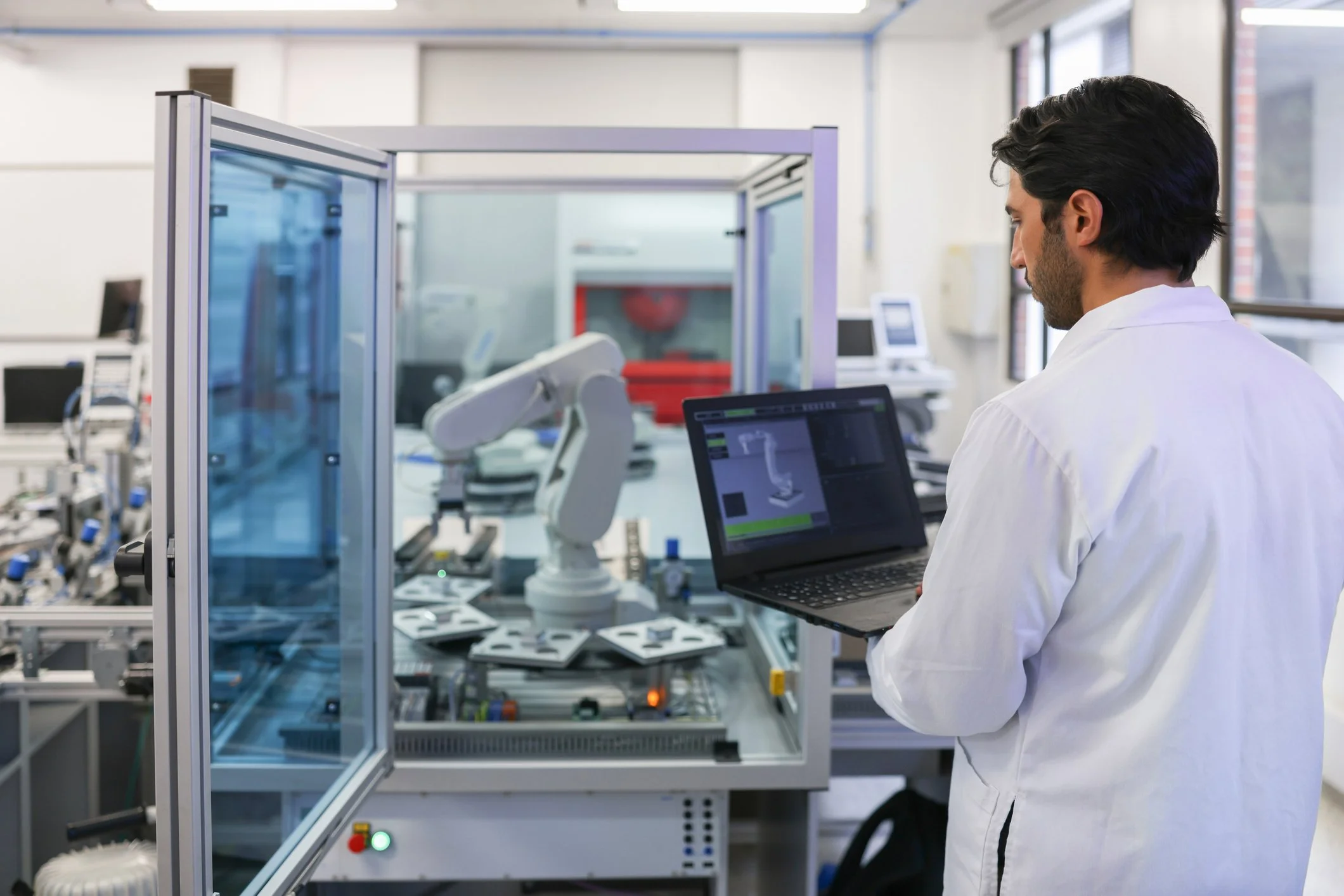
The rise of autonomous laboratories is changing how researchers think about experimentation—and how architects, engineers, and lab users approach facility design. Recent efforts to develop robotics-driven materials research platforms highlight a growing need for laboratories that can support not only scientific discovery, but also the integration of artificial intelligence, automation, and physical robotic systems.
Amazon’s search for a robotics scientist to help build an autonomous materials discovery laboratory reflects a broader industry trend: research environments are moving toward closed-loop systems in which AI models generate experimental hypotheses, robots perform tests, and data feeds back into the discovery process. While the technology is still evolving, the facility implications are already becoming clear.
Robotics labs require a different approach to planning than traditional research environments. Instead of designing around individual researchers performing most experimental tasks manually, these spaces must accommodate interactions among scientists, robotic platforms, analytical instruments, data systems, and support infrastructure.
“Designing an autonomous lab starts with understanding the workflow—not just the equipment,” says the emerging model of robotics-enabled research. Lab planners and architects must work closely with end users to understand how materials, samples, data, and experiments will move through the space.
As robotics, AI, and automation continue to reshape research environments, the digital tools used to plan and design these spaces are evolving as well. For more insight into how emerging technologies are transforming laboratory planning, design, and collaboration, join Lab Design’s Smart Design Tools & Software Digital Conference on July 14, 2026. The free virtual event will explore the role of AI, BIM, visualization tools, and other digital platforms in creating smarter, more adaptable laboratory environments. The event is eligible for AIA/HSW continuing education credit and will be available on demand after the live program.
One of the biggest challenges is flexibility. Robotics platforms, sensors, and analytical instruments are advancing rapidly, meaning today’s automation infrastructure may look very different in five or 10 years. Spaces should allow for equipment changes, new robotic systems, and evolving research workflows without requiring major renovations.
Key design considerations may include:
Flexible infrastructure: Robotics systems may require adaptable power, data connectivity, compressed air, specialty gases, or other utilities. Planning for future equipment changes can help avoid costly modifications.
Human-robot collaboration: Autonomous labs will not eliminate researchers; instead, scientists will increasingly supervise, program, maintain, and interpret robotic systems. Spaces must support safe and efficient interaction between people and machines.
Equipment integration: Successful automation depends on communication between robotic platforms and laboratory instruments. Early coordination between researchers, automation specialists, IT teams, and designers is essential.
Data-driven environments: Robotics labs generate significant volumes of experimental data. Facility planning should consider network capacity, computing requirements, cybersecurity, and data management workflows.
Maintenance and support zones: Robotic systems require calibration, troubleshooting, and service. Dedicated areas for maintenance and staging can improve reliability and minimize disruptions.
For lab users, early involvement in the design process is critical. Researchers can help design teams understand not only what equipment is needed today, but how experiments are expected to evolve. Questions about sample flow, operator interaction, failure recovery, and future automation goals can significantly influence layout decisions.
For architects and lab planners, robotics introduces a new opportunity: designing facilities around continuous experimentation rather than fixed workflows. The most successful autonomous labs will likely be those that balance advanced technology with adaptable spaces that support researchers, engineers, and the discoveries they are working to achieve.
As more organizations invest in AI-enabled experimentation and autonomous research platforms, robotics will become less of a specialized feature and more of a fundamental consideration in next-generation laboratory design.