
Designing for Automation: When Robots Move In
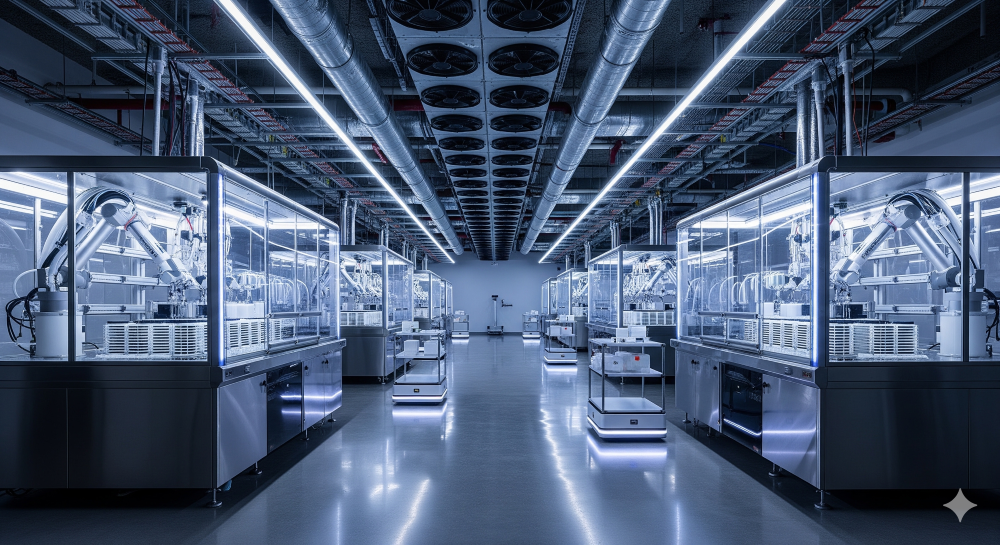
Robots don't need coffee breaks, but they do need reinforced floors and massive cooling. Designing the automated wing.
Credit: Gemini (2026)
Introduction: The shift to non-human occupancy
For centuries, laboratory architecture has been fundamentally human-centric. Planners obsessed over natural light, ergonomic bench heights, and clear sightlines to ensure the comfort and safety of the scientists pipetting at the bench. However, the scale of modern genomics, high-throughput screening, and bio-manufacturing has surpassed human capacity. Enter the era of the robot.
As facilities transition from manual processes to fully automated workflows, the architectural paradigm must shift. Robots have entirely different environmental needs than humans—they don't care about a window view, but they are incredibly sensitive to micro-vibrations, require massive amounts of uninterrupted power, and generate intense, localized heat. For the modern architect, designing robust lab automation infrastructure is no longer about accommodating a single machine on a desk; it is about designing a bespoke physical environment where the building itself acts as an extension of the robotic system.
The heavy burden: structural and vibration limits
The first and most unyielding architectural challenge in automation is gravity. High-throughput robotics, particularly fully enclosed automated liquid handling workcells, extensive automated compound storage systems, and multi-axis robotic arms, are exceptionally heavy. Unlike a standard lab bench that might hold a few microscopes and a centrifuge, these monolithic systems concentrate thousands of pounds of static and dynamic weight into a very small footprint. This requires structural engineers to completely rethink the building's skeletal requirements.
While a standard lab floor might be engineered for a live load of 100 pounds per square foot (psf), an automated wing often requires 150 to 200 psf to safely support the dense concentration of machinery and automated storage and retrieval systems (ASRS) for compound management.
Vibration Criteria: Beyond sheer weight, precision is paramount. A robotic arm dispensing nanoliter droplets into a 384-well plate cannot tolerate the bounce of a standard steel-framed floor. The lab automation infrastructure must be engineered to strict vibration criteria (often VC-A or VC-B). This frequently necessitates locating heavily automated zones on the ground-floor slab-on-grade, or heavily reinforcing upper floors with thicker concrete slabs and stiffer steel bays.
Spatial planning: the robotic lab layout
When designing for human scientists, the standard 11-foot planning module is the golden rule, providing the perfect balance for benches and human-sized aisles. A robotic lab layout, however, plays by an entirely different set of spatial rules. Removing the human from the immediate workflow means the scale of the equipment no longer needs to correlate with human reach or ergonomics. Instead, the architecture must conform to the sweeping arcs of robotic arms, the travel paths of autonomous vehicles, and the massive footprints of integrated workcells.
Robotic workcells are often massive, monolithic enclosures that do not conform to standard bench dimensions. Furthermore, the integration of autonomous mobile robots (AMRs)—which carry samples from one machine to another—requires entirely new circulation logic.
Aisle Widths: Aisles in an automated wing must be wide enough not just for human egress, but for AMRs to navigate, rotate, and pass each other without triggering collision-avoidance shutdowns.
The "Lights-Out" Concept: Because robots do not require natural light, automated wings are best located in the deep, windowless core of a building. This reserves the premium perimeter daylight zones for the human-centric computational or write-up areas, optimizing the facility's floor plate.
Thermal loads: cooling the machine
Robots do not need coffee breaks, but they do generate an immense amount of continuous, localized heat. The motors, power supplies, and onboard computers running 24/7 create thermal environments that are drastically different from a standard wet lab. A single high-throughput screening workcell can generate as much heat as a small server room, turning the surrounding space into a thermal hazard if not properly managed.
When multiple systems are operating in a dense robotic lab layout, standard overhead VAV air conditioning is often insufficient. The heat density can cause the robots' internal sensors to overheat, leading to catastrophic batch failures.
Cooling Strategies: Effective lab automation infrastructure requires targeted thermal management. This often involves localized cooling solutions such as chilled beams, high-capacity precision air conditioning (PAC) units, or even direct hydronic cooling piped directly into the robotic enclosures. The HVAC system must be engineered to handle constant, 24/7 high-density heat loads, distinct from the variable loads of a human-occupied wet lab.
Power and data: the umbilical cords
Successful lab robotics integration lives and dies by its utilities. In a manual lab, a researcher can pause their work if the power flickers or the network drops. In an automated lab, a momentary power blip that might merely annoy a human researcher will force a robot to completely abort a 48-hour continuous assay, ruining thousands of dollars of reagents and losing days of valuable research time. The infrastructure must provide an uninterrupted, pristine supply of electrons and data.
Uninterruptible Power Supply (UPS): Every automated workcell must be backed by a robust UPS and tied to the facility's emergency generator network to ensure graceful shutdown or continuous operation during grid failures.
Data Density: Robots generate terabytes of telemetry and assay data. The "ghost corridors" or ceiling service carriers above an automated zone must be saturated with high-speed, redundant fiber optic cabling to connect the machines to the local server room or the facility's digital twin.
Conclusion: the building as a machine
Integrating robotics into a laboratory is not a furniture exercise; it is a fundamental mechanical and structural challenge. Attempting to shoehorn a million-dollar automated liquid handling system into a legacy lab designed for manual pipetting inevitably leads to operational bottlenecks and overheating.
By prioritizing specialized lab automation infrastructure—from reinforced structural slabs and precise climate control to AMR-friendly layouts—architects can create environments where automation thrives. In the future of high-throughput science, the building is no longer just a shelter; it is the ultimate chassis for the robotic workforce.
Frequently asked questions (FAQ)
What is a "lights-out" laboratory?
A lights-out laboratory is a fully automated facility designed to operate continuously (24/7) with zero human intervention. Because there are no humans present during operational hours, the facility does not need to be illuminated, saving significant energy.
Can AMRs (Autonomous Mobile Robots) use elevators?
Yes, modern AMRs can be integrated with the building's elevator control systems via Wi-Fi or local networks. However, for high-traffic robotic facilities, architects often design dedicated "robot-only" elevators or dumbwaiters to prevent them from competing with human traffic.
How do you handle compressed air for robotics?
Most robotic pneumatic systems require incredibly clean, dry compressed air to prevent valve damage. The facility must specify oil-free lab air compressors with aggressive desiccant dryers and particulate filters, piped directly to the automated workcells.
