
Lab Utilization Tracking: Who Is Actually Using That Bench?
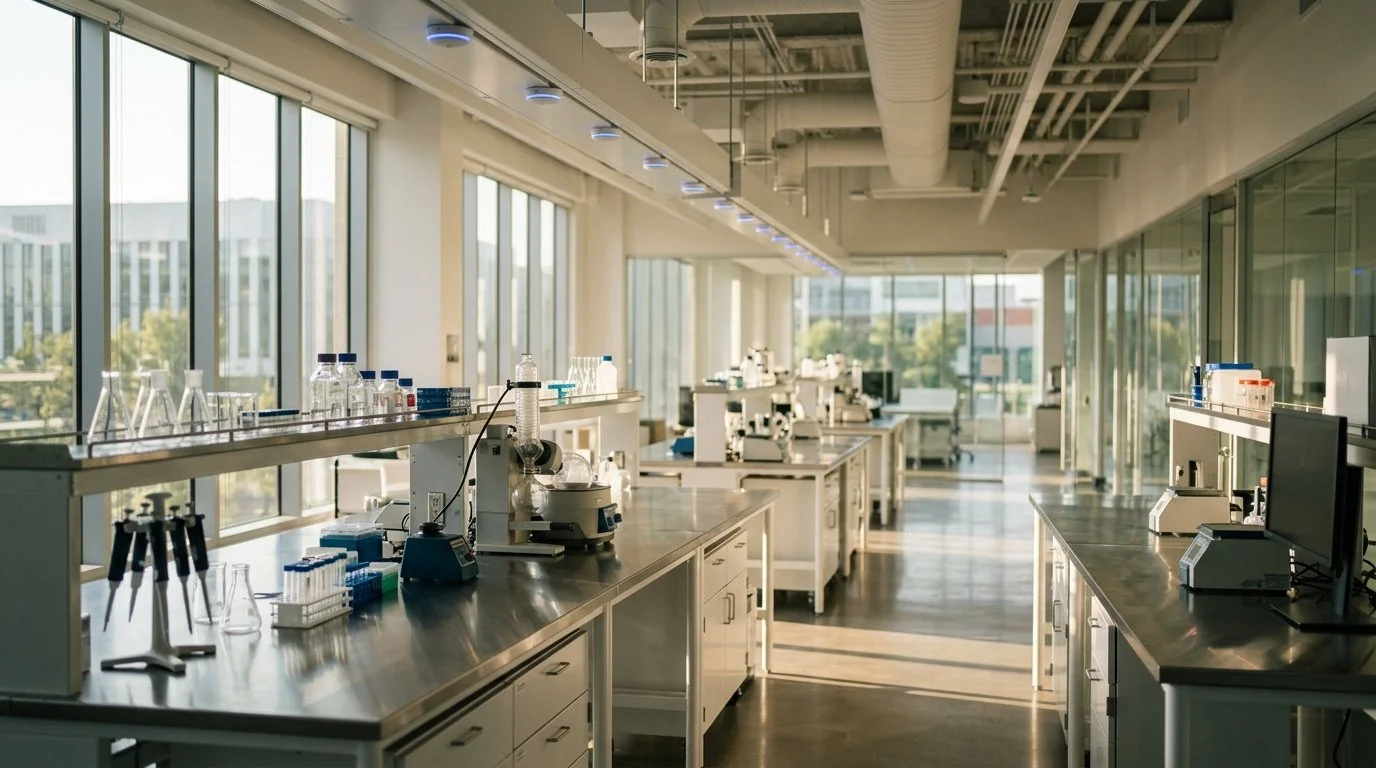
Before you approve a capital project for a new lab wing, check the data. | Credit: Flow (2026)
The data says your "full" lab is empty 40% of the time. Using sensors to optimize real estate.
The most persuasive argument against building a new laboratory wing is often the data sitting inside the existing one. Lab managers feel the pressure every day: researchers complain that benches are crowded, scheduling conflicts pile up, and the facilities director forwards another request to expand. The instinct is to build. The problem is that feeling crowded and being fully utilized are not the same thing—and without objective data, the difference is impossible to prove.
That is exactly what lab occupancy tracking is designed to solve. By deploying a network of smart sensors throughout a research facility—on benches, at equipment stations, across shared zones and corridors—facility managers and lab designers can replace anecdote with evidence. The result is a precise, time-stamped picture of how every square foot of a lab is actually being used, not how researchers imagine it is being used, and not how it was designed to be used years ago.
This article is part of our series on smart lab sensors and the IoT ecosystem in research. If you are new to the broader technology landscape behind connected lab monitoring, that hub guide is the place to start.
The Problem with "Full"
Research labs have a unique relationship with the perception of space. A bench covered in equipment feels occupied even when no one has touched it in a week. A shared instrument room feels perpetually busy because access is always scheduled in advance. A write-up area feels crowded on Tuesday afternoons and desolate on Friday mornings.
The result is that facility managers operate on a mix of researcher complaints, corridor observations, and scheduling logs—none of which reflect actual utilization. Studies across academic and corporate campuses consistently show that more than 40% of laboratory and office space is underutilized at any given time, yet the same organizations continue to fund expansions based on the perception that they are out of space.
As one real-world case documented in our coverage of occupancy sensors and laboratory design illustrated, a global medical technology manufacturer used occupancy analytics to discover that parts of their building were 30% underutilized. "Instead of leasing more space, they redesigned the lab, saving thousands of dollars each year," with those savings redirected back into research. The data did not reveal a space shortage. It revealed a space management problem.
Key Terms and Definitions
Lab Occupancy Tracking: The use of sensor-based systems to continuously measure whether specific areas, benches, instruments, or rooms within a research facility are occupied or in active use—generating time-stamped data that reflects actual patterns rather than scheduled or intended use.
Space Utilization Rate: The percentage of time a defined space or piece of equipment is actively in use during working hours. A bench with a 30% utilization rate is occupied for roughly two to three hours of a typical eight-hour shift. Rates below 50% in areas perceived as "full" are common findings in first-time utilization studies.
Heat Mapping: A visualization layer applied to occupancy data that translates raw sensor readings into color-coded floor plan overlays—cool tones for underused areas, warm tones for high-traffic zones—allowing facility planners to identify utilization patterns across an entire floor or building at a glance.
Desk / Bench Utilization: The granular tracking of whether individual workstations, bench sections, or equipment stations are occupied, as distinct from room-level occupancy. Bench-level data is more expensive to deploy but reveals internal workflow inefficiencies that room-level data misses.
Space Optimization Data: The aggregated, analyzed output of an occupancy tracking program—typically presented as utilization rates by zone, time of day, day of week, and season—that directly informs programming decisions, renovation scopes, and lease negotiations.
Dwell Time: The duration of an occupancy event at a given location. Short dwell times suggest transactional use; long dwell times suggest dedicated work. Understanding dwell time distribution helps distinguish between bench space used for active experimentation and bench space used for storage.
Peak vs. Average Utilization: The distinction between the highest utilization recorded during a measurement period (peak) and the average utilization across all measured hours (average). Capital projects are often justified on peak observations—"the lab was full on Tuesday"—while average data tells a very different story.
What Lab Utilization Data Actually Reveals
When a research facility deploys occupancy sensors for the first time and sits with the data for thirty to ninety days, several patterns emerge with remarkable consistency.
Scheduled ≠ occupied. Instrument booking systems and bench reservation logs systematically overstate utilization. Researchers book time they do not always use. A mass spectrometer booked for three hours may be actively operated for ninety minutes. The gap between scheduled time and logged utilization time is often 30% or more.
Time-of-day and day-of-week patterns are dramatic. Most research labs peak between 10:00 a.m. and 2:00 p.m. on Tuesday through Thursday. Monday mornings, Friday afternoons, and the hours before 9:00 a.m. and after 5:00 p.m. show utilization rates that often fall below 15%. If a lab "feels full," it typically means it feels full during a four-to-six-hour window on three days per week.
Storage masquerades as occupied space. Benches used to store equipment, reagent kits, and personal effects register as occupied in visual surveys but generate zero utilization signal in sensor data. This distinction is particularly important in chemistry and biology labs where bench space is expensive and specialized.
Shared instruments drive false crowding narratives. If three research groups share one PCR machine, the crowding complaint is actually an instrument scheduling problem, not a space problem. Utilization data disaggregates these two issues clearly—revealing whether additional bench space, additional instruments, or better scheduling software is the correct intervention.
As covered in our guide to lean lab workflow optimization, researcher travel time and bench access inefficiencies are often the root cause of crowding complaints. Occupancy data makes this visible in a way that no walk-through survey ever could.
How Occupancy Sensors Work in Lab Environments
The technology behind lab occupancy tracking has matured significantly. The dominant sensor approach in research facilities today is thermal infrared detection—sensors that identify human presence by detecting body heat signatures rather than capturing images. This approach is preferred in lab environments for three reasons: it preserves researcher privacy, it functions reliably in variable lighting conditions, and it is not confused by equipment or objects on benches.
Thermal sensors are typically deployed at ceiling height and can cover areas ranging from a few square meters (for individual workstations) to an entire open-plan lab bay. They detect the presence, count, and movement of people within their field of view, generating timestamped event logs that feed into a central analytics platform.
For bench-level granularity, supplementary approaches are used:
Passive infrared (PIR) sensors mounted at bench height detect motion within a defined zone, capturing whether a specific workstation is actively in use
Contact sensors on equipment doors, instrument lids, and storage cabinets log access events with timestamps
AC current meters on powered equipment track run-time and energy draw, providing utilization data for instruments even when no human is physically present
As explored in our hub article on smart lab sensors and the IoT ecosystem, these sensor types form part of a broader connected lab infrastructure that can also monitor environmental conditions, cold chain assets, and equipment health from a unified platform.
From Data to Decision: Using Utilization Analytics to Inform Space Planning
Raw occupancy data is not a space planning document. The value is in the analysis and the narrative built around it. These are the primary applications that translate sensor data into actionable capital and operational decisions.
Making the Case Against New Construction
The most powerful use of utilization data in a research institution is as evidence in a capital project conversation. When a principal investigator or department chair requests a new lab wing, occupancy data from the existing facility can either validate or challenge that request with precision.
A utilization study that shows existing bench space averaging 35% occupancy across the measurement period is a compelling document to bring to a provost, a CFO, or a board committee. It reframes the question from "Do we need more space?" to "Why isn't the space we have being used more efficiently?"—which is a very different and much cheaper problem to solve. Laboratory costs can range from $400 to $1,000 or more per square foot, making the financial stakes of a poorly justified expansion significant.
Programming and Renovation Scoping
For renovation projects, utilization data is invaluable at the programming phase. Rather than relying on researcher surveys—which consistently overstate space needs—designers can use actual occupancy patterns to right-size zone allocations. If write-up and data analysis areas are consistently underutilized while wet bench space is chronically overbooked, the renovation scope should reflect that imbalance.
Our guide to renovating laboratory spaces notes that "research priorities change rapidly, and today's cutting-edge laboratory may be outdated within a decade." Utilization data grounds that observation in real numbers, identifying which portions of a facility have drifted from their original programming intent.
HVAC Right-Sizing and Energy Reduction
Occupancy data has a direct mechanical engineering application. When a lab's ventilation system is calibrated to serve peak occupancy—which may occur only 20% of operating hours—the system runs at maximum capacity for the other 80% unnecessarily. Integrating occupancy data with a building automation system to enable demand-controlled ventilation can produce substantial energy savings without compromising air quality or safety during occupied periods.
Campus-level deployments of smart occupancy systems have demonstrated IoT-powered energy savings of 30–40% annually in higher education facilities, with some institutions reporting a two-to-three-times return on investment within the first year. Research facilities with high mechanical loads and continuous HVAC operation stand to gain proportionally.
Shared Resource Scheduling
For shared instrumentation, core facility managers, and multi-group lab suites, utilization data provides the evidence base for scheduling policy changes. If a high-value instrument is being underused because booking friction discourages access, the data shows that. If a particular research group is monopolizing shared bench time, the data shows that too—without the political difficulty of relying on complaints.
What Architects and Lab Designers Need to Know
For the design team, occupancy analytics changes the relationship between pre-design programming and the actual design process. These are the practical implications.
Post-occupancy evaluation becomes a feedback loop, not an afterthought. Historically, post-occupancy evaluations have been project closeout activities, conducted once and rarely revisited. When occupancy sensors are installed as part of the built facility, post-occupancy data becomes continuous—providing design teams and facility managers with ongoing evidence about whether the design intent is being realized.
Utilization data should inform future flexibility strategies. A flexible, modular lab design is only valuable if the flexibility is actually exercised. Occupancy data reveals which spaces have been reconfigured since construction and which are rigidly locked into their original use—informing whether flexibility was the right design investment or whether more fixed, purpose-built infrastructure was warranted.
Privacy and anonymity must be designed in, not added later. Research facilities are occupied by individuals who have legitimate expectations of professional privacy. Thermal-based occupancy sensors—which detect heat signatures rather than identifying individuals—are the standard approach for lab environments. The system should be designed from the outset to collect anonymous, aggregated data. If individual behavior tracking is a use case being considered, institutional review and clear communication with researchers is required before deployment.
Sensor placement is a design decision. Gateway hardware, sensor mounting locations, conduit pathways, and network access points all require coordination with the MEP engineer and interior designer during the construction documents phase. Retrofitting sensor infrastructure into a completed lab is possible but more expensive. The most cost-effective deployments plan sensor locations into the building's initial infrastructure. As noted in our broader smart lab sensor hub, "the infrastructure decisions made at the drawing-board stage determine whether a lab can be truly intelligent or merely technically sophisticated."
Frequently Asked Questions
Q: How long does a utilization study need to run before the data is useful?
A: A minimum of thirty days is generally recommended to capture a meaningful distribution of daily and weekly patterns. Ninety days is preferable, as it captures the variability between high-activity grant periods and quieter stretches. Seasonal patterns—end-of-semester rushes in academic settings, fiscal-year deadlines in corporate research—can take six to twelve months to fully characterize. That said, even a thirty-day dataset is typically sufficient to validate or challenge a capital expansion request, which is often the primary objective.
Q: Will researchers object to being monitored?
A: The most common objection to occupancy tracking is the perception that it constitutes surveillance. This concern is best addressed through the sensor selection and transparent communication. Thermal infrared sensors, which detect body-heat presence without identifying individuals, are widely accepted as privacy-preserving. The institution should communicate clearly what is being measured—anonymous presence and movement, not individual identity or behavior—and what the data will and will not be used for. Involving researchers in the process, rather than deploying sensors without discussion, consistently improves acceptance.
Q: Can utilization data integrate with lab information management systems?
A: Many occupancy analytics platforms offer API-based integration with LIMS, ELN, and facility management software. At the most useful level of integration, instrument run-time data from current-draw sensors can be associated with experiment logs, providing a complete picture of how equipment time maps to research output. More commonly, occupancy data integrates with facility scheduling systems to automate room and instrument booking based on real-time availability rather than manual reservation.
Q: How does lab utilization tracking relate to the broader IoT sensor ecosystem?
A: Occupancy tracking is one layer within a larger connected lab infrastructure that also encompasses cold-chain monitoring, ambient environmental sensing, equipment health monitoring, and asset tracking. These layers are covered in detail in our hub guide to smart lab sensors and the IoT ecosystem in research. The most effective deployments treat occupancy tracking not as a standalone project but as Phase 3 of a phased sensor rollout—building on the infrastructure and institutional familiarity established by cold-chain and ambient monitoring in earlier phases.
References and Further Reading
Elia. "Occupancy Analytics: The Key to Smarter Space Utilization." Elia.io. 2024.
National Institutes of Health, Office of Research Facilities. Design Requirements Manual. Bethesda, MD: NIH, 2020.
Occuspace. "Smart Building Technology for Data-Driven Campus Success." Occuspace.com. 2024.
