
The Lean Lab: Workflow Optimization Strategies
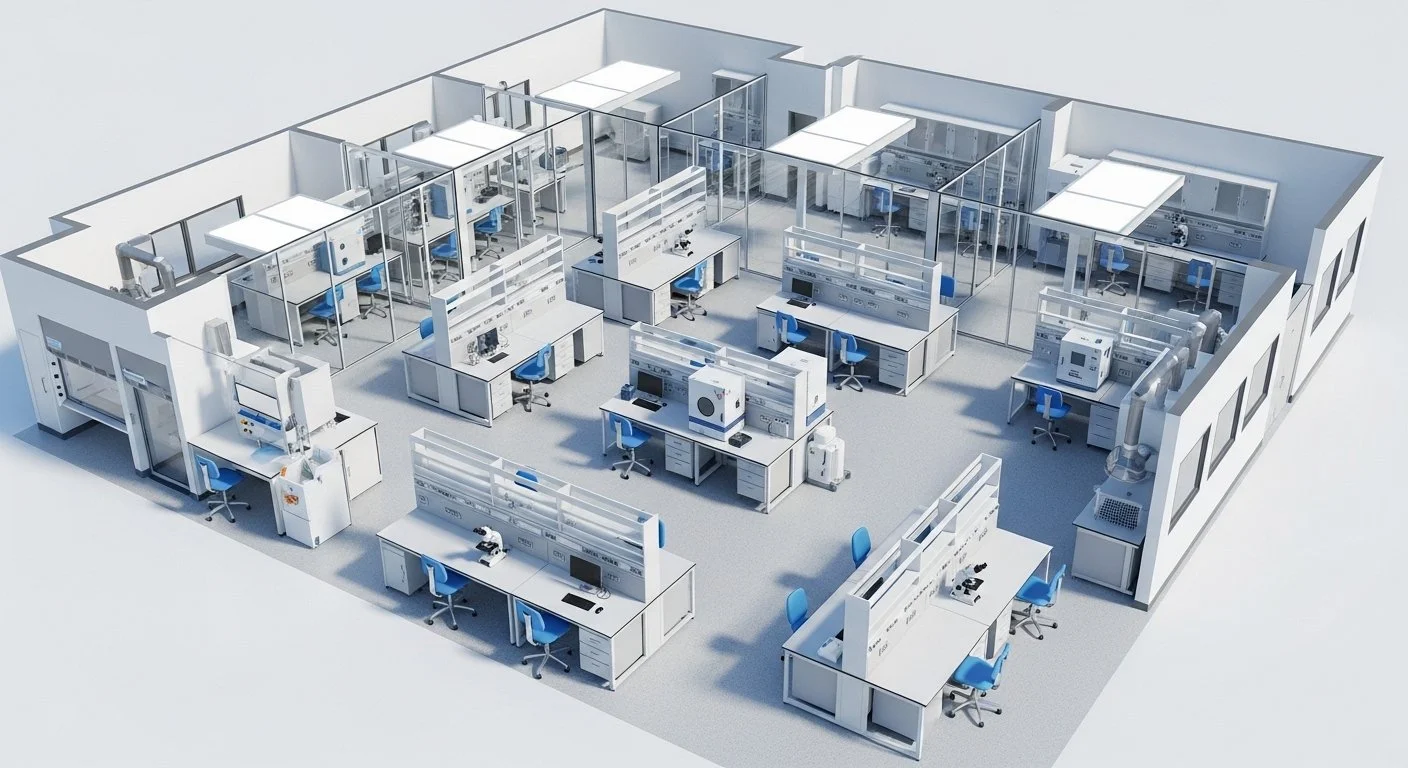
Lean laboratory design minimizes physical waste and travel time by treating the architectural footprint as an integrated, continuous production system. | Credit ImageFX (2026)
The average scientist walks 3 miles a day inside the lab; lean design gives them back an hour of research time. For decades, laboratories were designed as static environments, prioritizing maximum storage capacity and fixed casework over the actual flow of the science taking place within them. As throughput demands increase, this outdated architectural approach creates invisible bottlenecks, forcing highly trained researchers to act as human conveyor belts, shuttling samples between poorly placed instruments.
Enter the "Lean Lab," a design philosophy adapted directly from the Toyota Production System and lean manufacturing. In a lean laboratory, the physical architecture and the daily scientific workflow are inextricably linked. The objective is to ruthlessly identify and eliminate "waste"—not just physical trash, but wasted motion, wasted waiting time, and wasted inventory space.
When designing for automation and implementing continuous improvement strategies, facility managers can fundamentally reconfigure the lab topology. Utilizing techniques like spaghetti diagramming and 5S organization allows architects to transition a facility from a rigid, clustered layout to a fluid, modular workspace that actively accelerates research and development.
Key Takeaways
Workflow Mapping: Utilizing spaghetti diagrams to track and minimize the physical steps scientists take during daily assays and sample preparation.
5S Organization: Implementing Sort, Set in order, Shine, Standardize, and Sustain to eliminate benchtop clutter and reduce search time for critical tools.
Modular Casework: Designing adaptable, mobile benches that can be rapidly reconfigured to match changing experimental workflows without requiring MEP shutdowns.
Point-of-Use Storage: Storing specific reagents and consumables exactly where they are needed for a process, rather than relying on centralized, distant stockrooms.
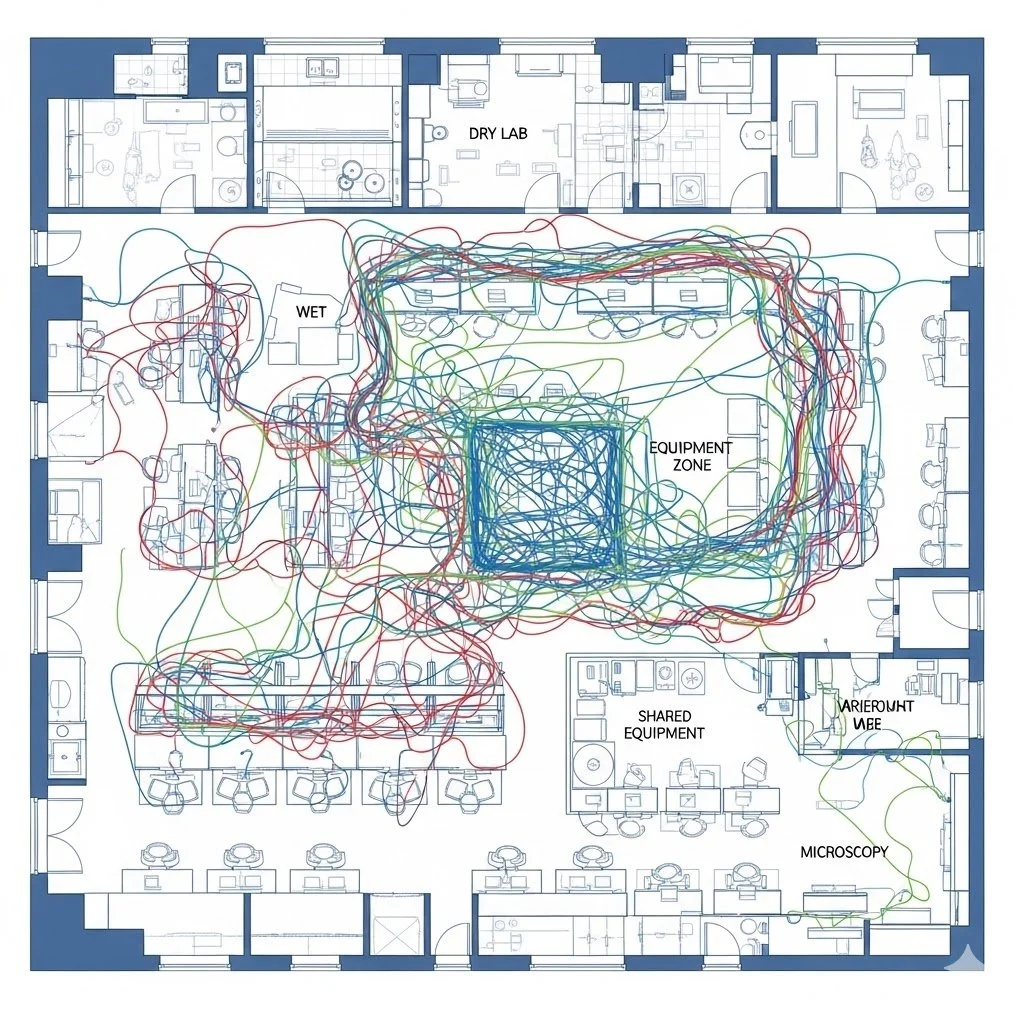
What is a spaghetti diagram, and how does it optimize lab layouts?
In lean methodology, a spaghetti diagram is a visual representation using a continuous line to trace the physical path of a scientist, sample, or piece of information through a specific process. When laboratory planners map out a standard assay in a traditional lab, the resulting drawing typically looks like a tangled plate of spaghetti, revealing frantic, crisscrossing paths between the biosafety cabinet, the centrifuge, and the incubators.
This visual tool highlights the "waste of motion." If a researcher must walk twenty feet across a main corridor just to transfer a microplate from a liquid handler to a plate reader, that transit time compounds over hundreds of cycles. By identifying these high-traffic, inefficient routes, architects and lean practitioners can completely redesign the equipment layout based on linear operational needs rather than utility convenience.
The goal is to create cellular workspaces where all instruments required for a specific assay are co-located in a logical sequence. By simply moving a refrigerator or repositioning a centrifuge to be within arm's reach of the primary workstation, a spaghetti diagram can help cut a scientist's daily walking distance in half. This directly translates into increased analytical throughput and reduced physical fatigue.
How do 5S organization principles improve scientific output?
The 5S methodology—Sort, Set in order, Shine, Standardize, and Sustain—is the foundational housekeeping framework of lean design. In a laboratory setting, a lack of 5S leads to cluttered benchtops, hoarded reagents, and the chronic misplacement of shared tools like calibrated pipettes or specialized glassware. This disorganization creates "waiting waste" as scientists spend valuable minutes hunting for the materials they need to begin an experiment.
Implementing 5S requires a physical transformation of the workspace. "Setting in order" means creating a specific, clearly labeled home for every single item. Lean labs frequently utilize shadow boards for hand tools, taped outlines on benchtops for vortexers and balances, and color-coded Kanban bins for consumable inventory. Visual management is critical; anyone should be able to walk up to a workstation and instantly know if a tool is missing or if pipette tips need to be restocked.
This rigorous organization radically reduces cognitive load. When the physical environment is perfectly standardized, researchers no longer waste mental energy navigating clutter or verifying inventory. They can focus entirely on the complex scientific variables of their work, ensuring that the physical space supports, rather than hinders, right-first-time quality metrics and overall lab safety.
Why is modular casework essential for a Lean Lab?
Fixed casework is the enemy of lean workflow optimization. If laboratory benches are bolted to the floor and utilities are hard-plumbed through the cabinetry, the facility cannot adapt when a scientific process changes. As new equipment is purchased or new assays are developed, a rigid lab forces the scientists to adapt their workflow to the room, rather than adapting the room to the workflow.
Modular casework solves this physical rigidity. By utilizing heavy-duty workbenches on locking casters paired with overhead ceiling service carriers (which deliver power, data, and gases from above), facility managers empower scientists to reshape their environment. This "plug-and-play" infrastructure allows an entire work cell to be reconfigured over a weekend to support a new automation platform or a sudden shift in testing volume.
Comparing Lab Layouts: Traditional vs. Lean Design
Space Utilization: Traditional labs use fixed, rigid benches that prioritize bulk storage over process flow. Lean labs utilize mobile, flexible zones that prioritize linear process efficiency.
Inventory Management: Traditional setups rely on centralized bulk stockrooms, leading to hoarding and expired reagents. Lean setups utilize point-of-use Kanban systems, keeping only a few days of inventory directly at the bench.
Scientist Travel Time: Traditional layouts often force researchers to walk 2–3 miles per shift to access shared, clustered equipment. Lean cellular layouts co-locate related instruments, reducing travel distance by up to 50%.
Adaptability: Traditional lab renovations require months of downtime and expensive mechanical and electrical changes. Lean labs featuring overhead utility carriers and mobile casework can be reconfigured by the scientists themselves in hours.
Expert FAQ: Lean Lab Workflow Optimization
Q: Does implementing lean design mean we will have less storage space in the lab?
A: Yes, intentionally. Lean principles discourage hoarding and bulk storage on the active lab floor. Instead, the design relies on "just-in-time" (JIT) inventory systems and Kanban cards to trigger restocking. This frees up expensive, highly ventilated laboratory real estate for active scientific instrumentation rather than cardboard boxes.
Q: How do we convince scientists to adopt 5S and lean practices?
A: Change management is the biggest hurdle. The most effective strategy is to involve scientists early in the spaghetti diagramming process so they visually confront the actual time they are wasting. When they realize that lean design will give them back an hour of research time each day by eliminating the "hunt and gather" phase of their work, adoption increases rapidly.
Q: Can lean principles be applied to an existing, older laboratory?
A: Absolutely. While you may not be able to easily change fixed casework or heavy fume hoods, implementing 5S organization, utilizing point-of-use Kanban inventory, and relocating smaller benchtop instruments to improve linear flow can drastically reduce waste without requiring a full structural renovation.
References
Yerian, L. M., et al. "A Collaborative Approach to Lean Laboratory Workstation Design Reduces Wasted Technologist Travel." American Journal of Clinical Pathology, vol. 138, no. 2, 2012, pp. 273-280.
Cherie, N., et al. "Improving laboratory turnaround times in clinical settings: A systematic review of the impact of lean methodology application." PLOS ONE, vol. 19, no. 10, 2024, e0312033.
Letelier, A., et al. "Workflow Optimization in a Clinical Laboratory using Lean management principles in the pre-analytical phase." Journal of Medical Biochemistry, vol. 40, no. 1, 2021, pp. 1-7.
Zarbo, R. J., & D'Angelo, R. "Transforming to a Quality Culture: The Henry Ford Production System." American Journal of Clinical Pathology, vol. 126, suppl_1, 2006, pp. S21-S29.
