
Smart Lab Sensors: The Internet of Things in Research
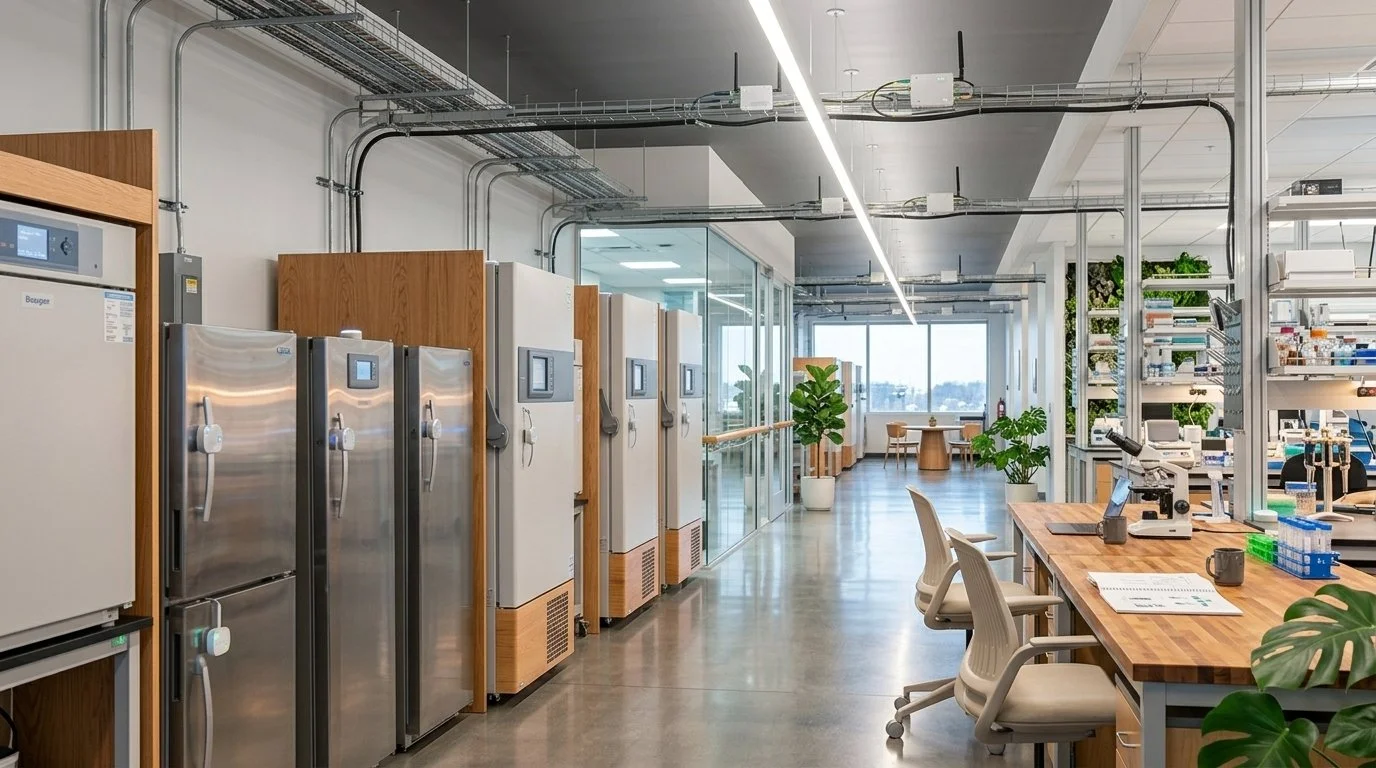
From freezer door alerts to real-time ambient monitoring, the connected lab is no longer a future concept—it's a design decision you make today. | Credit: Flow (2026)
Your phone knows more about your life than you know about your lab. It's time to sensor-up.
Right now, your smartphone can tell you the weather in Singapore, the location of your luggage, and whether your front door is locked. Meanwhile, somewhere in your building, a −80°C ultra-low freezer may be trending toward −70°C with no one watching, a critical incubator's humidity could be drifting two points outside spec, and a centrifuge that costs as much as a car might be sitting idle in a room no one has entered since Tuesday.
The gap between what modern sensor technology can do and what most labs are actually monitoring is enormous—and expensive. Irreplaceable cell lines, decades of tissue samples, years of reagent inventory—all of it sitting behind doors with no continuous visibility. The solution is not complicated. It is connected.
This is the hub guide to the smart lab sensor ecosystem: what it monitors, how it is designed into a building, what the data is used for, and why the infrastructure decisions made at the drawing-board stage determine whether a lab can be truly intelligent or merely technically sophisticated.
What Is a Smart Lab Monitoring System?
A smart lab monitoring system is a network of wireless or wired sensors deployed throughout a laboratory facility to continuously measure, record, and transmit environmental and operational data. Unlike a traditional building management system (BMS)—which focuses on building-level mechanical performance—a lab monitoring system is purpose-built for research, providing granular, asset-level visibility into the conditions that directly affect scientific outcomes, sample integrity, and regulatory compliance.
The core of any smart lab monitoring platform is the sensor node: a small, self-contained device that measures one or more parameters and transmits data wirelessly to a central gateway, cloud platform, or building automation system. Modern platforms integrate dozens of sensor types into a single dashboard, allowing a lab manager to see the entire facility's environmental status from a laptop or phone.
As one overview of smart lab technology noted, "the physical parameters of research facilities will be defined by the reliance on technology. Environmental parameters such as air exchange rates and temperature and humidity control will reflect the methods of science, and the controls for these parameters will be incorporated into the same systems to capture data from experimentation."
Key Terms and Definitions
Smart Lab Sensor: A compact electronic device that measures a physical parameter—temperature, humidity, pressure, motion, current draw, or door state—and transmits that data wirelessly to a central platform for logging, alerting, and analysis.
IoT (Internet of Things): The network of physical devices embedded with sensors and connectivity that enables them to collect and exchange data. In a laboratory context, the IoT connects freezers, incubators, fume hoods, environmental zones, and equipment into a unified, queryable data ecosystem.
Ambient Monitoring: Continuous, automated tracking of the environmental conditions within a laboratory space—temperature, relative humidity, CO₂, barometric pressure, and particulate levels—independent of specific equipment.
Lab Monitoring System: A platform that aggregates sensor data from across a facility, provides real-time dashboards and historical logs, triggers alerts when parameters deviate from setpoints, and generates compliance-ready audit trails.
IoT Asset Tracking: The use of wireless tags—RFID, Bluetooth Low Energy, or Wi-Fi-based—attached to physical equipment, samples, or assets to provide real-time or periodic location and utilization data across a facility or campus.
BLE (Bluetooth Low Energy): A wireless communication protocol widely used in IoT asset tracking. BLE tags are small, inexpensive, and can offer up to ten years of battery life, making them practical for tagging large numbers of non-powered lab assets such as carts, portable equipment, and sample containers.
RFID (Radio Frequency Identification): A tag-and-reader technology that allows bulk, non-line-of-sight identification of assets. Commonly used for high-throughput inventory management and sample chain-of-custody tracking in pharmaceutical and clinical research settings.
Gateway / Hub: The hardware device that collects wireless transmissions from multiple sensor nodes and routes the aggregated data to a cloud platform or building management system. Gateway placement during facility design is a critical infrastructure decision.
21 CFR Part 11: The FDA regulation governing electronic records and electronic signatures in regulated industries. Lab monitoring systems used in GxP environments must produce audit-trail-compliant logs that meet 21 CFR Part 11 requirements.
What Smart Lab Sensors Actually Monitor
The breadth of what a modern sensor network can track often surprises first-time adopters. This is not just thermometers on freezers. The connected lab ecosystem spans five broad categories.
1. Cold Chain and Ultra-Low Storage
This is where most labs begin their IoT journey, and for good reason. The loss of biological samples stored at −80°C, −196°C (liquid nitrogen), or even standard refrigerator temperatures (+2°C to +8°C) represents one of the most common and costly failures in research operations.
Continuous temperature monitoring platforms deployed on ultra-low freezers, standard refrigerators, incubators, and cryogenic tanks provide automated data logging that replaces manual temperature checks—reducing human error and creating the continuous documentation record required by FDA, CDC, USP, and institutional biosafety committees. Beyond basic temperature, door-contact sensors can detect and alert on an ajar freezer door in seconds rather than discovering the problem the next morning. Current-draw sensors on refrigeration compressors can detect impending mechanical failure before it causes a loss event—rising energy consumption is often the first sign that a compressor is working harder than it should.
2. Ambient Room Monitoring
Room-level ambient monitoring tracks the broader environment in which research takes place. Key parameters include:
Temperature and relative humidity—critical for cell culture rooms, cleanrooms, chemistry labs, and any space where hygroscopic reagents are in use. The World Health Organization recommends maintaining approximately 50% relative humidity in pharmaceutical laboratory settings.
Barometric pressure—particularly important in BSL facilities and cleanrooms where pressure differentials must be maintained continuously between spaces
CO₂ concentration—relevant for cell culture incubation areas and occupied lab spaces where personnel safety requires monitoring
Particulate levels—for cleanrooms and any space operating under ISO classification requirements
Lighting levels—relevant in specialized research environments sensitive to photodegradation
This ambient layer feeds directly into resilient lab design strategies. Facilities equipped with room-level sensor data can detect HVAC performance drift before it affects experiments, identify zones with poor air mixing, and build historical baselines that inform future renovation decisions.
3. Equipment Monitoring and Predictive Maintenance
Beyond cold storage, sensors can be deployed on virtually any piece of powered laboratory equipment to track operational status and health:
AC current meters detect changes in power draw that signal a failing motor, a clogged filter, or a refrigeration system working outside normal parameters
Vibration sensors on centrifuges, shakers, and analytical balances detect imbalance events that could compromise data or damage equipment
Run-time logging from motion or current sensors provides utilization data—revealing whether a $200,000 mass spectrometer is running 80% of the time or 20%
As one overview of IoT in life sciences noted, high-end equipment such as mass spectrometers carries maintenance costs of approximately 20% of total cost of ownership. Predictive maintenance via sensor data can meaningfully reduce that figure by catching issues before they become failures.
4. Space Utilization and Occupancy
Occupancy sensors have become one of the fastest-growing applications in lab design. Thermal-based sensors—preferred in lab environments because they detect human presence by body heat rather than by identifying individuals, thereby preserving privacy—provide objective data on how spaces are actually used versus how they were programmed.
The practical applications are significant. In one documented case, a global medical technology manufacturer used occupancy analytics to discover that portions of their building were 30% underutilized, allowing them to redesign the lab rather than sign a new lease. For HVAC, occupancy data enables demand-controlled ventilation, reducing air change rates in unoccupied spaces and cutting energy costs substantially without compromising safety when researchers are present.
Occupancy data also informs compliance. Sensors can detect whether high-risk protocols requiring two-person rules are being followed, flag after-hours access events near controlled-substance storage, and track dwell time near hazardous materials—transforming safety oversight from reactive to preventive.
5. IoT Asset Tracking
Lab asset tracking addresses one of the most mundane but genuinely costly inefficiencies in research operations: equipment cannot be found when it is needed. Portable centrifuges, pipette sets, mobile carts, and shared instrumentation routinely migrate between labs, floors, and buildings—creating search time, scheduling conflicts, and calibration compliance gaps.
RFID and BLE-based real-time location systems (RTLS) attach small, inexpensive tags to assets and use a network of readers or receivers to triangulate their position within a building. The result is a live map of every tracked asset's location, combined with historical movement data that reveals patterns invisible to manual tracking.
For calibration and maintenance compliance, asset tracking is particularly valuable. When a portable balance or pipette is due for annual calibration, the system knows not only that it is due but also exactly where it is—allowing calibration teams to locate and service equipment efficiently rather than hunting it across a multi-building campus.
Designing the Smart Lab: Infrastructure Decisions That Matter
The difference between a lab that successfully deploys IoT monitoring and one that buys sensors and struggles to make them work often comes down to infrastructure decisions made before construction begins. These are the questions to resolve at the programming and schematic design phases.
Wireless Protocol Selection
Not all sensor networks use the same wireless protocol, and the choice carries real architectural implications. The most common options in lab settings are:
Wi-Fi—high bandwidth, leverages existing network infrastructure, but requires power and may create IT security review complexity
Bluetooth Low Energy (BLE)—low power, long battery life, widely used for asset tracking and portable sensors, requires gateway placement at regular intervals
Zigbee / Z-Wave—mesh networking protocols suitable for dense sensor deployments; signals hop between nodes rather than requiring direct line-of-sight to a gateway
LoRaWAN—long-range, low-power protocol excellent for large campuses or facilities with many thick-walled spaces; ideal for outdoor or multi-building deployments but with lower data throughput
Cellular / NB-IoT—connects directly to cellular infrastructure without a local gateway; useful for remote or distributed facilities
The architectural implication is gateway placement. For BLE-based systems, gateways typically require placement every thirty to fifty meters throughout the facility, and they need power and network access. Designing conduit pathways, junction-box locations, and network drops for gateways during construction is far cheaper than adding them post-occupancy.
Network Infrastructure and Cybersecurity
Connecting sensors to a building's network introduces IT security considerations that must be addressed early. Dedicated IoT network segments (VLANs) that isolate sensor traffic from research data networks are standard practice in institutional settings. Lab planners should engage IT security teams during design—not during commissioning. The AI-driven shift in lab design increasingly demands that network architecture be treated as a first-class design element alongside HVAC and electrical.
Integration with Building Automation Systems
The most powerful smart lab implementations connect sensor data to the building automation system (BAS) or building management system (BMS), enabling closed-loop responses rather than just alerts. When a room humidity sensor detects drift above setpoint, a connected system can automatically adjust a humidification unit rather than simply sending an email. When occupancy sensors detect an empty lab, the BAS can reduce air change rates to minimum safe levels—a strategy that reduces fume hood energy consumption substantially without compromising safety protocols.
This integration requires that both the sensor platform and the BAS support open communication protocols—such as BACnet or Modbus—rather than proprietary closed systems. Specifying open-protocol compatibility at the equipment-selection phase is essential.
Power Planning for Sensors and Gateways
Most environmental sensors are battery-powered and require minimal planning, but gateways, display panels, and hardwired equipment sensors do require electrical access. A well-drawn sensor deployment plan, produced by the MEP engineer alongside the facility programmer, identifies every gateway location and its power and data requirements before walls are closed.
The Compliance Layer: Why Regulated Labs Need Audit Trails
For laboratories operating in GxP environments—pharmaceutical development, clinical diagnostics, biobanking—the monitoring system is not just an operational tool. It is a regulatory document.
21 CFR Part 11 requires that electronic records, including environmental monitoring logs, be maintained with controlled access, version history, electronic signatures, and audit trails that prevent retroactive modification. A spreadsheet or manually reviewed chart recorder does not meet this standard. A validated IoT monitoring platform with secure cloud storage, role-based access control, and tamper-evident logging does.
When specifying a lab monitoring system for a regulated environment, the key compliance questions are:
Does the system produce continuous, timestamped data logs with no gaps?
Does it support configurable alarm thresholds with documented escalation paths?
Are audit trails immutable—preventing record alteration without detection?
Can it generate compliance reports in formats accepted by FDA, EMA, or institutional biosafety committees?
Is the software validated per GAMP 5 guidelines?
Battery backup and failover connectivity are equally important. A monitoring system that goes offline during a power event—the exact moment most freezer failures occur—provides no protection at the critical moment.
Planning a Smart Lab Sensor Deployment: Where to Start
For lab managers and facility directors approaching IoT for the first time, the breadth of options can be paralyzing. A phased approach works well for most organizations.
Phase 1: Cold chain and high-value storage. Start with ultra-low freezers, liquid nitrogen tanks, standard refrigerators, and incubators. The ROI on preventing a single significant loss event typically justifies the entire system cost of a basic deployment.
Phase 2: Ambient room monitoring. Add temperature, humidity, and pressure sensors to critical lab spaces—cell culture rooms, cleanrooms, chemistry labs, and regulated storage areas. This layer establishes the environmental baseline for all downstream compliance reporting.
Phase 3: Equipment utilization and occupancy. Layer in occupancy sensors and AC current meters to begin capturing utilization data. This phase directly informs space planning decisions, HVAC optimization, and maintenance scheduling.
Phase 4: Asset tracking. Once the ambient and equipment layers are stable, deploy RFID or BLE asset tags on mobile equipment. This phase requires the most planning—asset inventories, tag attachment strategies, and integration with LIMS or ELN systems—and benefits from the infrastructure already established in earlier phases.
As the connected lab continues to take shape, each of these layers increasingly connects to the others, with sensor data flowing into LIMS platforms, ELNs, and AI-driven analytics tools that surface patterns no human reviewer would detect in isolation.
Smart Lab Sensors and Building Design: What Architects Need to Know
For architects and lab designers, the shift toward connected laboratories changes several assumptions that have historically been taken for granted.
The future of lab automation makes clear that "labs that treated data infrastructure as a first-class design element—not a layer added post-occupancy—were able to accelerate iteration cycles while maintaining scientific rigor." The same principle applies to sensor infrastructure. These are the design considerations that matter most:
Conduit and pathway planning for gateway locations—identify gateway mounting positions in corridors and lab spaces and provide appropriate conduit and network access during rough-in
Network closet capacity—sensor gateways and their associated network equipment require rack space and power; this load is frequently underestimated
Wireless signal penetration—thick concrete or lead-lined walls (common in imaging and radiopharmaceutical facilities) can block wireless sensor signals and require additional gateway density or wired sensor alternatives
Display and dashboard locations—facilities with central monitoring stations require display-mounting infrastructure in control rooms, corridors, or breakout spaces
Interoperability with BAS—specify that both the building automation system and the intended sensor platform support open protocols during the equipment-selection and specification phase, not after construction
The biotechnology laboratory of the future increasingly treats smart environmental controls not as an add-on but as a core design feature equivalent in importance to fume hood design or HVAC zoning.
Frequently Asked Questions
Q: What is the difference between a building automation system and a lab monitoring system?
A: A building automation system (BAS) manages building-level mechanical performance—HVAC, lighting, access control, and energy systems—at a macro level. A lab monitoring system operates at the asset and sample level, providing high-resolution, continuous data on individual freezers, incubators, rooms, and equipment, with the alarm sensitivity and audit-trail capability required for research compliance. The two systems are complementary; the most effective facilities integrate both, with the lab monitoring system feeding data into the BAS for coordinated response.
Q: Do smart lab sensors work in cleanrooms?
A: Yes, though cleanroom deployments require careful selection of sensor form factors that comply with the cleanroom's ISO or GMP classification. Sensors with exposed seams, rough surfaces, or particle-shedding materials are inappropriate for ISO Class 5 or Grade A/B environments. Purpose-built cleanroom sensors with smooth, coved enclosures and validated materials are available and should be specified by the cleanroom designer. Wireless protocols that avoid electromagnetic interference with sensitive analytical equipment should also be vetted for each application.
Q: How much IT infrastructure is needed to support a smart lab sensor network?
A: The answer depends on the wireless protocol selected. Wi-Fi and ethernet-connected sensor systems leverage existing network infrastructure but require IT team involvement for network segmentation and security. BLE or Zigbee-based systems use dedicated gateways that connect to the network via a single ethernet or cellular connection, reducing the IT footprint. In either case, a dedicated IoT VLAN—isolating sensor traffic from research data networks—is standard practice and should be specified during design.
Q: Can sensor data integrate with our LIMS?
A: Many modern LIMS platforms offer native or API-based integration with lab monitoring systems, allowing environmental data to be automatically associated with sample records. This is particularly valuable for biobanking, clinical trials, and pharmaceutical manufacturing, where the temperature history of a sample is part of its regulatory record. Confirming LIMS integration compatibility before selecting a monitoring platform is strongly recommended.
Q: What happens to sensor data during a power outage?
A: This is a critical design consideration. Quality lab monitoring platforms include battery backup in sensor nodes or gateways to maintain data logging during power interruptions, as well as local data buffering that syncs to the cloud when connectivity is restored. For regulated environments, systems must be specified to provide continuous, uninterrupted data—a gap in the log during a power event is not acceptable when that event may have caused the very excursion being documented.
Q: How do smart sensors support sustainability goals?
A: Sensor data is one of the most powerful tools available for reducing laboratory energy consumption. Occupancy-linked demand-controlled ventilation can reduce HVAC energy use significantly in spaces that are frequently unoccupied. Equipment utilization data identifies underused assets that can be consolidated or decommissioned. Predictive maintenance reduces the energy waste associated with equipment running in degraded states. As covered in our guide to building green labs, HVAC represents the dominant energy consumer in most laboratory facilities—and smart sensors are the primary tool for right-sizing it in real time.
References and Further Reading
Food and Drug Administration. "Part 11, Electronic Records; Electronic Signatures—Scope and Application." FDA.gov. Last modified August 24, 2003.
Lab Horizons. "The Connected Lab of 2025: IoT Devices and Interoperable Systems." Lab Horizons. December 11, 2024.
MachineQ. "Maximizing Lab Productivity: An Intro to IoT in Life Sciences." MachineQ.com. 2024.
Monnit Corporation. "Laboratory and Pharmaceutical Monitoring Systems." Monnit.com. 2024.
National Institutes of Health, Office of Research Facilities. Design Requirements Manual. Bethesda, MD: NIH, 2020.
