
Using Occupancy Sensors to Right-Size Laboratory Design
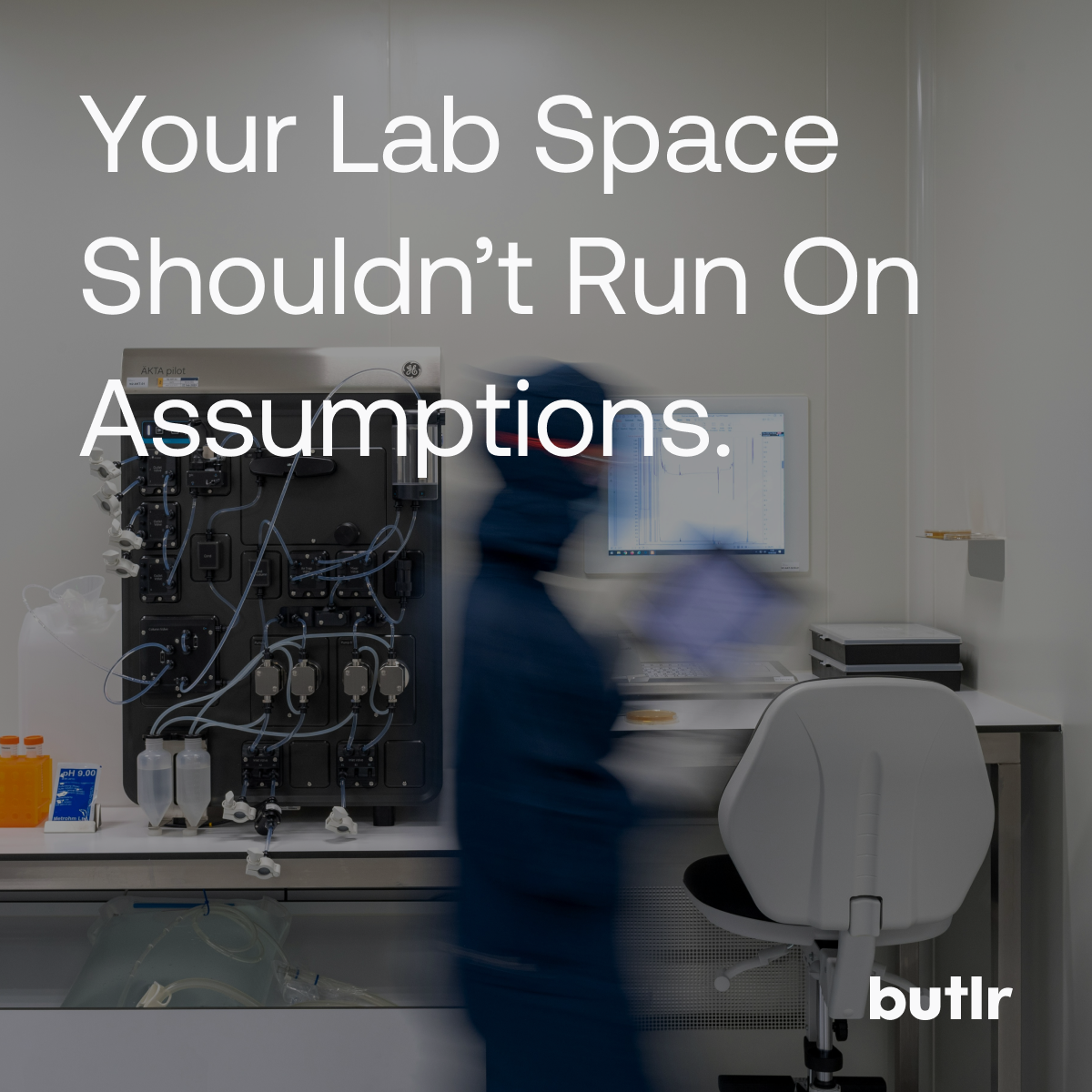
Take control of lab utilization without compromising privacy. Image: Courtesy of Butlr
Laboratory design has always required a careful balancing act between safety and efficiency, flexibility and compliance, and capital investment and long-term operating costs.
Traditionally, that balance has been guided by interviews, utilization assumptions, badge swipe data, and periodic observations. While useful, these methods often leave blind spots, particularly in environments where privacy concerns rule out cameras and sensitive research limits visibility into real-world behaviors.
Today, occupancy sensors—specifically, privacy-preserving thermal sensors paired with analytics—are giving lab planners, architects, and facility teams a more accurate, dynamic view of how laboratory spaces actually function.
Rather than guessing how space might be used in a lab, teams can design and operate labs based on how space is used, with measurable impacts on safety, compliance, and cost.
Why traditional space planning misses the mark
In laboratory environments, privacy is non-negotiable. Protecting intellectual property, safeguarding proprietary processes, and maintaining employee trust all limit the tools that planners can use to study space utilization. As Butlr CEO and co-founder Honghao Deng explains, “Since cameras cannot be allowed without increasing risks and alienating employees, the planning and design is limited to best guesses on optimizing the lab space.”
Thermal occupancy sensors change that equation. “They are ideal for lab environments because they combine AI and body heat sensing technology to detect human presence and movement and infer actions without compromising privacy,” says Deng. By detecting motion, dwell time, and proximity without identifying individuals, these sensors provide planners with objective data that fills long-standing gaps in laboratory programming.
For more information on Butlr's lab solutions, click here.
Early programming: separating need from assumption
One of the most powerful applications of occupancy analytics emerges during early programming and space needs assessments. Labs often feel crowded, leading organizations to assume they need more square footage. However, the real issue is typically misalignment rather than a shortage of space.
Deng points to occupancy and movement around hazardous materials as a top priority, but the insights go further. In one case, he notes, a global medical technology manufacturer used occupancy sensors to understand how employees were actually using their lab space.
“Once the company was able to better understand how employees used their current space by using occupancy sensors, they realized that parts of the building were 30 percent underutilized,” he says. “Instead of leasing more space, they redesigned the lab, saving thousands of dollars each year. Those dollars can go right back into critical research.”
When labs feel inefficient, occupancy analytics help project teams move beyond anecdotal complaints. “With occupancy analytics, you can get granular insight into how space is allocated and equipment is used,” Deng says. “Applying AI to your own data ensures its integrity, and the occupancy insights help surface trends, patterns, and behaviors that may have otherwise gone unnoticed.”
This granularity allows teams to see where equipment is over-specified, where work zones create bottlenecks, and where circulation patterns introduce unnecessary risk. The result is a more nuanced understanding of how labs should be laid out—not just for today’s workflows, but for future adaptability. This type of insight can fundamentally reshape the conversations that architects and designers have with clients. Occupancy analytics enable right-sizing labs based on evidence, not intuition, and justify design decisions with defensible data.
Improving safety and compliance through behavioral insight
Lab safety has traditionally relied on protocols, training, and periodic audits. Occupancy sensors add a behavioral layer that enables proactive risk mitigation. “Thermal sensors provide behavioral telemetry to detect body heat and movement without compromising privacy,” Deng explains. “Previously, the only way to understand what was happening in the lab was through cameras or trying to interpret the black box of badge swipes. Now, occupancy sensors provide insight that leads to proactive risk mitigation.”
With occupancy analytics, lab managers can understand dwell time and proximity around hazardous materials without identifying individuals. “Based on this behavioral data, an automated alert can be triggered after a certain period of time to limit exposure,” says Deng.
The technology also supports compliance in other ways. Sensors can detect overheating equipment and alert stakeholders before incidents occur. They can even verify whether protocols such as two-person rules for high-risk procedures are being followed. For safety officers and compliance teams, this transforms oversight from reactive to preventive.
Smarter HVAC and ventilation decisions
Few systems drive lab operating costs like HVAC. Cleanrooms and specialized lab environments require high air exchange rates, often running even when occupancy is low. “Occupancy data is crucial to HVAC, airflow, and ventilation,” Deng notes.
By integrating thermal sensor data with building management systems, facilities teams can adjust airflow in response to real-time occupancy levels. “If certain areas of the lab are unoccupied, the HVAC system can go into an energy-efficient safe mode,” Deng says. This approach maintains compliance while reducing energy waste and extending the life of building systems.
For designers, this has implications beyond operations. Understanding true occupancy patterns allows engineers to design HVAC systems that are responsive rather than rigid, supporting both sustainability goals and long-term resilience.
Lessons from underutilized space and equipment
Once labs begin collecting real occupancy data, familiar suspicions are often confirmed—with financial consequences attached. “The cost and time required to set up, redesign, or manage lab space go beyond the fit-out expenses,” says Deng. Underutilized spaces continue to incur rent, cleaning, security, lighting, and HVAC costs, often on fixed schedules that ignore actual use.
These inefficiencies can also accelerate building wear. Evenly heating and cooling unoccupied spaces leads to “poor air circulation, dust accumulation, and delayed maintenance,” says Deng, aging facilities faster than necessary.
A key consideration for future lab layouts is aligning design decisions with actual usage patterns. Occupancy analytics can provide data to support and inform that alignment.
For lab managers and facility stakeholders evaluating occupancy sensors, Deng recommends focusing on three criteria. First, he says, “they should be thermal-based because that is the only way to guarantee anonymity.” Second, the sensors must go beyond simple headcounts to capture meaningful movement and equipment usage data. Third, integration matters. Teams should evaluate “how easily the sensor data can integrate with existing building and facilities management systems,” says Deng, ideally through an API-first platform.
The payoff is speed and usability. Often installed in just minutes, sensors can immediately begin feeding data into operational systems, supporting both design decisions and day-to-day management.
Continuous improvement
Occupancy analytics don’t stop being useful once construction ends. Post-occupancy, the data becomes a benchmark for evaluating whether design goals are being met—and whether adjustments are needed. Deng describes occupancy sensor data as the “‘nerve system’ of a lab,” enabling continuous improvement while maintaining compliance and operational performance.
As with any technology, success depends on responsible integration. Privacy concerns must be addressed transparently, and employees must understand that thermal sensors provide anonymity—not surveillance. Overengineering is another risk. “This often happens when design overrides actual usage data,” Deng cautions.
The most successful labs allow data and design intent to work together. Occupancy analytics provide a data-driven approach to understanding space utilization, supporting safety considerations, and informing laboratory design decisions.
For more information on Butlr's lab solutions, click here.