
Cold Chain Monitoring: Automated Compliance for the Modern Lab
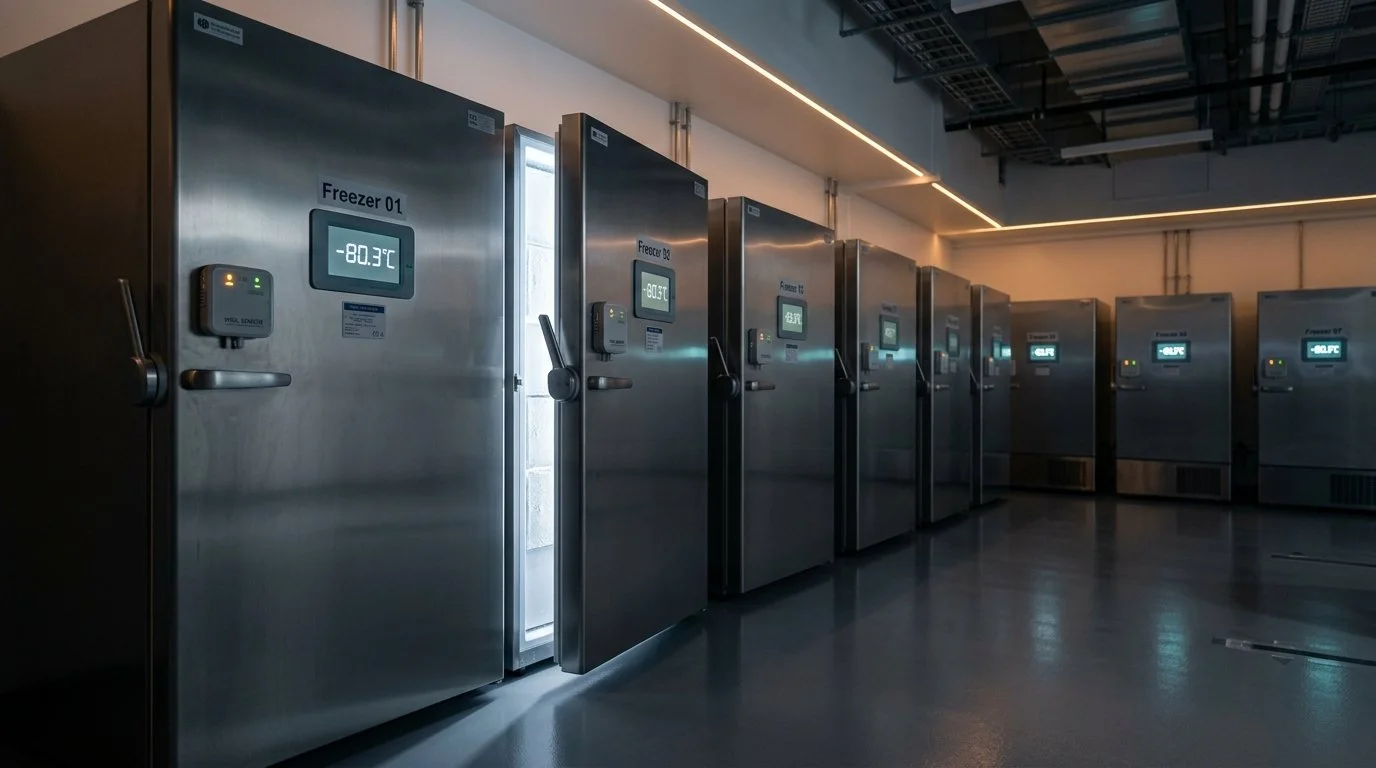
The clipboard on your freezer door is not a compliance strategy. | Credit: Flow (2026
Cold chain monitoring is the continuous, automated tracking of temperature in laboratory storage equipment—from standard refrigerators to −80°C ultra-low freezers—to protect sample integrity and generate the compliance records that regulatory agencies require. When it is done well, it is invisible. When it is done badly, it shows up in an FDA Warning Letter.
Throw away the clipboard. Automating the dullest—but most critical—job in the lab.
Somewhere in nearly every research and pharmaceutical laboratory, there is a clipboard. It hangs on a hook beside the ultra-low freezer, and twice a day—once in the morning, once before close—someone walks over, opens the log, reads the display, and writes a number. Then they walk away.
This two-minute ritual is the backbone of cold chain compliance in thousands of facilities. It is also deeply unreliable. The log can be falsified deliberately or, more commonly, filled in from memory an hour after the fact. It captures exactly two data points in a twenty-four-hour period, meaning that an excursion beginning at 2:00 a.m. and resolving before the 8:00 a.m. check leaves no trace. And when the FDA asks to see twelve months of uninterrupted temperature records for a −80°C freezer storing irreplaceable cell lines, a clipboard log is not what they have in mind.
This article is part of our series on smart lab sensors and the IoT ecosystem in research. If you are new to the broader landscape of connected lab monitoring—from ambient sensors to asset tracking—that hub guide provides the full ecosystem context. Here, we go deep on the specific challenge of cold chain compliance: what the regulations require, what automated systems provide, and what lab designers and facility managers need to specify to build a monitoring infrastructure that protects both samples and the organization.
Why Manual Logs Fail Cold Chain Compliance
The core problem with manual temperature logging is not laziness or bad intent—it is structural. Manual logs are point-in-time snapshots with no continuity between them. A −80°C freezer checked at 8:00 a.m. and again at 5:00 p.m. has nine unmonitored hours during every overnight shift. A compressor beginning to fail at 11:00 p.m. on a Friday can allow a freezer to drift from −80°C toward −60°C or warmer over several hours before anyone knows.
The consequences are not hypothetical. Pharmaceutical organizations maintaining biobanks can lose irreplaceable sample collections accumulated over decades from a single undetected freezer failure. Cell lines, biological specimens, proteins, DNA, and RNA stored at −80°C are effectively preserved indefinitely at that temperature—but many preservation mechanisms begin to fail above −40°C. A nine-hour undetected excursion is not a near-miss. It is a loss event.
From a regulatory standpoint, the stakes are equally high. The FDA has significantly increased scrutiny of data integrity in recent years. Approximately 60% of Warning Letters issued by FDA's Center for Drug Evaluation between 2021 and 2024 included data integrity concerns—many stemming from incomplete records, retroactive data entry, and missing audit trails. A temperature log filled in from memory at the end of a shift is not an audit-trail-compliant record under digital data logging standards. It is exactly the kind of documentation gap that triggers 483 observations.
Key Terms and Definitions
Cold Chain Monitoring: The continuous, automated tracking of temperature—and where relevant, humidity—for equipment and spaces used to store temperature-sensitive biological samples, pharmaceutical products, reagents, and clinical materials.
Remote Temperature Monitoring: The ability to view, query, and receive alerts from temperature sensors across a facility—or across multiple facilities—from a centralized platform accessible via web browser or mobile application, without requiring physical presence at each storage unit.
Digital Data Logger: An electronic device that automatically records temperature readings at defined intervals—typically every one to fifteen minutes—and stores them in a tamper-evident, timestamped digital record. Data loggers may be wired or wireless and may store data locally, transmit to a gateway, or upload directly to a cloud platform.
Compliance Reporting: The automated generation of audit-ready temperature records, excursion event logs, and summary reports that satisfy the documentation requirements of regulatory agencies including the FDA, EMA, and institutional biosafety committees. Compliance reporting replaces manual log compilation and is a defining feature of any 21 CFR Part 11-capable monitoring system.
21 CFR Part 11: The FDA regulation establishing criteria under which electronic records and electronic signatures are considered trustworthy, reliable, and legally equivalent to paper records. For cold chain monitoring, compliance requires validated systems, unalterable data storage, user-level access controls, and comprehensive audit trails.
Audit Trail: An automatically generated, timestamped, and user-attributed log of every record entry, modification, alarm event, and system access. Under 21 CFR Part 11, audit trails must be generated automatically—not constructed after the fact—and must be retrievable for the full record retention period.
Temperature Excursion: A documented event in which temperature deviates outside the defined acceptable range for a storage unit or space. Excursion management includes detection, alerting, root cause analysis, corrective action documentation, and product impact assessment.
IQ / OQ / PQ (Installation, Operational, and Performance Qualification): The three-phase validation process required for GxP monitoring systems. Installation Qualification verifies correct equipment installation; Operational Qualification tests performance under controlled conditions; Performance Qualification demonstrates reliable performance under actual use conditions.
Calibration Traceability: The unbroken chain of calibration records connecting a monitoring sensor to national or international measurement standards. ISO 17025-accredited calibration is the standard requirement for sensors generating GMP data. Expired or out-of-tolerance calibration invalidates all associated temperature records.
GAMP 5: The Good Automated Manufacturing Practice guideline published by ISPE providing a risk-based framework for validating computerized systems in regulated pharmaceutical environments. A 21 CFR Part 11-compliant monitoring platform should be validated in accordance with GAMP 5 principles.
What Automated Digital Data Logging Replaces—and What It Provides
The shift from clipboard to automated system is not simply a technology upgrade. It changes the fundamental nature of the compliance record, the workload distribution across staff, and the speed of response to excursion events.
Continuous Records vs. Point-in-Time Snapshots
A well-configured digital data logger records temperature readings at intervals as frequent as every fifteen seconds. A comprehensive monitoring platform deployed across a facility aggregates data from dozens of freezers, refrigerators, incubators, and cryogenic tanks simultaneously, creating an unbroken data record for every storage unit. The record captures not just the temperature at the moment of a manual check, but the full thermal history of the unit—including overnight behavior, door-open events, recovery curves after access, and the slow drift patterns that precede compressor failure.
This continuity is what makes automated digital data logging categorically different from manual logs, not simply more convenient. An automated system does not generate a record; it captures one. The distinction matters enormously in a regulatory context.
Automated Alarm Escalation
Manual logging catches excursions only if a human happens to check the unit during or after the event. Automated remote temperature monitoring systems detect excursions within seconds and trigger multi-tier alert escalation—text messages, emails, and phone calls delivered to a defined contact list, with escalation protocols ensuring the alert reaches someone who can act even if the primary contact is unavailable.
Alert configuration should include:
Minor excursion thresholds: temperature approaching but not yet exceeding the acceptable range, providing warning before a loss event
Major excursion thresholds: temperature outside the defined acceptable range, triggering immediate action
Door-open alerts: contact sensors on freezer doors detecting an ajar door within a configurable delay—typically two to five minutes
Power-loss alerts: detection of AC current interruption to a storage unit, distinct from a refrigeration failure
Equipment health alerts: rising compressor run-time or declining temperature recovery speed, indicating impending mechanical failure before it occurs
Automated Compliance Reporting Without Staff Labor
The most immediate operational benefit of automated cold chain monitoring is the elimination of manual logging labor. In a regulated facility with dozens of cold storage units, manual temperature checks can consume hours of staff time per week—time spent generating a documentation artifact far inferior to what an automated system produces continuously.
Automated compliance reporting generates on demand: thirty-day summaries for routine review, excursion reports including event timeline, alert log, and corrective action notes, and annual historical archives satisfying record retention requirements without anyone compiling handwritten logs. Temperature monitoring records in pharmaceutical environments generally require retention for at least one year beyond the product expiry date or shelf life, and cloud-based platforms archive data for the full retention period without local storage management.
21 CFR Part 11: What Digital Data Logging Must Provide
21 CFR Part 11 applies to any electronic record generated, modified, maintained, archived, retrieved, or transmitted under FDA regulations. For cold chain monitoring in pharmaceutical and regulated biological research environments, every temperature record generated by an electronic system is subject to Part 11 requirements.
System validation means the monitoring software and hardware must be validated to demonstrate that it consistently and accurately performs its intended function. This is accomplished through IQ/OQ/PQ qualification studies, with OQ mapping characterizing inherent temperature distribution and PQ using a representative product load to demonstrate real-world performance. Validation documentation must be maintained and revisited following any significant system change.
Audit trails must be generated automatically by the system at the time of each event—not reconstructed after the fact. The audit trail must record the date and time of each temperature reading, each alarm event, each acknowledgment, each corrective action note, and each system access or configuration change, with the identity of the user associated with each entry.
Access controls require that the system enforce unique user credentials, role-based permissions, and automatic session timeout after a defined period of inactivity. Shared login credentials are a direct Part 11 violation, as they prevent attribution of individual records to specific users.
Data integrity requires that records be stored in a format that cannot be modified without detection. An Excel spreadsheet that a technician can edit is not a compliant record. A tamper-evident, encrypted database with immutable logs is. The distinction is not a technicality—data integrity failures appear consistently in FDA Warning Letters across all regulated industries, and environmental monitoring records are a frequent inspection focus.
Electronic signatures, where required, must be unique to each individual, include the date and time of signing, and be linked to their respective records in a way that prevents the signature from being removed, copied, or transferred.
Specifying a Remote Temperature Monitoring System: What to Look For
For lab designers, facility managers, and procurement teams evaluating cold chain monitoring platforms, these criteria separate a compliance-ready system from one that creates problems during validation or inspection.
Sensor Accuracy and Calibration Management
All sensors generating GMP data must carry ISO 17025-accredited calibration certification traceable to national standards, with a documented calibration schedule—typically annual. The monitoring platform should include calibration management functionality that tracks due dates, prevents use of out-of-tolerance sensors, and generates calibration history reports for compliance reporting. A sensor lapsed past its calibration date invalidates every temperature record it generated during that period.
For ultra-low temperature applications—−80°C freezers, liquid nitrogen tanks, cryogenic storage—sensor selection requires particular care. RTD (resistance temperature detector) probes and purpose-built cryogenic sensors are the appropriate choice; not all sensors perform reliably at these extremes.
Battery Backup and Connectivity Redundancy
A remote temperature monitoring system that goes offline during a power failure provides no protection at the critical moment. Compliant systems must include battery backup in sensor nodes or gateway devices, local data buffering that syncs to the cloud upon reconnection, and alarm delivery through an independent cellular channel when the facility's primary network is unavailable. Data gaps in a temperature log during a power event are not acceptable when that event may have caused the excursion being investigated.
Integration with the Broader Lab Monitoring Infrastructure
Cold chain monitoring should not be specified in isolation. As covered in our hub on smart lab sensors and the IoT ecosystem, the most effective deployments integrate cold chain monitoring with ambient room monitoring, equipment health tracking, and LIMS or quality management systems. A fully integrated platform allows the temperature history of a storage unit to be automatically associated with the sample records it contains, creating a complete chain-of-custody compliance reporting trail.
Vendor Validation Support
For regulated environments, platform selection should include evaluation of the vendor's validation support package: IQ/OQ/PQ documentation templates, GAMP 5-aligned software validation documentation, change control procedures, and support for re-qualification following software updates. A vendor that cannot provide these materials creates a significant qualification burden for the facility's quality team.
What Lab Designers and Architects Need to Know
Cold chain monitoring infrastructure has direct implications for architectural and MEP design decisions that must be addressed during the construction documents phase—not at commissioning.
Gateway placement and power planning. Wireless remote temperature monitoring systems require gateway devices that collect sensor data and relay it to the cloud platform. Each gateway requires a dedicated power outlet and network connection. In cold storage rooms and cryogenic areas, gateways should be positioned outside the classified cold zone where possible, protecting them from temperature extremes. Locations should be coordinated with the MEP engineer and included in the reflected ceiling plan.
Cold storage room design. For walk-in cold rooms and freezer farms, the monitoring infrastructure design should include sensor placement planning at the programming phase, as sensor mounting locations and conduit pathways are far easier to accommodate during construction than after. Temperature mapping studies required for IQ/OQ/PQ qualification will also inform the number and placement of monitoring sensors needed to characterize the thermal uniformity of the space.
Network infrastructure. Monitoring platforms relying on facility Wi-Fi require dedicated IoT VLAN configuration, coordinated with the institution's IT security team. For facilities with thick concrete walls, lead lining, or significant RF interference, wired sensor connections or dedicated IoT wireless protocols—Zigbee, LoRaWAN—may be more reliable than standard Wi-Fi.
Backup power coordination. Cold storage units in regulated environments should be on emergency power circuits. The monitoring system's gateway and alert infrastructure should be on the same emergency power branch, or on independent battery backup, to ensure compliance reporting and alert delivery continues when facility power fails.
For broader guidance on equipment selection alongside monitoring specifications, our buyers guide to cold storage systems covers the full specification landscape.
Frequently Asked Questions
Q: Does every laboratory freezer need a 21 CFR Part 11-compliant monitoring system?
A: No—Part 11 applies only to records generated under FDA predicate rules, which means it governs monitoring in pharmaceutical manufacturing, GMP biologics production, clinical trial sample storage, and related regulated activities. Research laboratories operating under GLP have similar but distinct record-keeping requirements. Non-regulated academic labs are not subject to Part 11 but still benefit substantially from automated cold chain monitoring for sample protection and operational continuity. The first step is determining which regulatory framework governs the specific samples and activities in question.
Q: What is the difference between a "Part 11-compliant" and a "Part 11-ready" monitoring platform?
A: "Part 11-compliant" means the platform has been designed, validated, and demonstrated to meet the full technical and procedural requirements of 21 CFR Part 11. "Part 11-ready" is a marketing term without defined regulatory meaning—it typically indicates that a platform includes certain features supporting compliance but has not been independently validated or demonstrated to satisfy all requirements. When specifying for a regulated environment, require the vendor to provide validation documentation, an IQ/OQ/PQ support package, and references from regulated facilities that have used the platform in an FDA inspection context.
Q: What happens if a sensor's calibration expires?
A: All temperature records generated by that sensor after the expiration date are potentially invalidated—they cannot be defended as reliable during an FDA inspection. Calibration management should be treated as a quality-critical process, with proactive alerts and a defined procedure for taking out-of-calibration sensors out of service before expiration. Annual calibration with ISO 17025-accredited certification is the standard requirement, though specific applications may require more frequent recalibration.
Q: Can a cloud-based monitoring platform meet 21 CFR Part 11 requirements?
A: Yes—cloud storage does not create a compliance barrier and in many respects a validated cloud platform with redundant storage, multi-factor authentication, and professional-grade cybersecurity is more defensible than a locally hosted system. The critical questions are whether the platform has been validated for its intended use, whether the vendor can provide required qualification and change control documentation, and whether data remains retrievable for the full retention period if the vendor relationship is terminated.
References and Further Reading
Food and Drug Administration. "Part 11, Electronic Records; Electronic Signatures—Scope and Application." FDA.gov. Last modified August 24, 2003.
Eupry. "ULT and Freezer Qualification for Pharma." Eupry.com. 2024.
International Society for Pharmaceutical Engineering (ISPE). GAMP 5: A Risk-Based Approach to Compliant GxP Computerized Systems. 2nd ed. ISPE, 2022.
National Institutes of Health, Office of Research Facilities. Design Requirements
