
Fume Hood Energy Reduction: Reducing Air Change Rates
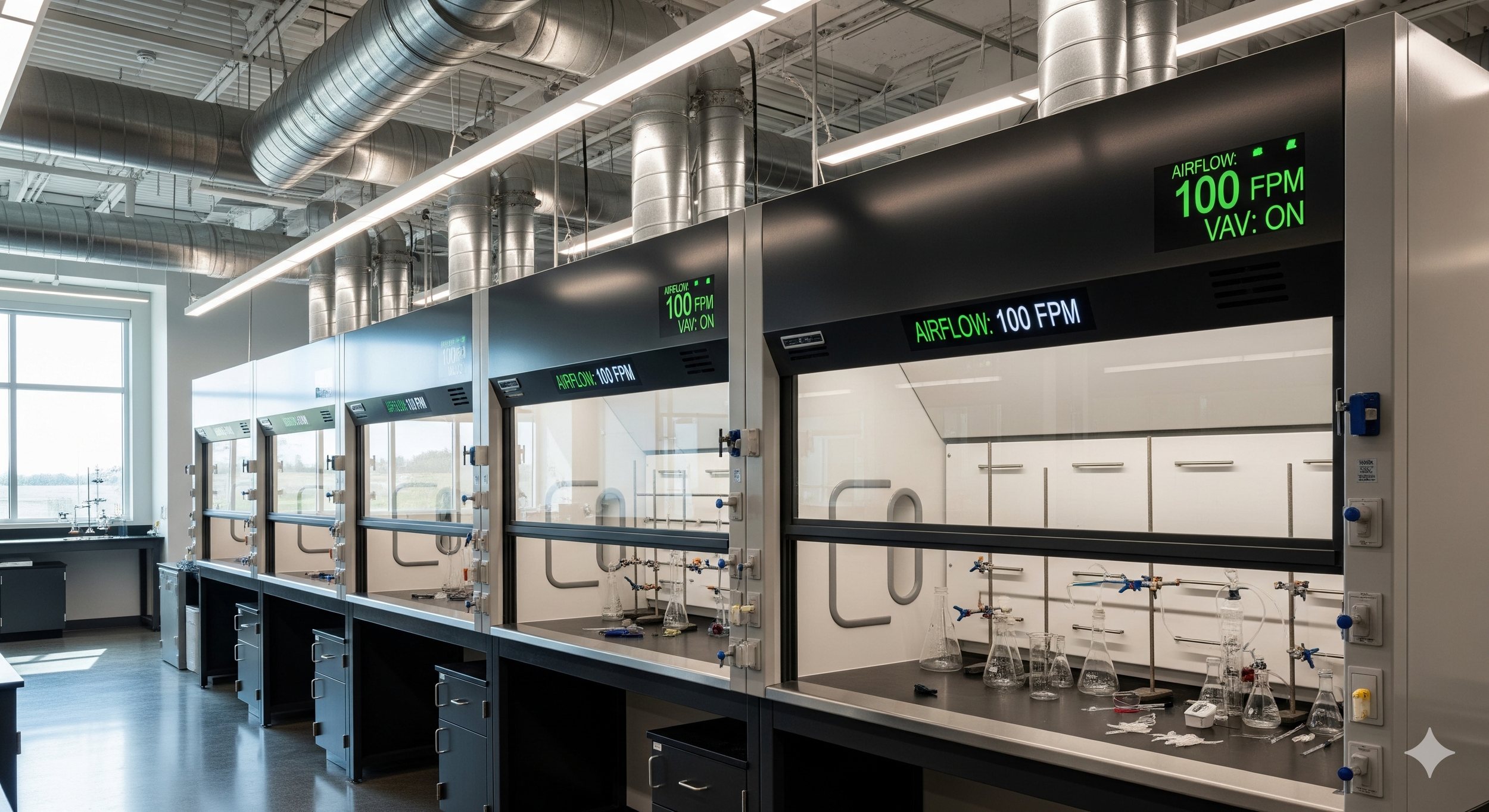
Your fume hoods are venting money. How auto-sash tech and lower ACH rates slash OpEx.
Credit: Gemini (2026)
Introduction: The open window effect
A single chemical fume hood running 24/7 consumes as much energy as three and a half average American homes. It is the thermodynamic equivalent of leaving a window wide open in the middle of winter while blasting the furnace, all in the name of safety. For research institutions, universities, and biotech startups operating on tight burn rates, fume hood energy consumption is often the largest single line item on the utility bill, frequently overshadowing lighting and plug loads combined. This massive energy penalty is the price paid for containment, but in an era of rising utility costs and strict carbon reporting, it has become a financial liability that facility managers can no longer ignore.
The problem is not the hood itself, but the volume of expensive, conditioned air it exhausts. To ensure safety, massive fans pull air from the room and eject it out the roof stack at high velocity to disperse contaminants. This requires the building's mechanical system to heat, cool, humidify, or dehumidify massive amounts of make-up air to replace it, only to vent it seconds later. This article explores how modern variable air volume (VAV) systems and auto-sash technology are revolutionizing lab efficiency, playing a pivotal role in comprehensive net-zero lab design.
The math of air change rates (ACH)
Historically, laboratory ventilation followed the crude maxim that "dilution is the solution to pollution." Labs were designed with a static, brute-force approach: pump air in and out at a constant rate, typically ten to twelve Air Changes per Hour (ACH), regardless of whether the lab was occupied, empty, or chemically inactive. This "set it and forget it" mentality was born in an era of cheap energy and limited sensing technology, but today it represents a colossal waste of resources. Running a lab at full throttle at 3:00 AM on a Sunday is financially unsustainable.
ACH Reduction is the low-hanging fruit of lab sustainability. By implementing Demand-Controlled Ventilation (DCV), facility managers can link airflow to actual usage, moving from static setpoints to dynamic control.
Occupied Mode: When sensors detect people, the rate maintains a safe six ACH.
Unoccupied Mode: At night or when the lab is empty, the rate drops to two to four ACH.
Emergency Mode: If a spill is detected, the system ramps up to purge the room.
Technology profile: variable air volume (VAV)
Old-fashioned Constant Air Volume (CAV) hoods exhaust the same amount of air whether the sash (the glass window) is fully open or closed. Whether a researcher is actively pipetting or the hood is sitting dormant, the fan spins at maximum speed. This inefficiency forces the building's central plant to size its chillers and boilers for a "worst-case scenario" that rarely happens, locking in high capital and operational costs.
Variable Air Volume (VAV) hoods change the game by treating air as a finite resource. They are mechanically linked to the building's exhaust valves and building management system (BMS). When a researcher lowers the sash, the valve throttles down immediately, reducing the volume of air exhausted while maintaining the required face velocity for safety.
The Impact: Closing the sash on a VAV hood can reduce airflow by 60 to 80 percent.
The ROI: Retrofitting CAV hoods to VAV typically has a payback period of less than three years due to energy savings.
The behavioral fix: auto-sash technology
The most efficient VAV system in the world is useless if the human operator leaves the sash wide open when they walk away for lunch or a meeting. Researchers are rightfully focused on their science, not on building thermodynamics, and "sash management" often falls to the bottom of their priority list. This is where auto-sash technology bridges the gap between engineering intent and human behavior, ensuring that energy savings are realized without relying on constant vigilance from the scientific staff.
Auto-sash systems use presence sensors to detect when a scientist steps away from the hood. After a set delay (usually 60 seconds), the motor automatically lowers the sash to its minimum position.
Safety: It creates a physical barrier between the chemical hazard and the lab.
Savings: It maximizes the VAV potential, ensuring the hood is in its lowest energy state for the majority of the day.
High-performance hoods: low-flow physics
Beyond controls, the aerodynamics of the hood itself have evolved to challenge the traditional safety standards. "High-performance" or "low-flow" hoods are designed to maintain robust containment at much lower face velocities (60 feet per minute vs. the traditional 100 fpm). By optimizing the rear baffles, aerodynamic airfoils, and sash handles to reduce turbulence, these hoods provide the same capture efficiency while exhausting 40 percent less air, significantly reducing the burden on the entire HVAC plant.
Conclusion: closing the loop on waste
Reducing fume hood energy efficiency is not just about buying better equipment; it is about changing the culture of the lab and integrating systems that are fail-safe. By combining auto-sash technology, ACH reduction strategies, and behavioral campaigns like "Shut the Sash," facility managers can stop venting their operating budget out the roof stack. In the modern high-performance lab, safety and sustainability are no longer mutually exclusive—they are engineered to work together to create a facility that is both safer for the scientist and lighter on the planet.
Frequently asked questions (FAQ)
How much money does shutting the sash save?
On average, a single fume hood left open costs roughly $5,000 to $7,000 per year to operate (depending on local energy rates). Closing the sash when not in use can reduce that cost by up to $4,000 per hood annually.
Is a face velocity of 60 fpm safe?
Yes, but only if the hood is rated for it. High-performance hoods are tested against the ASHRAE 110 standard to ensure they contain fumes effectively at lower velocities. You cannot simply turn down the fan on a standard hood and expect it to be safe.
Can auto-sash hoods be retrofitted?
Yes. There are aftermarket auto-sash kits available that can be installed on existing vertical-sash fume hoods, allowing facilities to upgrade without buying entirely new casework.
