
Lab Flexibility and Scalability: A Holistic Approach to Future-Ready Research Environments
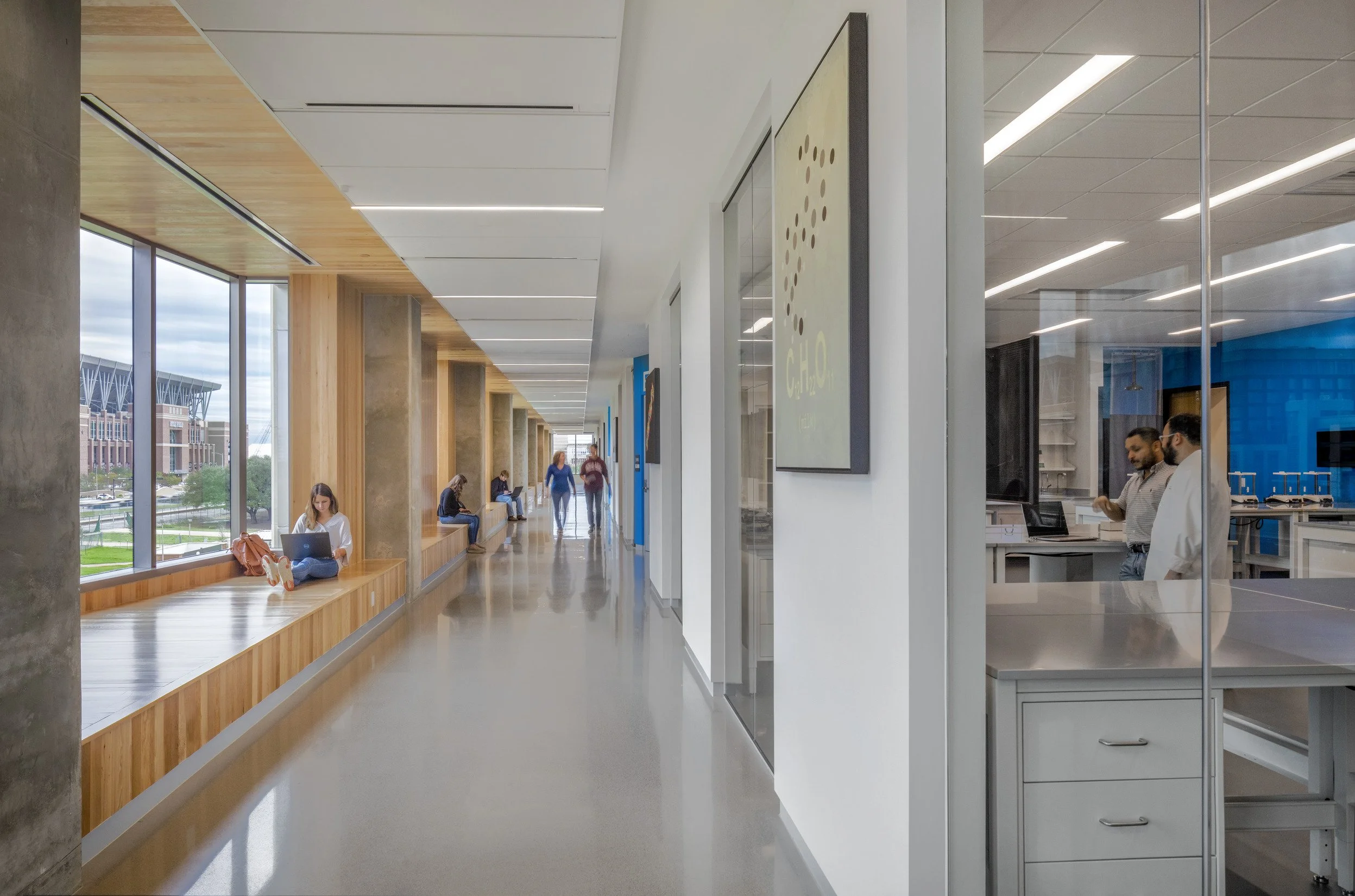
Texas A&M University Instructional Laboratory + Innovative Learning Building, designed by Ayers Saint Gross with TreanorHL. Image: Joe Aker
The quantity, quality, configuration, and location of lab space have always been moving targets. Change and adaptation are constants in research environments. But when sudden disruptions accelerate that pressure—as the recent federal funding uncertainty has done—the urgency to build adaptable, resilient labs becomes impossible to ignore.
Grant cancellations in late 2025 totaled an estimated $3 billion. A proposed 20 percent cut to the NIH budget looms for 2027. More than 10,000 STEM PhDs have left federal positions since early 2025. These shifts aren't happening in isolation—they're compounding existing pressures: declining enrollment pipelines, deferred maintenance backlogs, and institutions being asked to do more with less. The research ecosystem is under strain, and the buildings that support it need to be ready to respond.
To learn more about designing laboratories that can adapt to changing research priorities, evolving programs, and funding uncertainty, watch author Rainey's free on-demand webinar, Building with Flexibility & Scalability in Mind. Available for 1 AIA LU/HSW credit, the session explores practical strategies for improving space utilization, extending facility life, and reducing operational disruptions through flexible planning, shared core facilities, modular casework, and other scalable design approaches.
Flexibility is more than a module
Here is where the conversation usually goes wrong: lab flexibility gets reduced to a casework decision. Adjustable benches, modular storage, overhead service carriers—these are valuable tools, but they are not the strategy. True flexibility is a whole-building proposition. It operates at every scale simultaneously, from the structural frame to the bench surface, and it is held together not by any single product or system, but by the shared infrastructure that connects researchers to each other and to the resources they need.
The buildings that age well aren't the ones with the most reconfigurable casework. They're the ones designed around a shared ecosystem—where core facilities, collaboration zones, and open lab environments are woven together intentionally, so that as science evolves, the building can absorb that change without requiring wholesale reinvention.
For more than 50 years, the standard planning metric for research and instructional labs has been a 10'-6" x 10'-6" module with fixed casework. That module works reasonably well for basic bench work. It fails quickly when larger equipment, imaging systems, fume hoods, or automation enter the picture. And it was designed, almost exclusively, around a single physical demographic. Flexibility, properly understood, addresses all of this—but it starts with a much wider aperture than the casework catalog.
The ecosystem argument: core labs as connective tissue
The most underutilized lever in lab flexibility isn't adjustable furniture—it's shared infrastructure. Core facilities—instrumentation suites, imaging rooms, genomics labs, cold storage, prep spaces—are the engines of a high-performing research environment. When they are positioned thoughtfully within a building, they do something that no amount of modular casework can: they create the conditions for collaboration.
Rather than duplicating expensive equipment across individual PI labs, core facilities create a collective platform that elevates the capabilities of the entire building. A researcher doesn't need a dedicated imaging suite if a shared one is positioned at the intersection of their neighborhood and the one adjacent to it. That adjacency isn't incidental—it's a design decision with measurable consequences for how science gets done.
Core labs have traditionally made up 10–12 percent of research net assignable square footage. In institutions with historically lower grant funding—many of them IDeA-eligible states where NIH has specifically invested in building research infrastructure—that figure is trending toward 15–18 percent. That growth reflects a hard-won institutional understanding: shared resources don't just reduce cost, they build resilience. When individual grant funding contracts, a well-resourced core facility keeps the research enterprise moving.
The placement of these spaces matters as much as their presence. Core facilities positioned at the edges of departmental zones—at the seams between programs rather than buried within them—become natural convergence points. Researchers step outside their immediate domain. Students encounter methodologies and equipment from adjacent fields. Disciplines overlap not because anyone mandated it, but because the building made it easy. Proximity, it turns out, is one of the most powerful collaboration tools available to a designer.
The layers of flexibility
With the ecosystem framing established, the layered approach to flexibility becomes easier to apply strategically:
Layer 1—Base Building: Structure, core shafts, and major mechanical systems. These are expensive to change, so they should be designed with sufficient capacity and smart placement to support future modifications. High floor-to-floor heights, strategically located service chases, and stacked wet-over-wet lab configurations reduce retrofit costs dramatically over the life of the building. Get these right upfront—they are the fixed skeleton around which everything else adapts.
Layer 2—Infrastructure: Utility distribution, service carriers, and mechanical systems. Overhead service carriers—delivering gases, electrical, data, and vacuum from ceiling-mounted panels—support modular bench layouts while keeping floors clear and accessible. This layer should be designed explicitly for future access and modification.
Layer 3—Fit-Out: Casework, furniture, and equipment. This is where targeted investment pays the highest dividends. Modular and mobile casework can be reconfigured, replaced, or repurposed without construction. Fixed casework still makes sense in low-change areas—chemical storage, fume hood alcoves, heavy equipment zones. The goal is not universal flexibility, but strategic flexibility: concentrating adaptability where change is most frequent, most costly to address later, and most impactful to safety and operations.
Designing for the people inside
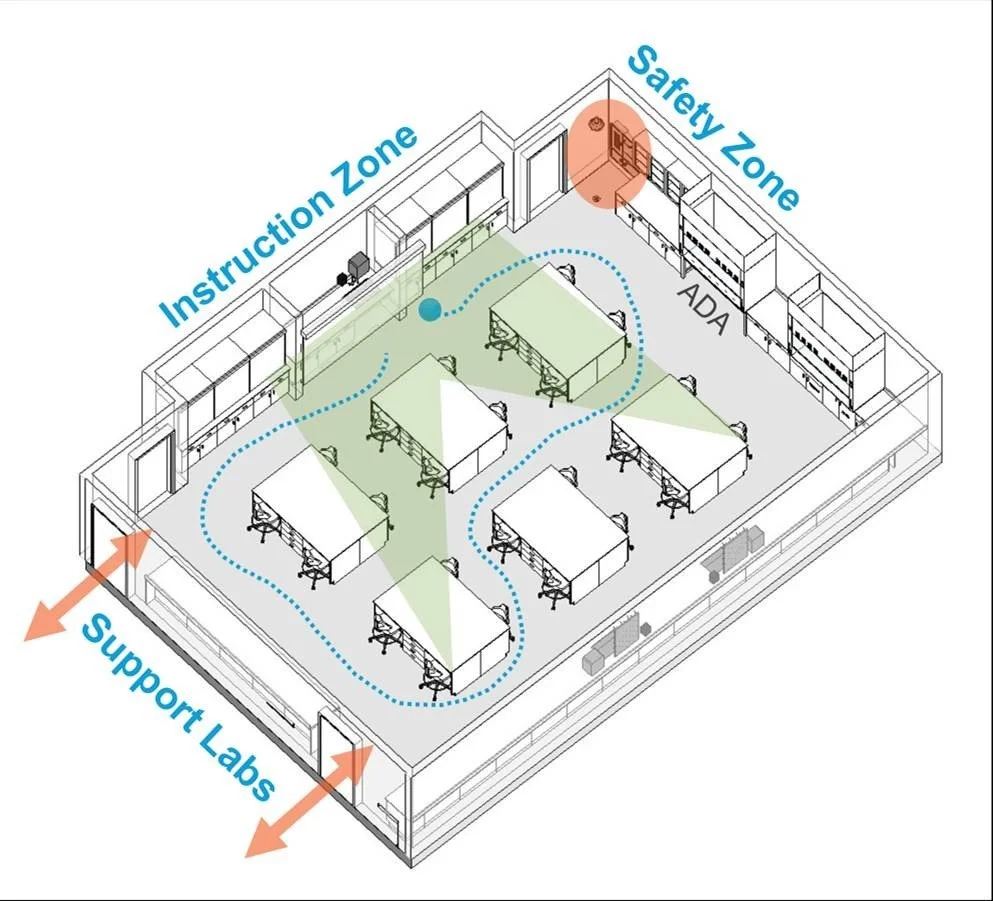
Instructional laboratory diagram: flexible design supporting evolving technologies and interaction. Image: Courtesy of Ayers Saint Gross
A flexible building that doesn't work for the full range of people using it isn't actually flexible—it's just reconfigurable for a narrow demographic. Human-factored design means building labs around the physical, cognitive, and behavioral realities of every researcher who walks through the door.
The history of lab design is, in part, a history of exclusion by default. Many labs built over the past half-century were designed around a single physical demographic, with no provisions for shorter users, those with physical limitations, or those with neurological differences. Adjustable bench heights, accessible sinks with lever controls and knee clearance, fume hoods designed to accommodate seated users—these aren't accommodations added after the fact. They are core components of a flexible lab. A space that requires a retrofit every time the workforce changes is not flexible; it's just expensive.
Inclusive design and ergonomic design are the same investment. When users don't have to overreach, work at awkward angles, or improvise around a space that wasn't built for them, safety improves, efficiency improves, and the lab's useful life extends.
The cost of getting this wrong
Labs are among the most expensive spaces to build and operate—and among the most commonly underutilized. Sensor-based occupancy data consistently shows that benches and support spaces are occupied far less than visual surveys suggest. More than 40 percent of lab space is underutilized at any given time. Storage accumulates on benches. Scheduled time overstates actual use. Dead equipment collects dust in spaces that cost hundreds of dollars per square foot to build and operate.
Rigid, cellular configurations compound this problem. They require frequent renovations as science evolves, generate operational downtime during reconfiguration, and expose workers to construction-related hazards—dust, noise, vibration, disrupted egress—on top of the chemical and biological risks already present. Every avoided renovation is a period where those risks don't exist. Flexibility, in this sense, is a safety strategy as much as a space strategy.
The question isn't whether to invest in flexibility. It's where to invest it—and at what scale.
Zoom out before you zoom in
Before a single line is drawn on a new lab design or renovation, the most valuable step is one that most institutions skip: understanding what they already have. Is there a database of existing spaces that could inform whether new construction or renovation is the right answer? Are there underutilized buildings suited for repurposing? Has utilization data been analyzed to understand what lab sizes and densities actually work? Are there areas of equipment duplication that a well-placed core facility could consolidate?
These questions reframe the design problem. The most flexible solution may be one that hasn't yet been considered—because no one has looked at the full picture.
Science isn't static, and the buildings that support it shouldn't be either. In an era of funding uncertainty and accelerating change, flexibility is no longer a design amenity. It is an institutional strategy—one that begins not at the bench, but at the scale of the building, the campus, and the ecosystem of shared resources that makes research possible.
Interested in learning how flexibility and scalability can help research facilities navigate funding uncertainty and changing program needs? Author Rainey Hufstetler explores these concepts in greater depth in Lab Design’s free on-demand webinar Building with Flexibility & Scalability in Mind. Available for 1 AIA LU/HSW credit, the webinar examines how design strategies such as shared core facilities, modular casework, and strategic storage can create more resilient, adaptable laboratory environments.