
Stakeholder-Driven Design: Planning an Integrated Cancer Research and Care Hub
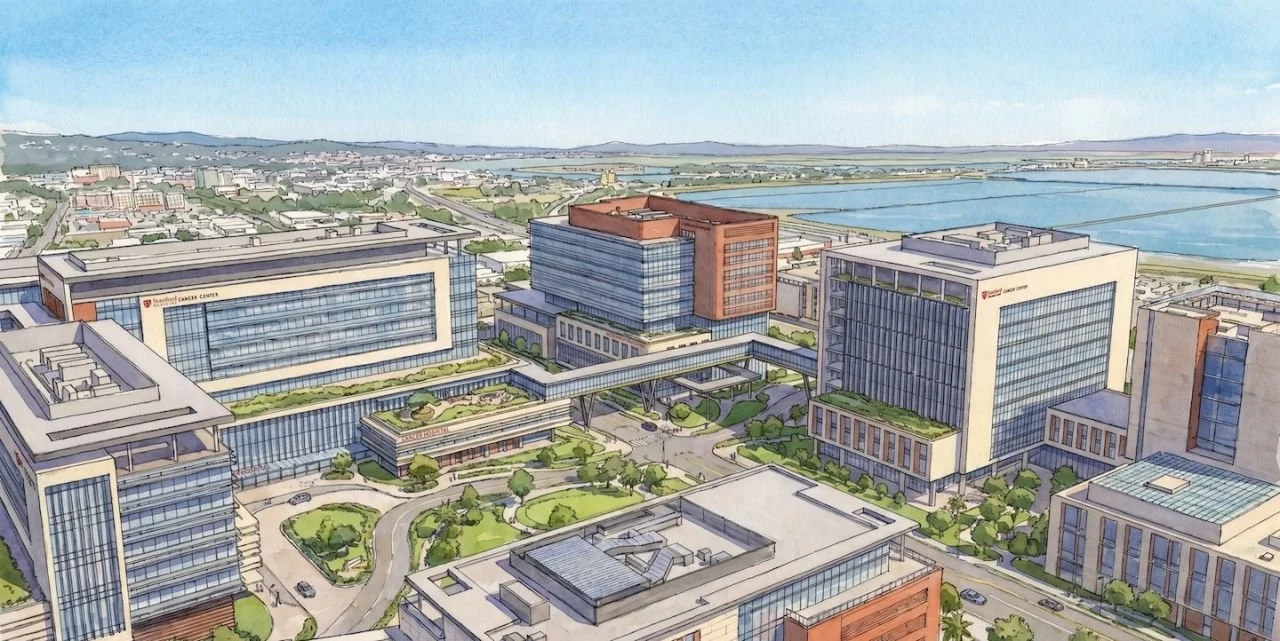
The proposed cancer center's research laboratories are being planned with flexibility, strategic adjacencies, and future-ready infrastructure to accommodate advances in cancer research and treatment. Image: HOK & Transparent House
As Stanford Medicine advances plans for a proposed integrated cancer center in Redwood City, CA, one message is already emerging clearly from the project's early planning stages: successful research and healthcare facilities begin long before design drawings are finalized.
The proposed development would bring together cancer research laboratories, clinical care, and clinical trials in a single location. The vision includes a hospital, clinics, and research facilities connected by skyways, allowing scientists and clinicians to work in close proximity while accelerating the translation of discoveries into patient care.
While the project remains in the proposal phase, the planning process offers valuable lessons for laboratory owners, researchers, facility managers, architects, and planners involved in major laboratory and healthcare projects.
Designing around workflows, not buildings
One of the most notable aspects of Stanford Medicine's approach is its emphasis on defining operational requirements before physical design solutions.
According to Bart Sapeta, assistant dean of facilities planning and management, stakeholder input is driving discussions about how research and clinical activities should function together long before specific spaces are finalized.
“At this early planning stage, the School of Medicine is defining the operational and spatial requirements for a ‘bench-to-bedside-and-back-again’ model through a highly iterative, stakeholder-driven process that links real-world workflow design with physical space planning,” Sapeta says.
Rather than starting with room counts or square footage targets, planning teams are examining how researchers, clinicians, and support staff actually work. Principal investigators, core facility directors, and researchers are helping define workflows and space requirements based on day-to-day operational experience.
This user-driven planning process may be particularly relevant for laboratory professionals advocating for their own projects. By documenting workflows, identifying bottlenecks, and articulating future needs early, end users can help ensure facilities are designed around scientific operations rather than forcing operations to adapt to the building.
Bringing diverse stakeholders to the table
Stanford Medicine has assembled a broad range of stakeholders to inform project requirements, including researchers, clinicians, core facility leaders, vivarium specialists, facilities personnel, and operational leadership.
According to Sapeta, each group contributes a different perspective. Researchers and clinicians are helping define scientific priorities and translational workflows, while technical groups are ensuring specialized infrastructure and shared resources are properly integrated. Facilities and operational leaders are helping ground design decisions in practical considerations such as logistics, circulation patterns, room sizing, and long-term maintainability.
For architects and laboratory planners, the process underscores the importance of engaging stakeholders beyond traditional user groups. Some of the most valuable insights often come from operational teams responsible for maintaining and supporting facilities after construction is complete.
Planning for an uncertain future
Perhaps the most significant challenge facing the project is designing for a future that remains largely unknown.
The central question guiding discussions is, “What changes will we see in cancer research, care, and treatment over the next 5, 10, and 20 years, and how will they affect the built environment?” says Ashley Umaña, vice president of Stanford Medicine Cancer Center Redwood City Facilities Planning and Design.
The challenge is one facing research and healthcare organizations across the country as advances in artificial intelligence, genomics, automation, robotics, and precision medicine continue to reshape both scientific workflows and patient care.
“While no one has a crystal ball, the key question is what we can do today to ensure our spaces evolve with rapid advances in research and care. This includes designing environments that can be easily reconfigured for different uses, balancing specialized functions with long-term adaptability, and better integrating research, clinical care, and trials to accelerate innovation. Priorities include creating flexible lab and clinical environments, building scalable infrastructure that can support emerging technologies such as AI, advanced robotics, and precision medicine, and ensuring facilities can adapt to unknown future care models while maintaining a high-quality patient experience across the full continuum of care,” says Umaña.
For laboratory planners and architects, the discussion highlights a common challenge: helping clients balance today's operational requirements with long-term adaptability. Addressing that challenge requires ongoing collaboration among researchers, clinicians, facilities leaders, and design teams throughout the planning process.
Learning from existing facilities
Another recurring theme in Stanford Medicine's planning effort is the importance of learning from previous projects.
According to Umaña, California's high construction costs have intensified the need to maximize the performance of every square foot. Stakeholders are closely examining where existing facilities operate efficiently and where improvements are needed.
“Space efficiency is therefore a central priority for the Stanford Medicine Redwood City Vision—doing more in less space while enabling greater clinical volume and research output,” says Umaña. “Prior projects have demonstrated the value of standardized labs and clinics, as well as environments that support collaboration and allow research teams and clinical programs to expand or contract as needs evolve. At the same time, they have highlighted challenges with fragmentation and underutilized space.”
Those lessons are informing current discussions about how to create more adaptable, higher-performing environments that can accommodate growing patient volumes, expanded clinical trial activity, and evolving research needs without requiring continuous facility expansion.
For laboratory owners considering future projects, the message is clear: post-occupancy evaluations and operational feedback from existing facilities can be among the most valuable planning tools available.
Community and sustainability as design drivers
In addition to research and clinical stakeholders, Stanford Medicine is incorporating input from community members, patients, and local organizations.
According to Lucy Wicks, assistant vice president of local government and community affairs, input from the university’s network has already influenced site planning decisions.
“The valuable feedback we've received through our ‘community-first’ engagement approach has directly shaped our updated project plans,” she says. “Over the past year, we've actively engaged with neighbors, community leaders, local organizations, patients and care providers to ensure our vision aligns with community interests while advancing the future of cancer care and research. Early community input has been instrumental in shaping our campus site plan design—particularly the outdoor spaces, streetscapes, and pedestrian connections around and through the site.”
Patient input has been valuable as well, Wicks adds. “[They] have also shared memorable aspects of their care journeys, which has helped advance how we think about designing environments for healing and navigation of care. Our commitment began with listening, and we'll continue this open dialogue as we work together to create a cancer center that reflects the best care and what it means to be a good neighbor.”
Sustainability is similarly being embedded into planning from the outset. Stanford Health Care intends for the project to achieve at least LEED Gold-equivalent performance while emphasizing electrification, renewable energy readiness, and long-term resilience.
Questions that still need answers
Even as planning progresses, Stanford Medicine leaders acknowledge that many important questions remain.
If given the opportunity to consult with organizations that have already completed major cancer center projects, Umaña says Stanford would focus on understanding which innovations delivered lasting value and which proved difficult to sustain operationally. “What new ideas—such as flexible labs, standardized clinics, and integrated research-care models—actually worked in practice, and which proved harder to sustain or underperformed once operational? How did organizations manage the transition from legacy workflows to new models of care, and what were the biggest barriers to adoption for clinicians, researchers, and staff?”
Those same questions are increasingly relevant across the laboratory design community. As research institutions pursue more integrated, technology-driven environments, successful projects may depend less on individual design features and more on how effectively stakeholders collaborate to align infrastructure, operations, technology, and user behavior from the very beginning.
For laboratory users, planners, and architects alike, Stanford Medicine's proposed cancer center serves as a reminder that the most important design decisions often happen before the design itself begins.