
The Next Wave of Research at the Whitney Laboratory for Marine Bioscience
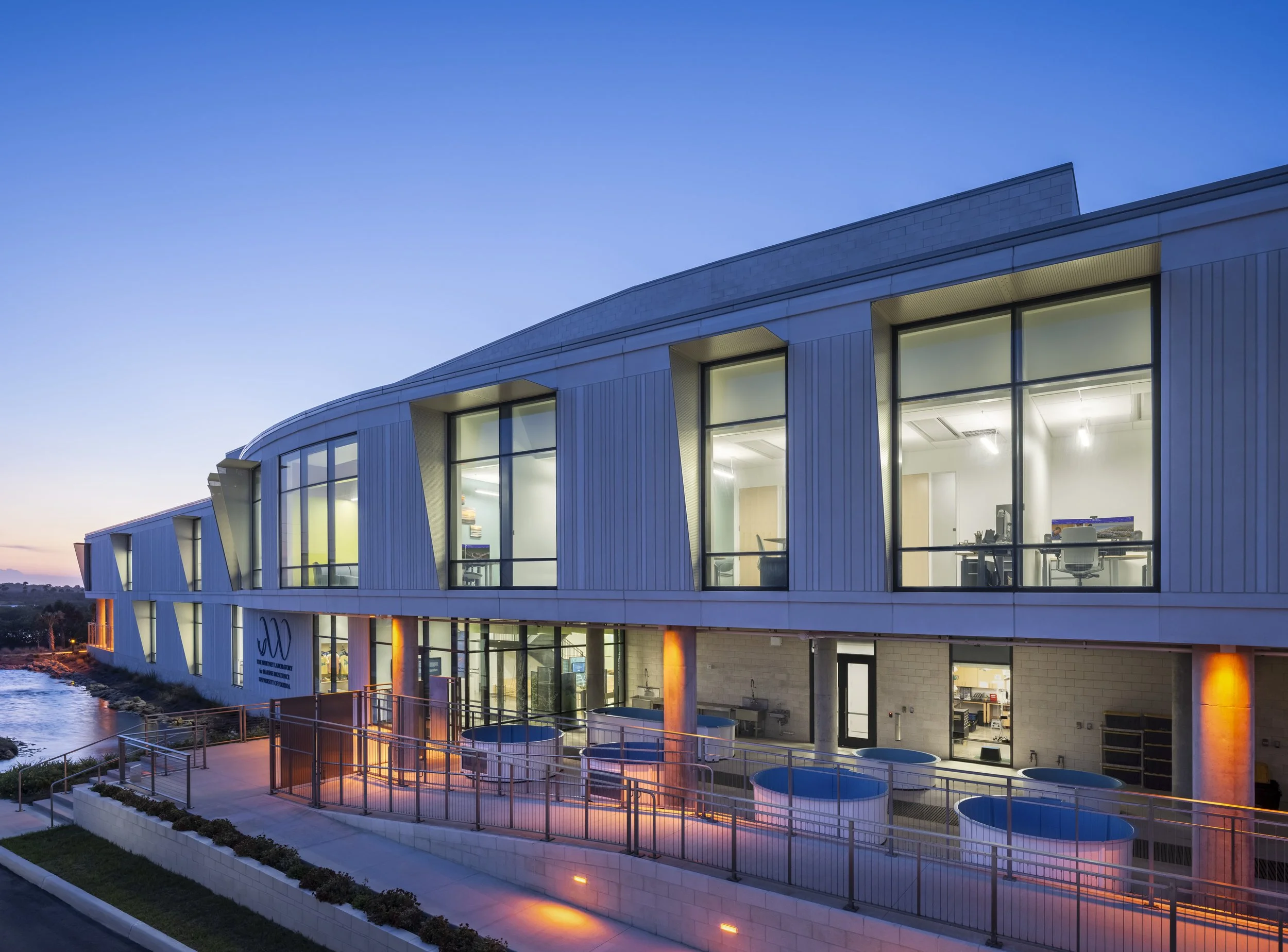
The University of Florida’s LEED Gold-certified Whitney Marine Research Center in St. Augustine expands marine science capacity with 38,000 sf of flexible research space, advanced laboratories, aquaculture systems, and an enhanced Sea Turtle Hospital designed to support interdisciplinary collaboration, innovation, and conservation. Image: Courtesy of Lord Aeck Sargent Planning & Design and Copyright Jonathan Hillyer Photography
The University of Florida’s newly opened Whitney Marine Research Center marks a significant expansion of marine science infrastructure, doubling research capacity while redefining how interdisciplinary collaboration and specialized research environments can coexist within a single facility. Located at the Whitney Laboratory for Marine Bioscience in St. Augustine, the $41.2 million, 38,000-sf building represents both a physical and strategic evolution for the institution’s research, education, and conservation mission.
Designed by Lord Aeck Sargent in collaboration with TTV Architects and constructed by DPR Construction, the LEED Gold-certified facility brings together 12 state-of-the-art laboratories, aquaculture systems, microscopy suites, a maker space, and an expanded Sea Turtle Hospital. The project not only increases research space but also introduces new planning approaches that balance flexibility, resilience, and community engagement.
A collaborative framework
At the core of the building’s design is an open-lab concept—an approach that reflects the Whitney Lab’s deeply collaborative research culture. Rather than isolating research teams, the layout encourages visibility and interaction among scientists working across disciplines. According to Patrick Thompson, assistant director of operations, “Whitney Laboratory is a collaborative research environment and faculty naturally gravitated towards an open concept during the initial design phase. The design facilitates spontaneous and productive conversations, fostering an atmosphere of information exchange and innovation.”
This emphasis on openness shaped the building’s adjacencies and circulation, enabling researchers to move fluidly between shared and dedicated spaces. However, the design team also had to carefully balance this collaborative framework with the need for specialized environments. Marine bioscience research often requires highly controlled conditions—particularly in aquaculture systems, microscopy suites, and clinical spaces like the Sea Turtle Hospital.
Further reading: Innovating Marine Conservation: Constructing UF's Sea Turtle Hospital
Flexibility through modularity
To address these competing demands, the facility incorporates a modular planning strategy. While the main laboratory bays follow consistent design principles, each lab is supported by adjacent rooms that can be tailored to specific research needs. This approach allows teams to customize lighting, equipment, and infrastructure without disrupting the broader layout.
“Modularity is crucial,” says Thompson. “The design principles for the lab’s main bays were consistent, but the true uniqueness lies in the separate support rooms for each of the 12 labs. These rooms offer flexibility in terms of research work, lighting, and other factors. If you require specialized equipment, electrical components, or unique counter designs, you can easily move them out of a room and rearrange them for the specific work that will take place in that space with minimal effort. Since Whitney Lab is a collaborative environment, there are dedicated spaces and rooms that house shared equipment used by multiple research labs.”
Designing for a coastal community
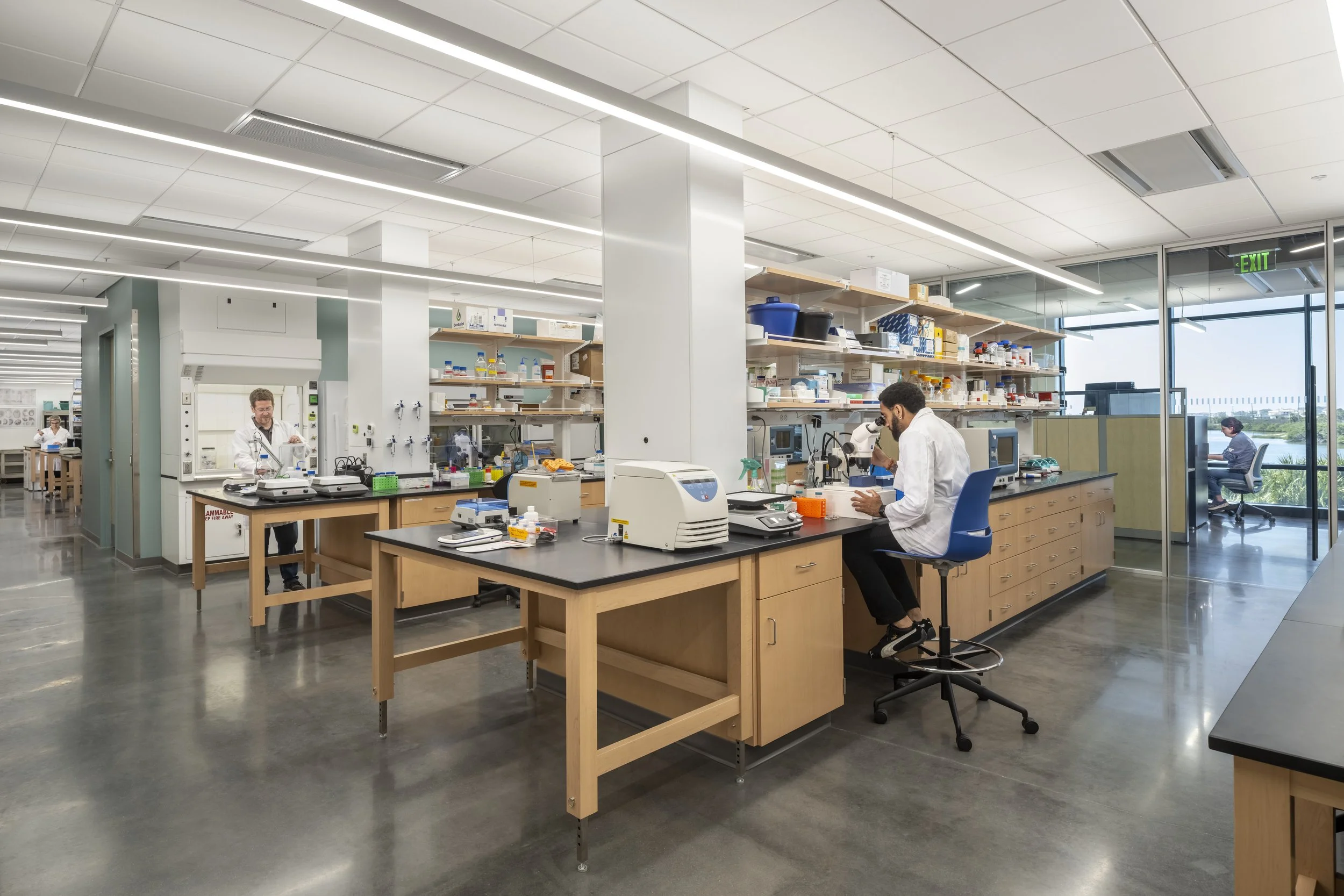
Designed for Florida’s challenging coastal environment, the Whitney Marine Research Center incorporates corrosion-resistant materials, resilient building systems, redundant power infrastructure, and public engagement spaces that support uninterrupted research, marine life care, and community education. Image: Courtesy of Lord Aeck Sargent Planning & Design and Copyright Jonathan Hillyer Photography
The integration of complex marine research systems added another layer of design complexity. Located on a barrier island along Florida’s northeast coast, the site is exposed to salt air, high humidity, and potential storm surge. These environmental conditions required careful material selection and system design to ensure durability and resilience.
“The challenges for the designer was to consider corrosion, salt air, and high humidity, which can rapidly degrade conventional building materials and mechanical systems,” Thompson says. “This was addressed through the use of corrosion-resistant materials, durable finishes, and building systems specifically selected for coastal conditions.” In addition, critical systems—including life support and aquaculture infrastructure—are connected to redundant power supplies, ensuring continuity during outages.
Flooding and climate resilience were also key considerations. The building is designed to remain operational under adverse conditions, supporting both ongoing research and the care of marine life in the Sea Turtle Hospital. The expanded hospital increases rehabilitation capacity while creating new opportunities for research and public engagement.
Community integration played a central role in the planning process. Early in the design phase, the project team conducted a town hall-style meeting to gather input from staff, researchers, and technicians. This collaborative approach helped identify priorities beyond core research functions. “During these discussions one item that was determined was a need for public-facing education and community centered spaces,” Thompson notes.
This input directly informed the creation of the building’s Discovery Lobby—an interactive, public-facing space designed to showcase the lab’s work. The lobby provides visitors with insight into ongoing research while strengthening connections between the scientific community and the public. It also reflects a broader shift in laboratory design toward transparency and outreach, particularly in fields with direct environmental and societal impact.
Early impact and lessons learned
Since opening, early feedback from occupants has been overwhelmingly positive. Researchers report improved workflow efficiency and a heightened sense of purpose within the new environment. Thompson says, “Every faculty and their lab that has moved into the Whitney Marine Research Center has had an elevated sense of work to propel and advance our mission.”
This sense of momentum aligns with the university’s broader vision for the facility. University leadership emphasized that the expansion will enable more ambitious research initiatives, particularly in areas such as biodiversity, environmental sustainability, and human health. By providing the infrastructure to support larger, more complex research programs, the center positions the Whitney Laboratory as a leader in marine bioscience.
At the same time, the project offers valuable lessons for future laboratory developments. One key takeaway is the importance of continuous communication between stakeholders throughout design and construction. Thompson reflected on this point, noting that maintaining alignment between initial design intent and final execution is critical—especially for specialized features that may seem minor but have significant operational impact.
Ultimately, the Whitney Marine Research Center demonstrates how thoughtful design can support both scientific innovation and environmental resilience. By combining open, collaborative spaces with adaptable, high-performance research environments, the facility creates a model for next-generation marine laboratories. As research challenges grow increasingly complex and interdisciplinary, this type of flexible, community-oriented infrastructure will play a vital role in advancing discovery and addressing global environmental issues.