
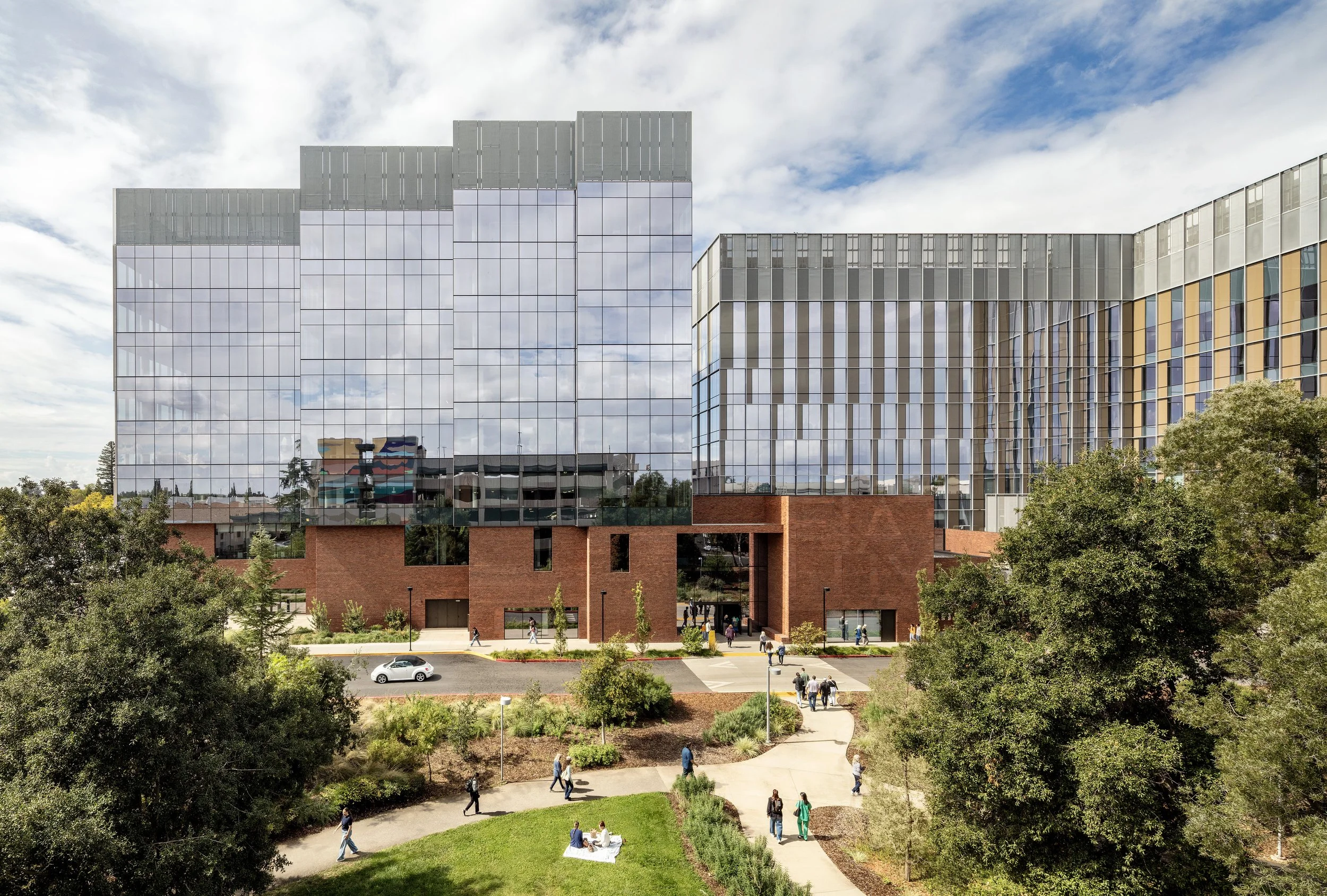
Designed as a next-generation innovation district, Aggie Square brings together laboratory, workplace, and community spaces to advance research and regional growth. Image: Courtesy of ZGF
Aggie Square at the University of California, Davis is a $1.1 billion innovation district developed to bring together university research, private industry, startups, and community partners within a shared environment focused on collaboration and innovation. Opened in Sacramento in May 2025 after eight years of planning, the 11-acre development reflects a growing approach to research environments that integrates laboratory, workplace, educational, and community uses within a single district.
Winner of the 2026 Design Excellence Award for Excellence in Whole Building/Holistic Design—New Build, Aggie Square represents an emerging model for research environments—one that intentionally blurs the lines between academia, industry, and community. Developed by Wexford Science + Technology in partnership with the UC Davis and designed by ZGF Architects, the project goes beyond a traditional laboratory building. Instead, it establishes a purpose-built innovation district designed to accelerate discovery through proximity, flexibility, and shared experience.
Located adjacent to the UC Davis medical campus in Sacramento, Aggie Square anchors a broader regional vision: positioning the area as a growing life sciences hub while delivering tangible economic and social benefits to the surrounding community. Through strategic program planning, highly adaptable laboratory infrastructure, and a strong urban design framework, the project illustrates how the built environment can actively support collaboration at scale.
ZGF representatives accepted the award at the Lab Design Conference in Orlando, FL on May 12.
A district designed for convergence
At its core, Aggie Square is conceived as an “innovation ecosystem”—a place where researchers, students, entrepreneurs, and community members engage in daily interaction. Rather than separating uses into distinct buildings or zones, the design deliberately interweaves them to promote connection.
“When you're trying to drive individual researchers to collaborate and interact with one another, you're creating ‘soft spaces’ in between the labs,” says Claire Drummond, vice president, Sacramento market executive with Wexford Science + Technology. “But in innovation ecosystems, you're trying to encourage and create space for researchers to collide with private industry, to collide with students, and even to actively invite the community into that ground floor space.”
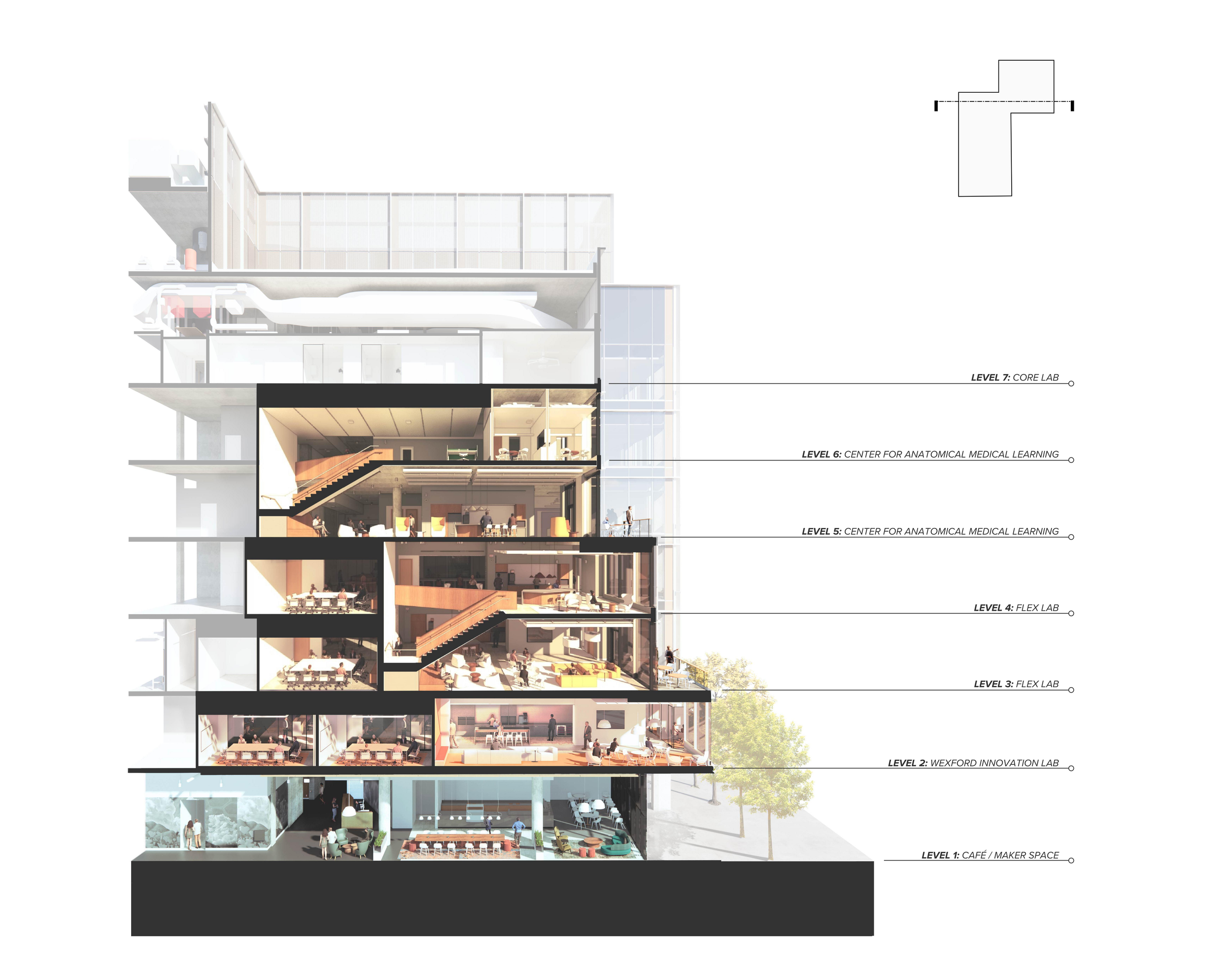
Designed to encourage daily collisions among researchers, entrepreneurs, students, and the public, Aggie Square emphasizes connection through shared and informal spaces. Image: Courtesy of ZGF
This philosophy is reinforced through the identity of the facility itself, says Vlad Pajkic, partner at ZGF Architects. “The name of the project, Aggie Square, sort of says that there's a very strong urban design idea around this, and it was the idea of creating a sense of place there. This was initiated by the university. So when Wexford and the design team came on board, we internalized their idea and took it a step further.”
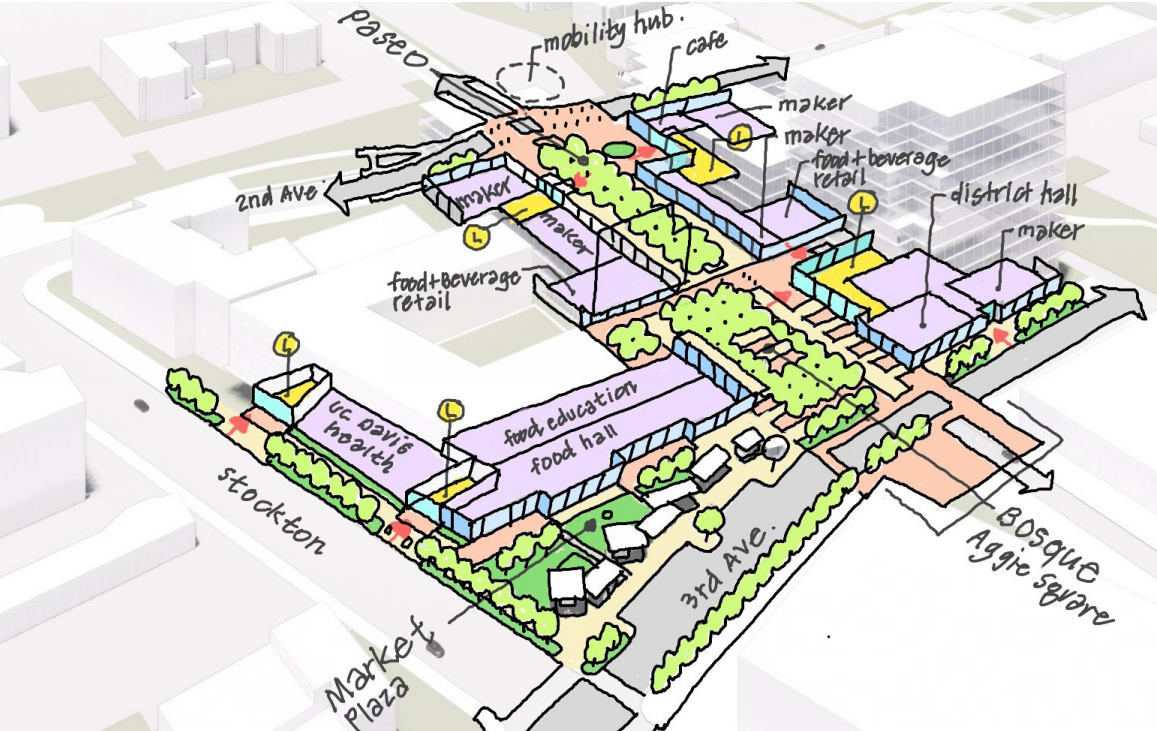
Central to this concept is the “Paseo,” a pedestrian-oriented street framed by porticos that provide both intimacy and exposure to science on display, says Pajkic. The team’s design layers “active science-related programming on top of this very strong urban idea,” ensuring the development integrates seamlessly into the surrounding city rather than functioning as an isolated research campus.
A defining feature of Aggie Square is its vertical program organization, which transitions from public-facing functions at the ground level to increasingly specialized research environments above. The ground floor is designed as a community-oriented zone, incorporating maker spaces, event venues, and classrooms.
Placing core labs at this level was a deliberate decision to increase visibility and engagement, Pajkic says. "These are manufacturing. They're 3D printers. They're different types of workshops, and being on the ground floor they're very accessible. So you see them as you walk by.” This level of transparency is uncommon in speculative or developer-driven lab buildings, he adds, noting that the approach creates “excitement on the ground floor of a lot of science right there.”
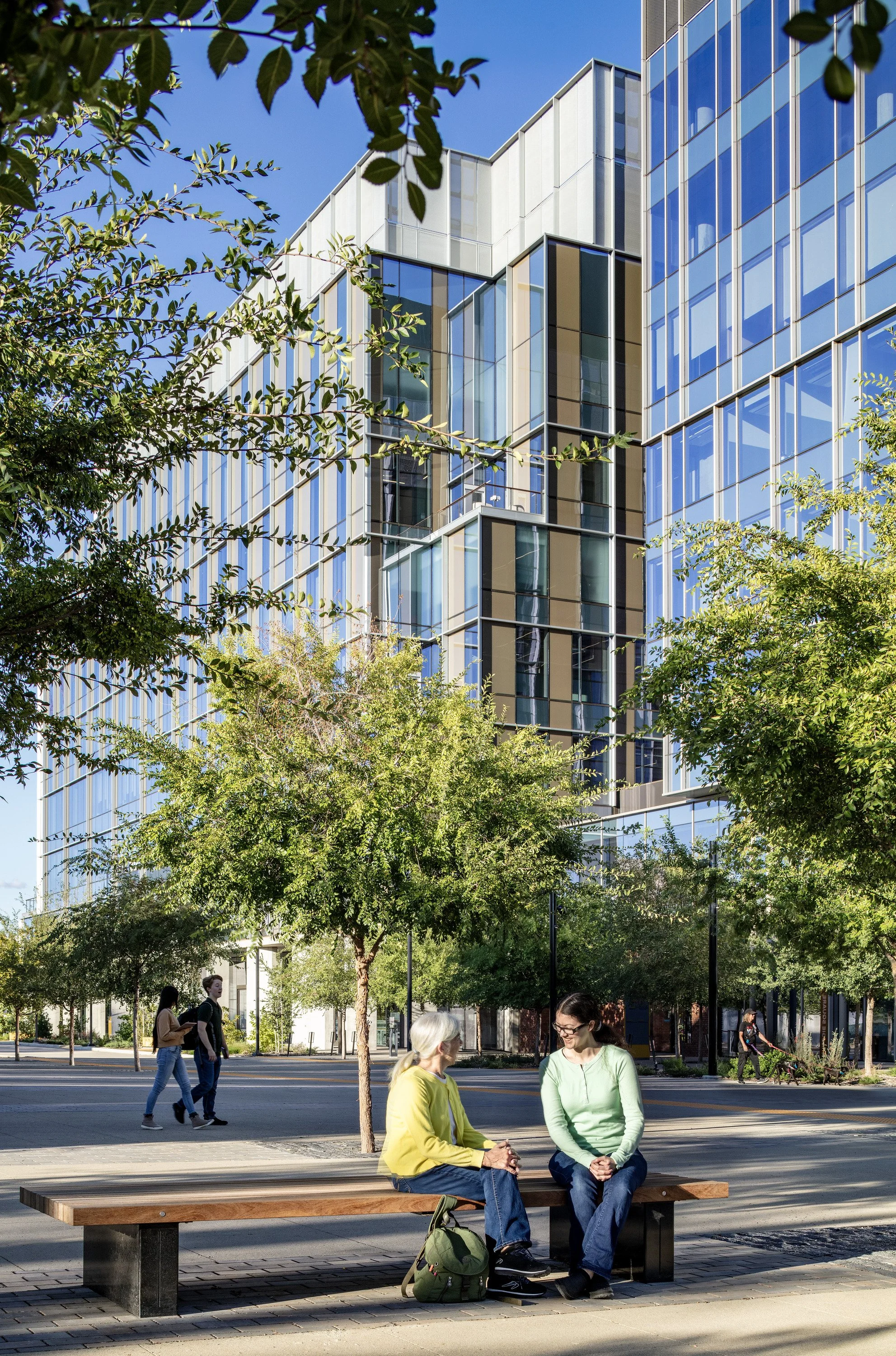
The Paseo, a pedestrian-focused corridor lined with porticos that balances intimacy and openness, anchors Aggie Square’s urban design vision, layering active science programming into a strong sense of place that integrates the development into the surrounding city rather than isolating it as a research campus. Image: Courtesy of ZGF
The social spine: circulation as community
Circulation design plays a central role in reinforcing the project’s collaborative intent. Open stairways and vertical connections act as a “social spine,” encouraging movement and interaction across floors.
A key feature is the inclusion of communicating stairs between dedicated UC Davis tenant floors—an approach that marks a significant cultural shift. Drummond notes that for the first time in decades, UC Davis Health researchers—who previously worked in more isolated environments—are "mixing and blending," sharing kitchens, conference rooms, and tissue culture lab space.
Pajkic adds that these vertical connections foster a "large community of researchers that can come together and share and run into each other" across expansive floor plates exceeding 80,000 square feet.
“They've taken efficiency to an extreme,” he says. “But we see that researchers that we've been chatting with for the last few years are now-office-to-office, and they've developed relationships. It's really cool to see.”
This emphasis on openness also informed late-stage design decisions. Drummond recalls a scenario involving a two-story classroom and community space that were initially separated by a wall. “Probably eight months before we opened the building, we redesigned that opening so that you would be able to move between the two and you'd have that beautiful visual openness,” she says, enabling the spaces to function together during large events.
Flexible and sustainable design
Flexibility is a core principle of Aggie Square’s laboratory design. The building is intended to support a wide range of users, from academic researchers to biotech startups, while remaining adaptable to evolving scientific needs.
The primary lab structure utilizes a concrete flat slab system engineered to accommodate 2000 MIPS vibration criteria. Large, uninterrupted floor plates allow for reconfiguration over time. “We made sure that the floor plates are relatively large and uninterrupted,” Pajkic explains, describing the strategy as “anticipating a changing market over next five to 10 years.”
This approach allows for seamless transitions between wet lab, dry lab, and computational research environments. The building’s architectural and MEP systems are designed so that different functions can be almost effortlessly stacked on top of each other, including incubator spaces such as Connect Labs alongside core research facilities.
One of the project’s more complex challenges was balancing its open, community-facing design with the security requirements inherent to research environments.
Drummond describes the challenge of offering a welcoming environment space while maintaining appropriate boundaries and security. “It’s meant to be an inviting space,” she says, noting that visitors can “see the science that is intended to be on display, but not get in space that is dedicated for private research.”
This was accomplished through layered access control strategies, including destination dispatch—an optimization method for multi-elevator systems that groups passengers traveling to the same or nearby floors into a single cab, reducing wait times and improving overall efficiency—and a redundant set of key card access into tenant space.
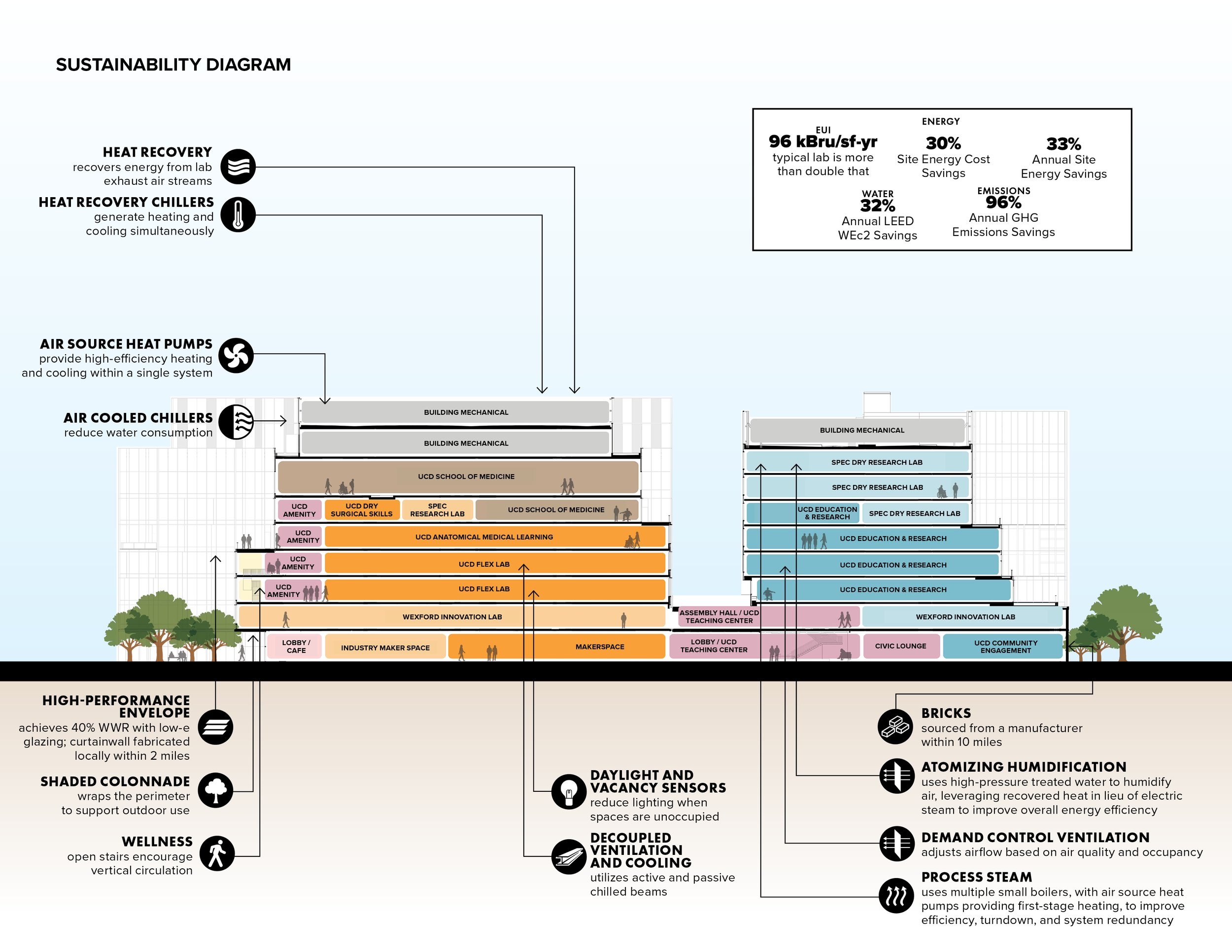
Aggie Square is a fully electric, net-zero operational carbon campus powered by SMUD’s 100 percent renewable energy grid, eliminating natural gas in favor of safe, high-performance systems that exceed California energy standards and target LEED Gold certification. Image: Courtesy of ZGF
Aggie Square is designed as a fully electric, net-zero operational carbon campus, enabled by Sacramento’s SMUD (Sacramento Municipal Utility District) grid, which provides 100 percent renewable energy. Through close collaboration between UC Davis, Wexford Science + Technology, and the university’s EH&S team, the project eliminates natural gas use and transitions laboratory systems to safe, all-electric alternatives. This shift not only improves safety by removing combustion and open flames from lab environments, but also positions the buildings to exceed California energy standards by at least 20 percent while targeting LEED Gold certification. High-performance systems such as heat recovery, efficient electrified HVAC, and water reuse strategies further reduce energy and resource demand across the district.
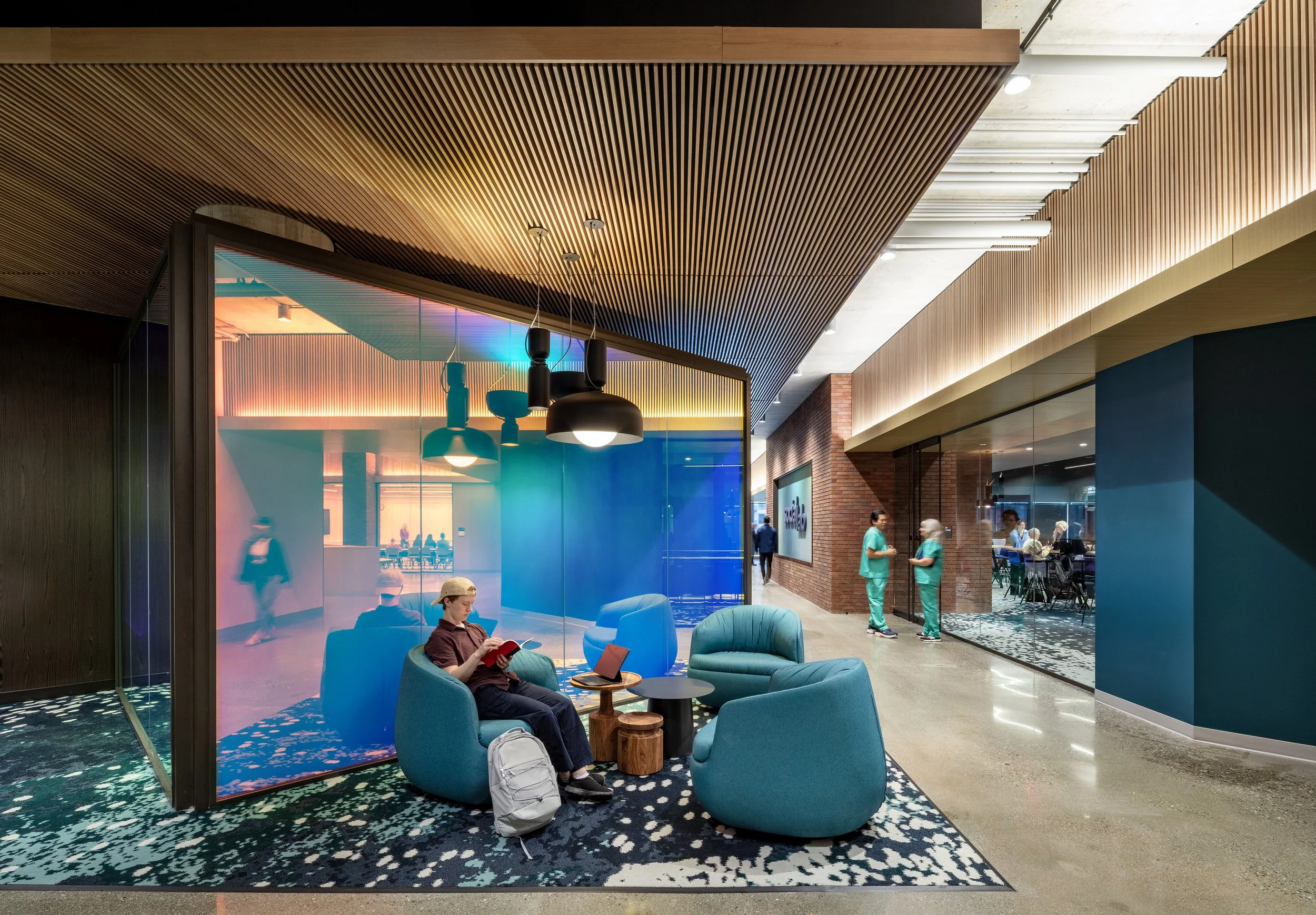
Aggie Square’s laboratory design emphasizes long-term flexibility, using large, uninterrupted floor plates and adaptable infrastructure to support seamless transitions between wet, dry, and computational research environments for a range of users from academic researchers to biotech startups. Image: Courtesy of ZGF
Interior design: a “living room” for science
Interior spaces at Aggie Square are designed to feel approachable and human-centered, reinforcing the idea of the building as a shared environment rather than a purely technical facility. ZGF Architects developed an interior “DNA” that reflects both developer priorities and the academic culture of its users.
A notable feature is the “clean deck” lobby design, which eliminates visual clutter by concealing conduit and infrastructure, resulting in higher ceiling heights. "Instead of a 10-ft. or even 9-ft. 6-in. that you see a lot of lab buildings, we have like 14-ft," Pajkic says.
Material choices also reinforce a strong sense of identity. The use of full brick on the exterior, paired with interior brick veneers, creates "beautiful consistency" while referencing Sacramento’s architectural context, says Drummond Despite deep floor plates, the design maximizes daylight penetration, ensuring light and transparency within the facility.
Integrated project management in a time of disruption
Aggie Square’s delivery required an unusually high level of cross-country coordination during design and construction, with more than 30 participants engaged in structured daily stand-ups and alternating in-person planning sessions throughout the COVID-19 pandemic to align distributed architect, engineer, contractor, and developer teams. Image: Courtesy of ZGF
Aggie Square’s delivery required an unusually high level of coordination, particularly as design and construction progressed between the 2018 announcement and the 2022 groundbreaking.
“Typically when you see these really prestigious, really beautiful buildings, they're done in cities where the architect, the engineer, and the contractor all live in that city. Not only was that not the case for Sacramento, but Aggie was designed and developed at the height of the COVID-19 crisis,” says Drummond. The team committed to a highly structured coordination process that included daily stand-up meetings involving more than 30 participants, eventually followed by in-person meetings every other week once it was safe to do so. Those sessions typically included full-day owner-architect-contractor meetings, pull planning discussions, and designated site walks during alternating weeks.
“The integration between contractor, architect, engineer, developer for distinct organizations that lived in four different regions in the country was really impressive,” Drummond says.
This approach helped avoid the siloed workflows often seen in large, complex projects. "It required a level of project management that I think was new for most of our teams, with inter-team coordination, the commitment for travel, the transparency and open dialogue around where things were starting to fail,” adds Drummond. “Talking about that very transparently in a vulnerable group setting—really thinking through all of the possible ways that something could go wrong, and figuring it out as a live team—I think that's impressive.”
A model for future innovation districts
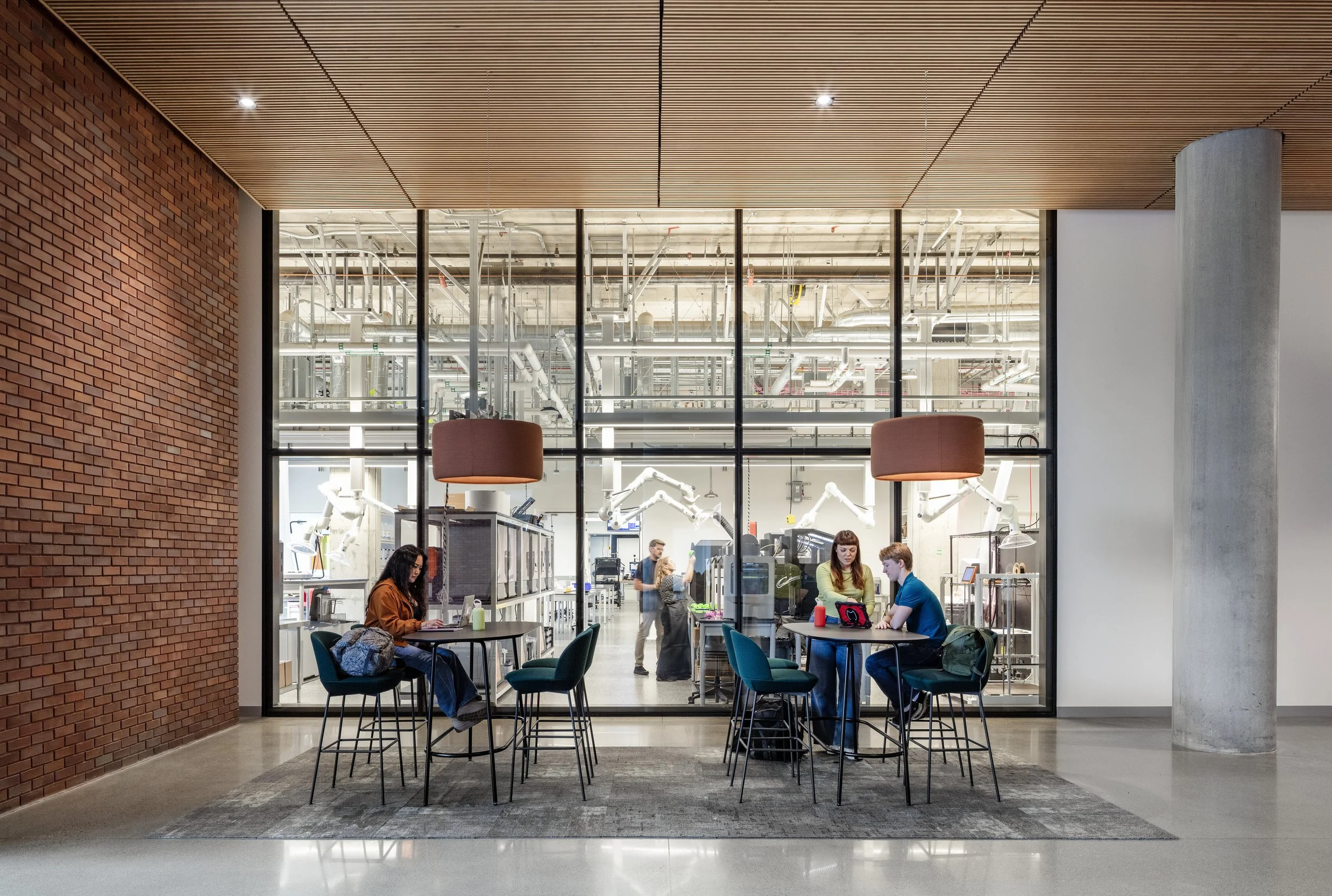
Aggie Square reflects a shift in research environment delivery, combining large-scale all-electric sustainable design with a deeply collaborative development model that integrates university, developer, and research needs into a hybrid innovation ecosystem. Image: Courtesy of ZGF
Aggie Square reflects a broader shift in how research environments are planned and delivered. As an all-electric facility at this scale, it also represents a significant step forward in sustainable lab design.
Equally important is its collaborative delivery model. By emphasizing a shared, collaborative approach on the client side, the project ensures that the university is fully integrated into the development rather than functioning as a separate entity.
As Pajkic summarizes, the project’s success lies in its collaborative nature: “How do we create something that works for the developer, but also works for the researchers coming from that more academic side of things? So in that way, it's kind of an interesting hybrid of the two,”
Aggie Square ultimately serves as a compelling example of how architecture can move beyond housing research to actively enabling it—creating a platform where science, industry, and community intersect to drive innovation forward.