
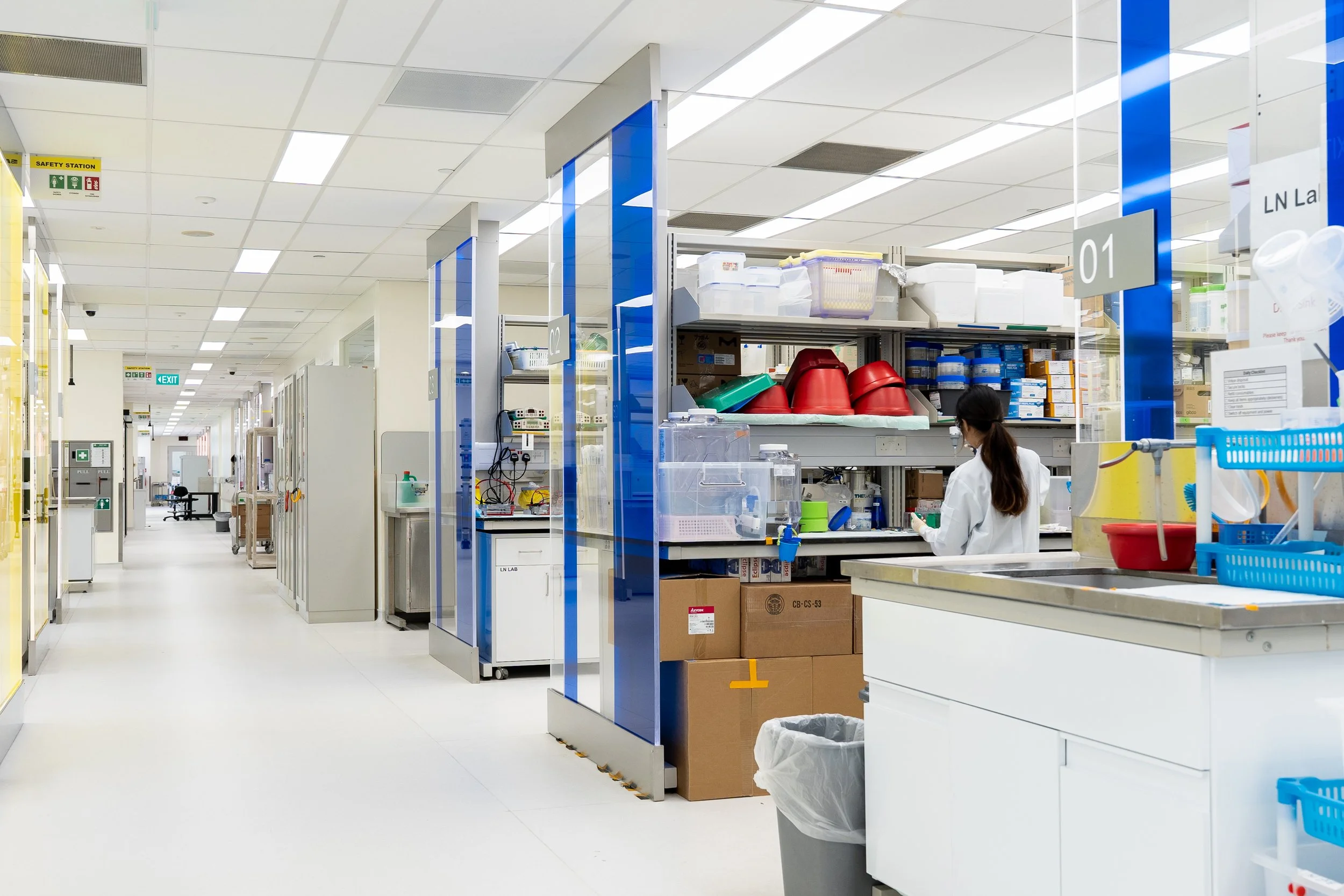
A*STAR IDL main lab thoroughfare with a few open lab zones. Each bench island is numbered to aid in easy assignment and coordination of deliveries and tasks. Image: Reza Muhammad Alfaiz
Infectious disease research facilities must meet some of the most demanding requirements in laboratory design. Biosafety, operational efficiency, and environmental control are nonnegotiable—but researchers also spend long hours in these environments, making comfort, clarity, and usability equally important. The renovation of the A*STAR Infectious Disease Labs in Singapore demonstrates how interior design can play a central role in balancing these priorities while transforming an existing facility into a modern research hub.
Located at 8A Biomedical Grove within the Immunos research complex, the 32,292-sf facility underwent a comprehensive renovation completed in 2024. The project consolidates previously scattered laboratories into a single integrated environment supporting research on infectious diseases, including SARS-CoV-2 vaccine development, vector-borne disease studies, and advanced imaging. Beyond infrastructure upgrades, the design team—led by HKS with FOMA Architects as architect of record—focused heavily on interior planning strategies that would improve navigation, safety awareness, and day-to-day user experience.
A*STAR Infectious Disease Labs was selected by the 2026 Design Excellence Awards judges for the Excellence in Interior Design prize. HKS Asia Pacific Design Consulting Pte. Ltd, which served as lab consultant, submitted the entry to the competition. The project team also included FOMA Architects LLP (architect of record), EWC Engineers Pte Ltd (MEP engineers), D+J Consultants Pte Ltd (QS), and General Industries (main contractor).
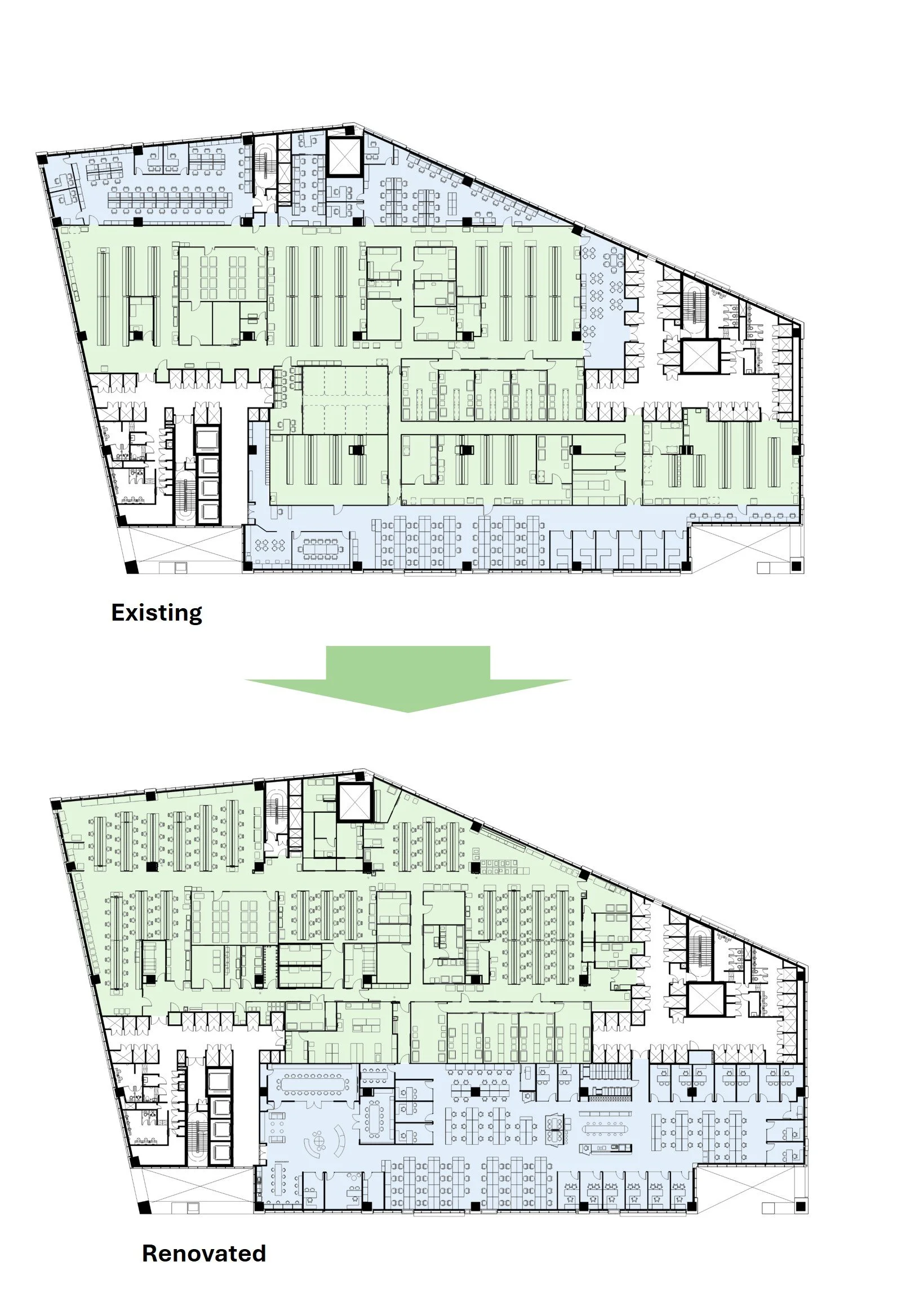
Top: Existing layout with sandwiched lab configuration. Lab located centrally caused circulation through lab spaces, resulting in inefficiency and safety concerns. Bottom: Final layout with clear lab-office separation. New layout supports clear operations and fosters collaboration while maintaining biosafety standards. Image: © HKS
Reorganizing space for safety and workflow
One of the most significant interior design challenges stemmed from the building’s original layout. The previous configuration placed the laboratory in the middle of the floor plate between two office zones.
Because the elevator core was located on the southern side, staff traveling to the northern offices had to pass through laboratory space, creating potential biosafety concerns and inefficient circulation patterns.
The renovation reorganized the floor plan to clearly separate office and laboratory functions. Offices were consolidated into a cohesive workspace near the building’s main entry, while the laboratory suite was relocated and expanded on the northern side of the floor plate. This new configuration improves containment and workflow while allowing more natural light to reach both research and office areas.
The spatial restructuring also enabled the creation of specialized research zones, including a BSL-2e laboratory for vaccine development, mosquito research facilities for vector-borne disease studies, microscopy suites, and flexible tissue culture rooms designed to support a wide range of microorganisms.
By clustering these functions within a unified research zone, the design encourages collaboration while maintaining strict biosafety boundaries.
Color, landmarks, and wayfinding in the lab
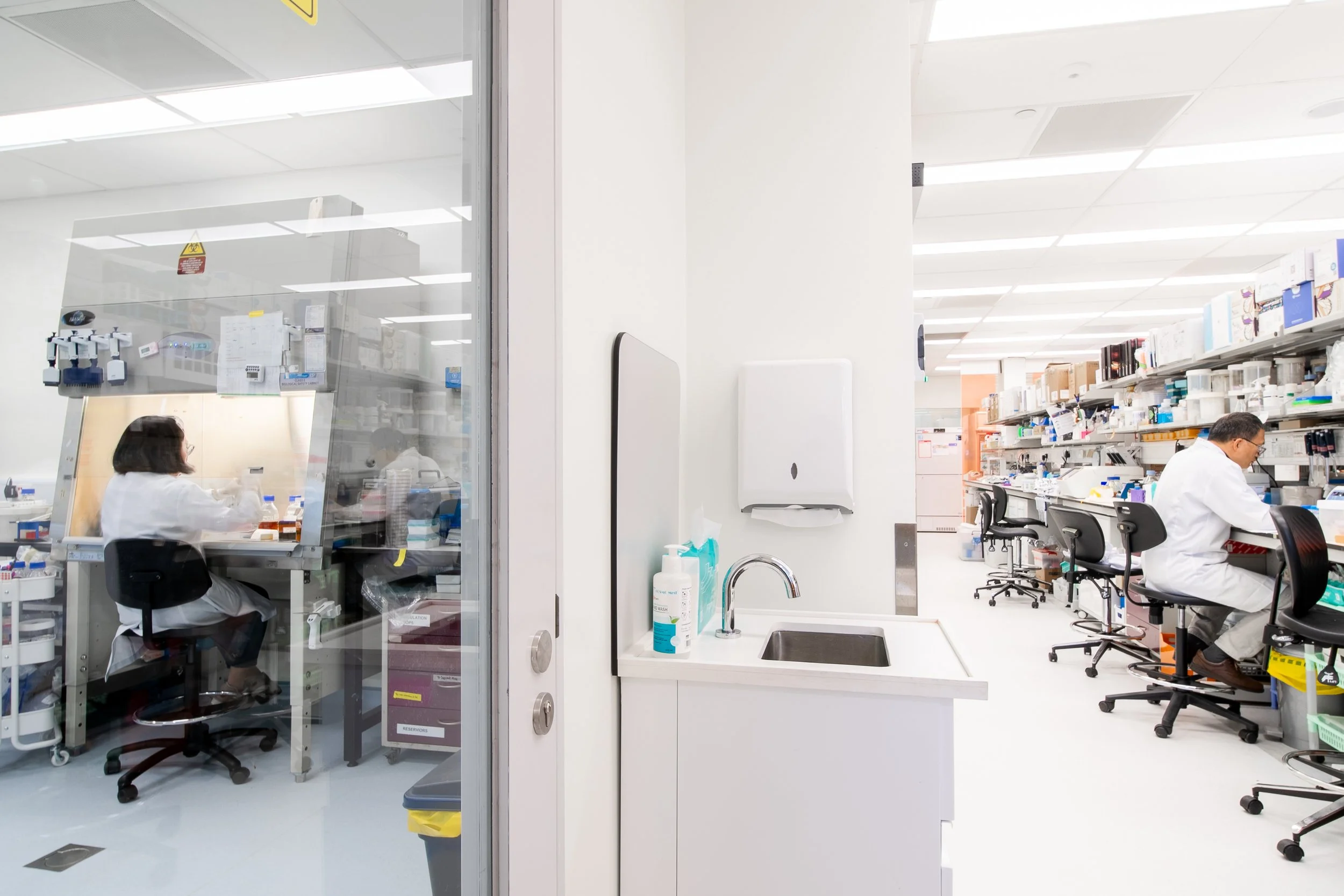
A*STAR IDL open lab and specialized lab. Image: Reza Muhammad Alfaiz
Laboratories often feature repetitive bench layouts that can make orientation difficult, particularly in large open lab environments. At A*STAR Infectious Disease Labs, the design team addressed this challenge through a carefully developed visual wayfinding strategy.
“Our approach to laboratory planning is always ‘safety first,’” says Manon Sora Koestoer, principal and studio practice leader of life science at HKS. “Therefore, when developing the wayfinding system, our key consideration was how to help users feel safer and navigate more efficiently. By guiding them along clear paths, we aim to reduce fatigue and the time spent moving through the facility, allowing researchers to focus on their work rather than struggling to find their way.”
The solution combines several visual cues. Laboratory benches are grouped into color-coded clusters, with each cluster assigned a distinct hue. At the ends of bench rows, translucent colored plexiglass panels act as visual landmarks, helping researchers quickly identify work zones. Individual bench islands are also numbered to simplify task coordination, deliveries, and workstation assignments.
“When selecting colors and patterns, we collaborated closely with users to ensure the design elements were both functional and well received,” Koestoer says. “Given that the laboratory environment can be quite busy, we determined that the signage should contrast with its surroundings and be clear, simple, and easy to read.”
Developing this strategy involved practical challenges. Because some lab zones sit adjacent to one another, the design team needed to ensure neighboring color schemes were clearly distinguishable.
“Given that some zones are adjacent to one another, our primary strategy was to ensure that the colors used for neighboring zones offered strong visual contrast,” Koestoer says. “During the design phase, we collaborated with the client to select preferred colors that also aligned with their corporate branding.”
Construction timelines also influenced design decisions. The compressed schedule prevented the use of custom-colored stickers originally envisioned for the wayfinding system, requiring the team to select materials that were immediately available.
Another technical challenge involved the construction of the colored landmark panels themselves. Each panel measures 1.5 meters wide and must be fabricated from two plexiglass sheets that may not perfectly align. To address this, the design team developed a creative solution that incorporated aluminum panels to serve as numbering signs while simultaneously clamping the plexiglass sheets together, ensuring visual continuity.
Reinforcing safety through visual cues
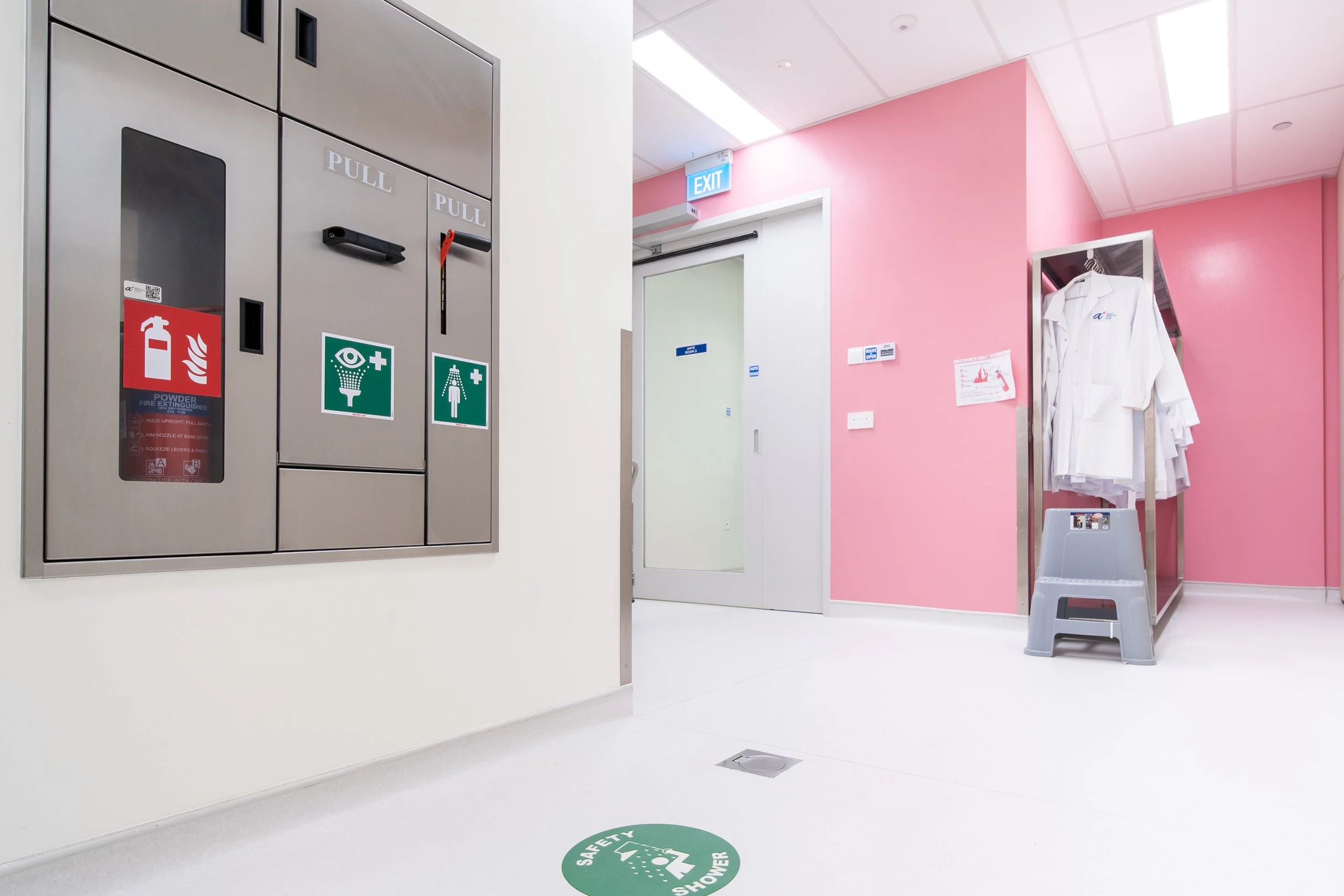
A*STAR IDL safe zone. Pink highlighted exit-linked areas designate ‘Safe Zones’ equipped with emergency safety equipment and supplies. Image: Reza Muhammad Alfaiz
In addition to improving navigation, color was used to reinforce emergency awareness within the laboratory. Designated “Safe Zones” were established at key points along corridors and exit routes. These areas consolidate essential safety equipment including emergency showers, eyewash stations, first-aid kits, fire extinguishers, and handwashing sinks into clearly recognizable locations.
When proposing a color-coded approach for these zones, however, the design team needed to carefully balance visibility with visual simplicity.
“Introducing color-coded zones was already a significant change within the users’ laboratory environment,” Koestoer says. “When we proposed adding a distinct color to indicate exit routes, the primary concern was ensuring this new element would not contribute to the visual busyness of the lab.”
The solution was a subtle pink tone used exclusively for emergency-related areas. While not required by regulatory codes, the color choice was intended to support intuitive recognition.
“It is important to note that this color differentiation is not driven by regulatory compliance,” Koestoer says. “Instead, the intent is psychological: to create a distinct mental association for the user. By embedding this visual cue, we hope to enhance spatial awareness and improve intuitive wayfinding during an emergency.”
Lighting design and acoustics
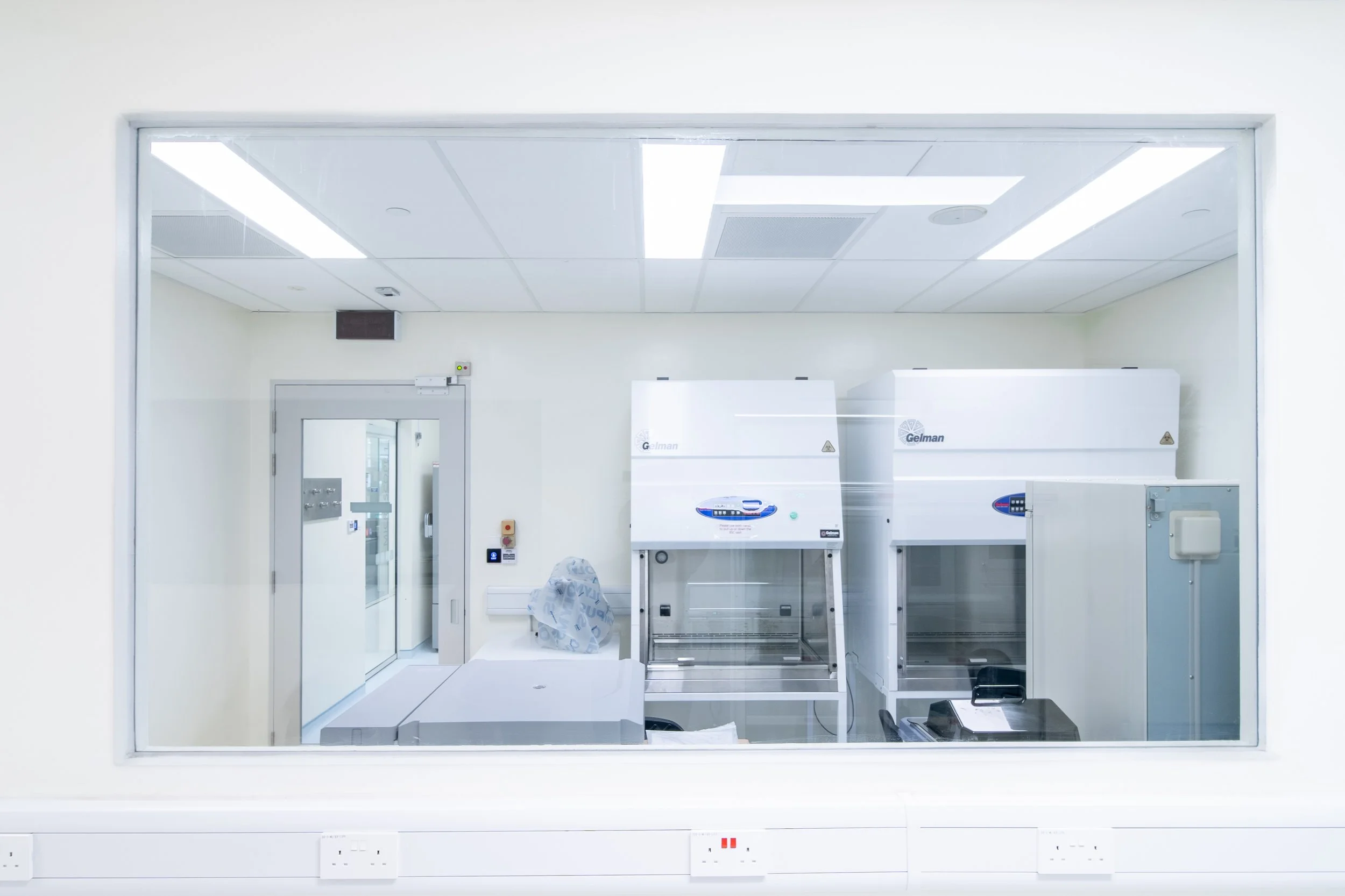
A*STAR IDL BSL2e facility. Image: Reza Muhammad Alfaiz
Lighting was another interior design feature that significantly improved the usability of the laboratory environment.
The original facility relied on fluorescent fixtures arranged parallel to lab benches, a layout that created uneven illumination and harsh shadows beneath shelving. In the renovated facility, the team introduced continuous LED strip lighting oriented perpendicular to the bench islands.
This arrangement provides more uniform lighting across work surfaces and reduces glare and shadowing—an important consideration in environments where precise visual work is common. The perpendicular orientation also adds flexibility: if bench islands are reconfigured or moved laterally, the lighting pattern remains effective without requiring fixture relocation.
Acoustic comfort is rarely associated with laboratory design, where hard, cleanable surfaces dominate. Yet noise from equipment, mechanical systems, and constant activity can contribute to fatigue during long workdays.
“In laboratory spaces, cleanable surfaces are non-negotiable,” Koestoer says. “However, one of the trickiest aspects of planning and designing a lab is often the acoustics.”
Because traditional acoustic materials are often incompatible with laboratory environments, the design team focused on strategies that reduce sound transmission rather than reverberation. Acoustic ceilings were installed where possible, and equipment zones were organized to limit noise transfer between rooms.
In office and collaboration areas, where material restrictions are less stringent, the team implemented more comprehensive acoustic improvements. Carpet flooring, acoustic wall panels, and full-height partitions replaced earlier solutions such as plexiglass dividers installed during the COVID-19 pandemic.
“In laboratories, acoustic strategies are largely limited to controlling sound transmission,” Koestoer notes. “In office environments, by contrast, we can address both sound transmission and reverberation, often with more aesthetic freedom.”
Coordinating renovation within a live facility
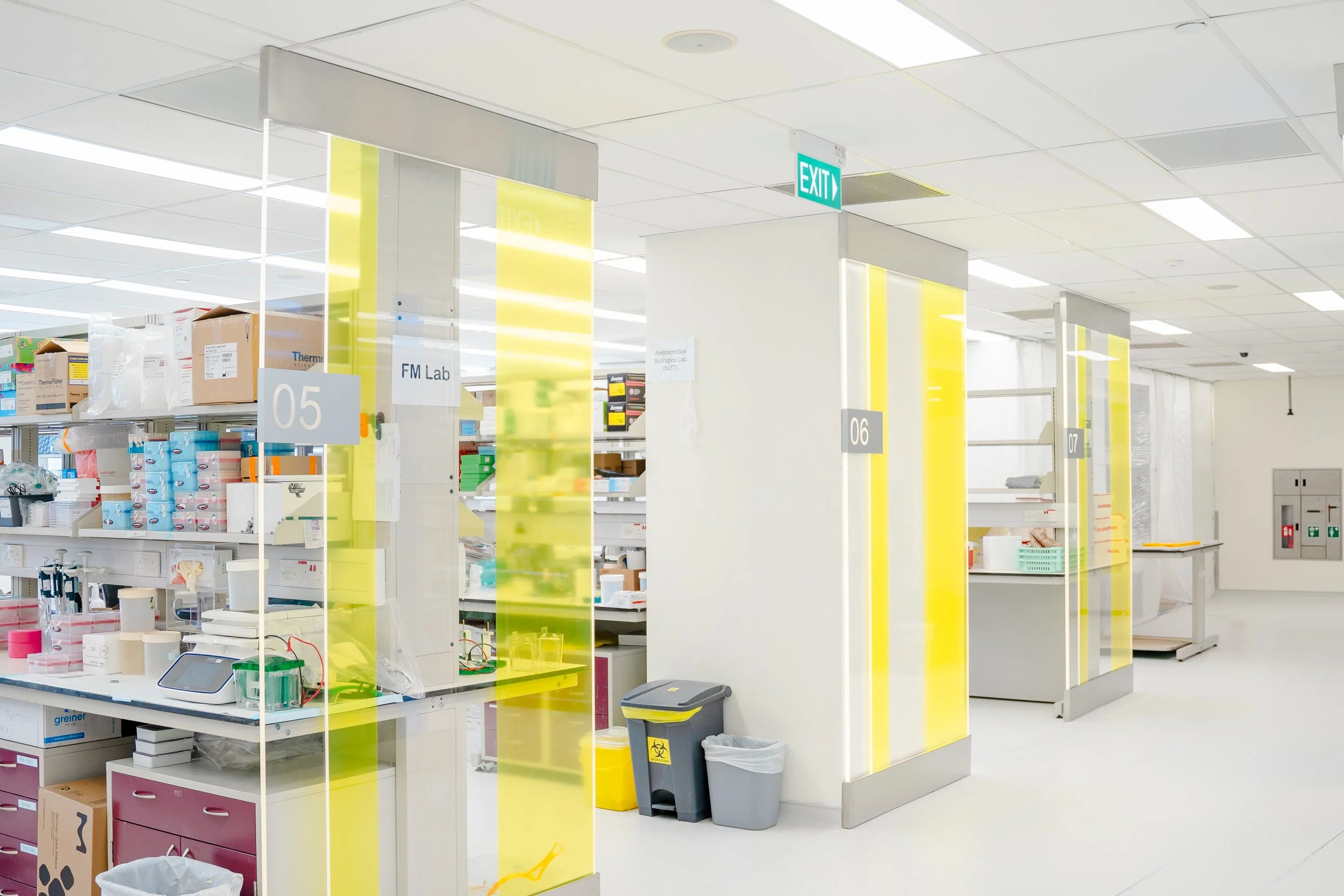
A*STAR IDL open lab zone. Image: Reza Muhammad Alfaiz
Executing these design strategies required careful coordination because the renovation occurred while research activities continued.
“The biggest challenge in renovating a live facility like this is not the technical complexity, but rather the sequencing of the work, managing overlapping dependencies between trades, and aligning the construction schedule with ongoing user operations to always ensure safety,” Koestoer says.
Design elements were installed toward the end of the construction process, once major infrastructure upgrades—including new air-handling units, a building management system, and upgraded environmental controls—were completed. Temporary signage guided staff during construction, while disruptive work was scheduled at night to minimize impact on research.
Looking back, Koestoer believes the project’s visual identity played an especially meaningful role in shaping the user experience.
“I think all of the value-added elements worked together as a whole to improve the quality of the office environment,” she says. “However, I believe the element that had the greatest impact on users, and was most unusual within the lab setting, was the color panel. It is both aesthetic and functional in improving user wellness and satisfaction.”
Post-occupancy surveys support this observation. Staff cited the clear separation between laboratory and office zones, improved lighting, and intuitive wayfinding as major improvements. Many also highlighted the increased sense of openness created by the new layout and shared social spaces such as the centralized pantry.
Together, these design interventions demonstrate how interior architecture can support both the technical demands and human realities of modern laboratory research—transforming a complex biosafety environment into a workplace that is safer, clearer, and more supportive of the scientists who rely on it.