Field of Dreams in West Texas
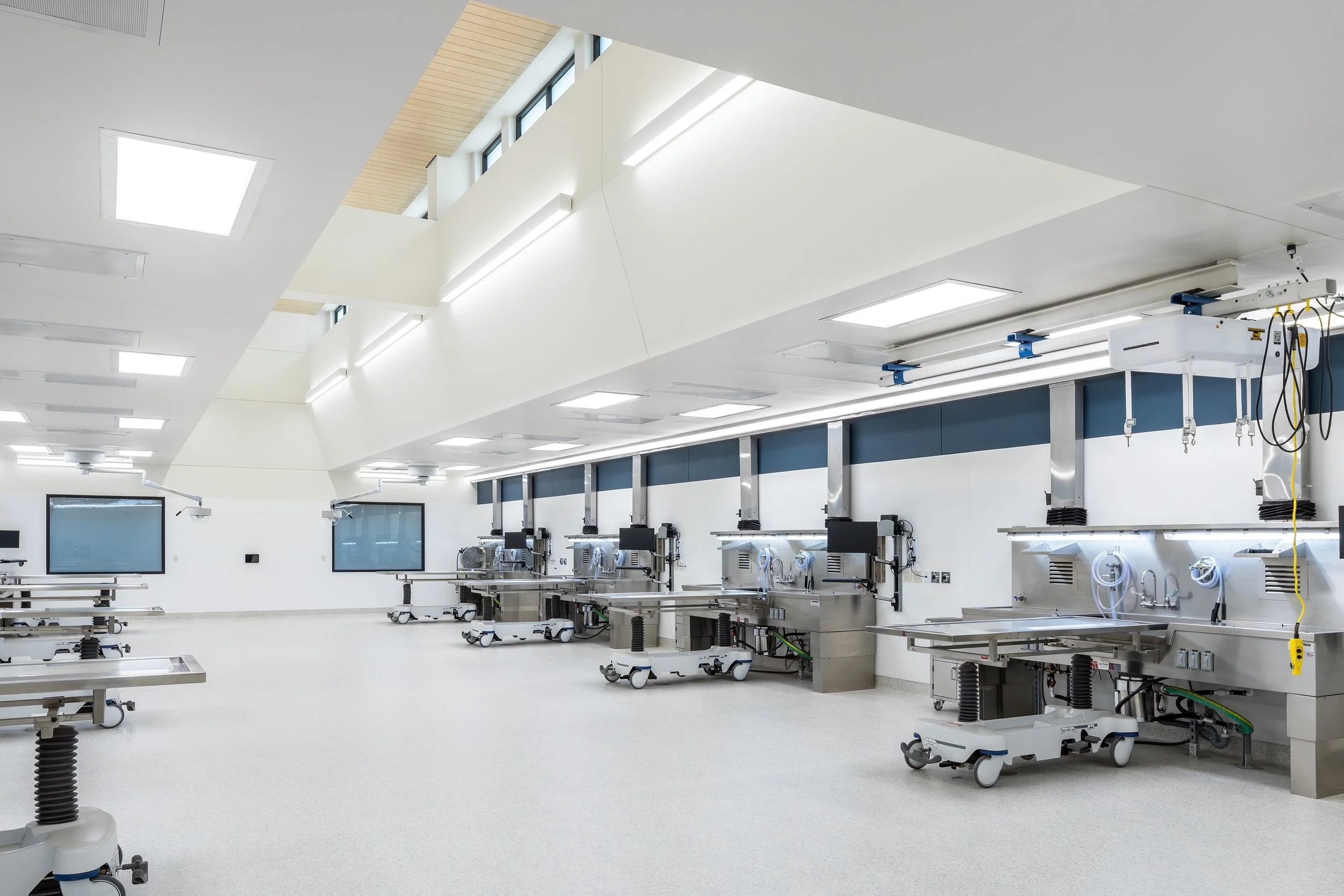
Lubbock County Medical Examiner’s Office, Autopsy Suite. Image: Dekker—Travis Lewis
There is a phrase long associated with medicine and forensic practice—Mortui vivos docent. “The dead teach the living.” Often spoken as a teaching motto, its deeper meaning is larger. It suggests that from loss can come knowledge, from inquiry can come prevention, and from understanding death can come greater care for life. Few projects embody that idea more fully than the transformation of the Lubbock County Medical Examiner’s Office.
There is another phrase that quietly shadows this story, borrowed not from medicine but from American folklore: If you build it, they will come. In West Texas, where long horizons tend to invite improbable thinking, that idea carries unusual resonance. Field of Dreams was never only about baseball. It was about faith in building something others could not yet fully see—trusting that vision, once made real, could draw people toward it. In many ways, the story of the Lubbock County Medical Examiner’s Office began with that same kind of belief.
This was not simply the replacement of an aging facility, but the pursuit of something larger—a field of possibility built around public service, forensic science, and community trust. It required believing a medicolegal institution could be more than overlooked civic infrastructure—that it could become a destination for talent, a model for peers, and a place others would come to learn from. Before others came, someone first had to believe enough to build.
At its heart, this is a story about what becomes possible when a community dares to imagine more from a place often overlooked. By seeing medicolegal infrastructure not simply as a facility but as an institution that can strengthen life, Lubbock shaped more than a building; it shaped a culture, a vision, and a legacy still unfolding.
Learning to reimagine
Years ago, lying in a hospital bed in England after a devastating athletic injury, a young Dr. Charles Addington was told by an orthopedic surgeon he would never compete again. What might have been a moment of defeat instead became a quiet turning point. If medicine could be practiced with greater humanity, he thought, perhaps he could help do it.
That instinct—to challenge accepted limitations—would later shape his leadership at the medical examiner’s office. When Dr. Addington assumed leadership, he inherited a system under strain. Years of operational instability, leadership turnover, accreditation challenges, and public scrutiny had tested confidence in the institution. Yet what followed was not simply recovery, but reimagination.
Before there was a new facility, there was a commitment to rebuild trust, stabilize operations, and restore belief in what the institution could become. The restoration of standards aligned with evolving expectations of the National Association of Medical Examiners became more than a compliance milestone; it signaled institutional renewal. In time, what had struggled to recruit became a place forensic pathologists sought out. In a profession marked by shortages, the fact that the office now maintains a waitlist speaks not only to a successful building but also to a culture people want to be part of.
What a community chose to build
For decades, the county’s conversation about its medical examiner facility centered on making do—incremental fixes, limited upgrades, deferred aspirations. But over time, the conversation shifted, not simply because a building had outlived its usefulness, but because the community began to recognize something larger: medicolegal facilities are not merely technical spaces. They are civic infrastructure, supporting justice, public health, emergency readiness, and public trust. They deserve to be imagined accordingly.
What began as a discussion of modest improvements ultimately became a $45 million investment in a long-held regional vision. With Dekker serving as architect of record and helping translate that vision into built form, the project became far more than a facility replacement. It became a declaration that this work matters, that these institutions matter, and that building for the future is itself an act of stewardship.
This was not simply a project funded by a community; it was something believed in by a community. Shared conviction shaped this as much as concrete did.
A building that teaches
One of the quiet revelations of this project is that the facility itself has become part of the teaching. Perhaps this is where Mortui vivos docent takes on expanded meaning: the building does not simply support learning through the work performed inside it; it teaches through how it was imagined.
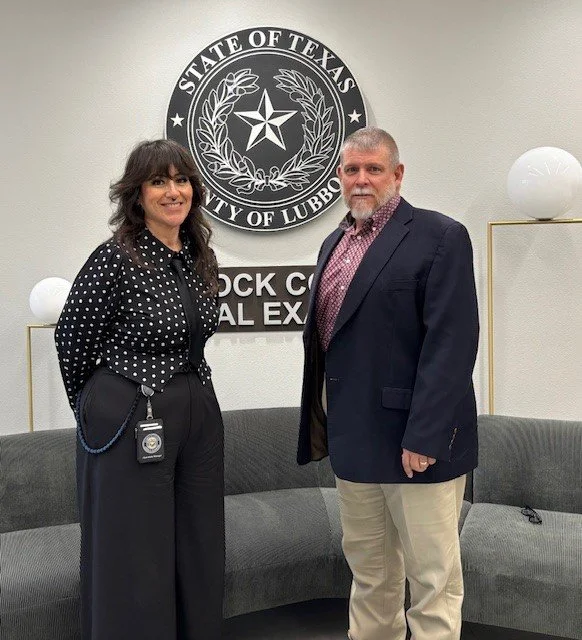
Bambi Trevino, CPM, operations manager, and Charles Addington II, DO, chief medical examiner, Lubbock County Medical Examiner’s Office
Natural daylight reaches into autopsy spaces, bringing humanity into environments too often defined only by technical necessity. Height-adjustable autopsy headwalls support ergonomics across users, reflecting a simple but profound premise: design should support people, not ask people to conform to the building. Integrated technologies strengthen documentation, evidence handling, and operational performance while creating opportunities for observation, instruction, and training that can support the next generation of forensic professionals, including students and residents from nearby Texas Tech University Health Sciences Center. Flexible planning anticipates evolving forensic practice rather than merely accommodating current demand.
What makes the facility especially compelling, however, is how deeply it responds to the realities of daily forensic work. Infrastructure decisions address challenges practitioners have long accepted as unavoidable. Hands-free foot-pedal-operated sinks support infection control and workflow efficiency. A specialized autopsy suite designed with enhanced containment principles—including a dedicated entry sequence and air-curtain separation—supports higher-risk examinations through an advanced BSL-2+ approach that reflects lessons learned about biosafety and resilience.
Even seemingly modest planning decisions reveal larger thinking. In many older facilities, transfer gurneys occupy corridors, creating congestion and quietly signaling that the building was never fully designed around the realities of use. Here, dedicated recessed alcoves remove that intrusion from circulation paths, improving safety, preserving dignity, and supporting a more orderly environment.
The same thinking extends to materials. In forensic environments, autopsy suites have traditionally defaulted to hard, monolithic wash-down surfaces to prioritize durability and infection control. Those priorities remain essential, but this project pushed beyond convention by also asking what long hours in these environments mean for staff well-being. In response, hospital-grade resilient rubber flooring was incorporated in key autopsy work areas, balancing cleanability with ergonomics, fatigue reduction, and comfort. It is a subtle but meaningful departure from standard practice—one that recognizes supporting the people doing the work is itself a design priority.
That may be one of the building’s most important lessons: excellence often resides in details easy to overlook but profoundly felt by those who use the space every day.
These are design decisions, but they are also expressions of values. They suggest that dignity matters in workflow as much as mission, that well-being can be supported through infrastructure, and that resilience is built not only through major systems but also through attention to how people move, work, and care within a place.
The building quietly asserts that infrastructure can do more than house a mission.
It can make care visible.
And perhaps that is what makes this a building that teaches.
Institutions teaching institutions
That spirit carries powerfully through the work of Bambi Trevino, whose journey from administrative assistant to operations leadership mirrors the transformation of the office itself. If Dr. Addington helped establish the vision, Trevino has helped sustain and extend it.
Her aspirations for internship pathways, workforce development, and opening the facility to peer agencies through structured tours reveal something important: this was never intended to be simply a successful facility for one jurisdiction. It was envisioned as a place others could learn from—a model not merely to visit, but one from which others carry lessons.
That may be one of the deepest extensions of Mortui vivos docent. The dead teach the living, and institutions can teach one another. Through mentorship, openness, and a willingness to share what has been learned, the office extends its impact far beyond its own walls. In that sense, the facility has become more than infrastructure. It has become a teaching instrument.
And perhaps that is one of its quietest achievements.
If the Field of Dreams idea is about building something worthy enough that people want to come, perhaps this adds another dimension: build something generous enough, and others come to learn.
What death investigation can teach about life
Dr. Addington often speaks of death investigation not only as forensic science, but as part of public health.
He speaks about the opioid crisis, suicide, and preventable deaths among aging populations from falls and injuries, not as issues adjacent to medicolegal work, but as realities illuminated through it. Those deaths do not simply demand explanation; they ask what they might teach communities about preserving life.
That question sits at the heart of Mortui vivos docent.
If the dead teach the living, then this work is not only about determining cause and manner of death. It is also about what those findings invite us to do differently—how they inform prevention, strengthen public health, and help reduce future loss.
Seen through that lens, the medical examiner's facility becomes something larger than a place where answers are found. It becomes a place where knowledge serves life.
And perhaps that is one of the most powerful lessons this work offers: death investigation, at its best, is not only about understanding loss but also about helping communities learn from it.
Field of Dreams
People often think Field of Dreams is about others coming once something is built. But perhaps it begins earlier, with believing enough to build at all.
Perhaps it is about building something worthy—worthy enough that people want to belong, worthy enough that others come to learn.
That may be what was built in Lubbock. A struggling institution became a model. A facility became a place others seek out. A civic investment became a legacy.
Build it, and they came.
But they came not because a building stood there.
They came because belief was built into it.
Building for life
What I have come to love most about this work is not the buildings themselves, but what they can hold and make possible. They can support people doing some of society’s most difficult and necessary work. They can bring dignity to places where grief, science, justice, and service meet. And, when thoughtfully shaped, they can quietly care for the people who care for others.
Projects like the Lubbock County Medical Examiner’s Office remind me that planning and design can reach far beyond infrastructure. They can help create environments that support those carrying extraordinary responsibility, ease the burdens of demanding work, and affirm the humanity of both those who serve and those they serve.
What moves me most are the moments when a project stops being about space and starts being about people—when a staff member feels supported in daily work, a family is received with dignity in a difficult moment, or a community chooses to invest in an institution that reflects its values. In those moments, architecture becomes more than problem-solving.
It becomes an act of care.
Serving this county and contributing to this project over the past four years has been among the great privileges of my professional life. To witness what can happen when leadership, staff, and public commitment unite around shared purpose—transforming something strained into something aspirational—has been deeply moving.
There is profound meaning in contributing to places where science, public health, justice, and compassion converge. To help shape environments that strengthen service, foster well-being, and quietly improve lives has been an honor.
If Mortui vivos docent teaches that the dead can guide the living, then perhaps the places we build can teach, too—by affirming dignity in moments of grief, supporting those who bear difficult responsibilities, and reminding us that even where loss is encountered, care can still be made visible.