
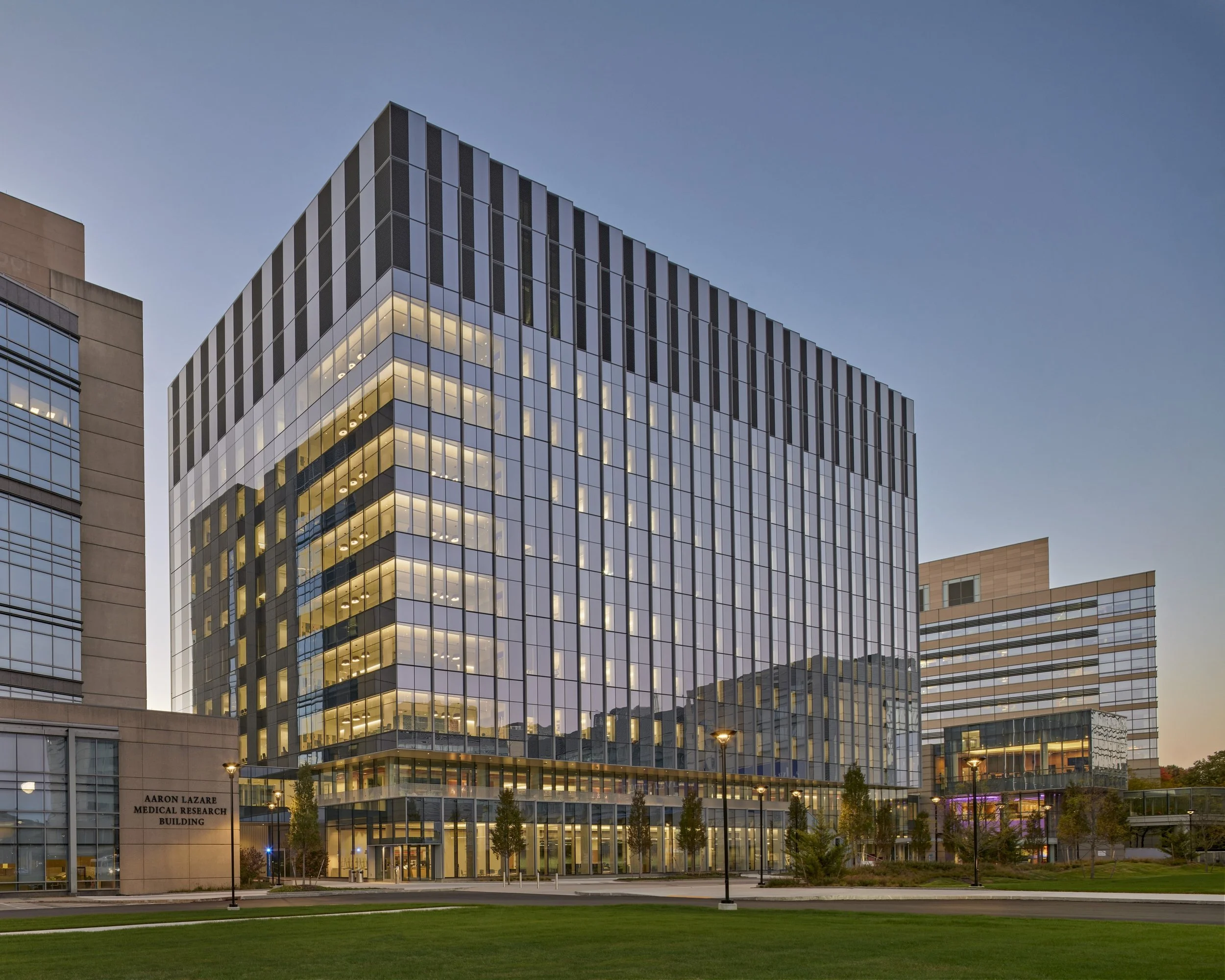
Dusk view of the Paul J. DiMare Center. Image: © Robert Benson Photography
The Paul J. DiMare Center at the University of Massachusetts Chan Medical School represents a new benchmark in laboratory design—one that balances sustainability, flexibility, and collaboration while supporting highly specialized biomedical research. The nine-story, 354,000-sf facility was designed by ZGF Architects, with Architectural Resources Cambridge as architect of record and Shawmut Design and Construction serving as general contractor. The $300 million building accommodates more than 70 principal investigators and their teams, while pursuing aggressive energy performance targets and creating a highly adaptable research environment.
Completed in June 2024, the project offers valuable lessons in aligning sustainability goals, enabling long-term flexibility, and coordinating complex infrastructure within a dense campus environment.
Aligning early around sustainability and performance
From the outset, sustainability was not treated as an optional feature but as a central design driver. According to David Hamilton, principal at ZGF Architects, energy performance goals helped shape critical decisions across multiple disciplines.
“One of the most important goals was delivering a facility with a low Energy Use Intensity (EUI) in compliance with the Massachusetts Department of Energy Resources code requirements,” Hamilton explains. “Meeting the state’s stringent energy standards established a clear performance benchmark early on and became a foundational driver for the project’s direction.”
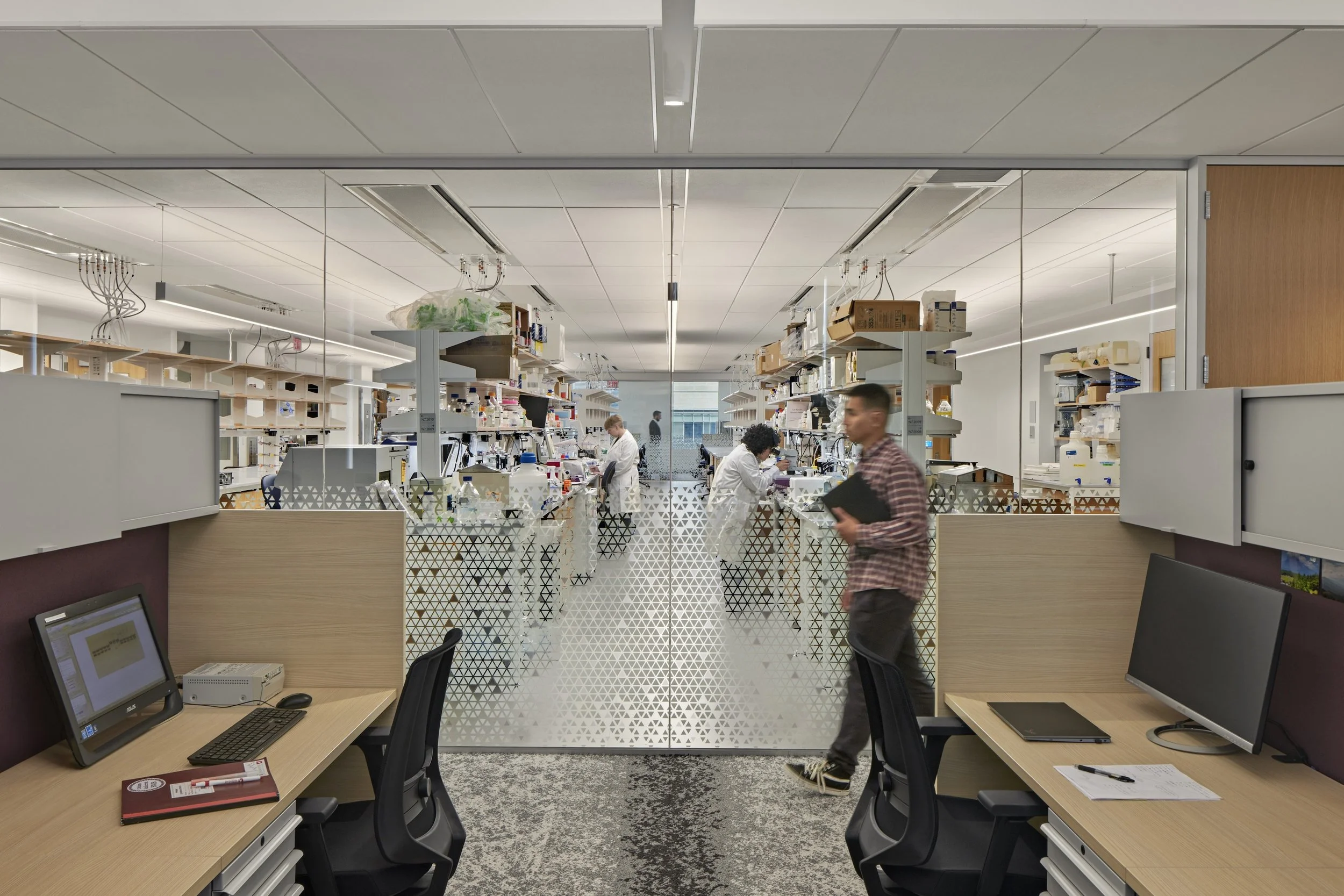
View of open workplace looking into labs. Image: © Robert Benson Photography
The building was designed to achieve Net Zero Energy Ready status and LEED Gold certification, with a target Energy Use Intensity of 130 kBtu per square foot per year, making it one of the most energy-efficient research laboratory buildings in Massachusetts. This early alignment between facilities leadership, engineers, and architects ensured sustainability was embedded into every aspect of the building’s design, from envelope performance to mechanical systems selection. Rather than treating sustainability as an add-on, the team prioritized systems that would deliver long-term operational efficiency and resilience.
Mechanical system decisions played a critical role in achieving these targets. Kurt Shank, principal at BR+A Consulting Engineers, highlights the importance of integrating efficient ventilation and heating and cooling strategies while maintaining laboratory functionality.
“On the air-side, the most significant decision was to utilize a dedicated outside air system (DOAS) to provide makeup, ventilation and dehumidification air and then leveraging local cooling/heating devices (chilled beams and fan coil units), which utilize hydronic systems, to condition the individual spaces,” Shank says. “On the hydronic side, the most significant decision was to utilize a six-pipe modular heat recovery chiller system. This system allows the building to satisfy simultaneous heating and cooling loads.”
This approach enables precise environmental control while minimizing energy consumption—an essential balance in high-performance laboratory environments.
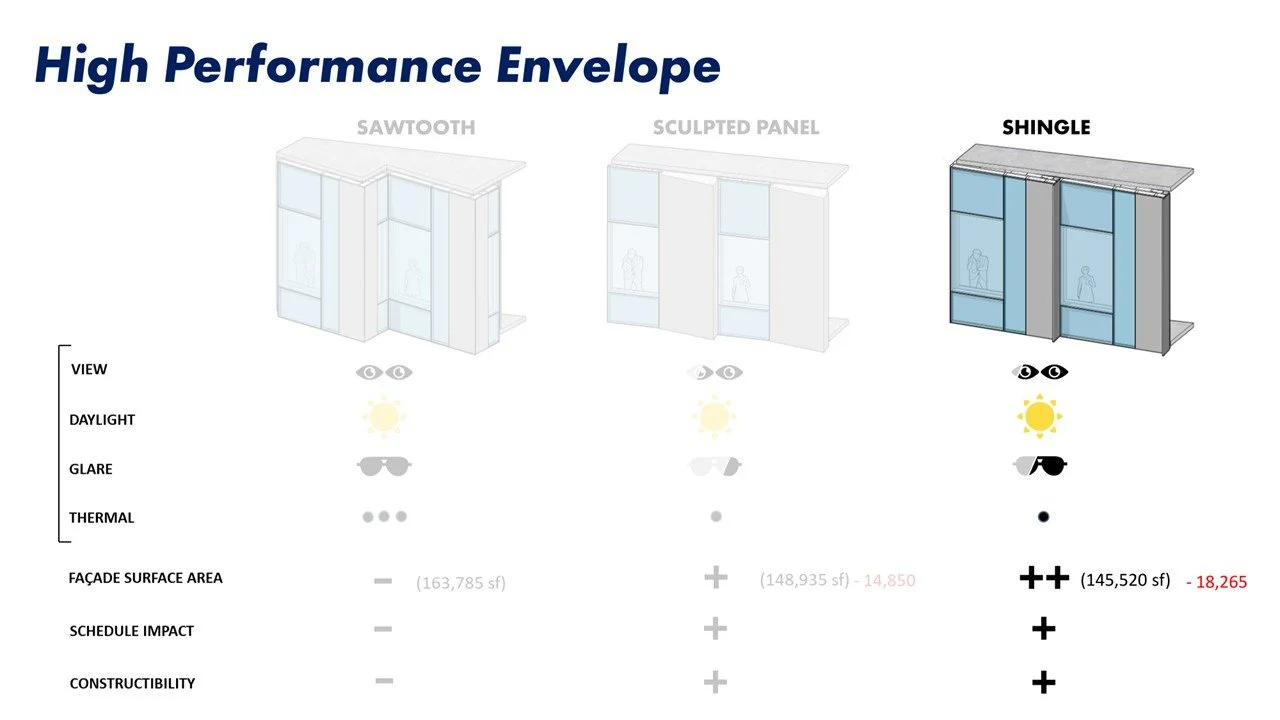
Diagram depicting the envelope study. Image: © ZGF
A hybrid geothermal system provides a significant portion of the building’s heating and cooling, reducing greenhouse gas emissions by 42 percent compared to conventional campus utility systems. The system includes 75 boreholes drilled 500 feet into bedrock beneath the campus quad, allowing the building to extract heat from the ground in winter and reject heat back into the ground in summer.
The building envelope also contributes significantly to energy efficiency. Triple glazing and an airtight façade outperform Massachusetts thermal code requirements by 22 percent, reducing heating loads and eliminating the need for perimeter heating. Together, these strategies demonstrate how mechanical systems and envelope performance must be integrated holistically to achieve meaningful energy savings in laboratory facilities.
Designing flexible laboratory infrastructure
Flexibility was another key priority, ensuring the facility can accommodate evolving research programs over time. The design team implemented modular planning strategies and standardized infrastructure to allow labs to adapt without requiring major renovation.
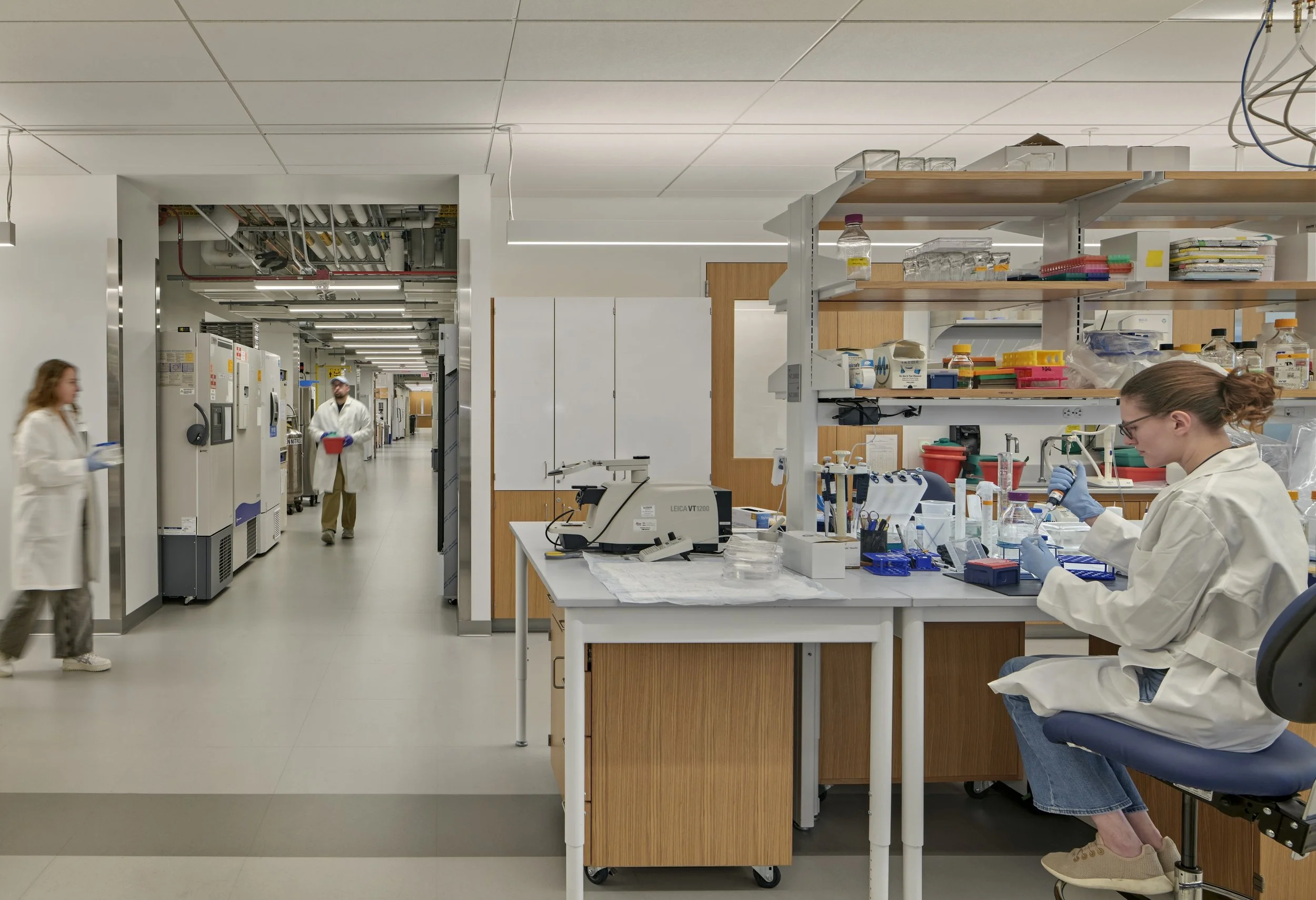
Tissue culture lab. Image: © Robert Benson Photography
“Balancing highly specialized research requirements with long-term flexibility was a central priority for the team,” Hamilton says. “The UMass facilities group strongly advocated for a modular planning strategy that would allow the laboratories to evolve alongside changing research programs.”
To support this adaptability, the building includes standardized laboratory modules and mechanical systems with additional capacity. This foresight enables future research programs to be integrated with minimal disruption.
“Another strategy was establishing consistent and standardized infrastructure systems throughout the building,” Hamilton adds. “The team also designed additional capacity into the MEP systems to accommodate future equipment loads, ventilation demands, or programmatic changes.”
For lab planners, this underscores the importance of designing infrastructure not just for current needs, but for anticipated growth and technological change.
Supporting collaboration through open lab neighborhoods
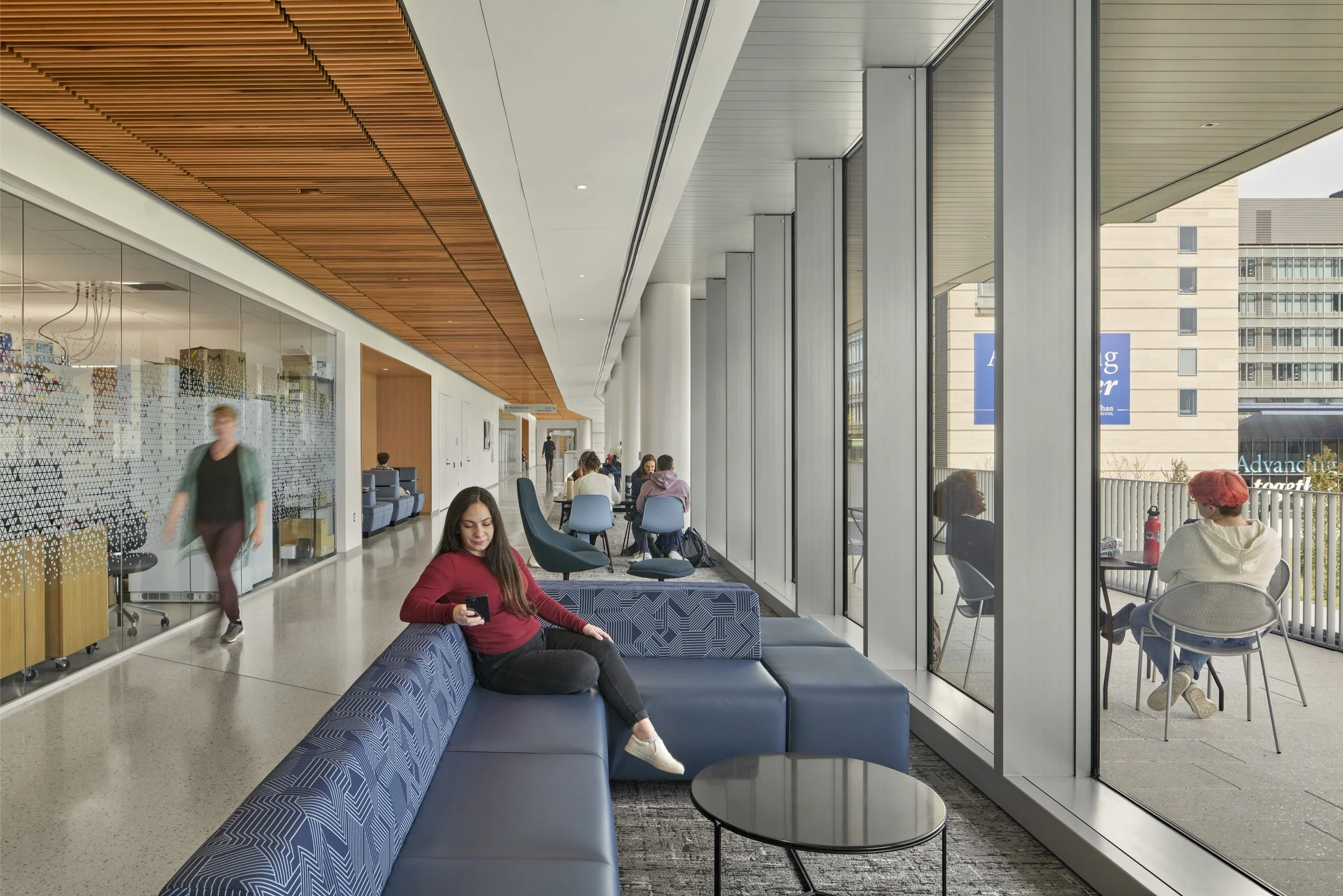
Level 2 Interior collab area. Image: © Robert Benson Photography
The building’s research floors are organized into open laboratory “neighborhoods,” designed to encourage collaboration while maintaining functional efficiency and safety. Laboratory benches are grouped into shared research zones, with adjacent write-up areas and collaboration spaces.
“The spatial plan organizes labs into distinct neighborhood groups, creating identifiable zones within the larger floor plate and offering more opportunities for collaboration,” Hamilton explains. “By locating office write-up areas immediately outside the labs, the design intentionally removes the traditional linear separation between offices and laboratory benches, fostering closer day-to-day interaction.”
This layout improves visibility, communication, and workflow efficiency, while supporting interdisciplinary collaboration.
Extensive interior glazing further enhances transparency, allowing daylight to penetrate deep into laboratory spaces while maintaining visual connectivity between research and write-up areas.
Active engagement with researchers, lab managers, and facilities stakeholders was essential to refining the design and ensuring it met user needs. The design team conducted multiple rounds of workshops to gather input and validate decisions.
“A robust data-gathering process was established to guide programming during the design stages,” Hamilton says. “This included multiple rounds of workshops where UMass stakeholders provided input, clarified project goals and space requirements, and reviewed evolving layouts with real-time feedback—ensuring the design optimized immediate needs while preserving long-term flexibility.”
This iterative engagement process helped build user buy-in and improved the overall functionality of the facility.
Constructing the DiMare Center within a dense, active campus presented significant logistical challenges. The project site required demolition of an existing parking garage, and construction activities had to minimize disruption to ongoing campus operations.
“Building within a dense, active campus presented several significant site and construction challenges, beginning with the demolition of an existing parking garage to make way for the new facility,” Hamilton says.
To mitigate disruption and control costs, the team used phased construction logistics, off-site storage, and careful coordination with campus stakeholders.
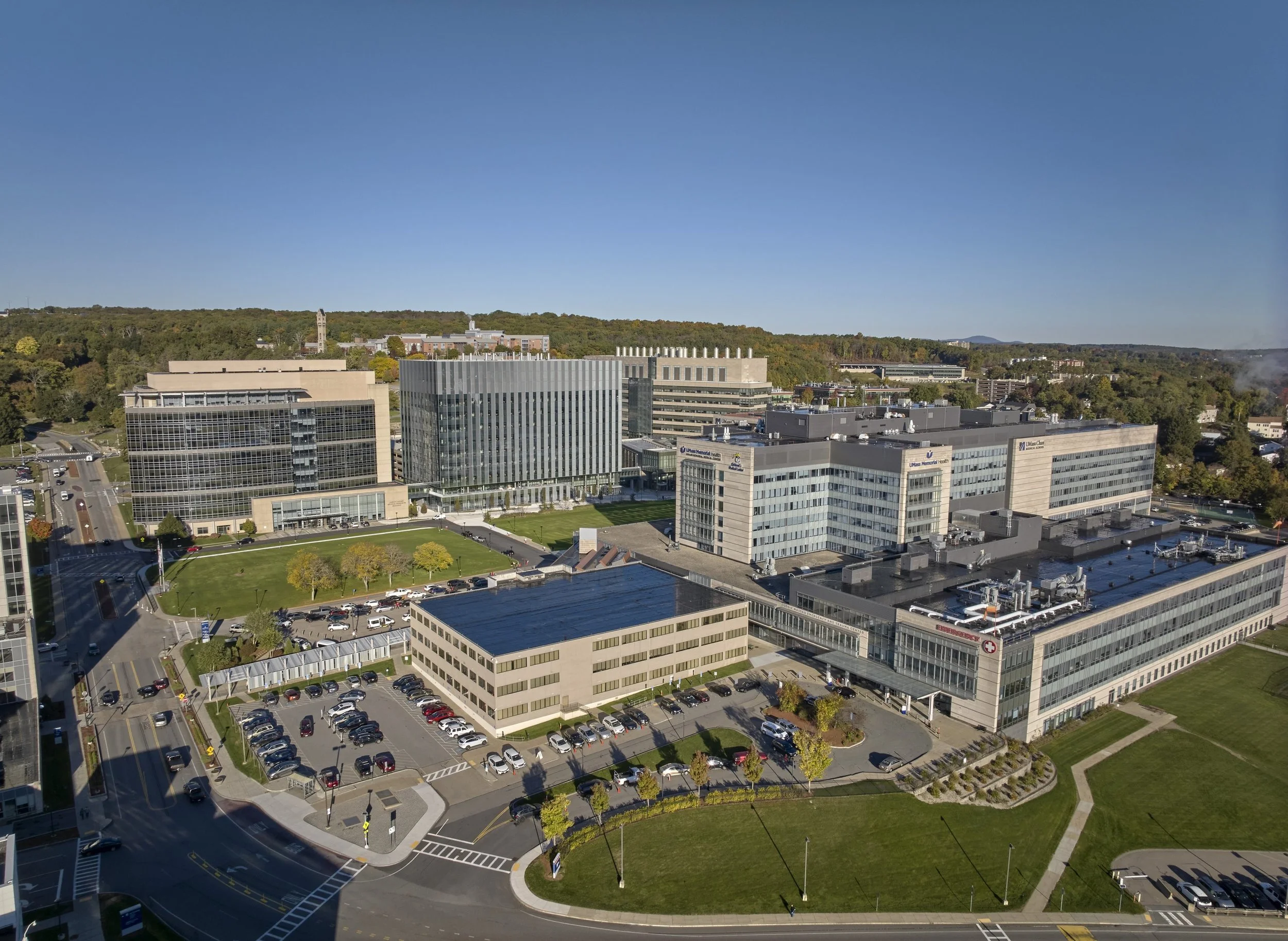
Campus view. Image: © Robert Benson Photography
Rather than selecting a new site, the project repurposed underutilized campus space, demonstrating how adaptive site planning can maximize land use efficiency while minimizing environmental impact.
Creating a connected and collaborative campus hub
Beyond its laboratory functions, the DiMare Center serves as a central hub that connects multiple campus buildings through pedestrian bridges and shared public spaces. The ground and second floors feature cafés, collaboration areas, meeting rooms, and outdoor terraces that encourage interaction among researchers.
These spaces foster both planned and spontaneous collaboration—an increasingly important aspect of modern laboratory design.
The Paul J. DiMare Center offers several key lessons for laboratory planners, architects, and facility stakeholders:
Align sustainability goals early. Establish clear performance targets at the outset to guide design decisions across disciplines.
Design flexible infrastructure. Modular layouts and scalable mechanical systems enable long-term adaptability.
Integrate sustainability holistically. Mechanical systems, envelope design, and geothermal energy must work together to achieve energy efficiency.
Engage end users continuously. Early and ongoing stakeholder involvement improves functionality and user satisfaction.
Plan proactively for site constraints. Strategic reuse of existing sites can reduce costs and minimize disruption.
By combining sustainability, flexibility, and user-centered design, the DiMare Center demonstrates how laboratory facilities can support cutting-edge research while achieving ambitious environmental and operational goals.