
Peer Review as Risk Management in Lab Renovations
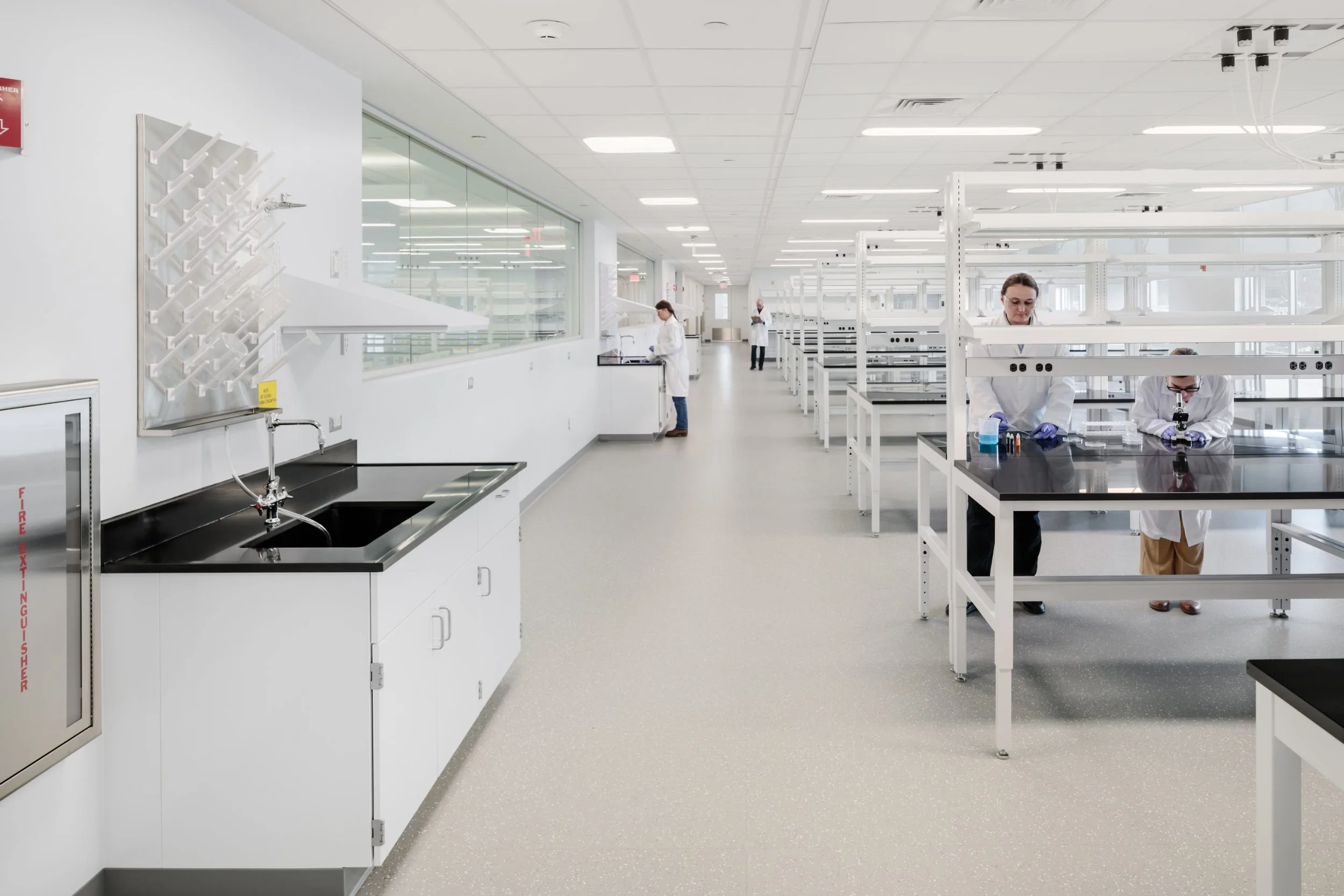
Peer review played a critical role in transforming Shannon Life Sciences’ renovation into a flexible, multi-tenant laboratory facility by identifying hidden infrastructure and design risks early, helping prevent costly changes while aligning the building with modern research requirements. Image: Roberto Farren Photography
In laboratory renovations, particularly those involving aging buildings, risk rarely announces itself clearly. It hides in undersized shafts, misaligned adjacencies, outdated mechanical systems, and well-intentioned overdesign. For lab design/build teams and facility stakeholders, peer review has emerged as one of the most effective tools for identifying and mitigating these risks before they become costly change orders or operational liabilities.
The recently completed renovation for Shannon Life Sciences in Watertown, MA offers a clear illustration of how peer review functions as structured risk management. Construction is now complete on the 70,000-sf, multi-tenant life science project at Arsenal and Elm Streets, where Ware Malcomb provided peer review and owner’s representative services. The project repositioned a three-story building with an occupiable roof and basement parking into a flexible life science asset designed to attract and support emerging research tenants.
Peer review as objective risk testing
According to Cameron Trefry, regional vice president at Ware Malcomb, “Peer review serves as a critical risk management tool in laboratory renovations, especially in older buildings, by objectively testing the owner’s requirements against the building’s existing infrastructure.”
For those looking to apply these principles in practice, the hands-on workshop “Minimizing Risk: Liability-Aware Lab Design Strategies” at the 2026 Lab Design Conference will explore how tools such as peer review, early infrastructure validation, and liability-conscious planning can help teams proactively identify risks and deliver safer, more resilient laboratory environments. Spaces are limited, so reserve your ticket today!
In adaptive reuse projects, legacy systems often present the greatest unknown. Existing HVAC, electrical distribution, structural capacity, and emergency power systems may not align with modern lab performance expectations.
“Often, legacy systems lack the capacity to support modern research demands, and a third-party reviewer can identify gaps the design team may overlook,” says Alicia Pandimos Maurer, practice leader/director science and technology at Ware Malcomb. Because peer reviewers operate with critical distance, they are positioned to challenge assumptions without being constrained by authorship or design defensiveness.
As Pandimos Maurer explains, “Because the peer reviewer combines critical distance with strong design advocacy, they can focus solely on whether the project truly delivers what the owner needs, reducing costly oversights and misalignment.”
In risk management terms, peer review introduces structured redundancy. It is not about mistrust of the design team; it is about ensuring alignment between owner intent, infrastructure reality, code compliance, and long-term operational performance.
Identifying hidden safety and infrastructure gaps

Independent peer reviewers bring objective perspective to laboratory renovations, identifying infrastructure gaps and challenging assumptions to ensure alignment with owner goals, code requirements, and long-term operational performance while reducing the risk of costly oversights. Image: Roberto Farren Photography
Laboratory renovations frequently involve subtle safety and compliance vulnerabilities. During peer review, common discoveries include issues within chemical control areas, misinterpretations of code allowances, and mechanical systems that are either oversized or undersized for intended use.
“Peer reviews commonly uncover safety gaps in chemical control areas, ensuring compliance with NFPA code requirements that might otherwise be overlooked,” says Trefry. In multi-tenant environments, these issues are amplified, as control areas and hazardous material limits must be evaluated not only within suites but across entire floors and building zones.
Infrastructure mismatches are another recurring theme. Mechanical systems may be designed for generic office loads while tenants anticipate high air change rates, fume hood density, or BSL-2 support spaces. Conversely, overdesign can inflate capital and operating costs without delivering proportional benefit. Peer review flags both extremes, protecting budgets while preserving performance.
Operational inefficiencies also surface. Poor adjacencies can disrupt workflow; improperly integrated equipment may limit monitoring through the building management system (BMS); and utility routing may constrain future expansion. Identifying these risks early allows the team to recalibrate before drawings are finalized and construction dollars are committed.
Case study: early intervention at Shannon Life Sciences

Early peer review during due diligence and design development enabled Shannon Life Sciences to identify HVAC and power limitations, optimize layouts with a flexible modular grid, and refine chemical control strategies—reducing risk, avoiding costly retrofits, and supporting long-term tenant adaptability. Image: Roberto Farren Photography
Peer review proved especially valuable during due diligence and early design development. Jenna Hester, operations manager at Shannon Life Sciences, tells Lab Design News, “One of the most meaningful examples of peer review mitigating risk occurred during our pre-acquisition due diligence while the building was still in a core and shell condition. As part of a third-party building assessment, it was identified that the existing HVAC capacity and emergency power infrastructure would not fully support life sciences use at the level we envisioned.”
Rather than deferring these upgrades, the team addressed them proactively. “Addressing these items early ensured system reliability and avoided costly modifications later,” Hester says. This sequence—identify risk before acquisition, validate through peer review, and integrate upgrades into early design—represents textbook risk mitigation.
Peer review also influenced architectural planning, Hester says. “During design development, layouts were reworked onto a standardized grid across the floor plate, increasing flexibility for future suite combinations and reconfiguration.”
This shift to a modular grid, paired with movable benches and ceiling utility panels for power and lab gas, reduced long-term leasing risk. Flexible infrastructure allows tenants to evolve without requiring structural rework or extended downtime.
Hester adds, “The team also refined control area strategies to help maximize compliant chemical storage while maintaining strict adherence to life safety codes.” In a multi-tenant lab building, chemical storage strategy is not merely a compliance issue; it is a leasing and operational continuity issue.
Influencing decision-making and preventing scope drift
Peer review also serves as a stabilizing force in project governance. “An independent peer reviewer influences decision-making by continually grounding the team in the owner’s original mission and scope, preventing the project from drifting over time,” says Pandimos Maurer. In complex lab projects, scope creep can occur gradually—driven by user requests, evolving standards, or design refinements that accumulate cost without clear alignment to owner priorities.
Peer reviewers provide objective feedback, she says, “flag[ging] both gaps and overdesign, ensuring the team isn’t adding unnecessary features or costs beyond what the owner agreed to fund.” Because they are not defending their own drawings or seeking user approval, they can recalibrate discussions around performance requirements, budget discipline, and long-term goals.
Designing for future flexibility

Peer review helps future-proof laboratory renovations by validating expansion assumptions and embedding infrastructure capacity early, enabling facilities to adapt to evolving research needs without disruptive retrofits or impacts to neighboring tenants. Image: Roberto Farren Photography
Perhaps the most strategic role of peer review lies in safeguarding future adaptability. Laboratory tenants evolve; research programs expand; utility loads shift. Renovations that fail to anticipate growth often require invasive retrofits.
Trefry says that peer review helps validate expansion assumptions and ensure that infrastructure pathways are embedded early. This may involve reserving shaft space, installing conduit for future systems, or planning pads for generators that are not immediately installed. By embedding these provisions, facilities can adapt without disruptive and costly retrofits.
In multi-tenant buildings, the stakes are even higher. Trefry notes that peer review adds long-term value “by ensuring infrastructure is designed so upgrades or renovations in one suite don’t disrupt the entire building.” Systems can be expanded (such as adding a future generator) without shutting down neighboring tenants. This foresight protects operational continuity, enhances tenant satisfaction, and strengthens long-term leasing appeal.
When should peer review begin? “The earlier the better,” says Pandimos Maurer.
Risk compounds over time. Early peer review (ideally during due diligence or conceptual planning) offers the greatest leverage, when design decisions remain fluid and correction costs are minimal.
For those involved in laboratory renovations, peer review is more than an added step—it is a practical risk management strategy. By challenging assumptions and validating decisions early, it helps safeguard safety and compliance, maintain budget discipline, and ensure that renovated spaces perform effectively today while remaining adaptable for future needs.