
Explosion-Proof Lab Design: Electrical Classifications for Pilot Plants
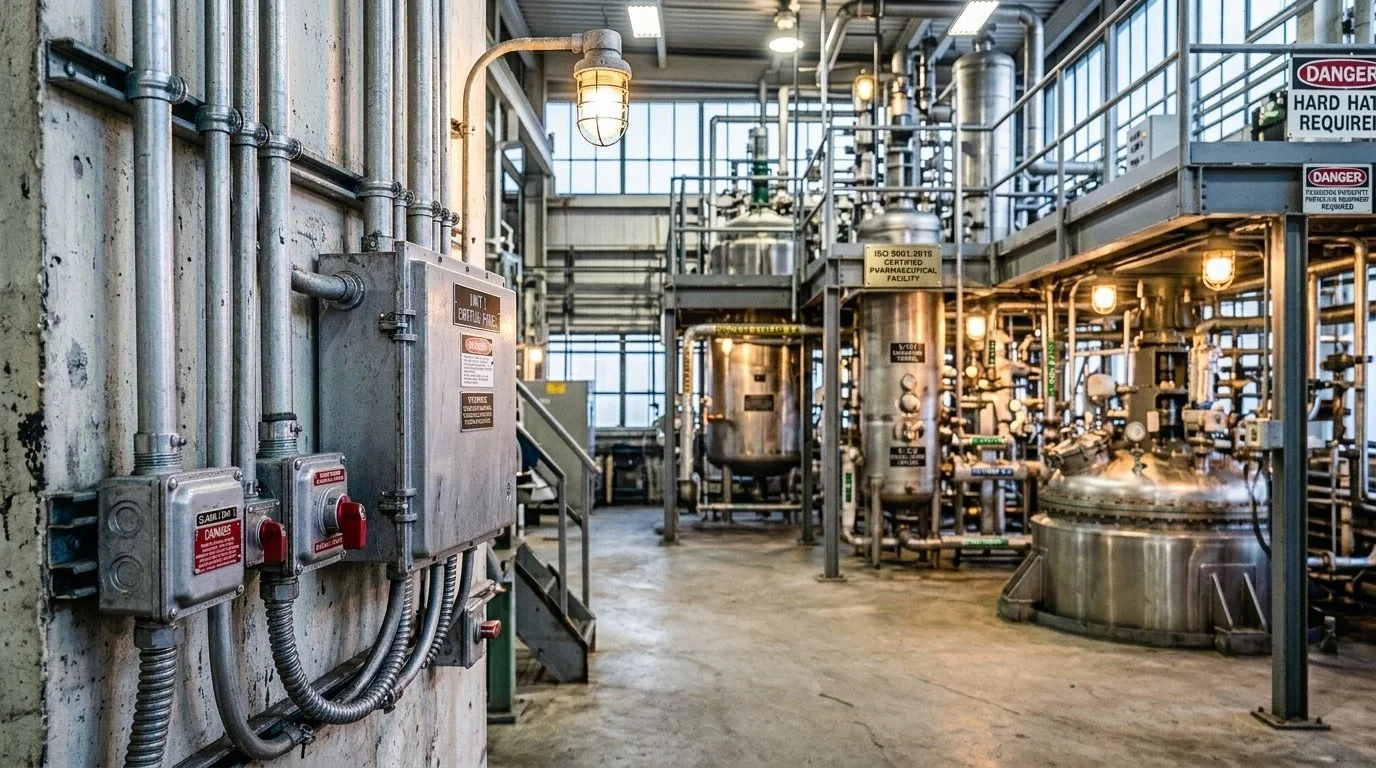
When your process scales up from milliliters to gallons, a standard laboratory outlet can become a detonator. | Credit: Flow (2026)
50 liters of acetone changes the rules. When does your lab need to become "explosion-proof"?
A standard research lab and a pilot plant may look similar on a floor plan — fume hoods, bench space, utility runs, processing equipment. But the moment a chemist scales a solvent-heavy reaction from a 500-milliliter flask to a 50-liter jacketed reactor, the rules governing the building's electrical infrastructure change fundamentally and permanently.
At bench scale, a flammable vapor event from a tipped solvent bottle is a serious hazard, but a contained one. At pilot scale, a 55-gallon drum of hexane, a 200-liter distillation column running under vacuum, or a continuous extraction train handling dichloromethane around the clock represents an entirely different order of magnitude. The question is no longer whether a spark could ignite a vapor — it's whether the entire electrical system has been engineered to ensure that no spark can occur in the first place.
This is the domain of explosion-proof lab design: a specialized field of electrical engineering, architectural planning, and code compliance that governs how facilities are designed, wired, and built when bulk flammable solvents are present.
What Is Explosion-Proof Lab Design?
"Explosion-proof" is often misunderstood as a description of a building or room that can withstand a blast. In the context of electrical engineering and lab design, it means something more precise: a system of equipment, wiring methods, and installation practices specifically designed to prevent an electrical component from becoming an ignition source in an atmosphere that may contain flammable vapors.
The term is defined and regulated primarily through two overlapping code frameworks:
NFPA 70 (National Electrical Code), particularly Articles 500–504, which establish hazardous location classification and installation requirements
NFPA 45, which governs fire protection for laboratories using chemicals and defines flammable liquid quantity limits
Together, these standards determine when a space must be electrically classified, what that classification means, and how every outlet, panel, conduit run, and light fixture within it must be designed.
Key Definitions
Understanding explosion-proof lab design requires fluency in a specific vocabulary. These are the terms every lab architect, engineer, and facility manager should know.
Hazardous (Classified) Location: Defined by NEC Article 500 as any area where fire or explosion hazards may exist due to flammable gases or vapors, flammable liquids, combustible dust, or ignitable fibers. Not every lab qualifies — the classification is triggered by the quantity and nature of materials handled.
Class I Location: An area where flammable gases or vapors may be present in sufficient quantities to produce explosive or ignitable mixtures. Essentially every pilot plant handling organic solvents at scale falls into this category.
Division 1: The higher-hazard tier. Flammable concentrations are expected to be present during normal operations — for example, the vapor space directly above an open solvent drum, or the area immediately surrounding an open distillation column.
Division 2: The more common classification for pilot plant processing floors. Flammable concentrations are only present under abnormal conditions — a seal failure, a spill, a vessel overpressure event. Under normal operation, the space is presumed safe due to adequate ventilation and closed-process handling. The key insight: most well-ventilated pilot plant processing floors handling solvents in closed systems qualify as Class I, Division 2 (C1D2), rather than the more stringent Division 1.
NEC Group Classification Beyond Class and Division, the NEC assigns materials to Groups based on their explosion characteristics. For common laboratory solvents:
Group C — ethyl ether, THF, ethylene (higher explosion pressure, more restrictive)
Group D — acetone, hexane, heptane, ethanol, toluene, methanol (most common lab solvents fall here)
All electrical equipment must be rated for the specific Group present — Group D equipment cannot be used in a Group C environment.
T-Code (Temperature Code): Equipment is also rated by the maximum surface temperature it can reach during operation, which must remain below the auto-ignition temperature of the materials present. T-codes range from T1 (450°C) to T6 (85°C). Acetone, for example, has an auto-ignition temperature of 465°C, while diethyl ether ignites at just 160°C — a critical consideration when selecting T-rated equipment.
Intrinsically Safe: An alternative protection technique to explosion-proof enclosures. Intrinsically safe (IS) equipment is designed to operate with energy levels too low to ignite a flammable atmosphere under any fault condition. IS systems are often used for instrumentation and sensors in classified locations, and can significantly reduce installation complexity and cost compared to full explosion-proof conduit runs.
Lower Explosive Limit (LEL): The minimum concentration of a vapor in air required for ignition. A space is generally considered safe when vapor concentrations are maintained below 25% of the LEL through ventilation. HVAC design plays a critical role in determining whether a space can be classified as Division 2 rather than Division 1.
When Does a Lab Require Explosion-Proof Electrical Design?
This is the question most lab planners ask too late. The honest answer: it depends on what you're handling, how much of it, and whether it's in a closed or open system. But there are concrete thresholds that trigger the conversation.
The NFPA 45 Trigger
NFPA 45 classifies laboratory units into four fire hazard categories (A through D) based on the quantity of Class I flammable liquids in use and storage. Class A laboratory units — the highest hazard level, and the category that most pilot plants fall into — are subject to the most stringent requirements for electrical systems, sprinklers, and compartmentation.
Importantly, NFPA 45 limits individual containers in laboratory work areas to 20 liters (approximately 5 gallons). When a pilot plant process requires 200-liter reactor charges of acetone or hexane, those volumes move the facility well beyond standard laboratory occupancy into territory requiring a formal hazardous area classification study.
The Scale-Up Trigger
At bench scale, a few liters of solvent in a closed round-bottom flask rarely generates enough vapor to approach the LEL — especially with a properly functioning fume hood. At pilot scale, the vapor-generating surface area, the total liquid inventory, and the potential spill volume all increase dramatically. This is the core engineering judgment that separates a standard lab from one requiring C1D2 design:
Open-system solvent handling (distillation, extraction, crystallization) at volumes greater than a few liters
Bulk solvent storage and transfer within or adjacent to the processing area
Elevated operating temperatures that increase vapor pressure above ambient conditions
Continuous processes where solvent is present in the system around the clock
As discussed in our overview of designing for multimodal facilities with flammable solvent processes, once bulk flammable solvents enter the picture, the classification requirements "creep into the other design modes because it is now a site-wide issue."
The Architecture of a Classified Space: What C1D2 Design Actually Looks Like
Understanding the code requirements is only half the challenge. The other half is translating them into architectural and MEP decisions that a design team can actually build. Here is what Class I, Division 2 design means in practice.
1. Hazardous Area Classification Drawing
Before a single conduit is specified, a formal area classification drawing must be produced. This plan view identifies every room, zone, and boundary within the facility and assigns its classification — Unclassified, Division 2, or Division 1. This document becomes the foundational reference for every downstream electrical, mechanical, and architectural decision.
The classification study considers:
The identity and flash point of every solvent in use
The maximum inventory at any one time
The operating conditions (open vs. closed system, temperature, pressure)
The ventilation design and air change rates in each zone
2. Explosion-Proof Wiring Methods (NEC Article 501)
NEC Article 501 is the detailed instruction manual for Class I electrical installations. The key wiring requirements for C1D2 spaces include:
Conduit: Rigid metal conduit (RMC) or intermediate metal conduit (IMC) with threaded fittings. Electrical metallic tubing (EMT) is permitted in Division 2 but not Division 1.
Conduit seals (NEC 501.15): Sealing fittings filled with a listed chemical compound must be installed within 18 inches of every explosion-proof enclosure to prevent vapors from traveling through the conduit system from the classified area into panels, junction boxes, or unclassified spaces. The sealing compound must have a melting point of no less than 93°C, and conductor fill within the seal fitting is limited to 25% of the conduit cross-sectional area.
Boundary seals: Conduit crossing the boundary from a classified location into an unclassified space must be sealed within 10 feet of that boundary.
All equipment must be listed and labeled for the specific Class, Division, and Group present, by a Nationally Recognized Testing Laboratory (UL, FM Global, CSA, or Intertek).
3. Explosion-Proof Equipment
Every electrical component within the classified boundary must be rated for the environment. In practice, this means:
Explosion-proof luminaires — sealed light fixtures designed to contain any internal arc or spark
Explosion-proof outlets and switches — heavy, cast-metal enclosures with threaded conduit entries
Explosion-proof motor starters and VFDs — for mixers, pumps, and compressors within the classified zone
Explosion-proof junction boxes — all splices and terminations must be inside rated enclosures
Intrinsically safe instruments — pressure gauges, flow meters, and temperature sensors, with barriers installed in a non-classified control room
4. HVAC Design as a Classification Tool
One of the most powerful tools for managing electrical classification costs is ventilation. A space that maintains vapor concentrations below 25% of the LEL through continuous, validated HVAC can often be classified as Division 2 rather than Division 1, significantly reducing the cost and complexity of the electrical installation. This requires:
Continuous exhaust capable of providing at least 6 to 12 air changes per hour in processing areas
Low-level exhaust returns (within 12 inches of the floor) to capture heavier-than-air vapors from solvents like hexane or dichloromethane
Vapor detection systems tied to building alarms and HVAC controls
5. The Classified Boundary and Equipment Placement Strategy
One of the most cost-effective strategies in explosion-proof lab design is keeping as much electrical equipment outside the classified boundary as possible. The NEC itself includes an informational note recommending exactly this approach: use "ingenuity to locate as much electrical equipment as possible in an unclassified location."
In practical terms, this means:
Locating motor control centers (MCCs) and electrical panels in adjacent unclassified rooms or corridors, with conduit seals at the boundary
Using remote starters for motors located within the classified zone
Routing control wiring to a non-classified control room where possible
Specifying IS instrument loops that require only simple wiring rather than explosion-proof conduit throughout
This is a core principle of pilot plant design: the architecture must actively work to minimize the classified footprint, because every square foot of classified space carries a significant premium in material, labor, and long-term maintenance costs.
Comparing Electrical Requirements: Standard Lab vs. Class I, Division 2 Pilot Plant
Electrical Code: Standard research labs follow NEC general provisions. C1D2 pilot plants are governed by NEC Article 501 (Class I hazardous locations).
Governing Safety Standard: Standard labs comply with NFPA 45 Class C or D requirements. Pilot plants must meet NFPA 45 Class A requirements and NFPA 30 for flammable liquid handling.
Conduit Type: Standard labs use EMT or MC cable. Classified spaces require RMC or IMC with threaded fittings throughout.
Conduit Seals: Not required in standard labs. In C1D2 spaces, sealing fittings are required within 18 inches of every enclosure and at all classified/unclassified boundaries.
Outlets and Switches: Standard commercial-grade devices in research labs. Every outlet, switch, and junction box in a classified space must be explosion-proof and rated for the specific Class, Group, and T-code.
Lighting: Standard LED fixtures in research labs. Classified spaces require explosion-proof luminaires or intrinsically safe lighting systems.
Motor Starters and VFDs: Standard enclosures in research labs. All motor control equipment within the classified boundary must be explosion-proof and appropriately rated.
Instrumentation: Standard sensors and transmitters in research labs. All instruments in a classified zone must be IS-rated, with barriers installed in a non-classified control room.
Equipment Certification: General UL listing is sufficient for standard labs. Every piece of electrical equipment in a classified space must be specifically listed for the Class, Division, and Group present.
HVAC Integration: Standard lab air change rates in research labs. Classified spaces require low-level exhaust returns with continuous vapor detection at 25% LEL tied to the building automation system.
Design Documentation: Standard MEP drawings for research labs. Classified pilot plants require a formal area classification drawing produced before any electrical design begins.
Five Common Design Mistakes in Explosion-Proof Lab Projects
Getting the electrical classification wrong — in either direction — is expensive. Over-classifying wastes budget; under-classifying creates a life-safety hazard. Here are the mistakes we see most often:
Performing the area classification study too late. Classification decisions directly affect architectural layout — where walls go, where panels live, where conduit enters and exits. Starting this study after schematic design forces costly redesign.
Treating the entire processing floor as Division 1 when a proper ventilation design and closed-process handling would support Division 2. This dramatically inflates electrical costs without improving safety.
Forgetting the boundary seals. A Division 2 processing room with unsealed conduit crossing into an adjacent unclassified electrical room defeats the entire system. NEC 501.15 seal requirements are frequently cited in inspections.
Specifying standard instrumentation in the classified zone. A standard 4-20mA temperature transmitter or pressure switch mounted in a C1D2 area is a code violation. Every instrument needs to be IS-rated or enclosed in an explosion-proof housing.
Ignoring the T-code. An explosion-proof fixture rated for Group D is not automatically appropriate for all Group D solvents. Diethyl ether's auto-ignition temperature of 160°C requires T4-rated equipment (maximum surface temperature 135°C) — equipment that meets only T1 or T2 could become an ignition source.
FAQ: Explosion-Proof Lab Design
Q: Does every lab that uses flammable solvents need explosion-proof electrical design?
A: No. Standard R&D laboratories using small quantities of solvents in closed vessels under a properly functioning fume hood are generally not classified as hazardous locations. The trigger is typically the quantity and manner of use — open-system operations, large inventories, or bulk transfer at pilot scale. A formal hazardous area classification study, conducted early in the design process and aligned with NFPA 45 and NEC Article 500, is the correct tool for making this determination.
Q: What's the difference between "explosion-proof" and "intrinsically safe"?
A: Both are protection techniques for electrical equipment in hazardous locations, but they work differently. Explosion-proof enclosures contain any internal arc or explosion — the housing is strong enough that a spark inside cannot ignite vapors outside. Intrinsically safe (IS) systems operate at energy levels too low to ignite a flammable atmosphere even under fault conditions. IS is often preferred for instrumentation because it allows simpler wiring and easier maintenance, but it requires careful circuit design and the installation of barriers in the non-classified control room.
Q: Can we use standard extension cords or power strips in a C1D2 space?
A: Absolutely not. All power distribution in a classified location must be through rated wiring methods — RMC or IMC with explosion-proof receptacles. Standard extension cords and power strips are unrated, pose an arc hazard, and would constitute a code violation. This is a surprisingly common problem during pilot plant commissioning, when operations staff plug in equipment before the electrical classification of the space has been fully communicated.
References
National Fire Protection Association (NFPA). NFPA 70: National Electrical Code, Article 500–504. NFPA, 2023.
National Fire Protection Association (NFPA). NFPA 45: Standard on Fire Protection for Laboratories Using Chemicals. NFPA, 2024.
National Fire Protection Association (NFPA). NFPA 30: Flammable and Combustible Liquids Code. NFPA, 2021.
Occupational Safety and Health Administration (OSHA). Hazardous (Classified) Locations, 29 CFR 1926.407. U.S. Department of Labor.
National Institutes of Health (NIH). Design Requirements Manual (DRM). Office of Research Facilities, 2020.
