
Project Profile: Pilot Biomanufacturing Center at Massachusetts Biomedical Initiatives
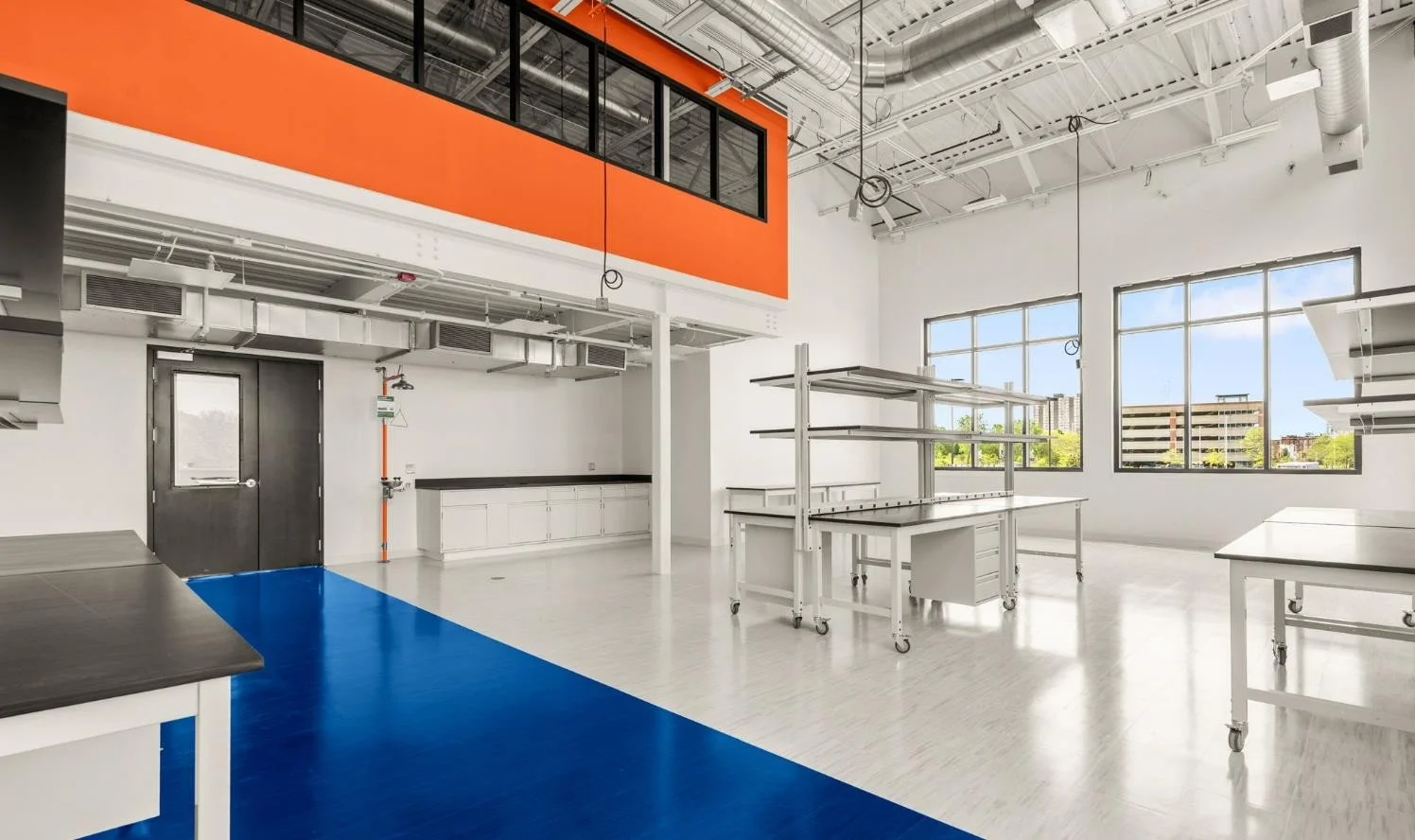
The Pilot Biomanufacturing Center at Massachusetts Biomedical Initiatives in Worcester provides flexible, high-bay lab space designed to help life science startups transition from R&D to early-stage manufacturing within a single integrated campus. Image: Courtesy of The Pilot Biomanufacturing Center at Massachusetts Biomedical Initiatives
The Pilot Biomanufacturing Center at Massachusetts Biomedical Initiatives (MBI) in Worcester, MA offers a useful case study in how incubator strategy is evolving to meet a persistent gap in the life sciences real estate continuum: the transition from bench-scale R&D to early pilot manufacturing.
Opened in late 2023 at 17 Briden Street, the ~15,000-sf expansion builds onto an existing ~25,000-square-foot incubator campus and is intentionally positioned between startup laboratory space and full commercial GMP manufacturing.
It is one phase of MBI’s integrated StartUp → ScaleUp → Pilot Biomanufacturing → ScaleOut model, designed to keep companies in a single ecosystem as they grow rather than forcing disruptive relocations at critical inflection points.
Closing the “missing middle” in biomanufacturing space
A core challenge the facility addresses is the lack of affordable, flexible pilot-scale manufacturing environments. Traditional incubators typically support early R&D, while commercial GMP facilities are often too large, too expensive, and operationally too rigid for emerging companies. At the same time, contract research and manufacturing organizations frequently require significant upfront capital and long project timelines, which can slow iteration during a company’s most vulnerable growth stage.
The Pilot Biomanufacturing Center responds by providing 10 high-bay biomanufacturing labs with 18-foot ceilings, modular cleanroom capability, and lower-cost BL2 infrastructure that supports process development rather than full-scale GMP production. Each lab also includes a second-floor office overlooking the lab space, enabling operational oversight while reducing contamination risk and improving spatial efficiency.
From a design perspective, Zu Shen, executive vice president of incubation at MBI, emphasizes that the intent was to support companies at their next stage of growth—not to overbuild for requirements they may not yet need.
Design intent: flexibility without overbuilding
The facility’s design strategy centers on balancing flexibility with discipline. High-bay lab shells allow for changing equipment footprints and evolving workflows, while modular cleanroom components enable reconfiguration without major capital disruption. Just as importantly, the infrastructure avoids premature GMP over-specification, helping companies control operating costs during early production scale-up.
This “right-sizing” approach reflects a broader shift in incubator planning: instead of designing for hypothetical future peak requirements, developers are increasingly designing for the next 18–36 months of operational reality. For MBI, this meant enabling process development and early manufacturing workflows without locking tenants into the cost structure of full commercial production environments.
Adaptive reuse and construction complexity
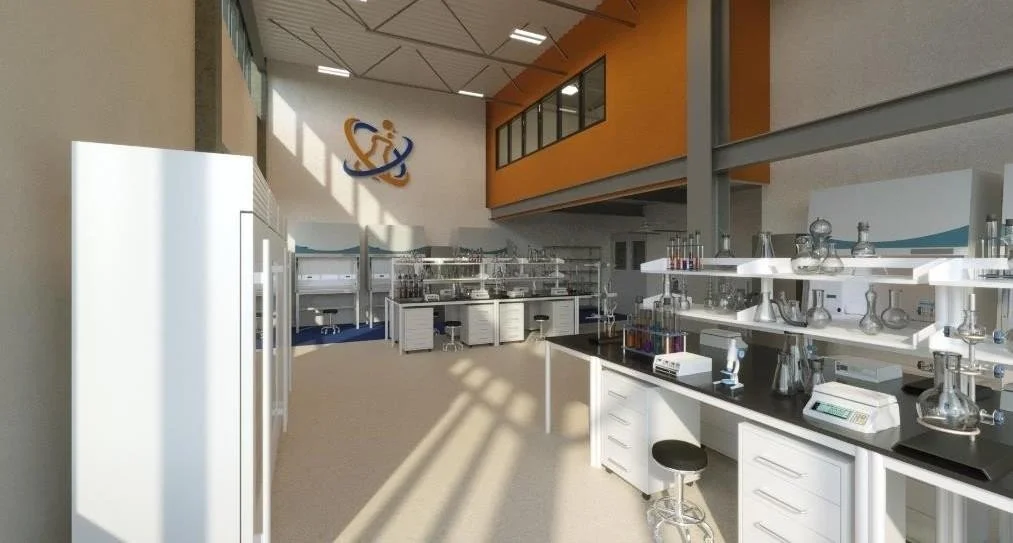
A key expansion of MBI’s incubator ecosystem, the Pilot Biomanufacturing Center supports pilot-scale production with modular cleanroom infrastructure and integrated lab-office layouts to streamline process development and scale-up. Image: Courtesy of The Pilot Biomanufacturing Center at Massachusetts Biomedical Initiatives
The project also demonstrates the challenges of transforming existing industrial stock into advanced biomanufacturing space. The building was previously used as a storage and device manufacturing facility, requiring substantial upgrades to mechanical systems, utilities, and environmental controls within an existing envelope.
The design team had to reconcile three competing priorities: flexibility for multiple tenant use cases, sufficient control for biosafety requirements, and infrastructure restraint to avoid overbuilding. This balance is increasingly common in life sciences redevelopment projects, where speed-to-market and capital efficiency matter as much as technical performance.
A key takeaway from MBI’s approach is that future-proofing does not necessarily mean adding more systems or redundancy. Rather, it often means designing adaptable systems that can evolve with tenant demand.
Post-occupancy outcomes and ecosystem impact
The results have been strong. The Pilot Biomanufacturing Center reached roughly 90 percent occupancy within its first year and is now reported at approximately 95 percent capacity. This high utilization rate underscores both the demand for pilot-scale space and the effectiveness of an integrated campus model that reduces friction between stages of growth.
The facility is also contributing to broader regional economic development goals. By enabling companies to remain in Central Massachusetts instead of relocating to higher-cost clusters near Boston or prematurely scaling into large commercial facilities, MBI is helping retain talent, support job creation, and reinforce Worcester’s position as an emerging biomanufacturing hub.
Recent additions of startups such as Roper Thermals and Proper Stagg Environmental Group further reflect continued demand within the ecosystem. These companies join a growing cohort of tenants working across biomanufacturing, materials, and industrial biotechnology applications, supported by broader regional initiatives including the BioHub partnership between MBI and Worcester Polytechnic Institute, alongside regional stakeholders and state-backed investment from the Massachusetts Life Sciences Center.
Key takeaways for incubator development
Several practical lessons emerge from the MBI model:
Design for lifecycle continuity: incubators are most effective when they reduce friction between R&D, pilot, and early manufacturing stages
Avoid overengineering for GMP too early: capital efficiency is critical for early-stage tenants
Integrate lab and office functions intentionally: visibility and oversight matter, but so does contamination control
Leverage existing ecosystems: proximity to talent pipelines and partner institutions increases occupancy and resilience
Align public and private funding: infrastructure like this is often only viable through coordinated investment strategies
Ultimately, the Pilot Biomanufacturing Center illustrates a broader evolution in incubator design: from static, stage-specific facilities into integrated ecosystems that support companies across multiple phases of technical and commercial maturation.