
Where AI Meets Agriculture: Inside Syngenta’s Next-Gen Research Center
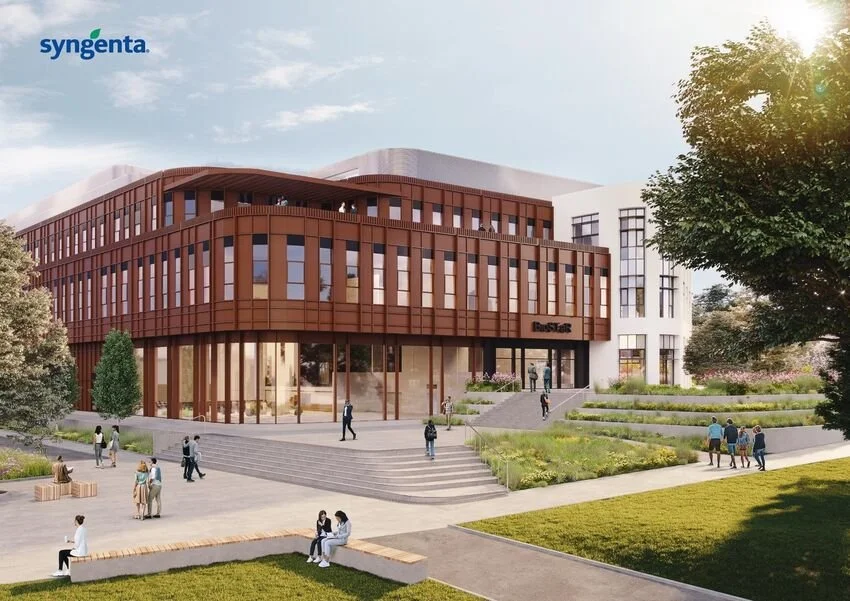
Syngenta’s BioSTaR research center at Jealott’s Hill in the UK marks a new approach to large-scale bioscience facilities, integrating advanced digital tools, automation, and interdisciplinary collaboration to create a flexible, future-ready environment designed to accelerate discovery and adapt to rapid technological change. Image: Courtesy of Syngenta
Syngenta’s new BioSTaR research center at Jealott’s Hill represents a significant evolution in how large-scale bioscience facilities are conceived, particularly where advanced digital tools, automation, and interdisciplinary collaboration intersect. The $130 million investment is not simply an expansion of laboratory capacity, but a rethinking of how scientific environments can be structured to accelerate discovery while remaining resilient to rapid technological change. The facility is expected to be fully operational in 2028.
A core driver behind the project was the decision to centralize approximately 300 scientists into a single facility. Rather than maintaining siloed, group-specific laboratories, the design team and stakeholders deliberately moved toward an integrated model built around shared, flexible environments. As Dr. Jutta Boehmer, head of bioscience & site lead at Jealott’s Hill, explains, “We believe strongly that a single facility that promotes interdisciplinary convergence will bring advantages to our teams and workflows, compared to conventional laboratories designed with small, group-specific and inflexible labs.”
This shift influenced the early design brief, which organized the facility around three lab typologies—Primary, Secondary, and Complex—supported by a “Future of Work” collaboration layer. The result is a framework that prioritizes function over ownership, allowing scientific activity to dictate spatial use rather than departmental boundaries.
Designing for long-term flexibility and conversion
A defining feature of the BioSTaR approach is its emphasis on adaptability over static specialization. From the outset, the project was planned as a long-duration asset, requiring structural and spatial systems that can accommodate scientific change over decades rather than years.
To achieve this, the design incorporates multiple layers of physical flexibility. Approximately 25 percent of office areas are constructed to laboratory structural standards, enabling future conversion without major disruption. These zones include soft spots in slabs and oversized risers, allowing services to be reconfigured as needs evolve. In parallel, lab spaces themselves are designed with reconfigurable partitions and open-plan layouts that can accommodate automation platforms and robotic systems.
Headroom allowances of around 15 percent were also introduced to ensure capacity for future equipment growth, while floor loadings, vibration criteria, and service distribution systems were designed to lab-grade specifications even in areas initially designated for office use. These decisions reflect a broader strategy of “designing in excess capacity” where uncertainty is highest—particularly in areas affected by emerging AI-driven research tools and automation technologies.
Concerned about vibration criteria for your next lab project? Join us at the 2026 Lab Design Conference in Orlando, FL, on May 11-14. Michael Wesolowsky, principal at Thornton Tomasetti, will lead an interactive roundtable session on Addressing Vibration Concerns in Laboratory Design and Renovation. Bring your questions for Mike and solutions to share with your peers. Register now to secure your spot!
Engaging users through redefined workflows

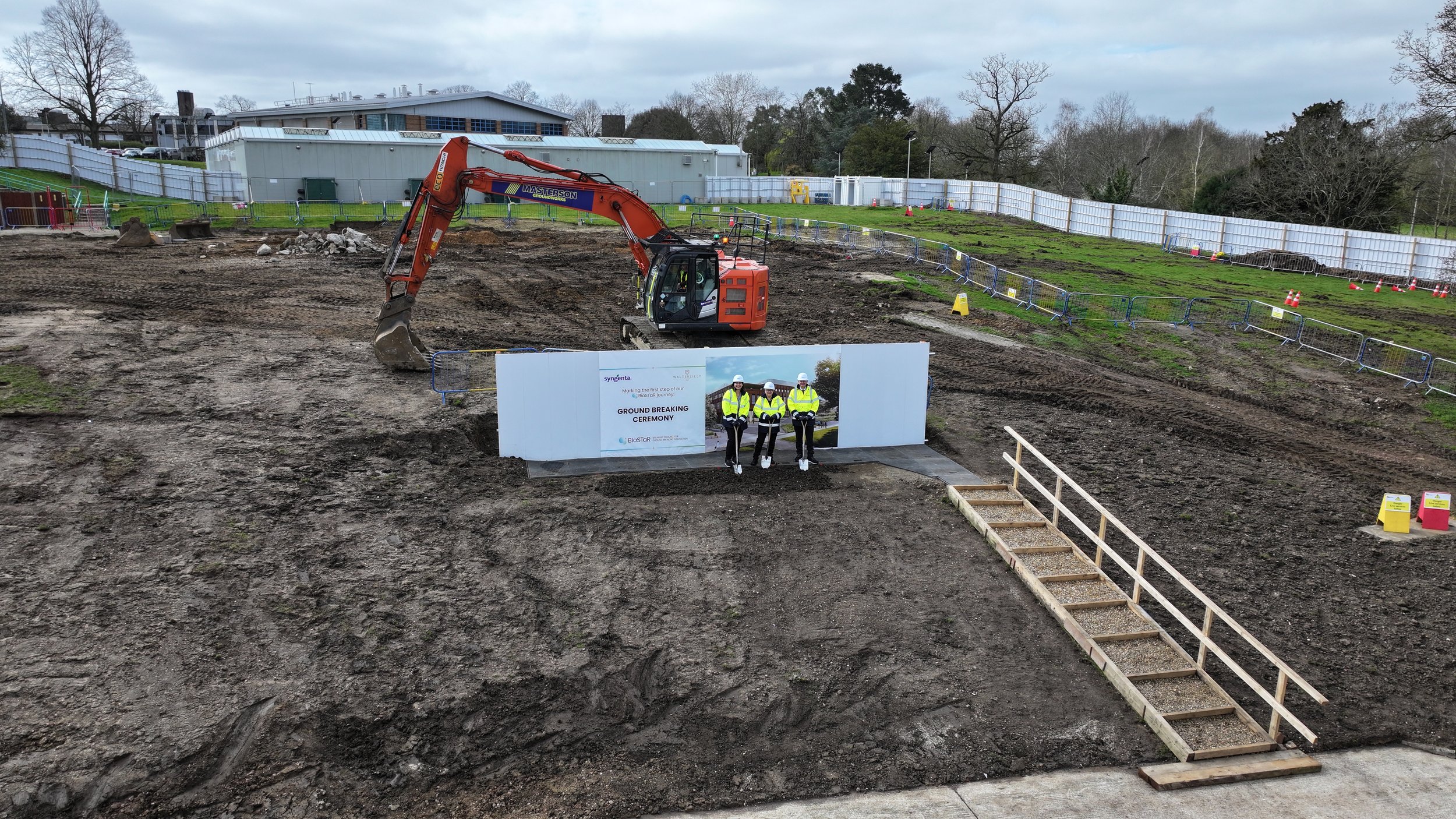
Camilla Corsi, Dame Angela Eagle, and Mike Hollands break ground for Syngenta’s BioSTaR research center. Image: Courtesy of Syngenta
A key factor in shaping the facility was the early and sustained engagement of scientists, technicians, and lab managers. Rather than validating predefined layouts, users were asked to actively reimagine how their work might evolve in response to new technologies and interdisciplinary collaboration.
This process reframed conversations away from departmental ownership toward functional lab categories and workflow compatibility. “From the start, spaces were defined not by ownership, but rather in functional terms—Primary, Secondary, Complex—while incorporating Syngenta’s Future of Work principles that focus on creating a flexible, human-centric and technology-enabled environment,” says Boehmer.
This approach ensured that design decisions were grounded in how research is actually conducted, rather than how organizations are traditionally structured.
Spatial strategies for collaboration and visibility
Collaboration is embedded into the building’s physical structure through both planned and incidental interactions. A central atrium with a prominent staircase serves as a connective spine, encouraging chance encounters between disciplines. On each floor, collaboration zones are positioned at the interface between laboratory and office areas, reinforcing the transition between focused work and cross-functional exchange.
More integrated workflows are also supported through physical links such as the Green Bridge and Air Bridge, which connect laboratories to external glasshouse environments. These connections are particularly important for plant science workflows that require seamless transitions between controlled environments.
The design also introduces a “Science on Show” concept, making research more visible through transparent lab boundaries, curated viewing corridors, and designated exhibition spaces. A 100-seat auditorium further supports cross-campus engagement, reinforcing the idea that knowledge sharing is both spatially and culturally embedded.
Infrastructure built for AI, automation, and flexibility
Syngenta’s BioSTaR facility will unite approximately 300 scientists in a purpose-built, AI-enabled research environment designed to accelerate agricultural innovation, strengthen the UK’s role as a global science hub, and advance bioscience and digital discovery by 2028. Image: Courtesy of Syngenta
Given the increasing role of AI and automation in agricultural bioscience, the facility incorporates dedicated spaces and systems designed to support experimentation with emerging technologies. A Flexible Lab functions as a prototyping environment for testing new instruments, automation platforms, and methodologies before wider deployment.
In addition, modular automation-ready labs are oversized and configured to accommodate robotics systems, while digital infrastructure has been designed to support high-density data flows. Advanced monitoring systems for energy, water, and gas usage further integrate building performance with research operations, reflecting the growing overlap between scientific output and building intelligence.
Despite its emphasis on flexibility, the facility also accommodates highly specialized scientific requirements. BioSTaR includes more than 20 distinct lab types, each defined by specific environmental conditions such as temperature, humidity, pressure, and containment requirements. These are supported by separate air handling systems tailored to different operational needs.
At the same time, shared infrastructure—such as centralized media preparation, water systems, and fume extraction—ensures that redundancy is minimized while scalability is preserved. This duality between specialization and shared systems reflects a key lesson in modern lab design: resilience is achieved not by uniformity, but by carefully balancing fixed requirements with adaptable infrastructure.
Lessons in future-proofing scientific environments
The BioSTaR project demonstrates how early decisions about flexibility, infrastructure capacity, and user engagement can fundamentally shape the long-term value of a research facility. By designing for conversion, embedding collaboration into circulation, and aligning infrastructure with emerging digital workflows, the project creates a framework that can evolve alongside scientific discovery rather than constrain it.
As Boehmer summarizes the planning philosophy behind the project’s adaptability, the distinction between flexibility and adaptability was central: understanding “the difference between flexible workspaces (which allow for short term changes such as the introduction of new equipment) vs. adaptable workspaces (which accommodate major changes such as the conversion of office space into a lab).”
That distinction, embedded throughout the design and construction process, underpins a facility intended not only to support today’s bioscience research, but to continuously reshape itself in response to tomorrow’s.