
UHP Gases and The Final Four Feet
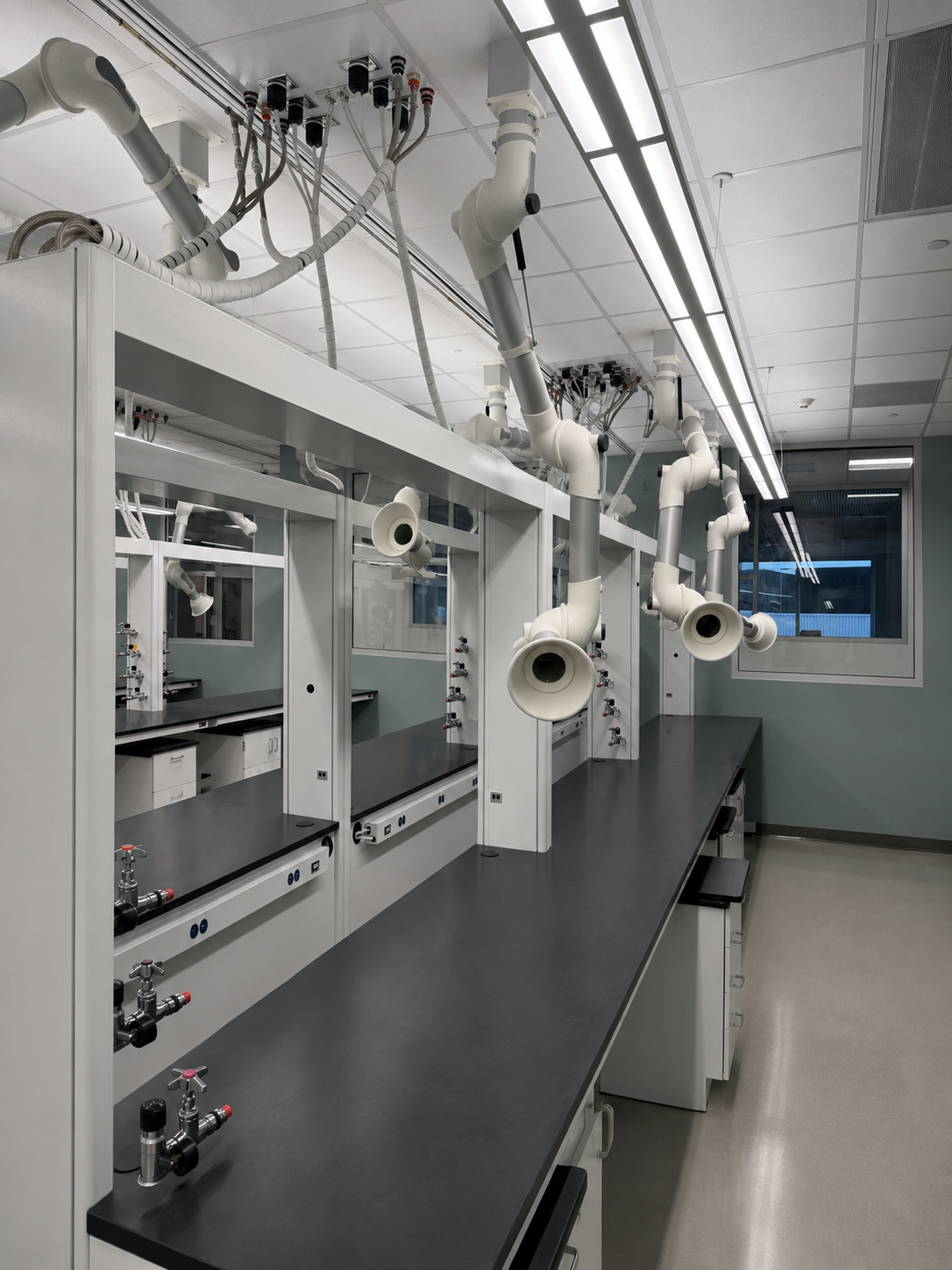
Engineers design UHP gas systems for precision and purity, but the final connection to laboratory instruments can introduce a subtle compromise when flexible hose assemblies are used for added flexibility. Image: Courtesy of Vanderweil Engineers
Engineers specify laboratory ultra-high-purity gas distribution systems to meet the precision required by scientists and researchers. We specify leak rates to the limits of physical detection, validate systems with helium, and rely on metallic piping systems that deliver predictable delivery. Yet within this culture of rigor, we routinely encounter a quiet compromise—materials that are leak-tight, but not impermeable.
Modern laboratory designs increasingly value flexibility. Research programs evolve, analytical equipment changes, and laboratory layouts must adapt to new technologies throughout a facility's life. Ceiling utility panels, modular casework, overhead service carriers, and plug-and-play laboratory systems have become common features of contemporary research environments.
At the same time, ultra-high-purity (UHP) gas systems demand continuity, containment, and predictability with ever-increasing limits of sensitivity.
The intersection of these objectives often occurs within the final few feet between a fixed gas distribution system and the instrument it serves. It is here that both designers and end-users introduce flexible hose assemblies, creating a subtle but important compromise between operational convenience and gas purity.
This is not a story about negligence. It is a story about subtlety.
The illusion of integrity
Installers routinely verify the integrity of UHP systems through leak testing. In the most demanding applications, helium is the tracer gas of choice because it is chemically inert, readily detectable, and can escape through extremely small defects.
There is a certain irony in this practice. There is no safety factor inherent when the same gas used to validate the integrity of a distribution system is the gas the system is ultimately designed to carry. A helium distribution system may successfully pass an extraordinarily sensitive helium leak test and still experience measurable helium transport through certain materials during normal operation.
This distinction is important because leak testing verifies the absence of leaks. It does not verify the absence of transport through permeation.
But permeation is not a leak; it’s a material property.
Gas molecules do not require defects, gaps, failed welds, or improperly assembled fittings to move. Certain materials allow molecules to migrate directly through the material itself. The system may be assembled perfectly with no detectable leakage and still permit measurable gas exchange.
The “final four feet”
Analytical instruments are replaced. Benches are reconfigured. Utility panels are relocated. Equipment is serviced, upgraded, and repositioned. To accommodate these realities, designers and users frequently rely on flexible connections between fixed distribution piping and laboratory equipment. The approach is practical and often necessary, yet it introduces a transition that deserves greater attention.
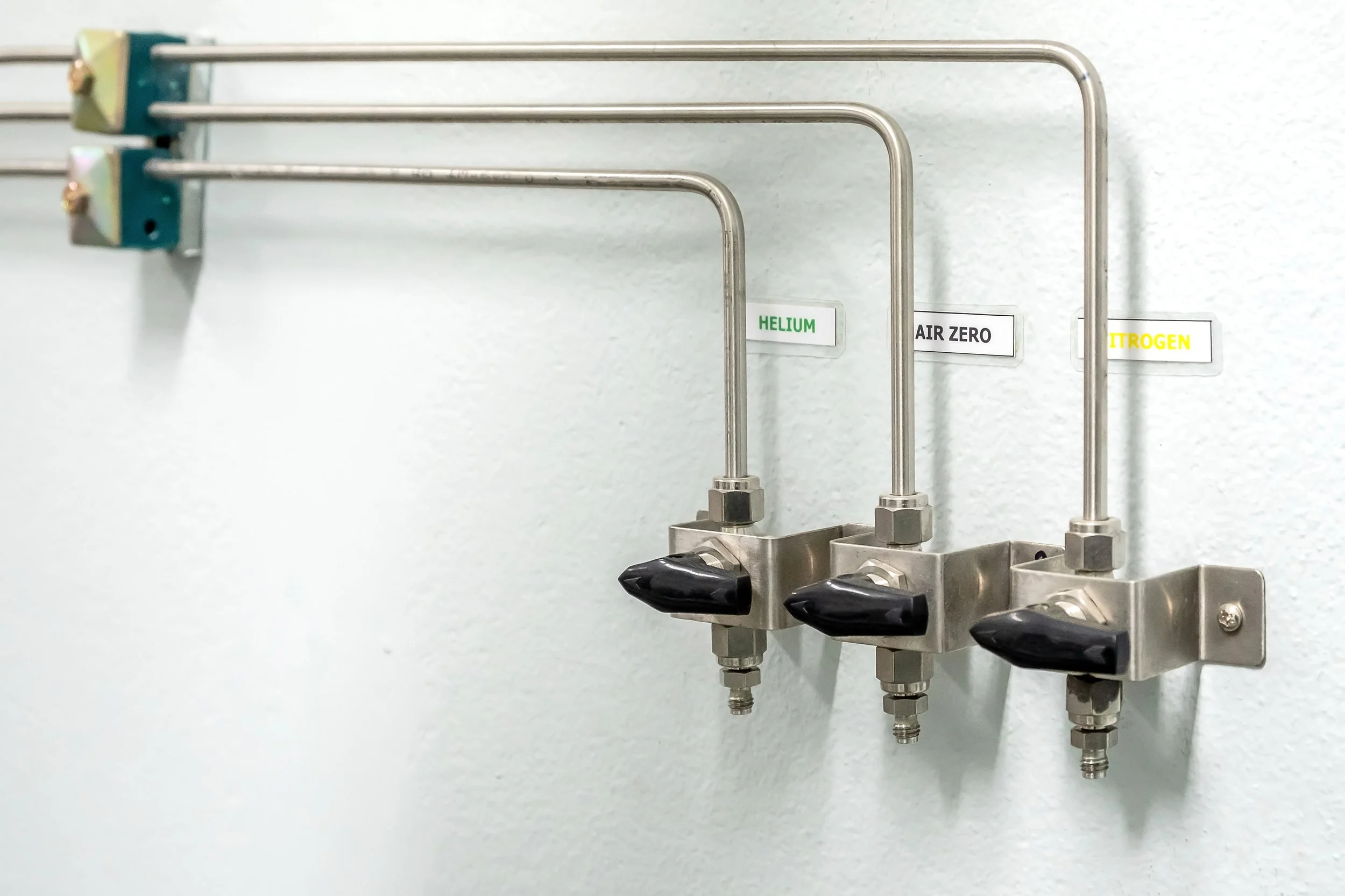
Within the span of only a few feet, a gas distribution system may transition from electropolished stainless steel tubing—effectively impermeable for most practical purposes—to a polymer hose that permits molecular diffusion.
This is not simply a material change. It is a behavior change.
The permanent distribution system above the ceiling reflects control. The choice of flexible connections at the bench or behind the equipment is driven by flexibility but introduces uncertainty.
In many facilities, that uncertainty is inconsequential. In others, it becomes measurable.
Permeation: the unassuming transport mechanism
Leakage occurs through imperfect or compromised components or connections. Permeation occurs through an otherwise intact material.
Polytetrafluoroethylene (PTFE), commonly used in flexible laboratory hose assemblies, is highly resistant to chemicals and widely compatible with specialty gases. Yet PTFE is not perfectly impermeable.
At the molecular level, gas molecules can dissolve into the polymer surface, diffuse through the material, and emerge on the opposite side.
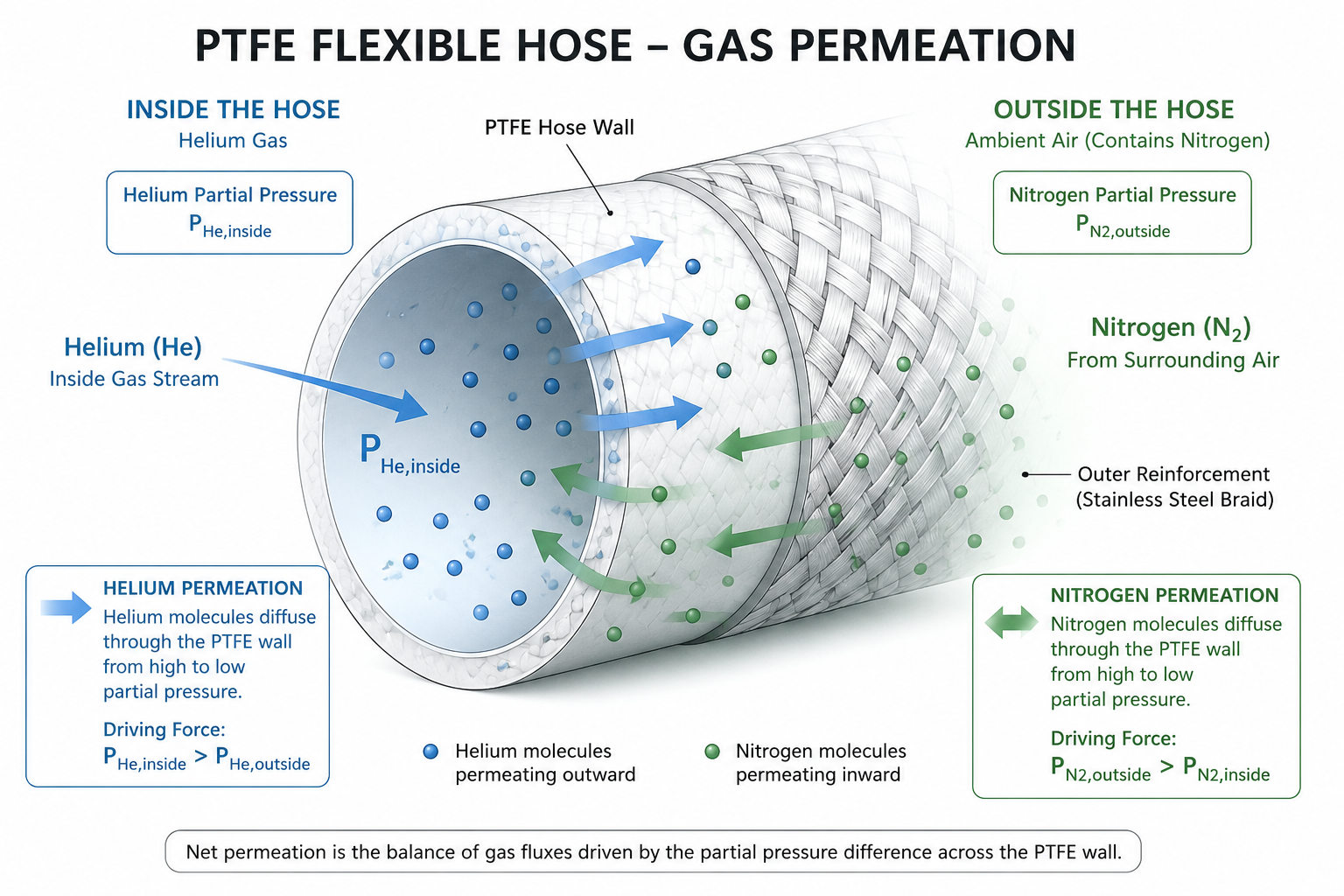
Flexible connections make labs easier to adapt, but the transition from metal piping to polymer hose can introduce molecular diffusion and uncertainty into UHP gas systems. Credit: AI-generated image
Helium is particularly effective in this process. Its small atomic size and high mobility make it one of the most difficult gases to contain. This characteristic is precisely why helium has become the industry standard tracer gas for leak testing. It is also why helium exhibits measurable permeation through many polymeric materials.
For most laboratory applications, the resulting losses are modest. A single hose may lose only a small volume of helium over the course of a day - about the volume of a tennis ball or two.
A hose can function exactly as designed while allowing gas to permeate through its wall, yet this permeation would ordinarily be imperceptible. However, distributed across dozens of instruments and accumulated over years of operation, the effect becomes measurable.
But another permeation mechanism might cause operational challenges.
The counterintuitive exchange
Even under positive pressure, gas permeation can allow helium to diffuse outward while nitrogen and oxygen migrate inward, potentially affecting ultra-high-purity applications.
Most discussions of permeation focus only on the outward loss of helium, but that’s only half of the story. The more interesting phenomenon occurs in the opposite direction.
In a helium distribution system, the helium concentration is effectively 100 percent. Outside the system, the surrounding atmosphere consists primarily of nitrogen and oxygen. These differences create independent partial pressure gradients for each gas species.
As a result, helium tends to diffuse outward through the hose wall. Simultaneously, nitrogen and oxygen diffuse continuously inward. It occurs regardless of the overall system pressure; it is a fundamental thermodynamic property of gases to seek the lowest-potential state.
This is where practice diverges from intuition:
Positive pressure prevents leakage inward. It does not prevent permeation.
Each gas species follows its own molecular gradient. The system, as a whole, does not behave as a one-way barrier.
For many applications, the resulting contamination remains insignificant. For applications operating near the limits of analytical sensitivity, the same phenomenon can become important.
When the margin disappears
Continuous instrument operation, moderate purity requirements, and regular carrier gas consumption frequently mask the effects of permeation. Most analytical laboratories operate successfully with flexible hose assemblies, but the issue emerges only when margins become ultra-small.
Examples include:
Ultra-high-purity gases exceeding five-nines
Trace-level analytical methods at or below the per-billion margins
Low-flow instrumentation
Extended standby conditions
Semiconductor applications
Research environments requiring extremely low contamination levels
Under these conditions, time becomes a factor. Gas that remains stagnant is gas that changes composition over time.
When calibration becomes unstable, baselines drift, or contamination appears difficult to explain, the focus often turns toward instrumentation, regulators, valves, and fittings. Rarely is the material itself questioned.
Yet the distribution material may be participating in the result.
The semiconductor standard
As advanced analytical laboratories continue to push detection limits to the levels typically encountered in the semiconductor industry, they increasingly encounter the same constraints.
Semiconductor manufacturing facilities routinely distribute gases at purity levels exceeding 99.9999 percent. At these levels, contamination measured in parts per billion or even trillion becomes operationally significant.
Their response has been straightforward: Eliminating permeability eliminates uncertainty.
The resulting systems rely upon:
Electropolished stainless steel tubing
Orbital welding
Metal gasket face-seal (VCR) fittings
Helium leak verification at the 10-9 std cc per day limits
Strict cleanliness protocols
Minimal mechanical connections
These practices are not philosophical preferences. They are practical responses to the realities of gas transport.
What once appeared to be over-design begins to look prudent in an advanced laboratory demanding semiconductor-level performance.
Reframing the design decision
PTFE hose assemblies are not inherently inappropriate. They are useful, practical, and often necessary in most cases. Modern laboratory design would be significantly more difficult without them.
The issue is not whether they should be used. The issue is whether their use is understood.
Every flexible connection represents a trade-off:
Flexibility in exchange for permeability
Adaptability in exchange for continuity
Convenience in exchange for a small degree of uncertainty
When permeation is recognized, it can be accommodated, managed, and minimized through effective engineering and installation practices. When it’s unrecognized, it becomes a hidden variable within the system, making it difficult to isolate.
A subtle reality
Permeation does not announce itself. It produces no alarms, no sudden failures, and no obvious defects. Its effects accumulate gradually and often remain below the threshold of observation, yet UHP systems are engineered and built precisely because small effects matter.
The discipline required is not necessarily more testing, more specifications, or more complexity. It is simply a deeper understanding of how materials behave over time, not just under pressure, and not just during commissioning. Material selections must be made to maintain gas purity at the molecular level throughout the system's life.
Closing thought
The objective of a high-purity gas distribution system is not merely to deliver gas without leaks; it is to deliver gas unchanged at the molecular level.
Achieving that objective requires attention not only to fittings, welds, and leak tests, but also to the permeability of the materials themselves. In the pursuit of purity, the most important design decisions are often found in the smallest and least conspicuous components of the system.
The “final four feet” may be the shortest segment of the distribution system, but they might also be the most consequential.
