
The Year in Lab Design News: Trends, Innovations, and Reader Favorites
As 2025 draws to a close, we’re taking a moment to look back at the content that resonated most with the Lab Design News audience over the past year. From higher education renovations and life sciences facilities to sustainability strategies and emerging technologies, these stories captured the questions, challenges, and priorities shaping laboratory environments today. Together, they offer a snapshot of where the industry has been—and where it’s headed next.
Throughout 2025, our most-read articles and most-viewed webinars reflected a growing emphasis on flexibility, collaboration, and future-proofing lab spaces, as well as the real-world lessons learned during design and construction. Below, we’ve rounded up the most popular Lab Design News articles and digital content of the year, along with brief summaries and links to revisit the insights that sparked the most interest and conversation among our readers.
Stay tuned for more exciting content in 2026, including our digital conferences, webinars, and editorial and news articles. Reach out to mdidonna@labdesignconference.com if you are interested in authoring a piece, being interviewed as a subject matter expert, or speaking in one of our webinars. Be sure to follow us on LinkedIn and subscribe to our weekly e-newsletter for updates as well!
Laboratory project case studies
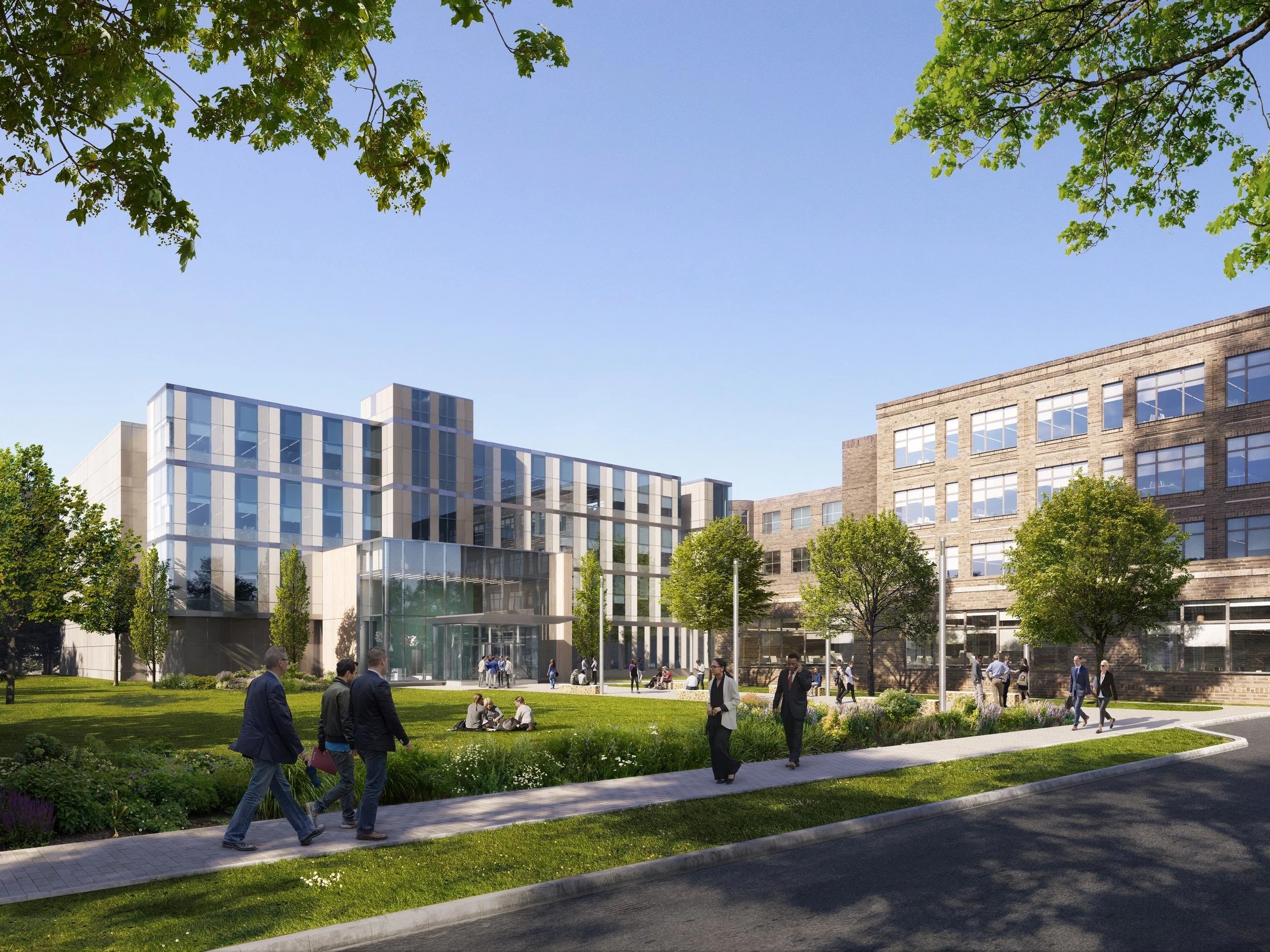
Rendering of 15 NEST, the future home of NJIT's Translational Research facility. Image: Courtesy of the HOK Group
Lab Design News readers continue to engage with case studies highlighting laboratory buildings from around the world. In the article NJIT Partners with NEST to Drive Life Science and Tech Advancements, readers gained insight into The Northeast Science and Technology (NEST) Center’s announcement of the New Jersey Institute of Technology (NJIT) as its first academic partner. The collaboration marks a significant step toward establishing a hub for life science, technology, and pharmaceutical research. As part of the partnership, NJIT will launch the NJIT @ NEST Center for Translational Research, occupying 25,000 sf at the NEST campus in Kenilworth, NJ, to support innovation across life sciences, biomedical engineering, AI, and related fields.
A Modernized Approach to Public Health Infrastructure examines the construction of the County of San Diego’s $93 million public health laboratory at the County Operations Center in Kearny Mesa, San Diego, CA, which is nearing completion and expected to open in late spring 2025. Developed to replace an outdated and undersized facility, the new two-story, 52,000-sf building is approximately three times larger than its predecessor. The expanded facility will increase the county’s capacity for infectious disease testing, food and water safety monitoring, and pathogen detection. It will also support advanced diagnostic capabilities, including whole genome sequencing and tuberculosis testing, strengthening the region’s public health infrastructure.
The University of Arizona’s Applied Research Building (ARB) was awarded the Excellence in Whole Building/Holistic Design—New Build honor as part of the 2025 Design Excellence Awards, and the project itself was covered in Lab Design News. The facility serves as a case study in how mission-driven planning can support highly specialized scientific research. Opened in 2023, the facility was designed to accommodate advanced work in space science, imaging, and high-bay integration. Instead of relying on a standardized laboratory model, the ARB demonstrates an approach to laboratory planning that balances program-specific needs with long-term flexibility. The design process offers several strategies and lessons applicable to teams planning complex research environments. Representatives from SmithGroup, which submitted the project for consideration, accepted the award at the 2025 Lab Design Conference in Denver and shared project insights with attendees. Keep an eye on Lab Design News for details about the winners of our 2026 Design Excellence Awards competition, who will be honored at the 2026 Lab Design Conference in Orlando, FL in May!
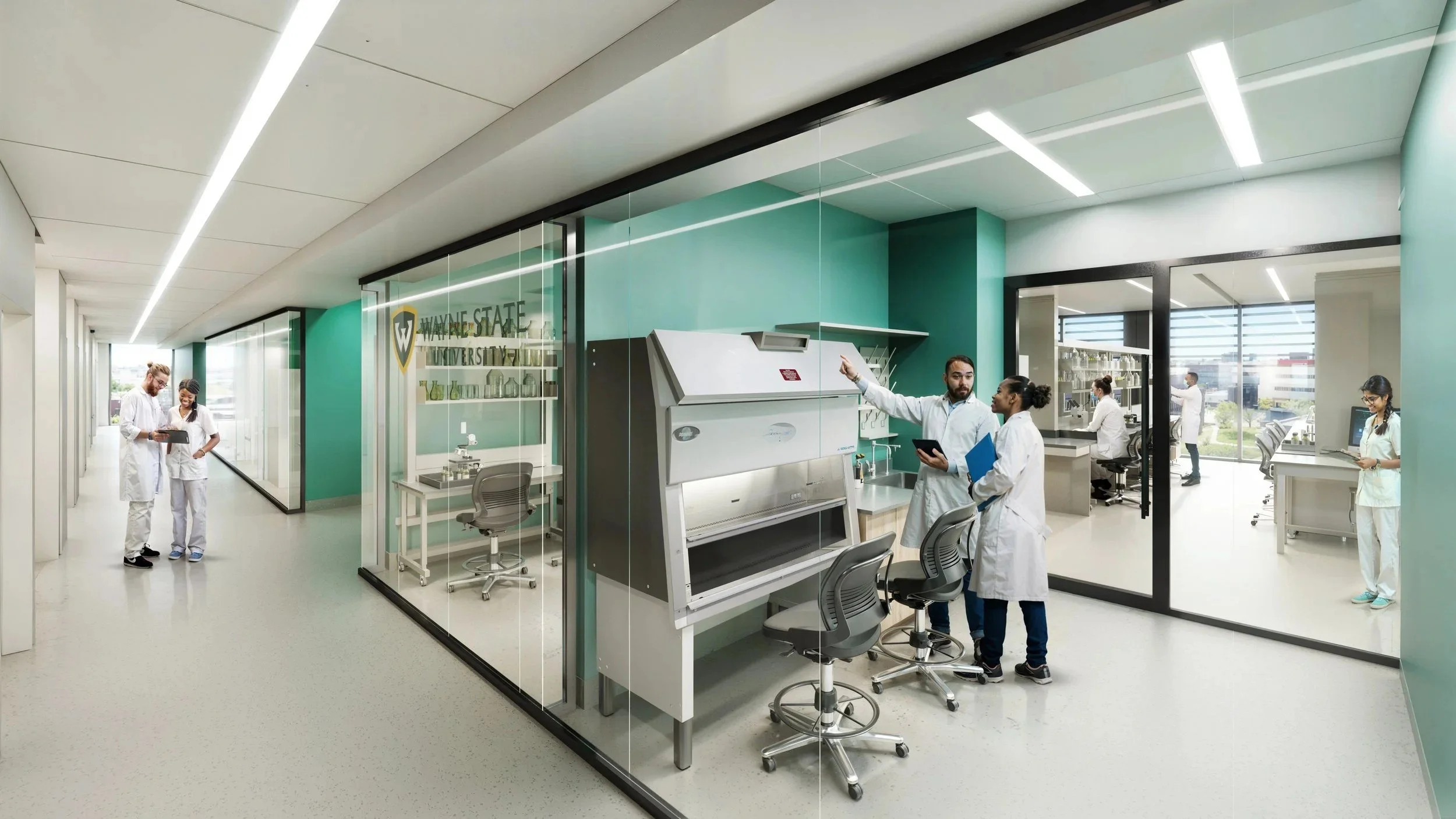
Wayne State University’s Health Sciences Research Building labs combine open bench areas with specialized support spaces and a modular, adaptable design, while careful zoning ensures safe placement of chemically intensive activities and fume hoods across multiple floors. Image: Courtesy of HKS Inc.
The article How Wayne State Is Preparing Labs for What’s Next explores Wayne State University’s groundbreaking of a $200 million Health Sciences Research Building designed to advance scientific research in Detroit, MI. Planned for the site of an existing parking lot at 545 E. Canfield Street, across from the School of Medicine, the 160,000-sf facility will consolidate researchers from multiple health sciences disciplines. The project aims to foster collaboration and accelerate discoveries focused on addressing critical health challenges in Detroit and beyond.
In Rhode Island Unveils Modern Laboratory to Advance Public Health and Safety, readers were introduced to Rhode Island’s new State Health Laboratory in downtown Providence. Located in the city’s expanding Jewelry District, the facility replaces an aging lab that was no longer equipped to meet current public health demands. Designed with modern systems and advanced capabilities, the new laboratory enhances the Rhode Island Department of Health’s ability to remain flexible, adaptable, and responsive to emerging public health challenges.
Trends in automation design
Lab Design News regularly features valuable perspectives from design and build professionals across the laboratory planning community. In their article, The Future of Lab Automation: Opportunities, Challenges, and Sustainable Design Solutions, Adam Harper and Megan Skarkas of Gensler examine how the growing adoption of lab automation is reshaping laboratory environments. They explore how automation influences design decisions, from the need for specialized infrastructure and flexible space planning to building systems that can support robotics, AI, and high-density equipment while managing energy use and sustainability goals. The article highlights the importance of integrating automated work cells, human-centered collaboration spaces, and efficient HVAC, power, and structural systems to create labs that are adaptable, sustainable, and well suited to both current and future research workflows.
The focus on automation continues in Incorporating Fully Automated Test Programs in Lab Design and Renovation. David Newell and April Schrank-Hacker, workflow solutions consultants at Leica Biosystems, share best practices for integrating automation into laboratory spaces. As labs increasingly turn to automation to enhance efficiency and streamline operations, embedding fully automated test programs into the physical environment has become a key consideration. Whether through new construction or renovation, this process requires addressing technical, spatial, and operational challenges while ensuring the facility is prepared to support future advancements.
Webinars and in-person events
In 2025, Lab Design News offered a series of free, AIA-accredited webinars. In Designing Shared Lab Spaces: Balancing Functionality, Collaboration, and Future-Proofing, Kelly Sullivan, PhD, of CIC shares strategies for optimizing layouts, designing with users in mind, and supporting effective communication and workflow among diverse lab teams. All of Lab Design’s webinars are available to view on demand for free and qualify for AIA continuing education credit. Click here to access our on demand and upcoming webinars for free.
Attendees can also continue the conversation on shared lab spaces in Kelly’s exclusive workshop at the 2026 Lab Design Conference in Orlando, FL. Her session, Collaborative Lab Planning: Aligning Space Design with Real-World Workflows, offers a deeper dive into these practical approaches. Attendees will work through planning scenarios and leave with practical tools to improve communication and design alignment across stakeholders. Workshop tickets are limited and must be purchased in addition to your general conference ticket—get your conference ticket before December 31, 2025 to save $200!
Another webinar, Panel Discussion: The Impact of Federal Funding Challenges on Lab Construction and Renovation, brings together experts in lab design, construction, and project management to explore how shifts in federal funding are affecting laboratory projects nationwide. The panel discusses impacts on timelines, budgets, and long-term planning, while offering strategies to adapt, secure alternative funding, and navigate evolving financial and policy landscapes. Attendees will gain practical insights on mitigating risk, maintaining project momentum, and implementing best practices in planning, resource allocation, and compliance—essential knowledge for architects, lab managers, planners, and construction professionals working in today’s uncertain funding environment.
Part of Lab Design’s “How to Build” webinar series, How to Build a Vivarium provides a comprehensive guide to planning and designing vivarium facilities, from high-level strategic decisions to the essential operational details that ensure functionality, compliance, and animal welfare. Attendees learn how to define facility scope and type, collaborate with end-users, and support diverse research goals across species, while meeting accreditation and regulatory requirements such as AAALAC, NIH, and FDA standards. The session covers critical design considerations, including facility layout, animal housing and care systems, support spaces for laboratories and procedures, and operational logistics like feeding, waste management, and storage.
Lab Design News continues to host digital conferences tailored for professionals in laboratory construction, renovation, and design, featuring expert presentations and interactive Q&A sessions to share insights and best practices. As always, sessions are available both live and on demand, at no cost to our readers. Register once to gain free access to all 2026 digital conferences for the entire year.
As we look ahead to 2026, Lab Design News will continue to bring you in-depth coverage, expert perspectives, and practical guidance to help navigate the evolving world of laboratory design, construction, and operations. Whether you’re planning a new build, a renovation, or exploring emerging technologies, our goal remains the same: to provide the insights and inspiration you need to create lab spaces that are efficient, adaptable, and ready for the future. Follow us on LinkedIn, make sure you’re subscribed to our free weekly e-newsletter, and be sure to explore our featured articles and stay connected for the latest trends and best practices shaping the industry.
Wishing you all the best for the year ahead!