
Predictive Maintenance: Listening to Freezer Motors
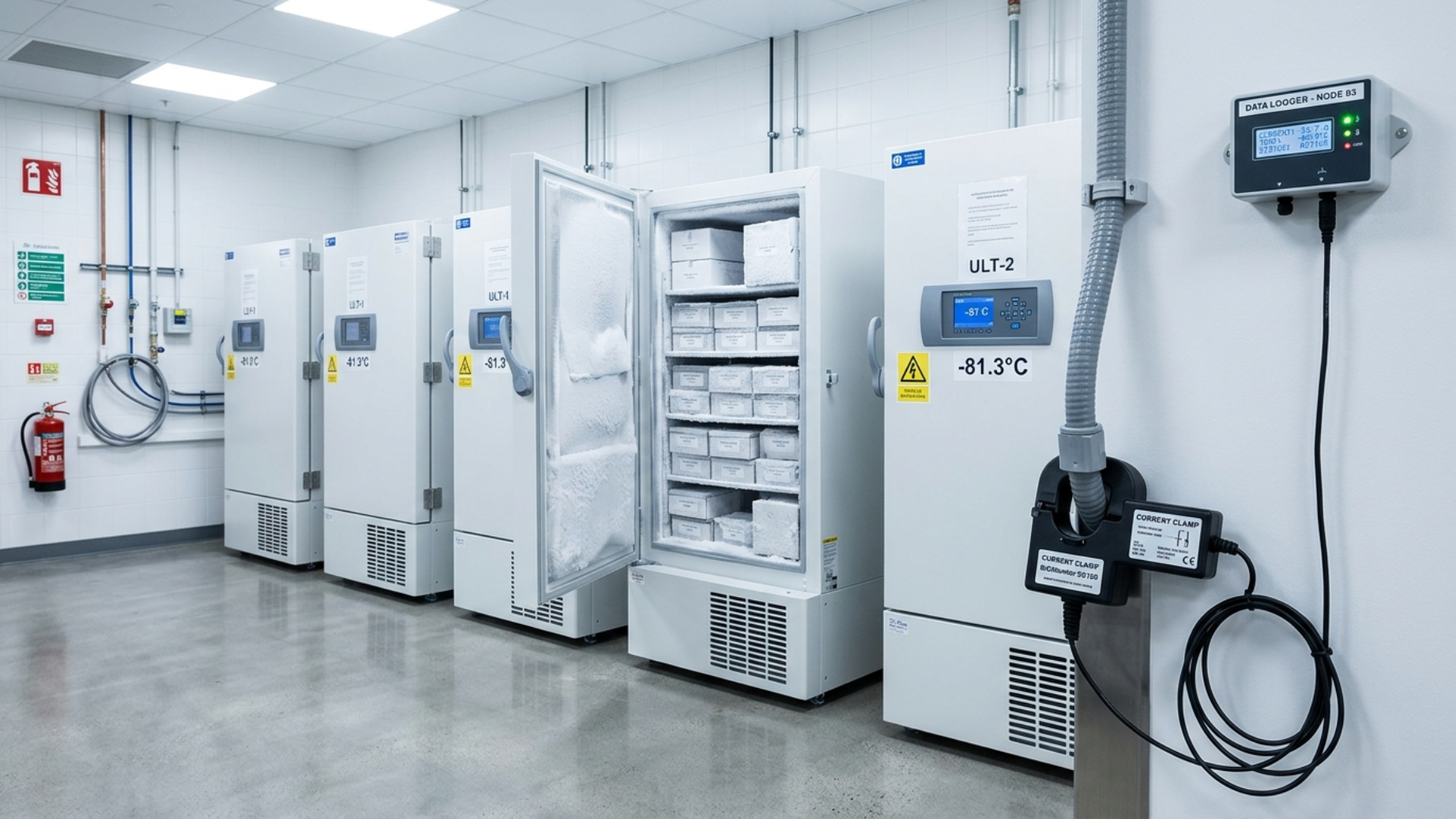
How current transducers and equipment monitoring systems predict ULT freezer failure weeks before it happens—and what that means for lab design. | Credit: Flow (2026)
What Is Lab Predictive Maintenance—and Why Does It Matter?
Lab predictive maintenance is the practice of using continuous equipment monitoring to detect early signs of mechanical failure before a breakdown occurs, replacing reactive repair cycles with data-driven service decisions. For research and clinical laboratories, where a single ultra-low temperature (ULT) freezer can hold years of irreplaceable biological samples, the difference between a predicted failure and a surprise one is the difference between a scheduled maintenance call and a catastrophic sample loss event.
Don't wait for the alarm at 2 AM. How current transducers predict freezer failure weeks in advance.
It is three o'clock on a Sunday morning. A ULT freezer in your biobank—one of dozens humming quietly in a dedicated freezer room—has been working just a little too hard for the past three weeks. Its compressor motor has been drawing slightly more current than its baseline. The duty cycle has been creeping longer. A trained engineer reviewing the data trend would have called for service two weeks ago. But no one was watching that signal.
The temperature alarm fires at 3:07 AM. By that point, the cabinet is already climbing past −60°C. Staff have roughly five hours before the contents are compromised—because when a ULT freezer set at −80°C fails, an average new unit takes approximately five hours to warm up to −60°C, a temperature that accelerates sample degradation.
Temperature alarms tell you a crisis has already begun. Predictive maintenance tells you a crisis is forming—days or weeks before the alarm ever sounds.
This article is part of a broader series on connected laboratory infrastructure. If you are new to the sensor ecosystem underpinning these systems, start with Smart Lab Sensors: The Internet of Things in Research on Lab Design News, which maps the full IoT landscape for lab designers and facility managers. What follows focuses specifically on the electrical signature monitoring strategy that makes freezer failure prediction possible: the current transducer.
The Status Quo Is Failing Laboratories
Temperature monitoring is the baseline standard in most research and clinical laboratories—and it has saved countless samples from quiet excursions caused by door gasket failures, door-ajar events, and power interruptions. But it is fundamentally a lagging indicator. By the time a freezer's internal temperature deviates enough to trigger an alarm, the mechanical failure driving that deviation has usually been building for days or weeks:
The compressor has been running longer duty cycles.
The refrigerant circuit has been laboring.
The motor has been drawing excess current.
The system has been compensating—until it can't.
The human cost is real. A freezer failure at Boston University in 2019 caused one researcher to lose approximately twenty years of research materials, the vast majority of which could not be easily or quickly replicated. A group that had been publishing six to seven research papers per year was subsequently only able to publish one. That is not a maintenance story. That is a research program story.
The institutional data reinforces the point: approximately fifteen percent of all ULT freezer failure calls could have been prevented with regular preventive maintenance, according to data collected by Helmer Scientific's Technical Service Department. Beyond direct repair costs, the ripple effects include:
Freezer downtime and the scramble for backup units
Lost staff productivity during emergency sample transfers
Risk of sample exposure even during a successful transfer
Potential regulatory documentation gaps in GxP-regulated labs
The standard reactive model—wait for the alarm, escalate, transfer samples under duress, call a technician—is inadequate for the scale and value of assets that modern research laboratories store. A predictive equipment monitoring program shifts the decision point from "the freezer failed" to "this freezer is trending toward failure and should be serviced on Thursday."
Key Terms and Definitions
Lab predictive maintenance: A condition-based maintenance strategy that uses continuous sensor data to detect early-stage equipment degradation and predict failure before it occurs, enabling scheduled intervention rather than emergency response.
Current transducer: A non-contact electrical sensor—often in a split-core configuration—that clamps around a power conductor and measures the alternating current flowing through it. In laboratory equipment monitoring, current transducers track the motor load of compressors and other electromechanical assets to detect subtle changes in energy draw that precede mechanical failure. See also: Yokogawa Test & Measurement, "Split Core Current Transformers."
Equipment monitoring: The continuous or periodic collection of operational data—current draw, temperature, vibration, run-time cycles—from laboratory instruments and building systems, typically aggregated by a software platform that generates alerts and trend analysis.
Freezer failure prediction: The use of analytics applied to historical and real-time compressor performance data to identify degradation signatures—rising current draw, lengthening duty cycles, increasing compressor head temperature—that statistically precede ULT freezer failure.
ULT freezer (ultra-low temperature freezer): A refrigeration unit designed to maintain internal temperatures between −60°C and −86°C (with −80°C as the global benchmark standard) for long-term preservation of biological samples, including DNA, RNA, proteins, cell lines, vaccines, and clinical specimens.
Split-core current transformer (CT): A variant of a current transducer whose ferrite or silicon-steel core is hinged or split into two halves, allowing it to be clamped around an existing conductor without disconnecting the circuit. This enables retrofit installation on live equipment with no service interruption.
Condition-based maintenance (CBM): A maintenance approach in which service is performed in response to measured indicators of equipment condition rather than on a fixed schedule. Predictive maintenance is a subset of CBM that incorporates trend analysis and failure forecasting.
Motor current signature analysis (MCSA): An electrical diagnostic technique that analyzes the current waveform drawn by a motor to detect mechanical faults—bearing wear, winding degradation, rotor eccentricity, compressor valve problems—that alter the motor's electrical load profile before they become visible mechanically.
Duty cycle: In refrigeration systems, the proportion of time a compressor runs relative to total elapsed time. A compressor whose duty cycle is trending upward is working harder than normal to maintain setpoint—a potential indicator of refrigerant loss, condenser fouling, door gasket deterioration, or impending mechanical failure.
CMMS (computerized maintenance management system): Software that tracks maintenance work orders, asset history, preventive maintenance schedules, and parts inventory. In predictive maintenance programs, CMMS platforms receive sensor-triggered alerts and auto-generate work orders when equipment health thresholds are exceeded.
What Equipment Monitoring and Freezer Failure Prediction Actually Provide
The Signal Hidden in the Power Feed
A ULT freezer's compressor motor announces its health continuously and silently through the power conductor feeding it. A healthy compressor draws current in a predictable, repeating pattern: it cycles on, sustains a steady draw, and cycles off. When a compressor begins to fail, that pattern changes in detectable ways:
Motor current draw rises as the compressor works harder.
On-time lengthens relative to off-time (duty cycle increases).
In some failure modes, the current becomes erratic or phase-imbalanced.
Compressor surface temperature climbs as heat rejection efficiency drops.
A split-core current transducer captures this signal non-invasively. The sensor clamps around the power lead to the freezer compressor, connects its output to a data logger or building management system (BMS) node, and begins accumulating a baseline—typically over seven to fourteen days of normal operation. No circuit disconnection. No service interruption. No downtime.
From Baseline to Prediction
Once a baseline current profile is established, the monitoring system compares ongoing readings against that baseline and flags statistically significant deviations. Commercial platforms built on this principle—drawing on large training datasets from monitored freezer fleets—can score compressor health continuously and deliver early-warning flags days or weeks before any temperature deviation occurs.
Although it might seem like freezers fail "instantly," there are actually subtle variations and events that can be detected with AI, which can indicate where preventive maintenance may be necessary. Conservative industry ranges for mature predictive maintenance programs show:
40–70% reduction in unplanned downtime
15–35% reduction in maintenance costs through fewer emergency callouts
5–20% increase in effective uptime depending on equipment criticality and baseline reliability
A Fleet-Level View of Cold Storage Health
The value of current transducer monitoring compounds when applied across an entire fleet of cold storage assets. A lab manager who can see, on a single dashboard, that Freezer 14 in Building C is running a duty cycle twelve percent above its three-month average—while Freezer 3 in the same room is nominal—can prioritize service intelligently.
For the lab designer, this fleet-level view has direct implications for:
Freezer room layout and aisle access for sensor installation
Electrical panel capacity and CT tap-point planning
Network infrastructure for data pathway routing
BMS integration architecture
These are design decisions, not afterthoughts. Refer to the Lab Design News Monitoring Systems Buyers Guide for a current overview of platform options and hardware requirements.
Regulatory and Compliance Standards for Cold Storage Equipment Monitoring
NIH Policy on ULT Freezer Management
For federally funded research facilities and NIH-operated campuses, the governance framework for cold storage monitoring is explicit. NIH Manual Chapter 26101-16, "Management of Ultra-Low Temperature and Lab Grade Freezers and Refrigerators," establishes:
Requirements for maintaining a full inventory of ULT, lab-grade, and laboratory-grade refrigerator units
Mandatory inspection schedules with a three-stage escalation procedure
Designation of cold storage coordinators at each NIH Institutional Component
Energy Star certification requirements for all new acquisitions
Full life-cycle maintenance record-keeping obligations
Critically, the NIH has also researched predictive monitoring systems for ULT freezers directly. The NIH National Energy Management System program has noted that predictive monitoring systems may be able to identify problems that may lead to freezer failures, allowing researchers, lab technicians, and emergency personnel to have a freezer repaired or replaced prior to a failure occurring. That is an institutional endorsement of condition-based monitoring at the federal research level.
FDA and GMP Compliance Considerations
In pharmaceutical and GxP-regulated laboratory environments, equipment monitoring intersects with 21 CFR Part 11 requirements for electronic records and electronic signatures. Monitoring platforms that generate audit-trail data must produce records that are:
Accurate and complete at the point of capture
Retrievable on demand for regulatory inspection
Time-stamped and attributable to specific equipment assets
Generated by validated software with documented IQ/OQ/PQ protocols
Lab designers working on cGMP facilities should specify monitoring systems with validated software from the outset—not as an afterthought during commissioning.
ASHRAE and Energy Star Standards
ULT freezers are among the most energy-intensive pieces of laboratory equipment. A non-Energy Star ULT freezer consumes approximately twenty kilowatt-hours of electricity per day—the same as the average U.S. household. ASHRAE Standard 90.1 governs energy performance requirements in laboratory facilities broadly, and current transducer data serves double duty here: it simultaneously provides compressor health intelligence and energy sub-metering data that feeds sustainability and ESG reporting.
Specifying Lab Predictive Maintenance Systems: Guidance for Design and Procurement Teams
Start with a Complete Asset Inventory
Before specifying any monitoring hardware, build a complete cold storage asset inventory. For each unit, document:
Make, model, and age
Refrigerant type and compressor configuration (single-stage vs. cascade)
Nominal current draw at rated load
Phase configuration (single-phase vs. three-phase)
Circuit identification on the electrical panel
This inventory drives hardware selection. A ULT freezer with a cascade compressor system—common in −80°C units—has two compressor stages, each drawing current independently; monitoring only one phase of one stage gives an incomplete picture. Review the Lab Design News Cold Storage Buyers Guide for specification considerations on both freezer hardware and monitoring integration.
Selecting Current Transducers for Laboratory Retrofit
For retrofit installations on existing freezers, split-core current transducers are the standard choice because they can be installed without disconnecting the power feed. Key specification parameters:
Current range: Should match or slightly exceed the compressor's full-load amperage
Accuracy class: Class 1.0 (one percent accuracy from five to one hundred twenty percent of rated capacity) is appropriate for condition monitoring
Output signal type: 4–20 mA or 0–10 V DC outputs are most compatible with standard BMS and data acquisition systems
Core aperture: Must physically accommodate the conductor diameter; verify before specifying
Targeting Freezer Failure Prediction with Multi-Parameter Monitoring
Current draw alone is a powerful signal, but the most robust predictive maintenance programs combine current transducer data with at least two additional parameters:
Duty cycle tracking: Derived from current data itself; a rising duty cycle is often the first indicator of compressor stress.
Compressor surface temperature: A thermocouple mounted on the compressor housing provides trending data on heat rejection efficiency. Rising head temperature combined with rising current draw is a high-confidence failure precursor.
Ambient room temperature: Freezer rooms that run hotter than design intent cause every unit in the room to work harder. Monitoring ambient temperature alongside unit current draw separates equipment-specific problems from room-level HVAC issues—an important distinction for maintenance prioritization and MEP coordination.
For new construction and major renovation projects, specify current transducer tap points and conduit pathways on the electrical drawings during design development. Panel schedules should identify cold storage circuits and reserve space for CT installation at the disconnect level.
Integration with Building Management Systems and CMMS Platforms
A current transducer feeding an isolated data logger provides value. Current transducer data flowing into a laboratory BMS—and from there into a CMMS that auto-generates work orders—provides institutional value. When specifying this integration, confirm:
Open-protocol BMS connectivity (BACnet or Modbus are the standard options in laboratory buildings)
API-level integration between the monitoring software and the facility's CMMS
Alert escalation workflows that assign, route, and close work orders without manual re-entry
Data retention and export capabilities that satisfy regulatory audit requirements
What Lab Designers and Architects Need to Know
Design Freezer Rooms for Monitoring from Day One
The transition from reactive to predictive cold storage management begins in the electrical design of the freezer room. Every dedicated cold storage circuit should be designed with current transformer tap points in mind. Key design provisions include:
Adequate wire management space in panel enclosures for CT installation
Individual single-conductor power feed runs where possible (split-core CTs require access to a single conductor; bundled multi-conductor cables complicate retrofit installation)
A low-voltage data raceway or wireless gateway infrastructure within the freezer room to carry CT signal outputs to the BMS network
Sufficient cooling capacity for monitoring hardware—data acquisition nodes and wireless gateways generate heat in an already thermally loaded room
Network Infrastructure and Data Pathways
Current transducer monitoring systems require reliable data connectivity. In existing laboratory buildings, this often means extending BMS network coverage into freezer rooms—spaces frequently located in basements or utility areas where network infrastructure is sparse. For new construction, treat the freezer room as a monitored equipment space from the start:
Specify network outlets and wireless access points rated for cold and humid environments
Designate a clearly routed pathway for low-voltage monitoring cabling back to the BMS closet
Coordinate IT, facilities, and MEP early in design development—not during construction administration
The broader context for this infrastructure decision is covered in depth in Smart Lab Sensors: The Internet of Things in Research on Lab Design News, which examines the network and gateway architecture that supports facility-wide equipment monitoring programs, including the considerations specific to cold storage environments.
Backup Power and Redundancy Planning
Predictive maintenance reduces the probability of surprise freezer failure—but it does not eliminate all risk. The design team must still address:
Generator-backed circuits for all critical cold storage assets
UPS bridging power for the highest-value storage units (to carry the load during generator transfer time)
Monitoring system continuity on backup power (the alarm system is useless if it loses network connectivity during the same event that stresses the freezer)
n asset whose compressor is flagged for service in three days still needs to stay cold tonight.
Frequently Asked Questions
What is lab predictive maintenance for freezers, and how does it differ from standard temperature monitoring?
Lab predictive maintenance for freezers uses continuous monitoring of electromechanical signals—primarily compressor motor current draw and duty cycle—to detect early-stage mechanical degradation before any temperature deviation occurs. Standard temperature monitoring is a lagging indicator that alerts staff after a failure has already begun to affect the cabinet interior. Predictive maintenance detects the failure forming at the compressor level, typically days to weeks before the internal temperature is affected, giving facility teams time to schedule service rather than manage a crisis.
How does a current transducer detect freezer failure in advance?
A current transducer clamps non-invasively around the power conductor feeding a freezer compressor and measures the motor's electrical current draw continuously. A failing compressor motor draws measurably more current, runs longer duty cycles, and in some failure modes displays current waveform irregularities—all detectable weeks before the motor fails outright. By establishing a performance baseline and monitoring for statistically significant deviations, the system identifies compressors working harder than normal and flags them for inspection before they fail.
What are the key equipment monitoring signals to track for freezer failure prediction?
The most informative signals for freezer failure prediction are compressor motor current draw (tracked via a current transducer), compressor duty cycle (the proportion of time the compressor runs, derived from current data), compressor surface temperature, and ambient room temperature. Rising current draw combined with a lengthening duty cycle is a high-confidence indicator that a compressor is under stress. Adding surface temperature trending allows maintenance teams to distinguish between refrigerant loss, condenser fouling, and bearing or valve failures—each of which produces a different thermal and electrical signature.
What should lab designers specify to enable predictive maintenance in a new freezer room?
Lab designers should specify individual dedicated circuits for each ULT freezer, current transformer tap points with adequate panel space at each circuit disconnect, a low-voltage data raceway or wireless monitoring gateway infrastructure within the freezer room, and network connectivity rated for cold and humid environments. BMS integration points should be identified in the electrical and controls drawings, and the specification should require that monitoring system vendors provide a validated integration path to the facility's CMMS platform. These decisions are significantly less costly at the design stage than in a retrofit of an occupied freezer room.
References and Further Reading
National Institutes of Health. "Management of Ultra-Low Temperature and Lab Grade Freezers and Refrigerators to Promote Energy Efficiency in Cold Storage for Biomedical Research." NIH Manual Chapter 26101-16. Office of Management, 2023.
National Institutes of Health, National Energy Management System. "Sustainability Predictive Monitoring for Ultra-Low Temperature Freezers." Office of Research Facilities, n.d.
Boston University Office of Research. "Safe & Effective Freezer Storage." Boston University, 2020.
Helmer Scientific. "Ultra-Low Temperature (ULT) Freezer Design: Reducing the Risk of Service Costs." Helmer Scientific Technical Resources, n.d.
Yokogawa Test & Measurement. "Split Core Current Transformers: Design, Operation, and Applications." Yokogawa, n.d.
Arunan, Elansezhian, et al. "A Machine Learning Implementation to Predictive Maintenance and Monitoring of Industrial Compressors."Sensors 25, no. 4 (2025): 1006. MDPI.
National Institutes of Health, Office of Research Facilities. Design Requirements Manual. Division of Technical Resources, 2016.
