
Just-in-Time Lab Logistics: Loading Dock & Supply Design
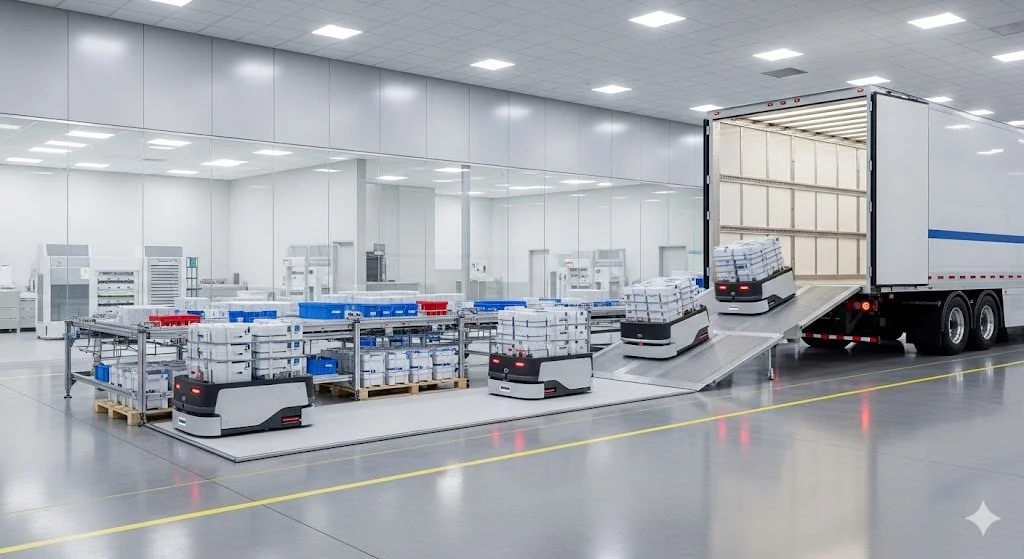
Modern supply chain facility design replaces massive, static warehousing with highly efficient receiving bays designed for rapid, automated ingestion of daily consumables. | Credit: Gemini (2026)
Shrinking the warehouse to expand the science
Your loading dock is the most expensive bottleneck in your building. How shrinking your warehouse expands your science requires a fundamental reevaluation of laboratory real estate. Historically, research facilities dedicated massive, contiguous blocks of square footage to central supply rooms and bulk storage warehouses. This "just-in-case" inventory model tied up millions of dollars in hoarded, expiring reagents and consumed prime, highly ventilated floor space that should have been generating scientific output.
To eliminate this spatial waste, architects and facility managers are transitioning to a just-in-time lab logistics model. By partnering with preferred vendors for daily or twice-daily micro-deliveries, a modern laboratory can radically decrease the volume of stock held on-site. This operational shift relies heavily on integrated Lean lab design principles, where the physical architecture actively supports rapid inventory turnover rather than static hoarding.
Translating this logistics model into the built environment means rethinking the supply chain facility from the pavement up. It demands a specialized loading dock design that prioritizes rapid offloading, immediate barcode scanning, and direct routing to decentralized point-of-use shelving, bypassing the traditional central stockroom entirely.
Key Takeaways
Just-in-Time Lab Logistics: Shifting from bulk quarterly ordering to daily or twice-daily micro-deliveries to minimize on-site holding requirements and increase inventory turnover.
Loading Dock Design: Engineering specialized, segregated receiving bays that allow rapid offloading, immediate scanning, and distribution without clogging pedestrian corridors.
Inventory Reduction: Slashing the square footage dedicated to static warehousing to free up expensive, highly ventilated lab space for active bench science.
Supply Chain Facility Integration: Designing seamless physical pathways, including dedicated freight elevators and service corridors, from the receiving dock directly to point-of-use supermarkets.
How loading dock design enables high-frequency deliveries
In a traditional facility, the loading dock is a chaotic, shared zone where hazardous chemical deliveries, clean consumables, and biological waste removal all intersect on a single concrete pad. This design completely breaks down under the strain of just-in-time lab logistics. When a facility transitions to receiving dozens of small parcel deliveries daily rather than one massive pallet a week, the dock must function with the precision of an airport sorting hub.
Modern loading dock design requires physical segregation and immediate triage capabilities. Planners must design separate bays for "clean" deliveries (e.g., pipette tips, sterile media) and "dirty" removal (e.g., chemical waste, biohazards). Because delivery trucks will be arriving constantly, the apron space outside the dock must be engineered to prevent queuing and traffic bottlenecks that delay time-sensitive reagents.
Inside the dock, architects must integrate immediate, dock-adjacent staging vestibules. Instead of moving boxes to a central stockroom to be unpacked later, these vestibules act as rapid-ingestion zones. Here, logistics staff utilize barcode or RFID scanners to log inventory into the Laboratory Information Management System (LIMS) the moment it crosses the threshold. The supplies are then immediately placed onto rolling carts or automated guided vehicles (AGVs) for direct transport to the specific lab bench that requested them.
Why inventory reduction is a primary architectural goal
Laboratory real estate is phenomenally expensive, often exceeding $1,000 to $1,500 per square foot in primary life science clusters due to heavy MEP (mechanical, electrical, and plumbing) requirements. Dedicating this highly engineered space to storing cardboard boxes of latex gloves and empty glass beakers is a catastrophic waste of capital. Therefore, aggressive inventory reduction is not merely an operational goal; it is a primary architectural directive.
By implementing just-in-time lab logistics, a supply chain facility can reduce its centralized storage footprint by 60% to 80%. This recovered square footage can be immediately repurposed into revenue-generating tissue culture suites, analytical equipment zones, or collaborative write-up spaces.
Architecturally, this requires a paradigm shift in how corridors and elevators are sized. If inventory is no longer moving on massive, wide pallets once a week, but rather on smaller, nimble push-carts multiple times a day, the internal circulation routes can be optimized. However, to prevent these high-frequency logistics carts from disrupting the science, architects must design dedicated "back-of-house" service corridors that connect the loading dock directly to the rear of the laboratory suites.
Comparing Supply Models: Bulk Warehousing vs. Just-in-Time Delivery
Delivery Frequency: Bulk warehousing relies on massive, infrequent weekly or monthly pallet drops. Just-in-time delivery relies on highly frequent, targeted daily parcel or tote deliveries.
On-Site Storage: Bulk models require massive, multi-aisle central stockrooms consuming prime real estate. JIT models require a small, rapid-turnover receiving vestibule and decentralized point-of-use shelving.
Square Footage Costs: Bulk storage wastes expensive, highly ventilated lab real estate on static inventory. JIT logistics reallocates that critical footprint to active, revenue-generating bench space and instrumentation.
Waste and Expiration: Bulk purchasing leads to high rates of expired, hoarded reagents hidden in the back of deep shelves. JIT ensures a high-turnover, rigorous first-in-first-out (FIFO) supply chain driven by actual consumption.
Expert FAQ: Just-in-Time Lab Logistics
Q: Doesn't JIT put the lab at risk during supply chain disruptions or bad weather?
A: This is the most common concern. Modern JIT does not mean zero inventory; it means optimized inventory. Facilities still calculate a localized safety stock (typically a 3- to 5-day supply) held at the bench. Furthermore, modern supply chain facilities rely on strategic vendor-managed inventory (VMI) partnerships, where the primary distributor holds the bulk safety stock in a local, off-site warehouse just miles from the lab.
Q: How does a high-frequency supply chain facility handle cold-chain deliveries?
A: The loading dock design must include immediate, dock-adjacent cold storage vestibules. When a shipment of temperature-sensitive reagents arrives, it cannot sit on a warm concrete dock waiting to be logged. Planners integrate pass-through refrigerators and -20°C freezers directly into the receiving bay wall to secure the cold chain instantly upon offloading.
Q: Does implementing JIT increase delivery truck traffic and carbon emissions?
A: Without strategic planning, yes. To mitigate this, laboratories engage in "supplier consolidation" or utilize a third-party logistics (3PL) cross-docking facility. Instead of ten different vendors sending ten different half-empty trucks to the lab each day, the vendors deliver to the 3PL hub, which then consolidates the lab's entire daily order into a single, fully loaded delivery vehicle.
References and Further Reading
National Institutes of Health (NIH). Design Requirements Manual (DRM). Office of Research Facilities, 2020.
Womack, J. P., & Jones, D. T. Lean Thinking: Banish Waste and Create Wealth in Your Corporation. Free Press, 2003.
Clinical and Laboratory Standards Institute (CLSI). QMS04: Laboratory Design; Approved Guideline. 3rd ed., CLSI, 2016.
