
Movable Casework vs. Fixed: A Cost-Benefit Analysis
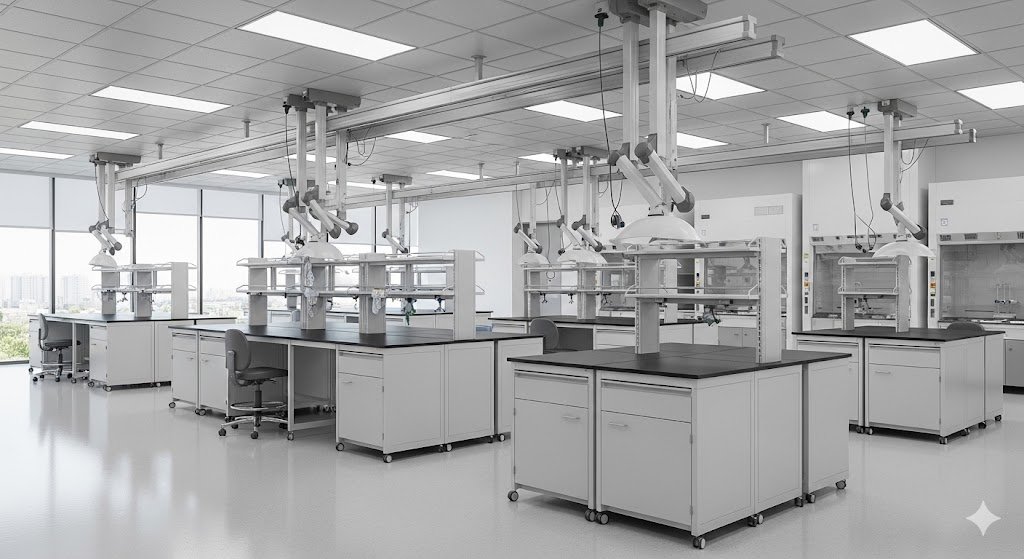
Mobile benches cost 15 percent more upfront but save 300 percent on the first renovation. We run the numbers.
Introduction: the price of permanence
For the lab architect and project manager, value engineering (VE) is often where the battle for flexibility is lost. When budgets get tight during schematic design, movable lab benches are frequently the first item cut, replaced by traditional fixed casework to save upfront capital.
This decision, while seemingly prudent on a spreadsheet today, often becomes a financial liability tomorrow. In the volatile world of life sciences, research priorities shift rapidly. A lab designed for wet chemistry today may need to support computational biology or robotics in three years. If the furniture is bolted to the floor, the cost of that transition is exponential. This article provides a comparative cost analysis of modular laboratory furniture versus fixed millwork, proving that flexibility is not a luxury—it is an asset management strategy.
The upfront premium: understanding the delta
It is undeniable that flexible systems cost more on day one. Fixed Casework: Traditional floor-mounted steel or wood casework is a commodity. It relies on standard manufacturing and simple installation (shimming and bolting). Movable Casework: Mobile systems require heavier gauge steel to withstand movement, high-performance locking casters, and vibration-dampening engineering. Furthermore, they require overhead utility carriers (as detailed in our guide on flexible lab design) rather than cheaper floor-fed rough-ins.
The Math: On average, a fully flexible lab fit-out (mobile benches + overhead service panels) carries a 15 to 20 percent premium over a traditional fixed lab fit-out. For a 10,000-square-foot facility, this can look like a significant line item to cut.
The hidden cost of fixed: the renovation scenario
The return on investment (ROI) for flexible casework is realized the moment the science changes. Let’s compare the cost of a minor lab reconfiguration—moving a bank of six benches and a sink to create space for a new floor-standing piece of equipment.
Scenario A: traditional fixed lab renovation
To move fixed benches, the facility manager faces a construction project:
Demolition: Contractors must unbolt casework and demolish floor-mounted tombstones.
MEP Rework: Plumbers must cut into the slab to cap old lines and core drill new locations. Electricians must trench the floor for new conduit.
Downtime: The lab must be shut down for weeks due to dust, noise, and vibration.
Flooring Repair: The vinyl composition tile (VCT) or epoxy floor must be patched and refinished. Estimated Cost: $300 to $500 per square foot. Time: 4 to 8 weeks.
Scenario B: movable lab renovation
To move mobile benches in a flexible lab:
Disconnect: The researcher or facility manager unplugs quick-connect gas fittings and twists-lock electrical cords from the ceiling carrier.
Relocate: The benches are unlocked and rolled to the new location or into storage.
Reconnect: The equipment is plugged into the overhead grid in the new configuration. Estimated Cost: $0 (internal labor only). Time: 2 to 4 hours.
The break-even point
For a facility with a "churn rate" (the frequency of layout changes) of just 10 percent per year, the modular laboratory furniture pays for itself within three to five years. For high-churn environments like incubators or startups, the break-even point can be less than 18 months.
Beyond hard costs: recruitment and retention
While lab renovation costs are the easiest metric to track, the soft costs of a static lab are equally damaging. Top-tier talent in genomics and personalized medicine expects a modern, adaptable environment. A lab that cannot accommodate a new piece of automation because "it’s too expensive to move the benches" is a lab that stifles innovation.
Furthermore, movable lab benches allow for better ergonomics. Many mobile systems include vertical adjustability, allowing the same bench to serve a technician standing at a microscope or a researcher sitting at a computer—a crucial factor in employee wellness and retention.
Conclusion: future-proofing the budget
For the lab planner, the argument for movable casework is not about buying furniture; it is about buying insurance against obsolescence. By advising clients to absorb the initial 15 percent premium, architects are saving them from the inevitable 300 percent penalty of future renovations. In the long game of facility management, the only thing more expensive than a flexible lab is a static one.
Frequently asked questions (FAQ)
Do movable lab benches vibrate?
High-quality mobile benches are designed with heavy-duty, locking casters and reinforced frames to minimize vibration. However, for highly sensitive equipment like NMRs or SEMs, a dedicated vibration isolation table or a fixed island is still recommended.
Can I mix fixed and movable casework?
Yes. A "hybrid" approach is a common compromise. Architects often place fixed casework with sinks on the perimeter walls for stability and drainage, while keeping the center "dance floor" comprised entirely of movable tables to allow for reconfigurability.
How long do mobile benches last?
Modular laboratory furniture is typically built to a higher standard of durability than fixed casework because it is designed to be handled. When properly maintained, a mobile steel bench system has a lifespan of 20+ years, often outlasting the building's mechanical infrastructure.
