
Overhead Service Carriers: The Key to Plug-and-Play Utilities
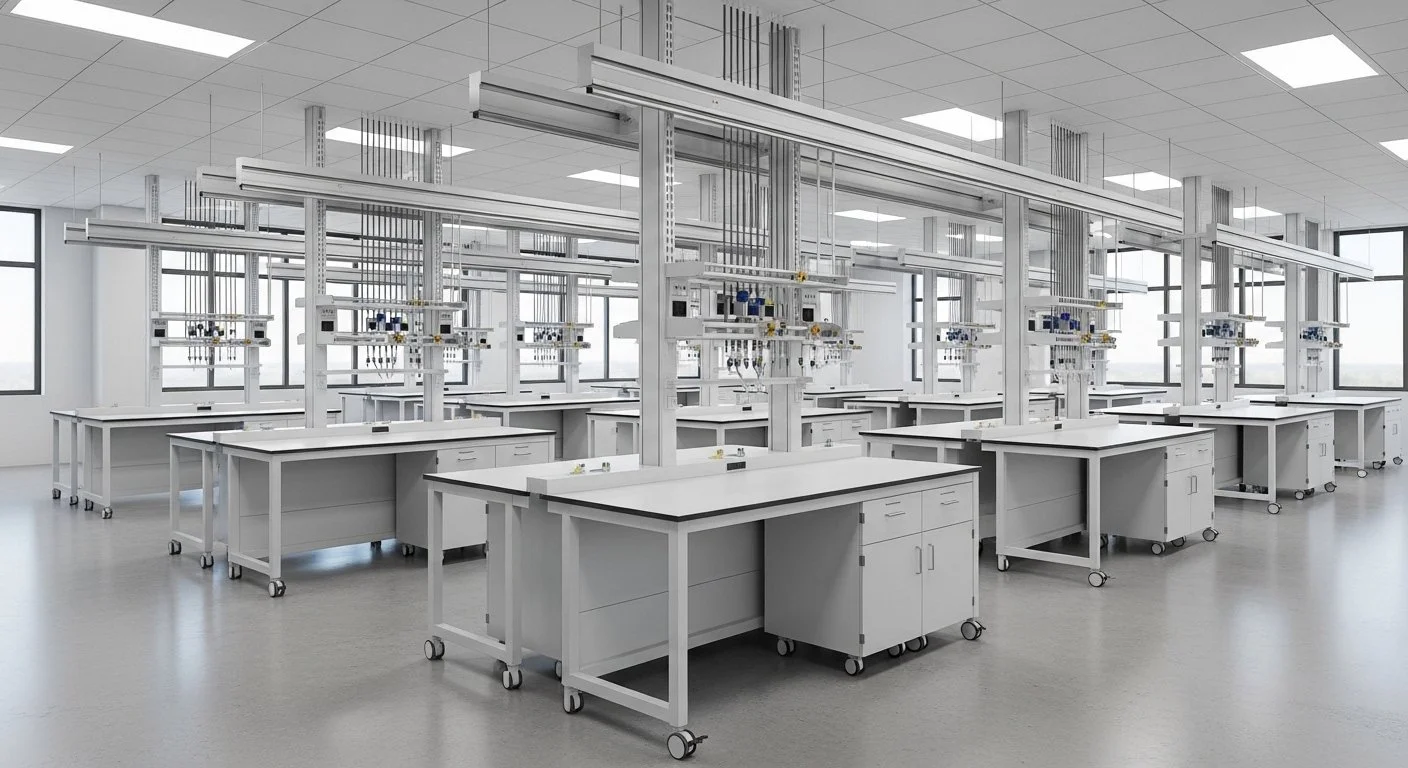
Stop tearing up floors to move a sink. Why overhead utilities are the ROI king of flexibility.
ImageFX (2026)
Introduction: decoupling the slab
In traditional laboratory construction, the mechanical, electrical, and plumbing (MEP) systems are entombed in the concrete slab. If a lab planner needs to add a gas line or move a sink three feet to the left, it triggers a cascade of core drilling, floor trenching, and downtime that can paralyze research for weeks. This rigid approach is incompatible with the speed of modern science.
The solution lies in decoupling the infrastructure from the architecture. By shifting utilities from the floor to the ceiling, overhead service carriers transform the laboratory from a static monument into a responsive machine. This article compares the two dominant strategies—service panels versus service gantries—and guides the lab architect on how to select the right system for a truly adaptable research environment.
What are overhead service carriers?
Overhead service carriers are suspended infrastructure elements that deliver gases, power, data, and vacuum to the benchtop from above. Unlike floor-mounted tombstone pedestals, which anchor benches in place, overhead systems allow the floor to remain completely clear. This enables the use of mobile tables and allows for rapid reconfiguration of the layout without requiring a single plumber to cut a pipe.
For any facility aiming to achieve comprehensive, flexible lab design, selecting the correct overhead distribution method is the critical first step.
Strategy one: the service panel
Service panels (often called ceiling service panels or service tiles) are discrete, flush-mounted units integrated directly into the suspended ceiling grid. They typically fit into standard two-by-four or two-by-two ceiling grids.
The mechanism: Service panels utilize flexible hoses and cables that drop down to the benchtop. These drops can be connected to vertical service columns on mobile benches or directly to equipment. When not in use, the hoses can be retracted or disconnected, leaving a clean ceiling plane.
Pros:
Aesthetics: Because they are flush with the ceiling, panels offer the cleanest visual look, ideal for open-plan labs where sightlines are a priority.
Grid flexibility: Panels can be easily relocated within the ceiling grid if the underlying MEP rough-ins allow for slack.
Cost: Generally, service panels have a lower material cost than heavy-duty gantries.
Cons:
Density limits: A single panel has limited real estate for outlets and gas fittings.
Vertical management: Managing the "spaghetti" of hanging cables can be visually chaotic if not strictly managed by lab staff.
Strategy two: the service gantry
The service gantry (also known as a boom, wing, or carrier) is a rigid, linear structure suspended 18 to 24 inches below the ceiling. It runs parallel to the benchtop, acting as a floating spine for utilities.
The mechanism: The gantry houses hard-piped gases and hard-wired electrical lines. It features face-mounted outlets and valves along its entire length. Benches are wheeled underneath the gantry, and equipment is plugged directly into the face of the carrier or via short umbilicals.
Pros:
High density: Gantries can accommodate a massive volume of services, making them ideal for chemistry and physics labs with heavy utility demands.
Lighting integration: High-performance task lighting is often built directly into the underside of the gantry, providing optimal illumination for the bench surface.
Shelving support: Many gantry systems are structural, allowing for adjustable shelving or monitor arms to be suspended directly from the carrier, freeing up desk space.
Cons:
Visual obstruction: Because they hang lower than the ceiling, gantries can interrupt sightlines and make the room feel smaller.
Fixed orientation: While the services are flexible, the gantry itself is a large, linear element that dictates the orientation of the bench rows.
Critical consideration: the gravity drainage problem
The biggest technical challenge for the lab architect when moving to overhead utilities is drainage. Water does not flow up.
If a lab planner specifies a ceiling utility grid, they must address how cup sinks and waste lines are handled.
Pumped Systems: Small lift stations pumps, installed under the mobile sink bench, pump waste up to the overhead carrier. This offers maximum mobility but introduces mechanical points of failure and noise.
Floor Points: A hybrid approach uses overhead carriers for gases and power but retains a grid of floor drains. This compromises total flexibility but relies on fail-safe gravity drainage.
The ROI of flexible MEP design
Implementing overhead service carriers typically incurs a premium of 15 to 20 percent over traditional floor-fed systems during construction. However, the return on investment (ROI) is realized during the first renovation.
Moving a floor-fed sink involves cutting concrete, x-raying the slab, and abatement—a process costing thousands of dollars per linear foot. Reconfiguring a lab with overhead carriers involves unplugging a quick-connect fitting and unlocking the casters on a bench. The cost is zero, and the time is measured in minutes.
Conclusion: future-proofing the envelope
Whether the design team favors the discrete aesthetic of service panels or the industrial utility of gantries, the move to overhead services is non-negotiable for modern facilities. By clearing the floor, the lab architect grants the user ownership of their space, allowing the laboratory to evolve at the speed of their research.
Frequently asked questions (FAQ)
Can overhead service carriers handle high-voltage power?
Yes, both panels and gantries can be configured to deliver high-voltage power (208V, 240V, or 480V) required for specialized equipment like mass spectrometers or freezers.
How do quick-connect fittings work for gases?
Quick-connect fittings operate like hydraulic couplers. They allow lab staff to plug and unplug gas lines (vacuum, air, and nitrogen) instantly without tools and without the risk of leaking, as the valve seals automatically upon disconnection.
Are overhead carriers compatible with cleanroom environments?
Yes, specially designed flush-mounted service panels are standard in cleanroom design to minimize horizontal surfaces where dust can collect and to seal the plenum against air leakage.
