
The "Dance Floor" Lab: Designing for Maximum Flexibility
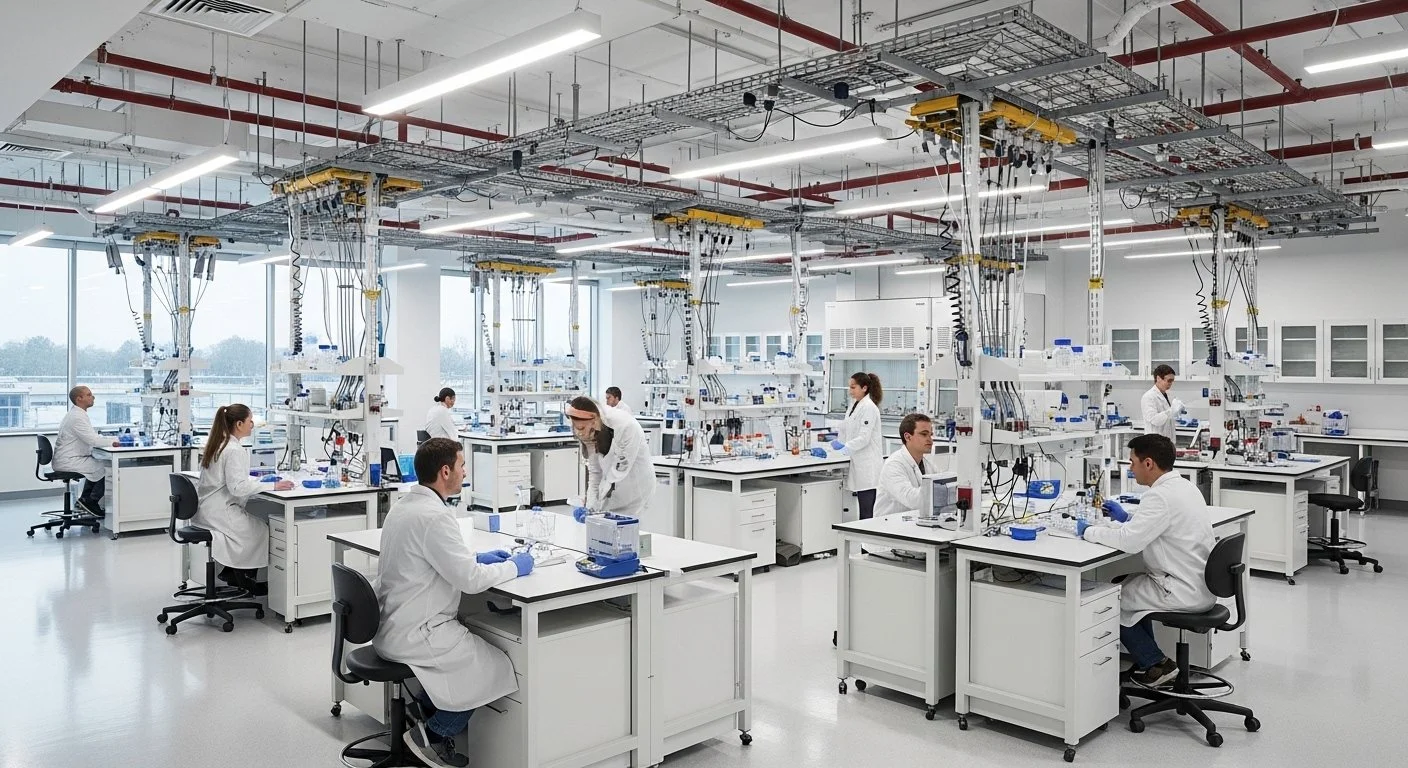
Research changes faster than construction. If your benches are bolted to the floor, your lab is already obsolete.
Introduction: the static lab is dead
For decades, laboratory design was dictated by a legacy of permanence. Heavy, fixed casework, floor-mounted utilities, and rigid partition walls defined the research environment, creating spaces that were built to last fifty years but often became functionally outdated in five. This static model forces costly renovations every time a principal investigator leaves or a grant focus shifts. However, the modern scientific method is fluid and increasingly interdisciplinary. A space dedicated to wet chemistry and genomics today may need to transition to robotics, automation, or computational analysis tomorrow.
For the Lab Architect and Lab Planner, the mandate has shifted from designing for a specific function to designing for capability. The challenge is no longer just housing equipment; it is creating an infrastructure that supports rapid pivot capability. This article serves as a definitive guide to flexible lab design, exploring the architectural strategies, mechanical infrastructures, and modular lab furniture systems required to build the "future-proof" laboratory that can weather the volatility of modern science.
What is flexible lab design?
Flexible lab design is an architectural and engineering approach that prioritizes adaptability, allowing research spaces to be reconfigured rapidly with minimal cost and operational downtime. It goes beyond simple movability; it is a holistic strategy that decouples the building's fixed infrastructure (MEP systems) from the user's operational equipment. Unlike traditional static labs, where change requires demolition permits and contractors, flexible designs utilize mobile workstations, overhead utility grids, and open floor plans to accommodate changing scientific workflows on demand.
The three pillars of flexible lab design include:
Open architecture: Minimizing fixed walls to create vast, open sightlines.
Mobile casework: Replacing fixed joinery with wheels and quick-connect systems.
Overhead distribution: Moving utilities (gas, power, data, vacuum) from the floor to the ceiling.
The "Ballroom" concept: creating the lab dance floor
The most aggressive and successful iteration of flexibility is known as the "Ballroom" or "Dance Floor" concept. Moving away from the cellular or "bay and alcove" models that isolate teams, this layout treats the center of the laboratory as a tabula rasa—entirely void of fixed vertical elements. It reimagines the lab as a vast, open stage where the "furniture sets" can be changed between acts without altering the theater itself.
The architectural grid
To make the ballroom concept work, planners must rely on a rigorous planning module. The industry standard has shifted from the tight 10-foot module to a more generous 11-foot (3.3-meter) planning module.
Why 11 feet? It allows for a standard 5-foot bench, a 5-foot aisle, and wall thickness/clearance.
The result: This spacing creates a predictable grid where movable casework can be rearranged without blocking egress paths or violating safety clearances.
Sightlines and collaboration
By removing floor-mounted service columns and fixed shelving, the "Dance Floor" opens up visual connectivity across the lab. For the Laboratory Designer, this isn't just about aesthetics; it's about safety and science. Principal investigators can oversee multiple workflows simultaneously, and researchers are encouraged to collaborate across disciplines, breaking down the silos that fixed walls tend to create.
Modular lab furniture vs. traditional fixed casework
The defining feature of an adaptable lab is the furniture specification. The transition from fixed millwork to a "kit-of-parts" approach is essential for a future-proof lab layout. Traditional joinery, while durable, locks a lab into a specific configuration. If a researcher needs to add a floor-standing piece of equipment—like a high-performance liquid chromatography (HPLC) unit or a robotic handler—removing a fixed bench is a construction project. Modular systems eliminate this barrier to entry.
The anatomy of modular systems
Modular lab furniture is independent of the building structure. It consists of:
Mobile tables: Heavy-duty tables on locking casters, rated for vibration sensitivity suitable for microscopy and instrumentation.
Suspendable cabinets: Under-bench storage that can be unhooked and moved, rather than permanently attached.
Vertical adjustability: Shelving systems and work surfaces that can be raised or lowered to accommodate sitting or standing workflows (ergonomic compliance).
Movable casework strategies
When specifying movable casework, architects should look for systems that integrate with the overhead infrastructure. The goal is "plug-and-play." A researcher should be able to disconnect a bench, wheel it to a new location, and reconnect it within minutes, not days.
Designer note: Avoid "hybrid" systems that bolt mobile tables to the wall. True flexibility requires 360-degree mobility.
Vertical integration: the ceiling as the utility highway
If the furniture moves, the utilities cannot come from the floor. Floor boxes, monuments, and tombstone pedestals act as anchors, effectively killing flexibility by tethering benches to a specific location. To achieve a truly agile environment, the "umbilical cord" of the laboratory must be inverted. The solution lies in the ceiling service panels and overhead carriers that create a utility highway accessible from anywhere on the grid.
Overhead service carriers
The modern flexible lab utilizes overhead carriers (often called service wings, booms, or gantries) that run parallel to the bench grid. These carriers house:
Gases: Vacuum, compressed air, nitrogen, and specialty gases.
Power: High-voltage and standard outlets.
Data: High-speed Ethernet ports.
Quick-connect fittings
To achieve true mobility, plumbing and gas connections must utilize quick-connect fittings (similar to hydraulic couplers) rather than hard-piped connections. This allows lab managers to disconnect equipment without calling a plumber or shutting down the main supply for the entire floor.
The ceiling grid challenge
For the Lab Architect, this requires intense coordination of the Reflected Ceiling Plan (RCP). The overhead carriers must not conflict with:
HVAC ductwork and diffusers.
Pendant lighting (direct/indirect).
Sprinkler coverage and fire alarm strobes.
Designing for the "wet-to-dry" shift
One of the primary drivers for flexible lab design is the changing ratio of wet lab (chemical/biological) to dry lab (computational/analysis) space. As bioinformatics, in silico experimentation, and AI-driven research grow, the traditional requirement for miles of benchtop and sink space is decreasing. Conversely, the need for high-power computing space and data analysis zones is skyrocketing. Designing a lab that can oscillate between these two states is the ultimate test of flexibility.
The swing space strategy
A future-proof lab layout designates "swing zones"—areas capable of functioning as either wet or dry labs.
HVAC capacity: Design the HVAC system to handle the heat loads of freezers and incubators (wet) and high-density server racks or workstations (dry).
Drainage points: Place floor drains and sink connections at regular intervals (e.g., every other module grid) and cap them. If a dry zone needs to become a wet zone later, the plumbing infrastructure is already in the slab.
Data density: Ensure dry labs have robust data trunking that exceeds standard office requirements.
Mechanical systems: the invisible backbone
While architects focus on the visible layout, the flexibility of a lab is ultimately dictated by the Mechanical, Electrical, and Plumbing (MEP) systems. You cannot move a wall if the ductwork is rigid, and you cannot add a fume hood if the air handler is maxed out. The MEP infrastructure must be the "invisible backbone" that supports the modularity of the visible space, often requiring over-engineering in the initial phase to support future unknowns.
Variable air volume (VAV) & manifolded exhaust
Flexible labs rely on VAV systems that can ramp up or down based on occupancy and chemical usage. Manifolded exhaust systems allow for the addition of fume hoods or snorkels in the future without requiring new rooftop fans.
The "plug-and-play" fume hood
Fume hoods are traditionally the most static element in a lab. However, new filtered (ductless) fume hoods and flexible-ducted hoods allow for limited mobility. For hard-ducted hoods, providing multiple capped duct connection points in the ceiling allows hoods to be relocated to different zones within the "Dance Floor" without major renovation.
The cost argument: CAPEX vs. OPEX
Clients often balk at the initial price tag of flexible systems. Modular lab furniture and overhead service carriers can cost 15 to 20 percent more upfront than traditional fixed casework. However, this view is myopic. When presenting to stakeholders, architects must frame the conversation around the Total Cost of Ownership (TCO). The initial capital expenditure (CAPEX) is higher, but the operational expenditure (OPEX) over the life of the building is drastically lower.
The ROI argument for architects:
Renovation costs: Moving a fixed wall and plumbing in a traditional lab can cost $300-$500 per square foot and take weeks. Reconfiguring a "Dance Floor" lab costs $0 and takes hours.
Churn rate: Research teams change rapidly. A facility with a high "churn rate" will recover the premium cost of flexible design within three to five years of operation.
Recruitment: Top-tier talent expects modern, adaptable facilities. A flexible lab is a recruitment tool.
Key considerations for lab planners
When moving from concept to schematic design, detailed planning prevents flexibility from becoming chaos. While the broad strokes of the "Dance Floor" are appealing, the success of the project often lies in the specific technical constraints. Keep these checklists in mind:
1. The vibration factor
Mobile furniture is lighter than fixed casework.
Challenge: Sensitive equipment (microscopes, NMR) requires stability.
Solution: Create designated "fixed islands" or vibration-dampened zones on the perimeter, keeping the center floor mobile. Or, specify heavy-duty locking casters rated for high stability.
2. Chemical storage
If benches are mobile, where do the reagents go?
Solution: Utilize mobile flammable and acid storage cabinets that fit under benches but can be rolled to a safety zone. Ensure strict adherence to fire codes regarding the quantity of chemicals stored in the open zone.
3. Acoustic control
Open "Ballroom" labs can be noisy.
Solution: Use high-NRC (Noise Reduction Coefficient) ceiling tiles and acoustic baffles. Segregate noisy equipment (centrifuges, shakers) into enclosed equipment rooms with glass walls to maintain visibility but dampen sound.
Conclusion: designing for the unknown
The era of the "forever layout" is over. As science advances into the realms of personalized medicine, quantum computing, and CRISPR applications, the physical requirements of the laboratory will continue to mutate.
For the Lab Architect and Laboratory Designer, success is no longer defined by how well the space fits the current equipment, but by how effortlessly it accommodates the equipment that hasn't been invented yet.
By embracing the flexible lab design ethos—utilizing the "Dance Floor" concept, modular lab furniture, and overhead utilities—we create infrastructure that does not just house science, but actively accelerates it.
Frequently asked questions (FAQ)
What is the difference between modular and flexible lab design?
Modular design refers to the components (furniture, walls) being standardized and independent. Flexible design is the holistic strategy that uses those modular components to allow for easy reconfiguration of the space.
How does flexible lab design impact LEED certification?
Flexible design often contributes positively to LEED scoring. Modular components are reusable, reducing construction waste during renovations (Materials & Resources). Furthermore, efficient VAV systems required for flexibility improve Energy & Atmosphere scores.
Can existing labs be retrofitted into flexible spaces?
Yes, but it is challenging. It usually requires gutting the space to the slab to reroute plumbing to the ceiling. However, replacing fixed casework with mobile benches in an existing grid is a cost-effective "light" retrofit.
