
Life Science and Physical Science in Transition: Flexibility, AI, and the Future of Research Spaces
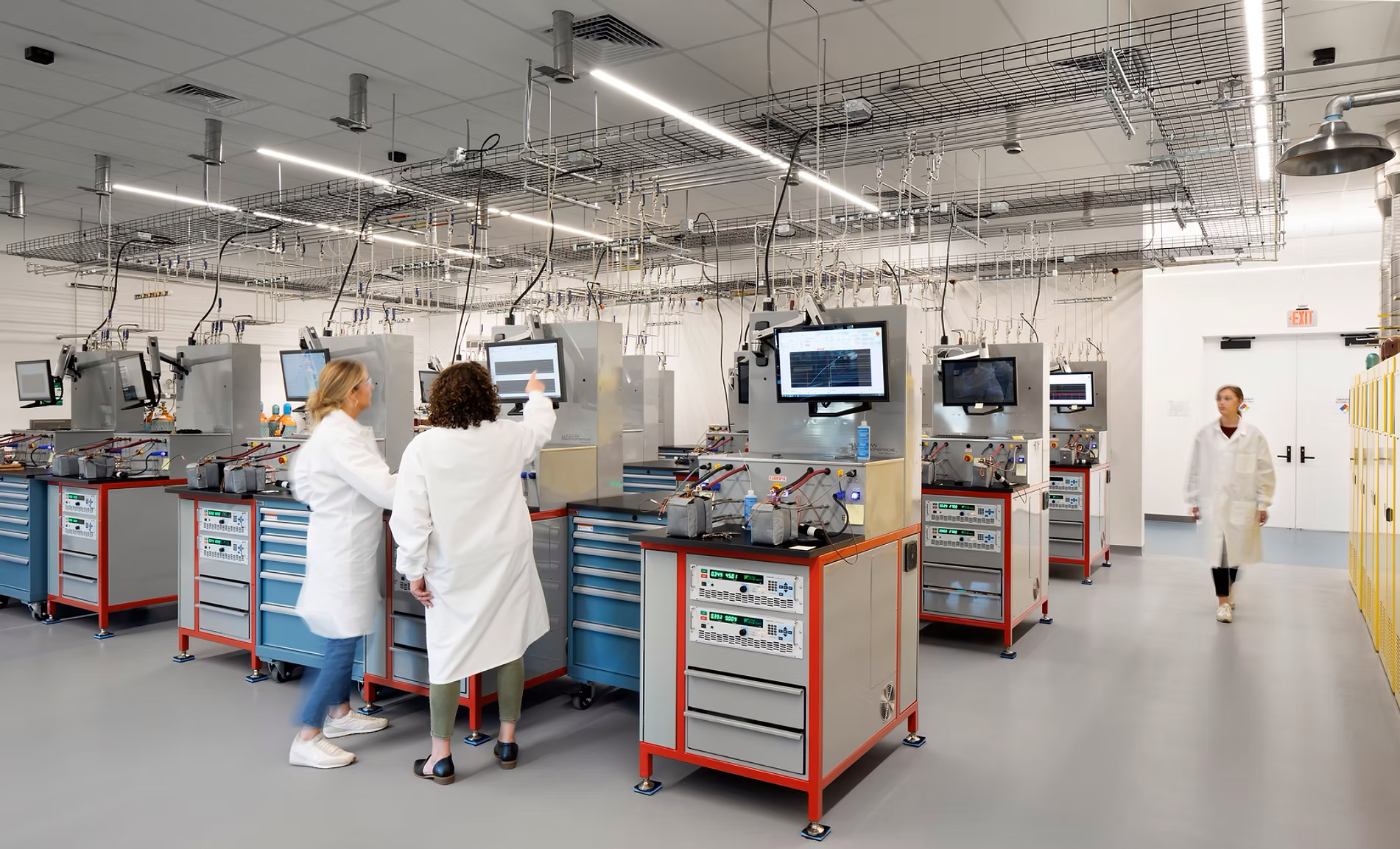
Advent Technologies in Charlestown, MA, features flexible design for the possibility of multiple startups incorporating their own automation processes. Image: Courtesy of Ci Design
Anna Evangelista, associate principal, director of lab and manufacturing planning with Ci Design, is co-author of this piece.
The life sciences and physical sciences sectors are navigating a turbulent period shaped by the aftershocks of the COVID-era boom. In 2024, a flood of new lab spaces entered the market, driven by heightened demand during the pandemic. But as venture capital funding remained cautious, momentum slowed.
As companies face the difficult decision to restructure in order to extend their funding runway or look for operational efficiency, the market is grappling with how to absorb the glut.
Despite these challenges, innovation is reshaping how science is conducted—and how lab spaces are designed.
AI as a catalyst
Scientific discovery and artificial intelligence are increasingly intersecting, with some clients dedicating entire buildings to AI-driven research. The promise is compelling: AI can process and learn from massive data sets, identifying workflow patterns, improving efficiency, and shortening discovery timelines.
Historically, drug development has been slow and labor-intensive. Now, AI offers the possibility of accelerating discovery time significantly, transforming what can take years into months. Scientists are no longer limited to traditional automation; they can now leverage smarter coding and data analysis tools to solve problems in real time as the technology constantly learns and refines its insights.
For lab designers and engineers, this shift places a focus on flexibility. Spaces must be able to adapt quickly to new workflows, whether by reconfiguring benches or rethinking equipment layouts based on the latest data.
Cloud vs. physical space
Another major evolution is the role of data. Increasingly, scientists rely on the cloud rather than physical server rooms with racks in the lab proper, creating the perception that storage and processing are limitless and “free.” Behind the scenes, however, mission critical design teams are working to ensure these systems can handle the demands of next-generation research and data analysis. The distinction highlights an invisible but essential backbone of the modern science ecosystem.
Cleanrooms reimagined
Cleanrooms remain essential in advanced research and manufacturing, but their design and use are evolving. Companies are beginning to use robots for cleanroom work, reducing the need for human presence—the greatest source of contamination. This shift can also eliminate the need for traditional transversing spaces such as airlocks, cutting both cost and space requirements.
Traditional cleanroom environments are notoriously uncomfortable for the end users: extremely cold or hot, dry, and physically taxing due to stringent protective equipment. Automating these spaces not only improves efficiency but also alleviates the human burden.
Companies that are in the advanced stages of discovery, are also exploring modular cleanroom designs, collaborating with leading equipment manufacturers to provide scalable solutions that can be tailored to project needs. Instead of investing in massive, permanent infrastructure, companies can build cleanrooms that can expand or contract depending on demand.
A leaner, smarter future
While the current climate for scientific discovery may feel uncertain, the long-term trajectory points toward smarter, leaner, and more adaptable solutions. AI integration, flexible lab design, cloud-based infrastructure, and robotic cleanrooms are not just trends—they represent a redefinition of how science gets done.
In an industry where efficiency and speed are critical competitive advantages, the question is no longer whether to adopt these innovations, but how quickly they can be implemented. The companies that embrace this shift—working smarter, not harder—will be best positioned to thrive in the next chapter of scientific discovery.

Anna Evangelista, co-author of this piece, brings more than 13 years of science and technology design experience to Ci Design, Inc. As an associate principal and the director of lab & manufacturing planning, she blends a strong architectural foundation with a thoughtful, human‑centered approach to environments that are often perceived as cold or clinical.
Anna is known for her ability to define, streamline, and manage project workflows from concept through completion. She is deeply committed to client satisfaction and ensures that every stakeholder feels supported and informed throughout the process. Her distinctive information‑gathering process helps uncover critical project needs, enabling innovative and efficient design solutions.