
Designing Lab and Support Spaces as Welcoming, Productive Workplaces
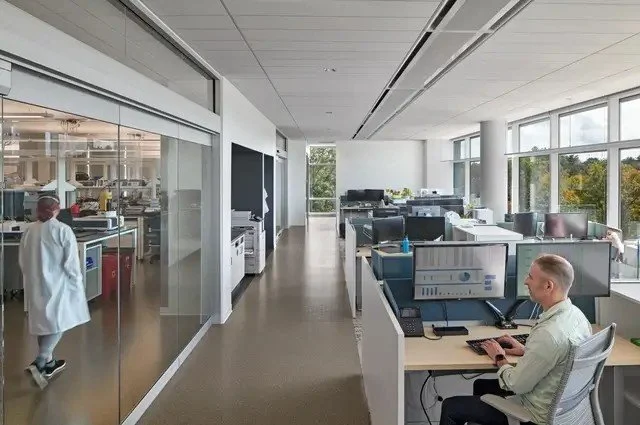
At New England Biolabs, workplace design emphasizes both scientific performance and the employee experience, creating environments where researchers and support staff can collaborate, focus, and feel supported throughout the workday. Image: Courtesy of ARC
Laboratories have long been designed with safety, technical requirements, and specialized equipment as top priorities. While those factors remain essential, many life science organizations are now expanding their focus to include the overall employee experience. Lab environments are no longer viewed solely as technical workplaces—they are also everyday environments where scientists, administrators, and support staff collaborate, concentrate, and spend much of their day.
Design teams and organizations are increasingly recognizing that thoughtful workplace design can help attract talent, improve productivity, and support employee well-being. As Katie Archard, AIA, LEED AP BD+C, architect and associate principal with ARC/Architectural Resources Cambridge, tells Lab Design News, workplace design has become closely tied to business strategy.
“Clients see the workplace as an everyday advantage in the race to retain, recruit, and support employees,” she says. “The challenge there is how to provide the amenities in their renovations that are actually attractive to current and future employees.”
Katie will be a featured speaker at the 2026 Lab Design Conference in Orlando, FL, being held on May 11-14. Katie and her co-speakers will present on “Maximizing Efficiency in Urban Lab Spaces Through Phased Fit-outs.” Tickets are available on the Lab Design Conference website—get yours today to join us in Orlando!
Designing for flexibility and long-term value
Life science companies often operate in an environment of rapid change, whether driven by shifting research priorities, new technologies, or evolving market demands. As a result, designing laboratories and support spaces that remain useful over time can be difficult.
Archard notes that uncertainty about future needs is one of the biggest challenges many organizations face. “First, many of our clients experience rapid marketplace changes that make it hard to plan and forecast,” she says. “Developing a design that delivers flexibility and provides a long lifecycle return for their investment is challenging.”
One effective strategy is the development of design standards that can guide future renovations and updates. Standardized layouts and systems for certain types of labs or support spaces help organizations adapt as research groups change or expand. Archard says, “These standards assist our clients in guiding the renovation of their spaces so that future use and subsequent lab teams can more seamlessly occupy these spaces as they shift and/or relocate within their buildings and existing portfolio locations.”
This approach allows companies to update and reconfigure spaces without starting from scratch each time a new team or project moves in.
Understanding the employee experience
Before any design decisions are made, many organizations are beginning to take a closer look at how employees actually use their workplaces. Understanding daily workflows, frustrations, and preferences can help ensure that renovations and upgrades support real needs rather than assumptions.
“What we’ve learned is how valuable it is, before any design conversations happen, to start with an objective look at the day-to-day employee experience,” Archard says. “When we understand employee expectations, frustrations, and preferences, any design work that follows is more informed and practical, and better able to meet employees' needs and desires.”
Gathering this insight often involves surveys, interviews, and workshops with staff. These conversations can reveal issues that might otherwise go unnoticed, such as the need for better proximity between lab and support functions or improved circulation between different work areas.
“We strongly encourage clients to open this dialogue with their teams as early as possible in the design phases,” Archard says. “We help our clients identify both what is working and what needs improvement.”
For more insights from Katie Archard on collecting lab end user feedback, view our free on demand webinar: Client and Design Team Communications: Strategies for Seamless Lab Design.
Balancing focused work and collaboration
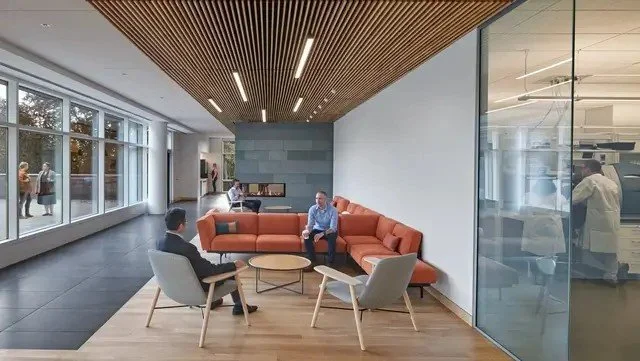
Workplace “zones” at New England Biolabs support different working styles, offering quiet areas for focused tasks alongside collaborative spaces where lab teams can gather, share ideas, and move easily between activities throughout the day. Image: Courtesy of ARC
One consistent finding from employee feedback is the need for a range of workspace types. Scientists and lab teams often move between collaborative and highly focused tasks throughout the day, and a single type of workspace rarely supports all those activities effectively.
To better accommodate different working styles, many organizations are creating varied workplace “zones.” In one project, Archard’s team helped a pharmaceutical client conduct a survey before beginning a multi-floor renovation. The results highlighted a strong need for quiet areas where employees could concentrate away from the bustle of the lab.
“The responses showed us, among other things, how important it is to provide quiet spaces for focused work, which greatly balances and supports the activities taking place in the lab,” Archard says.
Other projects have used a neighborhood-based approach to workplace design. One client divided its workspace into three acoustically distinct areas: a quiet zone for individual work, a moderate zone for team collaboration, and a more energetic zone for social interaction and informal gatherings. Carefully designed acoustics, furniture selections, and layouts reinforce the intended activities within each zone.
These strategies allow lab employees to move between different environments depending on the task at hand, helping maintain both productivity and collaboration.
Rethinking existing space
Many life science organizations are focusing on renovation and reuse rather than new construction. Repurposing existing lab and office space can improve efficiency while reducing costs and environmental impact.
“In approaching renovation, we look first at current lab and office assets to determine what we can keep or repurpose,” Archard says. “Having a clear understanding of the space inventory available for these clients is vital.”
This assessment often reveals opportunities to consolidate underused areas and improve space utilization, especially in hybrid work environments. Offices and cubicles that once dominated many facilities may no longer reflect how employees actually work.
“Many clients are re-evaluating/re-thinking the need for assigned seating and dedicated offices,” Archard notes. In some cases, former office areas can be transformed into meeting rooms, collaboration spaces, or open work areas that offer greater access to daylight and exterior views.
These changes can dramatically reshape the feel of a workplace, turning dense, enclosed floor plans into brighter and more flexible environments.
Supporting health and wellness
Wellness has also become a central consideration in workplace design. While laboratory safety requirements remain critical, organizations are recognizing that healthy environments can also improve morale, engagement, and performance.
“With greater awareness of the productivity and health benefits of a well-designed, healthy workplace, our clients see wellness as a strategic opportunity, a must-have,” Archard says.
Design teams are applying strategies such as increased daylight access, biophilic design elements, and materials that connect interior spaces to the natural environment. Natural materials like wood and stone, nature-inspired color palettes, and carefully designed lighting systems can create a more comfortable and calming atmosphere. This is especially beneficial in collaborative areas outside the lab.
Outdoor amenities can also play a role. Walking paths, landscaped seating areas, and garden spaces encourage employees to spend time outside and incorporate movement into their workday, supporting both physical and mental health.
Creating workplaces that inspire
Ultimately, the goal of modern lab workplace design is to create environments that support a wide range of working styles while helping employees feel engaged and energized.
“Given how much choice people have about where they work and for whom, it’s more important than ever to create an environment designed for a wide range of working styles,” Archard says. “Whether considering an employee’s experience when working in a lab or an office, a fundamental design goal should be to create spaces that excite and allow creativity to thrive.”
As life science organizations compete for talent and adapt to evolving research priorities, the workplace itself has become an important part of the equation. Thoughtful design can transform laboratories and their support spaces from purely technical environments into workplaces that are comfortable, flexible, and supportive of the people who use them every day. When done well, these environments not only support scientific work, but help create a setting where employees can stay engaged, productive, and inspired.