
The "Collab-Corridor": Designing Zones for Serendipity
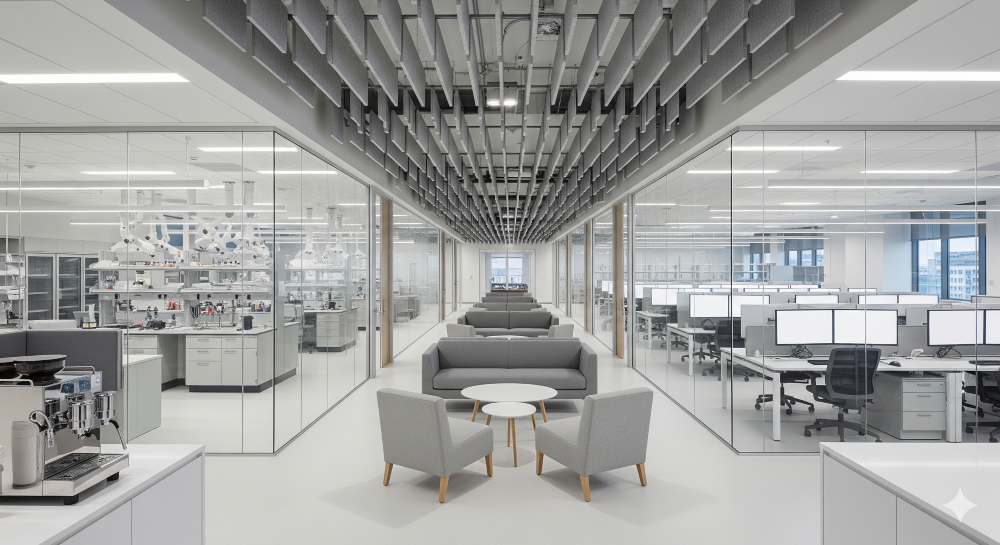
Innovation happens in the hallway. Designing 'collision zones' to break down the Wet/Dry silo.
Credit: Gemini (2026)
Introduction: The architecture of interaction
Historically, laboratory buildings were designed to keep people apart. To maintain safety and containment, wet bench scientists were sequestered behind heavy fire doors, while administrative and computational staff were relegated to separate floors or entirely different buildings.
Today, that physical separation is stifling innovation. The modern drug discovery process is an iterative loop between physical experimentation and digital simulation. As the industry shifts heavily toward computational models—a shift we detailed in our analysis of dry lab design trends—the disconnect between the wet lab chemist and the dry lab bioinformatician is becoming a massive bottleneck.
For the modern lab architect, the challenge is to engineer serendipity. By intentionally designing a lab collaboration space that acts as a bridge between the physical and digital sciences, architects can force interaction, spark spontaneous conversations, and ultimately accelerate the speed to market.
The "Collision Zone": Forcing the interaction
You cannot schedule a breakthrough in a sterile conference room. True innovation often happens organically—in the hallway, waiting for the elevator, or grabbing a cup of coffee. These spontaneous, unstructured interactions are where cross-disciplinary ideas are born, and complex problems are suddenly viewed from a new angle. Planners refer to these highly trafficked, informal intersections as "collision zones."
To design an effective collision zone, architects must deliberately manipulate the circulation paths of the building, turning passive transit areas into active destinations that encourage people to linger and converse.
The Centralized Amenity: Instead of putting a small coffee pot in every departmental breakroom, successful facilities create centralized social hubs. By placing the only premium espresso machine or the primary cafe at the exact nexus of the wet lab and dry lab wings, scientists from different disciplines are forced to cross paths daily.
The "Collab-Corridor": Rather than treating hallways simply as life-safety egress routes, widen them. Introduce soft seating, writable glass surfaces, and acoustic dampening to turn a 6-foot corridor into a 12-foot linear collaboration lounge. When two researchers bump into each other and start discussing an assay, they should have a place to sit down and sketch a formula immediately.
Write-up zones: The physical bridge
The most critical transition point in a modern facility is the boundary between the active bench and the desk.
In the past, this boundary was a massive physical and cognitive barrier. Scientists would perform a wet experiment, go through the tedious process of de-gowning, wash their hands, and walk down a long, disconnected hallway to an enclosed office just to record their findings or run a quick analysis. This physical separation broke the momentum of discovery and caused critical delays. Today, the preferred strategy eliminates this friction by utilizing integrated write-up zones. These are clean, tech-enabled "dry" zones placed immediately adjacent to the "wet" lab floor, often separated only by a high-visibility glass partition, allowing the researcher to transition from pipette to keyboard in seconds.
Visual Connectivity: The glass barrier maintains necessary safety and acoustic isolation while allowing the computational biologist sitting in the write-up zone to make eye contact with the chemist running the centrifuge.
Ergonomics & Tech: These spaces must feature sit-stand desks, dual-monitor setups, and high-speed data access, acknowledging that analyzing the data is just as critical as generating it.
Science on display
A key concept in breaking down silos is "science on display." Solid walls breed isolation; transparency breeds curiosity.
By utilizing extensive interior glazing along the collab-corridors and social hubs, visitors and researchers from other departments can physically see the science happening inside the labs. This visual accessibility demystifies the work being done across the aisle. When a coder can watch a robotic liquid handler in action through a glass wall, it grounds their digital algorithms in physical reality.
Design Tip: When utilizing glass partitions for science on display, ensure proper glare control (through lighting design or fritted glass patterns) so that researchers inside the lab are not blinded by the ambient light from the collaboration corridors.
Case study: The Francis Crick Institute
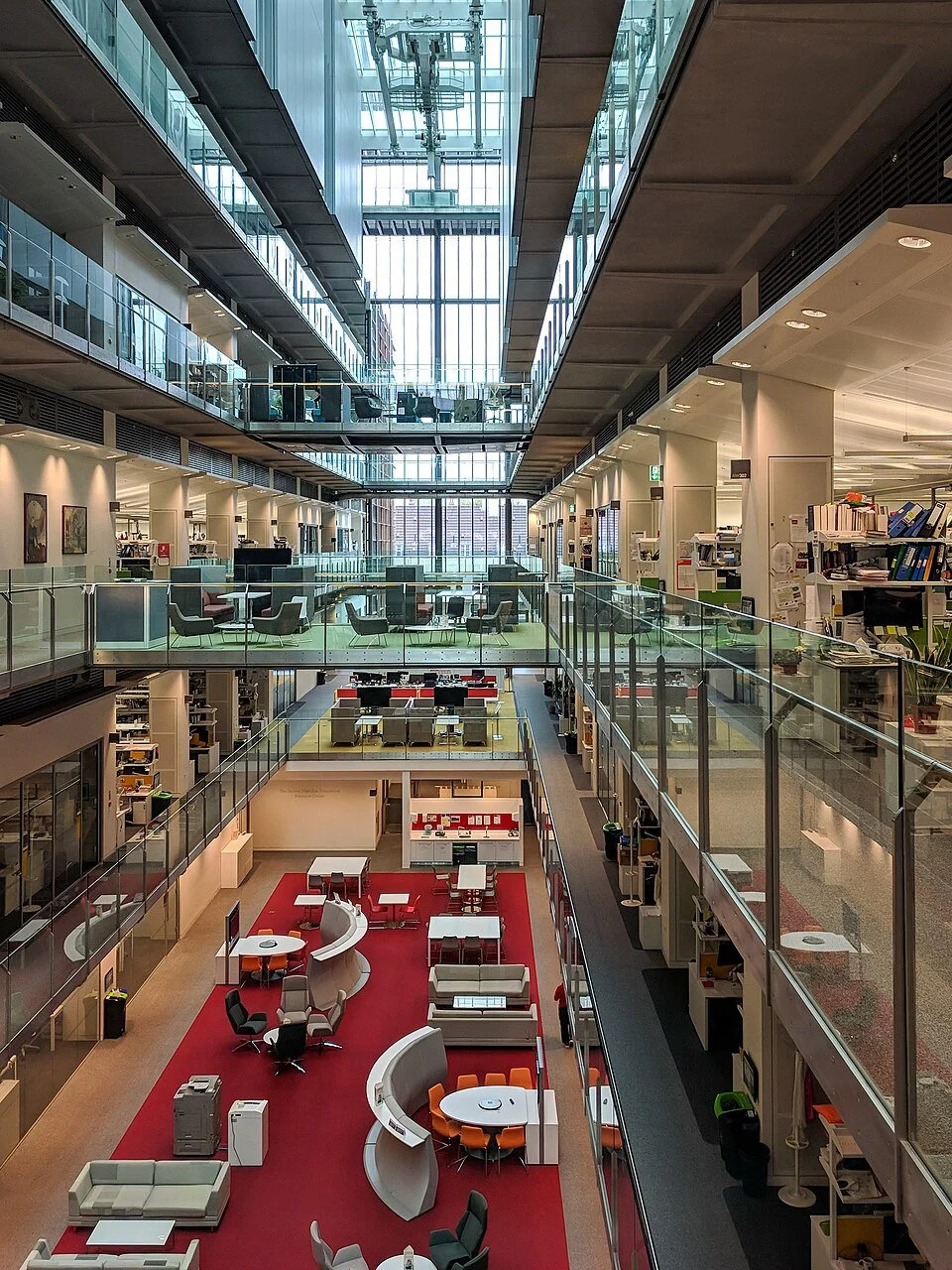
A globally recognized masterclass in engineering serendipity is the Francis Crick Institute in London. Designed by HOK, PLP Architecture, and BMJ Architects, this massive biomedical research facility was built from the ground up with the specific mandate to break down disciplinary silos and "encourage collaboration and discovery."
The Central Atrium and Crossing Walkways: Instead of a traditional closed-off floor plan, the building is split by a soaring central atrium. Wide, highly visible walkways crisscross this atrium, acting as the ultimate "collab-corridors." Researchers moving from a wet lab to a cafeteria must traverse these bridges, creating guaranteed, daily collision points between distinct research teams.
Neighborhoods and Write-up Zones: The facility is organized into multi-disciplinary "neighborhoods." Highly transparent write-up zones and dry computational spaces are integrated directly outside the secondary wet lab enclosures. The extensive use of interior glass ensures that "science on display" is a constant, ambient presence, connecting the researchers visually even when they are physically separated by containment boundaries.
Centralized Social Hubs: The design intentionally pulled break areas and informal meeting spaces out of the private lab suites and pushed them into the central, shared atrium. By concentrating the amenities, the architects successfully engineered a building where a computational biologist and a geneticist are virtually forced to share the same casual spaces.
Image: Wikimedia Commons
The Crick Institute proves that architecture can directly influence the culture of a scientific organization, actively driving interdisciplinary breakthroughs by simply changing how people move through the building.
Conclusion: The ROI of serendipity
It is easy to measure the ROI of a new mass spectrometer, but it is incredibly difficult to measure the ROI of a conversation. Because of this, lab collaboration space is often the first thing targeted for value engineering during budget cuts.
However, building owners and lab planners must defend these spaces. The "collab-corridor," the social hubs, and the transparent write-up zones are not wasted square footage; they are the intellectual connective tissue of the building. By designing architecture that forces chemists, biologists, and data scientists out of their silos and into shared spaces, we build facilities that actively catalyze the next great scientific discovery.
Frequently asked questions (FAQ)
Don't collaboration spaces waste valuable lab square footage?
While they do consume Net Leasable Area (NLA), they are a critical driver for tenant retention and recruitment. In the highly competitive life science real estate market, facilities that offer premium, shared collaboration spaces lease faster and command higher rents than strictly utilitarian buildings.
How do you handle noise in open collaboration hubs?
Acoustics must be strictly managed. Because lab floors are full of hard, reflective surfaces, collaboration hubs should feature highly absorptive materials: carpet tiles, fabric-wrapped acoustic panels, and suspended acoustic ceiling clouds. Sound masking systems (pink noise) can also help prevent conversations from carrying into adjacent quiet zones.
Where is the best place to locate a write-up zone?
The ideal location is directly adjacent to the primary wet lab, often acting as a buffer zone between the main circulation corridor and the active bench. This allows researchers to monitor long-running experiments through a glass partition while focusing on data entry in a safe, quiet environment.
