
Inside the £1B Expansion of the London Cancer Hub
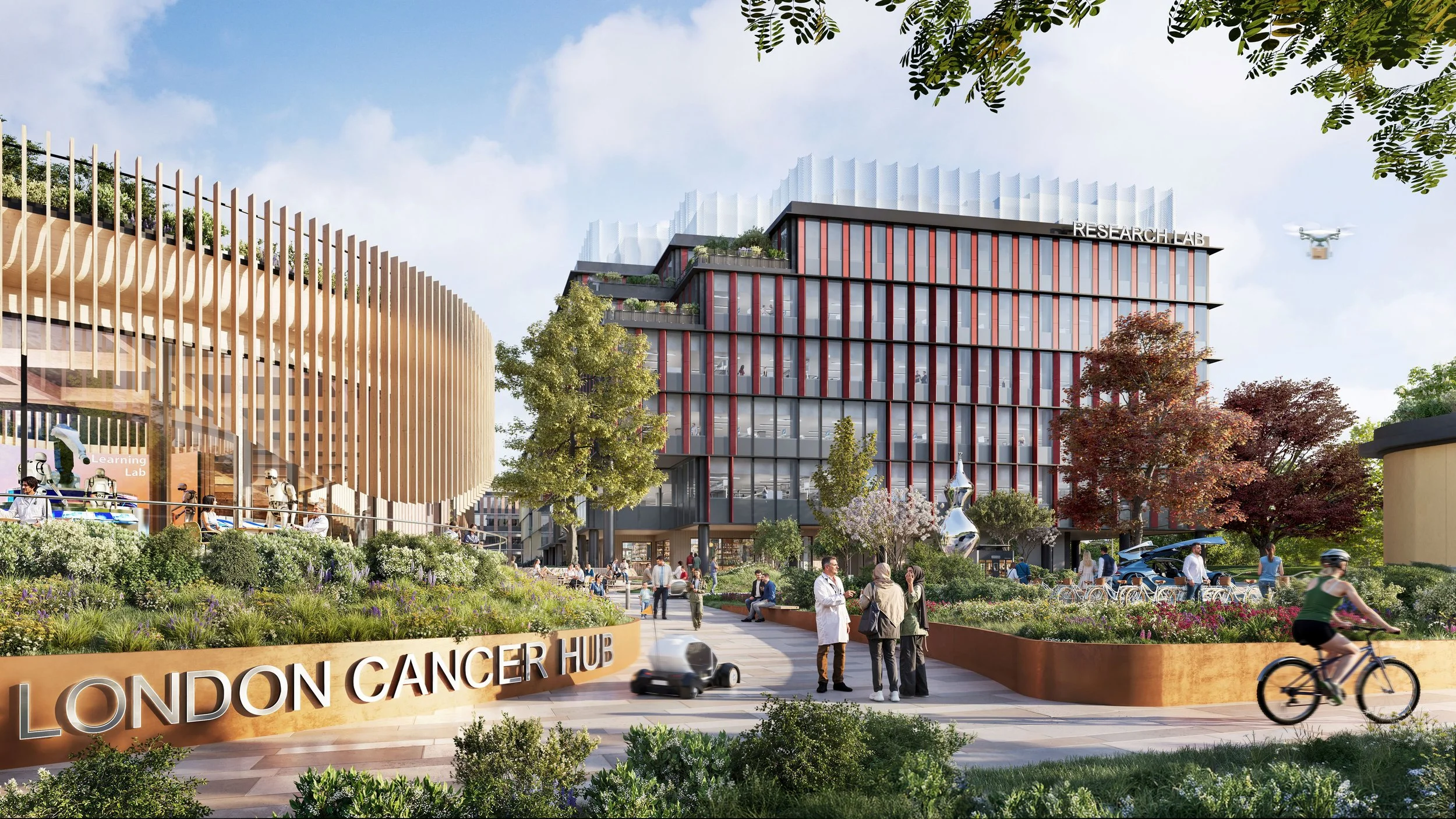
Planning approval has been granted for a £1 billion expansion of the London Cancer Hub, which will add approximately one million square feet of new laboratory and research space to strengthen the UK’s cancer research infrastructure. Image: Courtesy of Socius
Planning approval for a major expansion of the London Cancer Hub marks a significant step in the evolution of one of the world’s most prominent cancer research clusters. Backed by developer Socius in partnership with Aviva Capital Partners, the newly approved scheme will add approximately one million square feet of laboratory and research space across 12 acres in Sutton, south London—creating a new phase of growth for the district and reinforcing the UK’s life sciences infrastructure.
The project team also includes Gensler (architect), Arup (structural engineers), Savills (planning), and London Borough of Sutton (landowners).
Granted planning approval by Sutton Council on February 4, recognized globally as World Cancer Day, the project represents a £1 billion investment in science facilities designed to accelerate discovery, attract commercial life sciences companies, and strengthen the translational research ecosystem surrounding the campus.
Once complete, the expansion is expected to generate roughly 3,000 new jobs—primarily in high-skilled research and life sciences manufacturing. The broader innovation district surrounding the hub could ultimately support around 13,000 jobs and contribute an estimated £1.2 billion in gross value added to the UK economy, according to the London Borough of Sutton.
Beyond its economic impact, the project is also attracting attention for its approach to laboratory design, flexibility, and stakeholder engagement, factors that will shape how the next generation of cancer research spaces are delivered.
Extending a world-class research district
The expansion builds upon a campus already anchored by two globally recognized institutions: the Institute of Cancer Research (ICR) and The Royal Marsden NHS Foundation Trust. Together, these organizations form one of the world’s leading partnerships in cancer research and treatment.
According to Daniel May, director at Socius, the new facilities are intended to complement rather than duplicate the capabilities already present on campus.
“The London Cancer Hub will extend and enhance one of the world’s leading cancer research and treatment districts,” May says. “The delivery of approximately one million square feet of new space will provide much-needed commercial laboratory accommodation alongside the ICR and The Royal Marsden.”
The goal is to attract a wide spectrum of tenants, ranging from early-stage startups to multinational pharmaceutical firms.
“The new state-of-the-art laboratories are being designed to support the full spectrum of occupiers—from single-bench start-ups and scale-ups to global pharmaceutical companies,” May says. “The ambition is to create an environment that complements the existing academic and clinical excellence on campus, strengthening translational research and reinforcing Sutton’s position as a global life sciences destination.”
Designing laboratories for flexibility and future science
Because laboratory technologies evolve rapidly, flexibility is a central design consideration for the expansion. However, the project team is also taking care to balance adaptability with environmental and financial constraints.
“The development of the London Cancer Hub will provide a platform capable of supporting a wide range of research and development activities, including advanced therapeutics and translational science,” May says.
To achieve that goal, the design incorporates structural and mechanical features that can accommodate diverse research programs.
“The buildings are being designed to accommodate the vast majority of tenant requirements through carefully considered structural grids, servicing capacity and floor-to-floor heights,” May explains.
“However, true flexibility must be balanced against cost, operational efficiency and embodied carbon,” he says, noting that maximizing flexibility does not mean building for every conceivable scenario. “Over-engineering laboratory buildings can introduce unnecessary expense and environmental impact. Our approach is therefore to specify intelligently—providing robust, adaptable infrastructure while avoiding excessive provision that may never be utilized.”
This approach reflects a growing trend in laboratory development: designing a strong base building that supports varied tenant fit-outs without oversizing core systems.
Creating spaces that encourage collaboration
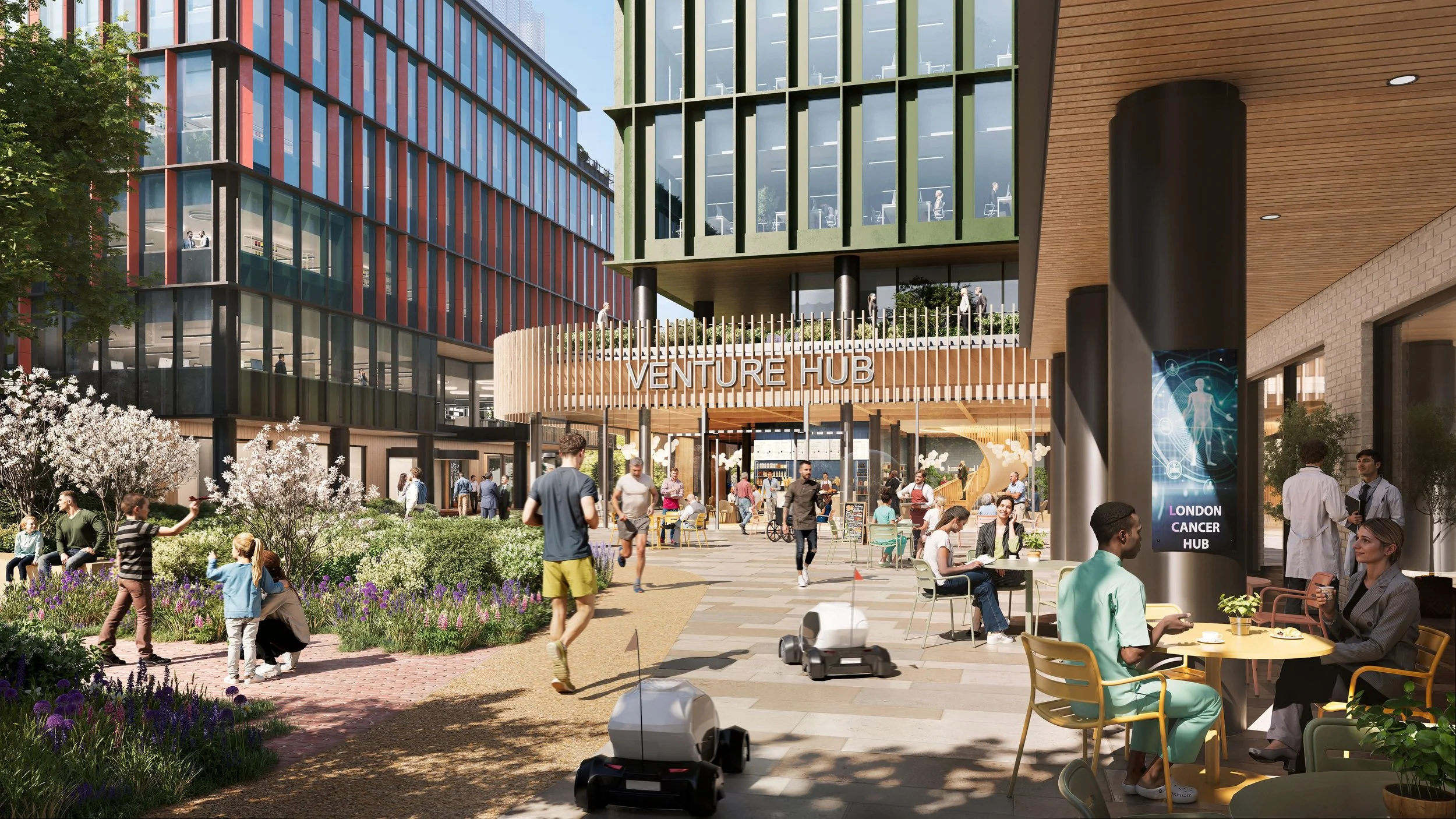
Designed to foster collaboration across the research ecosystem, the expanded London Cancer Hub will integrate laboratory spaces with write-up areas, shared meeting rooms, breakout zones, and active ground-floor amenities to encourage interaction among scientists, clinicians, and industry partners. Image: Courtesy of Socius
Another key design goal is to promote interaction across the research ecosystem. Modern scientific discovery increasingly depends on collaboration between disciplines, institutions, and commercial partners.
“We believe that best-in-class laboratories increasingly reflect the latest thinking in workplace design,” May says. “Science is now a highly collaborative endeavor, requiring environments that support both focused research and cross-disciplinary interaction.”
To encourage that dynamic, the proposed buildings incorporate both formal and informal collaboration spaces integrated with laboratory environments.
“The proposals include well-functioning, efficient laboratory space complemented by generous write-up areas, shared meeting rooms, breakout spaces, and informal collaboration zones,” May says.
At the ground level, public-facing features and shared amenities are designed to create a sense of openness across the campus.
“Active ground floors and shared amenities will further promote interaction across organizations,” he says. “By designing spaces that encourage visibility and connection, the Hub will help bring academia, clinicians, and industry partners together in a genuinely integrated research ecosystem.”
Integrating buildings into a broader innovation district
The laboratory buildings are part of a larger masterplan intended to create a cohesive innovation district rather than isolated facilities.
“The masterplan is structured to promote connectivity—physically, visually, and socially,” May says.
Shared infrastructure and public spaces will play a central role in linking research organizations with startups, investors, and clinical partners.
“Active ground floors, shared amenities, and well-designed public realm will encourage interaction between occupiers, clinicians, researchers, and visitors,” May says. “By clustering complementary uses and providing shared meeting, collaboration, and amenity spaces, the district will operate as a single innovation ecosystem rather than a collection of standalone buildings.”
The broader development will also incorporate approximately 220 affordable homes for key workers and new public spaces intended to support wellbeing and community engagement.
Incorporating input from scientists and lab staff
For laboratory planners, one of the most critical aspects of any new research facility is ensuring that the design reflects the operational realities of scientists and technical staff. The project team has prioritized engagement with potential users early in the process.
“Engagement with end users is central to the design process,” May emphasizes.
Rather than relying solely on theoretical planning models, the team has gathered direct feedback from researchers and potential tenants.
“We are working closely with the on-site expertise, a world-class design team, and technical specialists to test layouts, servicing strategies, and operational assumptions,” he says. “Most importantly, we have conducted a huge amount of potential occupier interviews to understand their priorities.”
This feedback loop is helping shape decisions about circulation, workflow, and lab support spaces.
“This iterative process ensures the buildings respond to real-world workflows, compliance requirements, and day-to-day laboratory management needs,” May says.
Among the early insights gathered from stakeholders were practical considerations related to movement, safety, and logistics.
“Early discussions have reinforced the importance of clear circulation routes, separation of people and materials where required, efficient goods access, and well-located write-up and collaboration areas adjacent to laboratory space,” he says.
Minimizing disruption during expansion
“Phasing and logistics planning are critical,” May says, noting that the London Cancer Hub already hosts active research and clinical programs. Therefore, careful planning will be required to ensure that construction does not interfere with ongoing work. Construction zones will be carefully separated from operational areas to protect both research continuity and patient care.
“Construction activity will be carefully managed to minimize noise, vibration, and access disruption, with clear segregation between construction zones and operational clinical or research areas,” he says.
The sequencing of building services and infrastructure upgrades will also be coordinated to avoid interruptions.
“Servicing connections and infrastructure upgrades will be sequenced to protect continuity of research and patient care throughout the development programme,” May says.
Building toward a net-zero research campus
Sustainability is another major driver of the project, with the new buildings targeting net-zero carbon operation—an ambitious goal for energy-intensive laboratory environments.
“Achieving net-zero in laboratory environments requires a rigorous, fabric-first and systems-led approach,” May says.
Strategies under consideration include high-performance building envelopes, efficient HVAC systems, heat recovery, and advanced building management systems.
“Demand reduction through intelligent design—including right-sizing of plant and careful specification to avoid unnecessary over-capacity—will be key,” he says. “Low-carbon energy strategies and potential on-site renewables will further support operational net-zero ambitions while maintaining the performance standards required for world-class laboratory space.”
As planning progresses, the London Cancer Hub expansion represents not only a major investment in cancer research infrastructure but also a test case for how future laboratory districts can integrate flexible design, sustainability, and collaborative science environments at scale.