
Designing Flexible Laboratories with Overhead Power Distribution
Laboratories are no longer static environments.
Research programs evolve. Equipment changes. Bench layouts are reconfigured to support new workflows. Yet in many facilities, the electrical infrastructure remains fixed, defined by conduit runs installed during initial construction and difficult to modify without disruption.
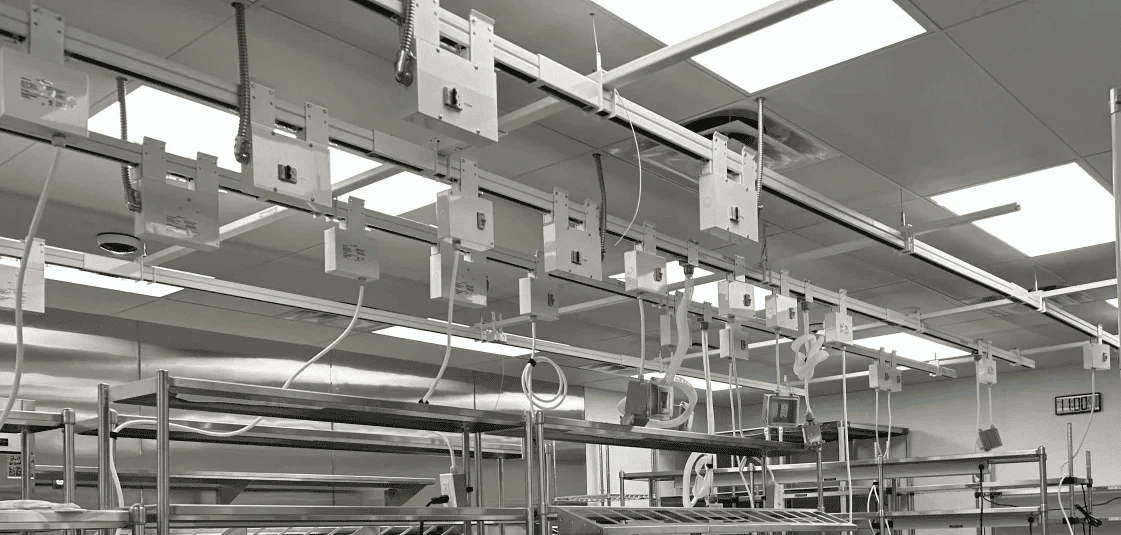
Figure 1. Overhead plug-in busway system delivering flexible power distribution across laboratory workstations. Image: Courtesy of TrackBusway
This disconnect between flexible lab operations and static electrical infrastructure is becoming a growing challenge in modern lab design.
To address this challenge, designers are increasingly turning to overhead power distribution systems that allow electrical access to be repositioned as laboratory layouts evolve.
Designing for flexibility from day one
Laboratories are expected to support changing research priorities, new equipment, and evolving workflows over time. However, when electrical systems are tied to walls or floors, they introduce constraints that limit how a lab can adapt.
By moving power distribution overhead through an open-channel system, USA TrackBusway® allows electrical access to remain aligned with the workspace as layouts change. This reduces dependence on fixed outlet locations and supports laboratory planning that can evolve over time.
This approach allows laboratories to be designed not only for initial use, but for long-term adaptability.
Matching power to application
Laboratories typically require a mix of electrical configurations depending on the equipment being used.
Most general-purpose lab applications rely on single-phase power, which supports standard instruments and bench-level equipment. Three-phase power is typically reserved for larger mechanical or process-driven systems.
Traditional distribution approaches often size infrastructure for peak or theoretical demand across the entire space—resulting in excess capacity, larger conductors, and unnecessary cost.
Continuous plug-in busway systems such as USA TrackBusway provide a more targeted and adaptable approach.
By allowing power to be accessed along the run, engineers can match electrical delivery to the specific requirements of each workstation—rather than overbuilding the entire system.
Designing scalable electrical infrastructure
In addition to flexibility, track busway systems can support more efficient electrical design in laboratory environments.
Traditional systems are often sized based on peak or theoretical demand, which can result in oversized conductors and unnecessary cost.
A more adaptable approach is to distribute power along the system using multiple feed points.
By introducing power where it is needed—rather than uniformly across the entire run—designers can reduce system weight, improve efficiency, and scale capacity over time.
This is particularly valuable in laboratory environments where equipment density and power requirements vary across different areas.
How an overhead plug-in busway system works
Overhead power distribution is commonly implemented using continuous plug-in busway systems such as USA TrackBusway. As an open-channel system, it provides continuous access to power along the run rather than restricting access to fixed tap points.
A typical system consists of an electrified track installed above the workspace, allowing plug-in devices to be installed where power is needed along the run.
This allows power to be positioned precisely above benches, equipment, or future work zones.
Because access is continuous, electrical infrastructure no longer needs to be fully defined during design. Instead, it becomes a flexible framework that can adapt as laboratory needs change.
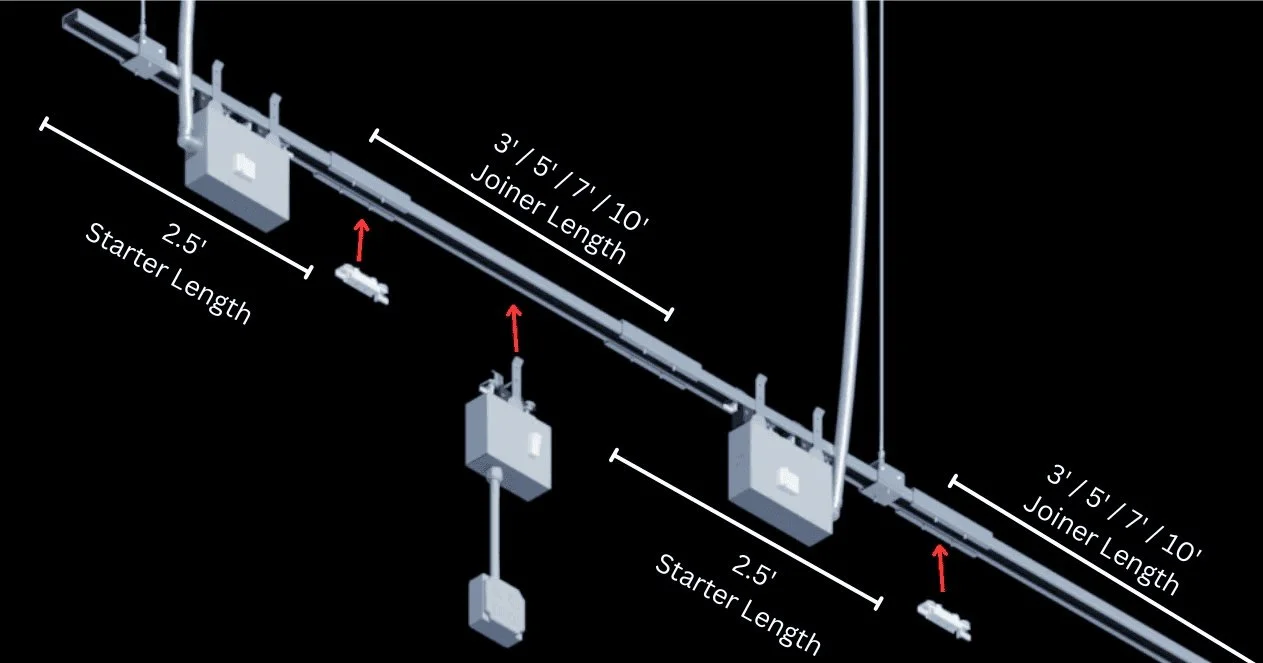
Figure 2. Continuous plug-in busway system illustrating modular sections, distributed feed points, and repositionable power access. Image: Courtesy of TrackBusway
Reducing disruption during change
One of the most significant advantages of USA TrackBusway is the ability to support change without major electrical rework.
With traditional wiring/conduit, reconfiguring a lab often requires shutdowns, demolition, and reinstallation—introducing downtime, cost, and coordination challenges.
USA TrackBusway reduces this disruption by allowing power access points to be repositioned as layouts evolve, helping facilities integrate new equipment and reconfigure work zones without full electrical rework.
For laboratories where uptime and continuity are critical, this flexibility supports both operational efficiency and long-term cost control.
Designing for the lifecycle of the lab
Laboratory environments are continuously evolving. Electrical infrastructure that cannot adapt becomes a limitation over time.
Overhead busway systems provide a framework that supports ongoing change, allowing facilities to evolve without being constrained by initial design decisions. This is especially relevant in laboratories with movable benches, modular casework, and changing equipment needs.
Rather than modifying electrical infrastructure to match layout changes, the infrastructure remains constant while the layout adapts beneath it. Designers evaluating this approach for laboratory applications can see an example at https://trackbusway.com/pages/laboratories.
By separating power distribution from fixed layout constraints, designers can create laboratories that remain functional, efficient, and adaptable throughout their lifecycle.
Moving toward flexible infrastructure
As laboratory environments become more dynamic, the infrastructure that supports them must become more adaptable as well. Electrical systems that are difficult to modify can add cost, delay layout changes, and create unnecessary disruption as equipment and workflows evolve.
Overhead plug-in busway systems such as USA TrackBusway help address that challenge by separating power distribution from fixed bench layouts and providing continuous access along the run. This supports more flexible laboratory planning from the outset while making future changes easier to accommodate.
Designers interested in overhead track busway strategies for laboratory environments can learn more at https://trackbusway.com/pages/track-busway.