
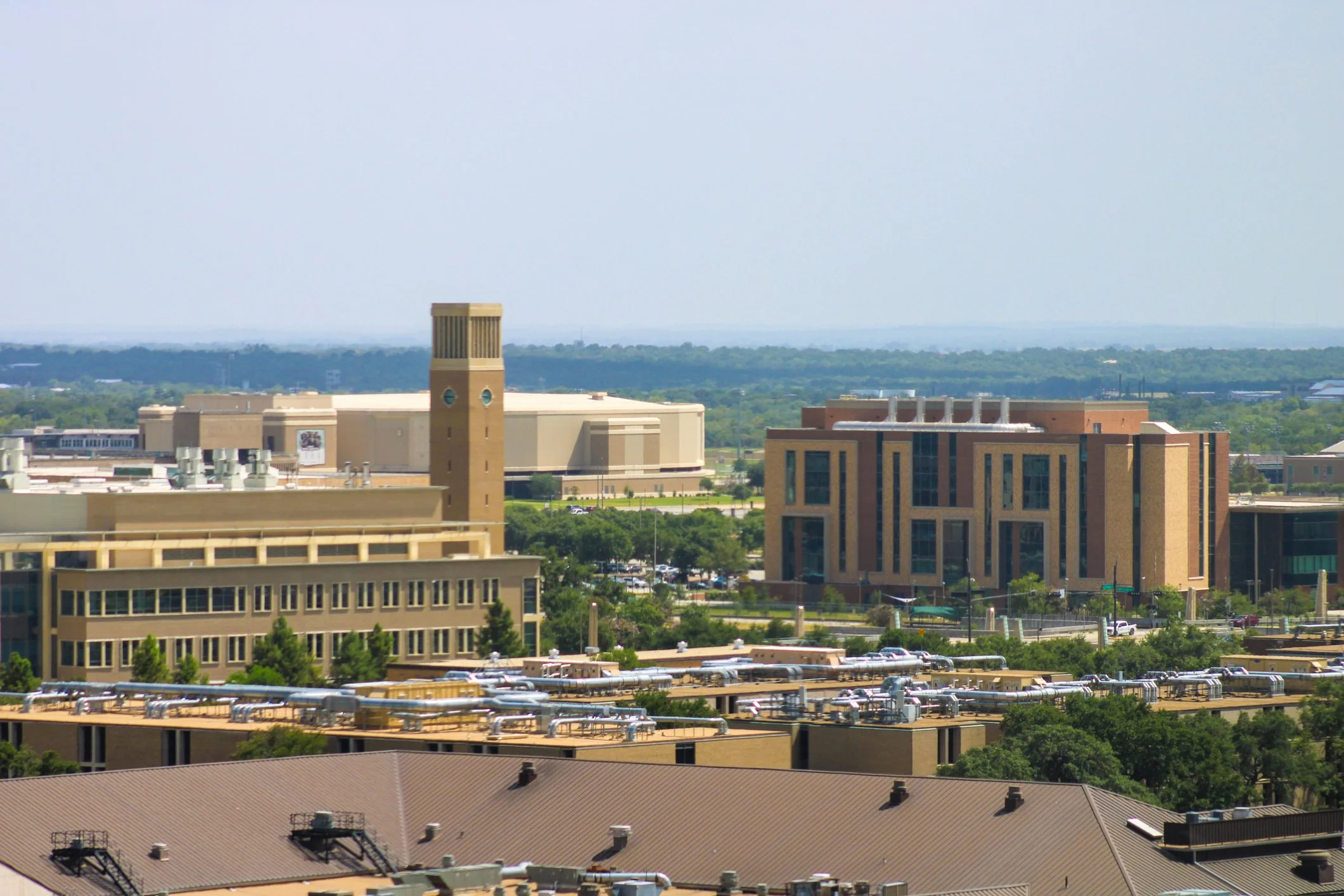
Texas A&M University’s Biology Teaching and Research Building is set to open in 2029 on its College Station campus (pictured). The facility will be a centralized hub for undergraduate education and interdisciplinary biological research, serving more than 20,000 students annually.
After decades of planning and advocacy, Texas A&M University is preparing to break ground on a transformative project—the $220 million Biology Teaching and Research Building (BTRB) at its College Station campus.
Scheduled to open in 2029, the four-story, 184,651-sf facility will serve as a central hub for both undergraduate teaching and advanced interdisciplinary research, supporting more than 20,000 students annually.
The project’s realization marks the culmination of many years of effort. As Dr. Alex Keene, head of the department of biology, tells Lab Design News, “A former dean was promised a new building over 30 years ago.”
The excitement across the department is well-founded—its current facilities have long been challenged by aging infrastructure, persistent leaks, and mold issues.
Designing for flexibility, longevity, and collaboration
From the start, the BTRB planning committee adopted a long-term vision that prioritizes flexibility and resilience. “This building isn't going to be built for us, it's going to be there 50 years down the line,” says Keene. “I think that really helped focus us on making the best building for Texas A&M biology and not for our own research labs.”
The committee’s approach helped prevent tunnel vision during design discussions. “Without that mindset,” Keene adds, “you can get caught up in, ‘What do I want my lab to look like?’” which can lead to a less effective outcome for the department as a whole.”
The BTRB will feature modular, flexible research laboratories designed to promote interdisciplinary work across multiple research themes, including biological resilience; synthetic biology; evolution, regeneration, and repair; and biological timing.
Equipment and freezer corridors between labs will enable teams to “sort of pair people together and grow and shrink labs,” says Keene. The labs will not be divided by subject area; instead, “all of the department’s most research-active labs will go into this building,” encouraging cross-disciplinary collaboration.
Balancing open and closed concepts
One of the committee’s most spirited debates centered on whether labs should follow an open or closed layout—a particularly complex question for a department encompassing everything from plant ecology to spinal cord injury research. Another focus area was how to design graduate student spaces: “How much privacy do you give students? Do students get their own office space? Do you have them in open bays?” Keene says.
The current design draws inspiration from a University of Arizona facility, positioning trainee desks directly across from the labs, separated by a glass wall. This setup, says Keene, “creates a seamless entry into the lab,” while maintaining necessary barriers for air changes and security—ensuring that when undergraduates are “walking around the hallways, you don't have to worry about them gaining access.”
Many labs will incorporate glass walls to make research visible to passersby, reinforcing the goal of transparency and student engagement. Support areas will include:
Open labs and procedure rooms
Advanced microscopy and imaging suites, including virtual reality tools for 3D visualization of the brain
Cold and freezer rooms
Autoclave and glass wash facilities
A 4,000-sf vivarium for specialized small-mammal research
A collaborative planning process
The project’s success so far has hinged on broad faculty engagement. A core group of 10 faculty members represented the department’s diversity—from teaching-focused instructors to neuroscientists and geneticists—and regularly reported back to the full 80-member faculty. These sessions, Keene says, sometimes led to “heated discussions,” including debates over the vivarium’s size and the balance between open and procedure spaces.
Keene credits the architectural team that led the Program of Requirements (POR) phase for fostering trust through their listening-first approach. “It was like, take as long as you need to tell me about your needs, and we will make suggestions,” he says. “They sort of taught us about the architectural limitations, and then they just sort of listened to the science and helped us figure out what was going to work best.”
He describes the POR committee as “one of the most effective committees I’ve ever been on,” a notable feat in academia.
As Texas A&M moves into the design and construction partner selection phase, the department seeks firms that will maintain this spirit of collaboration—teams “very interested in our vision” rather than those coming in with “a really clear vision of what they want to do.”
A key priority for the BTRB is to provide a true home for biology students, who are currently dispersed across multiple campus buildings. The first floor will serve as a dynamic student hub, featuring four flexible classrooms, a science peer learning center for tutoring and advising, faculty and advising offices, study areas, and a café designed to bring people together rather than serve as a quick stop. The layout is intended to encourage interaction between students and faculty, with the café and first-floor design allowing students to connect with their faculty members.
The building’s narrow site and high-traffic use demand efficient planning. “Every square foot of this building is going to have to be used effectively,” says Keene. “There’s no room for wasted space, grand entryways,” though the facility will still maintain a “beautiful aesthetic.”
Preparing for change
While technical challenges like vibration control and site conditions will be addressed during design, the biggest hurdle may be cultural, Keene says. The transition from older, enclosed spaces to an open, glass-walled environment will reshape how faculty and students work.
Keene acknowledges that researchers accustomed to “closed doors” and generous storage will face an adjustment. “Faculty footprints are going to shrink,” he says. “You could basically do whatever you want” in the old spaces, he notes, but the new facility—“gorgeous, shiny new space that's super functional”—will operate differently, a necessary evolution for the next generation of biology research.
When complete, the Biology Teaching and Research Building will deliver on a promise more than four decades in the making, providing Texas A&M’s biology community with modern, flexible, and collaborative space designed to serve generations to come.