
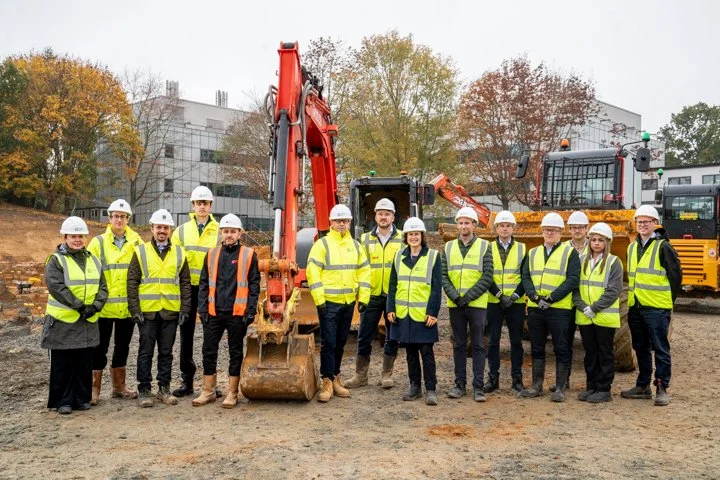
Construction is underway on Project GB1 at Norwich Research Park—a 63,000-sf laboratory and office building backed by Vengrove and Anglia Innovation Partnership that marks the first step in a 10-year expansion plan to boost scientific innovation and commercial growth across the campus. Image: Courtesy of Norwich Research Park
Construction is officially underway on Project GB1, the first in a planned series of new laboratory and office buildings at Norwich Research Park in the UK—marking a significant step forward in the campus’s long-term vision to expand its capacity for scientific innovation and commercial growth. Backed by real estate investment manager Vengrove, the 63,000-sf facility is designed to support companies working across agri-food, health, and environmental sectors, all of which are central to the Park’s research strengths.
Scheduled for completion in January 2027, Project GB1 represents the opening phase of a 10-year partnership between Vengrove and Anglia Innovation Partnership (AIP), the organization responsible for managing the Norwich Research Park campus. With more than £200 million in planned investment, the collaboration aims to deliver up to 750,000 square feet of new development, creating space for both scaling companies already on site and new entrants drawn by the Park’s ecosystem.
Designing for flexibility in an uncertain tenant landscape
At its core, GB1 is intended to provide flexible, high-performance environments tailored to the evolving needs of scientific tenants—many of whom have yet to be identified. This requirement has driven a design approach focused on adaptability without excessive cost.
“The challenge is to get the right balance between over-engineering a lab for a specific situation and retaining the flexibility to adapt,” says Roz Bird, CEO of Anglia Innovation Partnership.
The building has been carefully planned with this balance in mind. Featuring a 60:40 split between laboratory and office space, GB1 is organized into three distinct wings: one dedicated to office functions and two for laboratory use. This configuration allows for operational separation while maintaining the flexibility to accommodate different tenant requirements.
“The building has three distinct wings so that we can compartmentalize certain operations,” Bird says. “There is a dedicated office wing and two dedicated lab wings which have built-in flexibility so that they can be adapted to different requirements from different tenants.”
Learning from existing tenants
Design decisions have been informed by direct engagement with existing tenants across the Park, leveraging their insights to anticipate future needs. For example, the incorporation of a standardized structural grid enables a wide range of laboratory layouts, supporting both bench-intensive workflows and those requiring specialized infrastructure such as sinks or wash stations. At the same time, careful consideration has been given to complex elements like drainage systems—critical for lab functionality but costly and disruptive to modify after construction.
“One of the issues that you have to face into is that of avoiding under-engineering as that makes it difficult to retrofit specific tenant requirements,” Bird says. “At the same time, you don’t want to install lots of drainage that is not then needed as this adds unnecessary cost to the build.” The result is a design strategy that seeks to optimize flexibility while maintaining financial viability for developers and future tenants alike.
Mechanical systems are another key feature of the building’s adaptability. Advanced air handling infrastructure will support both clean air requirements and the integration of fume hoods, with flexibility in their placement to accommodate varying lab configurations. These systems are essential for meeting the diverse operational and safety needs of tenants across multiple scientific disciplines.
Shaping the campus experience
Beyond the building itself, Project GB1 reflects a broader strategy to enhance the overall campus experience. Long-term planning considerations—rooted in a master plan originally developed in 2012 and now being updated—have influenced decisions around site layout, infrastructure, and connectivity.
“We are thinking more about the arrival experience—amenities and connections between the buildings and across the whole campus,” Bird says. By leveraging existing topography and infrastructure, the project team has also minimized costly site preparation work, improving efficiency in this first phase of development.
Collaboration between stakeholders has been a defining feature of the project to date. The partnership between Vengrove and AIP brings together complementary expertise: Vengrove’s experience in large-scale real estate development and AIP’s deep understanding of science park operations and tenant needs.
“The partnership is a good match of skills and experience,” says Bird. “We know the people that work here and we know why people are likely to come to Norwich.”
This collaborative approach extends into the construction phase, with AIP working closely on-site alongside the contractor, design team, and Vengrove representatives. Regular meetings, structured reporting, and ongoing engagement with local stakeholders and planners help ensure alignment and timely decision-making throughout the process.
Sustainability and well-bring as core principles
Sustainability is also central to the project’s design and construction. GB1 is targeting a BREEAM ‘Excellent’ rating, reflecting a commitment to high environmental performance. The all-electric building will incorporate renewable energy systems, including rooftop solar panels and air source heat pumps, alongside features such as EV charging, water-saving measures, and low-carbon construction methods.
“We want to make the building as super-efficient as it can be,” Bird says, noting that the long-term goal is to align with a decarbonized energy grid.
Equally important is the emphasis on occupant well-being. The building is being designed to maximize natural light, provide views to the outside, and create a healthy indoor environment—factors increasingly recognized as critical to productivity and satisfaction in laboratory workplaces.
At the campus level, shared amenities and programming will continue to foster collaboration among tenants. Existing facilities, such as centralized meeting and café spaces, serve as informal gathering points that encourage interaction across disciplines—an essential ingredient in driving innovation.
As construction progresses, Project GB1 is poised to play a pivotal role in strengthening Norwich Research Park’s position as a leading hub for bioscience and innovation. By combining flexible design, sustainable performance, and a collaborative development model, the project sets the tone for the campus’s next decade of growth—supporting not just new buildings, but a thriving ecosystem of research, business, and community.