
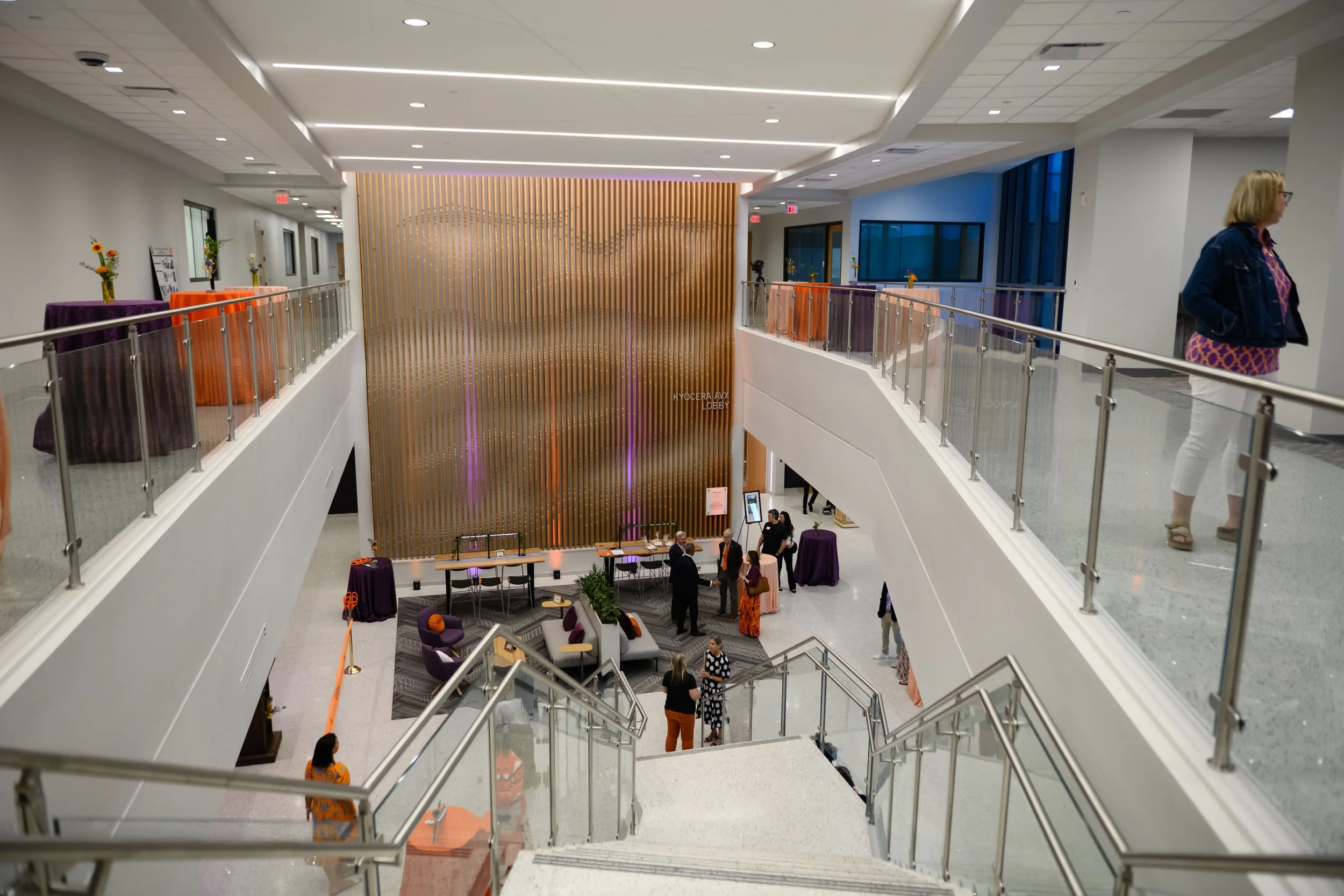
View from the staircase that descends into the KYOCERA AVX Lobby. Image: DPR Construction
With the opening of the new Advanced Materials Innovation Complex (AMIC), Clemson University has created a centralized hub designed to accelerate advanced materials research, expand interdisciplinary collaboration, and strengthen South Carolina’s role in high-tech manufacturing and innovation.
The 150,000-sf facility, which opened in early 2026, brings together the university’s Materials Science and Engineering, Chemistry, and Chemical and Biomolecular Engineering departments under one roof for the first time. Previously distributed across multiple buildings and campuses, the departments now share research laboratories, teaching environments, instrumentation spaces, and collaboration areas within a purpose-built complex designed to support both fundamental scientific discovery and translational, industry-focused research.
Project leaders say the consolidation was essential to Clemson’s broader research ambitions.
“AMIC was conceived as a convergence center to propel Clemson as a top-tier Advanced Materials research institute and to resolve the dispersion of three departments (Materials Science and Engineering, Chemistry, and Chemical and Biomolecular Engineering) historically scattered across multiple buildings, and two campuses,” says Chirag Mistry, senior principal and director of science & technology, HOK, whose firm led the facility’s design. “By bringing the departments into one building, the design could organize research labs, teaching labs, shared instrumentation, and collaboration zones around the disciplinary interfaces themselves, making cross-disciplinary work the default rather than the exception.”
The building supports Clemson’s growing research footprint while aligning with the university’s Clemson Elevate strategic plan, which aims to significantly expand research activity and infrastructure over the next decade.
Designing for interdisciplinary science
Advanced materials research increasingly relies on collaboration between disciplines, particularly in industries such as aerospace, healthcare, energy, electronics, and advanced manufacturing. The AMIC design team sought to create an environment where those interactions occur naturally.
According to Allison Anderson, senior project manager, DPR Construction, researchers and equipment had previously been spread across five separate buildings, limiting interaction and the efficient use of shared resources.
“By bringing departments together, Clemson University improved operational efficiency,” Anderson says. “This approach also supports advanced materials research by creating an environment where collaboration can accelerate innovation across disciplines. This required careful coordination of program elements and building systems to successfully consolidate multiple functions into a single, high-performing facility.”
The facility organizes open laboratories, support labs, classrooms, and shared instrumentation spaces around highly visible collaboration zones. Glass-fronted labs along public corridors allow students and visitors to observe research activity, reinforcing transparency while creating opportunities for interaction between disciplines.
The building also balances academic and industry-facing functions. Mistry notes that Clemson wanted the facility to support both exploratory research and faster-moving partnerships tied to South Carolina’s manufacturing economy.
“Industry partnerships are central to the building's mission, so AMIC is designed to be inviting and to accommodate industry needs,” Mistry says. “Most of that interaction happens on the two main public floors, where the core labs sit at the hub of the building, supporting industry partners, student projects, and faculty research.”
Flexible laboratories for evolving research
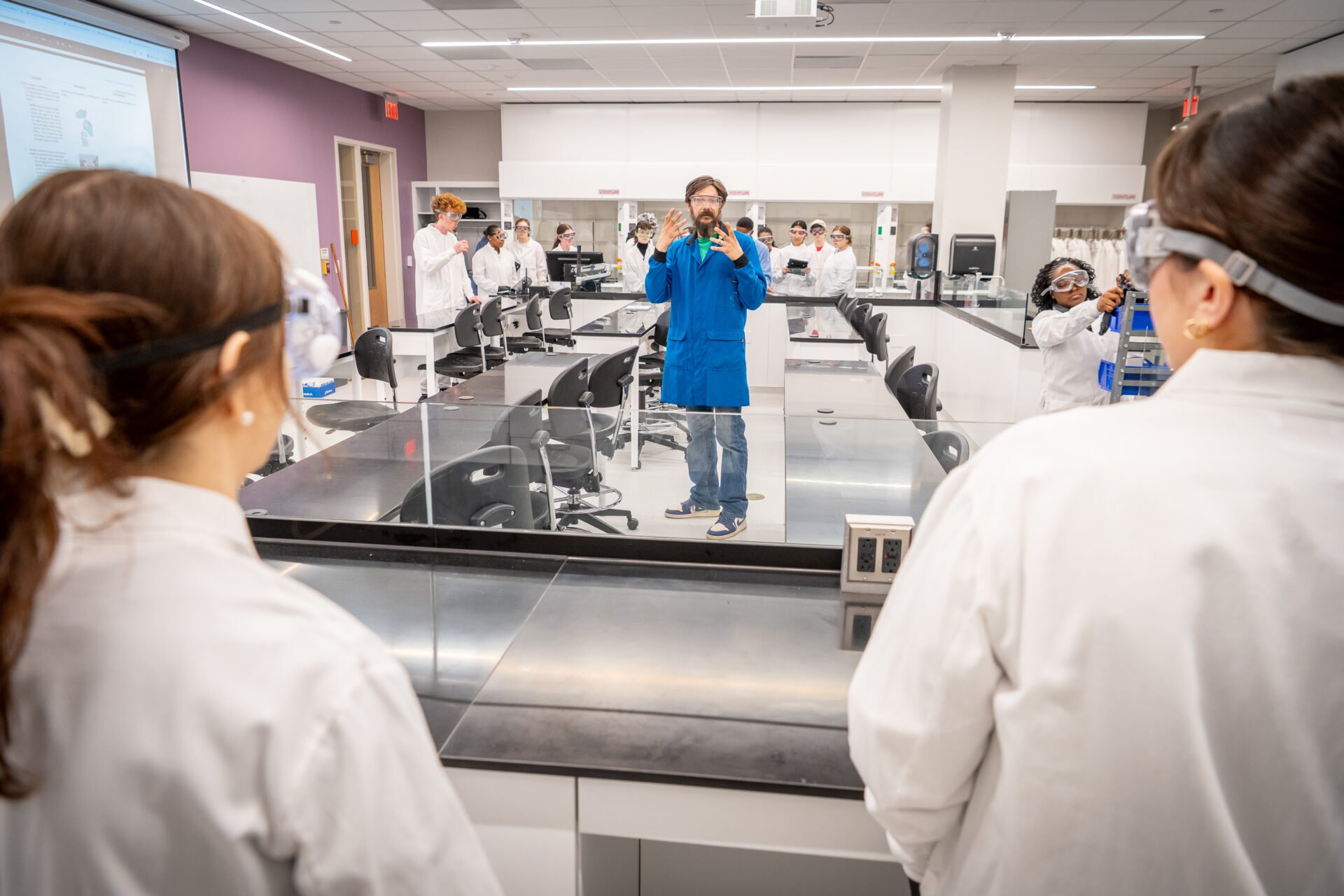
James N. Plampin III, senior lecturer and coordinator of the undergraduate organic chemistry teaching laboratory, teaches a chemistry class in the Kekas Family Teaching Lab. Image: Clemson University
A major project priority was ensuring that laboratory environments could evolve alongside rapidly changing research needs and technologies.
To support long-term flexibility, the project team incorporated adaptable lab layouts, overhead utility distribution systems, and specialized support spaces that can accommodate a wide range of research applications.
“The labs were planned and constructed to allow spaces to be reconfigured or modified with minimal disruption,” Anderson says. “DPR coordinated and installed overhead service carriers and plug-and-play utility connections to enable quick adaptation as research needs change.”
The facility includes both open laboratories and specialized support labs tailored to specific technical requirements. Some rooms feature light-controlled environments, while others are designed for higher vibration control or increased HVAC capacity to support heat-generating instrumentation.
“Generous floor-to-floor heights and robust utility distribution allow new instrumentation to be absorbed without renovation,” Mistry says. “Together, the open and support labs give researchers and students space that can keep pace with their work as materials science advances.”
Teaching environments were similarly designed with flexibility and visibility in mind. The building’s teaching laboratories feature modern layouts, advanced ventilation systems, and integrated safety features intended to support students with varying levels of laboratory experience.
In the Bishop Family Teaching Lab, students use 3D printing equipment capable of working with plastic, carbon fiber, and steel materials. Other teaching spaces support chemistry instruction, biomaterials experimentation, and materials characterization research.
Infrastructure supporting high-performance research
Because advanced materials research often depends on highly sensitive instrumentation, the facility required sophisticated mechanical, structural, and utility systems.
“High-performance HVAC systems were essential to maintain the necessary temperature, humidity, and air change requirements, particularly in labs with sensitive instruments,” Anderson says.
The building’s structural design also prioritized vibration mitigation. The project team selected a concrete structural system rather than steel to minimize vibration transmission, particularly in areas housing precision instrumentation.
“One the lowest level, a future imaging suite was planned with highest vibration isolation slab to support the most sensitive instrumentation, even though the equipment is not yet defined,” Mistry says.
The project also included extensive coordination of laboratory ventilation systems. Anderson noted that the installation of 172 laboratory fume hoods required detailed coordination of airflow, ventilation, and pressurization systems to ensure proper performance.
Building Information Modeling (BIM) played a critical role throughout design and construction, helping coordinate complex mechanical, electrical, plumbing, and specialty systems within the dense laboratory environment.
Prioritizing safety and accessibility
Designed with safety, transparency, and accessibility in mind, the facility features glass-fronted labs with clear sightlines, separated circulation paths, specialized environmental controls, and ADA-compliant workstations that support both secure research operations and an enhanced student experience. Image: DPR Construction
The design team emphasized safety, visibility, and accessibility throughout the building.
Teaching labs feature clear sightlines and intuitive layouts, while research spaces include specialized environmental controls and safety systems tailored to each laboratory type. Public and laboratory circulation paths are carefully separated, with fire-rated barriers creating distinct zones throughout the building.
“Glass-fronted labs make work visible from the public corridors, reinforcing a culture of safety through transparency and shared accountability,” Mistry says.
The facility also incorporates ADA-compliant laboratory stations and operational features designed to improve the student experience, including a lab coat cleaning service that ensures students have access to clean PPE before each class.
Lessons for future research facilities
Project leaders say one of the most important lessons from AMIC was the value of sustained stakeholder engagement throughout planning and construction.
“User engagement was central to the project’s success,” Anderson says. “By involving users throughout the process, we were able to create a facility that not only meets technical requirements but also supports the workflow of the researchers, students, and staff.”
Mistry adds that multidisciplinary research buildings require more than flexible laboratory space alone.
“Multidisciplinary research buildings also require a defined operational structure, not just well-defined space requirements,” he says.
As Clemson continues expanding its research enterprise, the Advanced Materials Innovation Complex represents a significant investment in the future of interdisciplinary science, advanced manufacturing, and workforce development — both for the university and for South Carolina’s growing innovation economy.