
The "Dark Lab": Designing for Zero-Occupancy Zones
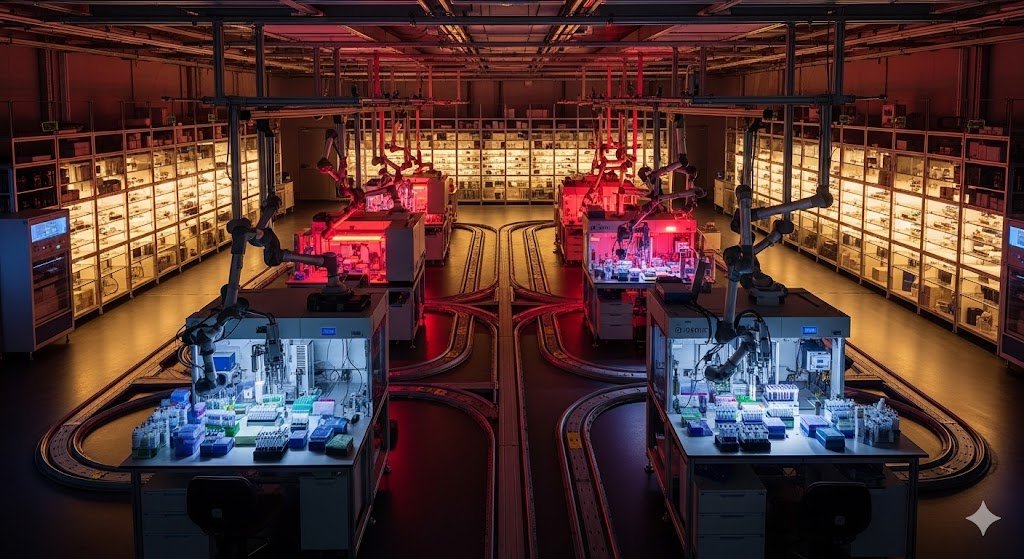
As automated robotics replace human researchers on the lab floor, architects and engineers must radically rethink HVAC, fire suppression, and vibration control to build high-performance environments tailored exclusively for machines. | Credit: Gemini (2026)
If a tree falls in a forest? If a robot spills a sample in a Dark Lab, how do you know? Designing purely for machines requires a fundamental paradigm shift in architectural and engineering priorities. A dark lab is a fully automated scientific research environment designed to operate continuously without human occupation or intervention.
In these zero-occupancy zones, the architectural focus shifts entirely from human comfort and life safety to equipment optimization and stringent environmental control. Facility managers and laboratory planners must collaborate to create high-density, resilient infrastructures capable of self-monitoring and self-correction. The ultimate objective is an uninterrupted, 24/7 robotic workflow that maximizes scientific throughput while mitigating the risks of unobserved catastrophic failures.
Key Takeaways
Decoupled Ventilation: HVAC systems must decouple air changes per hour (ACH) from sensible cooling, focusing purely on equipment thermal loads and particulate control.
Waterless Suppression: Fire protection relies on dual-interlock clean agent systems to prevent water damage to high-value robotic assets.
Sensory Redundancy: Continuous operational integrity demands highly integrated building management systems (BMS) with overlapping sensor arrays for chemical and physical anomalies.
Structural Rigidity: Vibration isolation criteria must meet or exceed stringent micro-vibration standards to support automated microscopy and liquid handling.
What are the foundational engineering requirements for dark lab design?
The foundational requirements for dark lab design center on high-density thermal management, automated anomaly detection, and highly redundant power infrastructure. Because humans are absent, traditional ventilation rates dictated by the American Society of Heating, Refrigerating, and Air-Conditioning Engineers (ASHRAE) for occupant comfort no longer apply. Instead, the architecture must cater strictly to the environmental tolerances of robotics, computational hardware, and sensitive chemical reagents.
To achieve this, engineers must implement an uninterruptible power supply (UPS) backed by generator redundancy to ensure the continuous operation of robotic tracks and automated storage and retrieval systems (ASRS). Power densities in these spaces frequently exceed 50 watts per square foot. Consequently, electrical distribution must be designed with overhead busways to allow for modular, rapid reconfiguration of robotic cells without requiring invasive construction.
Structural engineering also plays a critical role in the foundational design of a zero-occupancy lab. High-throughput screening robots and automated scanning electron microscopes are highly sensitive to floor vibrations. Therefore, structural grids must be stiffened to achieve vibration criteria (VC) ratings of VC-B or VC-C, isolating mechanical vibration from the primary scientific floorplate.
How does HVAC design differ in a zero-occupancy lab?
HVAC design in a zero-occupancy lab shifts from a focus on human breathing zone air quality to pure sensible cooling and particulate containment. Air change rates per hour (ACH) can often be significantly reduced, provided that the intense equipment thermal loads are adequately managed. Designers typically utilize localized cooling strategies, such as active chilled beams or in-row computer room air conditioners (CRACs), rather than relying on massive overhead variable air volume (VAV) systems.
By eliminating the need for human thermal comfort, ambient temperatures can be allowed to float within the wider operational bandwidths of the machinery, saving significant energy. However, localized hot spots generated by server racks or automated incubators require precision cooling loops. Engineers often utilize computational fluid dynamics (CFD) modeling during the design phase to predict these thermal plumes and optimize the placement of supply diffusers and return grilles.
Furthermore, pressurization strategies in an automated science facility focus entirely on containment and contamination control. If the robotic processes involve biohazards or volatile organics, the space must maintain strict negative pressure relative to adjacent maintenance corridors. Standards established by the Centers for Disease Control and Prevention (CDC) for bio-containment are adapted to ensure that exhaust systems feature redundant HEPA filtration and automated fail-safes.
What are the cooling loads for an automated science facility?
Automated science facilities generate significantly higher sensible heat loads per square foot compared to traditional human-occupied laboratories. While standard laboratories might average 10 to 15 watts per square foot of equipment load, a fully automated facility can easily exceed 50 watts per square foot. This necessitates a shift from conventional air-based cooling to targeted, high-density liquid cooling solutions.
To manage these thermal loads efficiently, facilities often deploy elevated chilled water temperatures to maximize free cooling hours via waterside economizers. The following list illustrates the stark contrast in engineering baselines between conventional spaces and automated environments:
Typical Equipment Load: Traditional laboratories average 10–15 W/sq ft, whereas dark labs demand 50–100+ W/sq ft.
Baseline Ventilation: Traditional human-occupied spaces require 6–12 air changes per hour (ACH), while dark labs only need 2–4 ACH (for thermal and purge purposes only).
Primary Cooling Method: Conventional labs rely on overhead VAV air distribution; automated facilities shift to localized chilled water and CRACs.
Lighting Requirements: Traditional labs need 50–75 foot-candles of illumination, compared to a dark lab's 0–10 foot-candles (used strictly for service and maintenance).
Vibration Criteria: General benchwork in traditional labs requires VC-A, but the high-precision automation in dark labs demands stringent VC-B to VC-C ratings.
How do you implement fire suppression in a remote monitoring lab?
Implementing fire suppression in a remote monitoring lab requires utilizing clean agent systems rather than traditional wet-pipe sprinklers to protect high-value automation equipment. Systems using inert gases (like IG-55) or fluorinated ketones actuate automatically upon cross-zoned smoke detection, suppressing combustion chemically without leaving destructive residue. Because no human evacuation is necessary, these systems can deploy more rapidly to minimize asset loss.
The architectural envelope must be heavily modified to support these gaseous suppression systems. Walls and ceilings require strict air-sealing to maintain the necessary gas concentration for the required hold time as defined by National Fire Protection Association (NFPA) standards. Additionally, pressure relief dampers must be engineered into the partitions to prevent structural damage to the room during the rapid expansion of the discharged agent.
Integration with the facility's master control system is paramount. Upon detection of an incipient fire, the building management system must immediately interface with the robotic controllers to execute an emergency stop (E-stop), halt moving tracks, and close chemical supply valves. This level of automated physical interlocking prevents the fire from spreading via moving automation components.
How are chemical spills detected and managed without human presence?
Chemical spills in a dark lab are managed through an integrated network of localized leak detection cables, volatile organic compound (VOC) sensors, and automated containment perimeters. When a sensor triggers, the facility's building management system automatically isolates the affected zone's ventilation and immediately alerts off-site personnel. As we continually discover when designing for automation, physical architecture must proactively accommodate these automated failsafes.
The physical design of the floorplate is critical for unmonitored spill management. Floors should be seamlessly welded, chemically resistant epoxy or urethane, featuring integrated slopes that direct fluids away from electrical floor boxes and toward dedicated, monitored sumps. These sumps are equipped with optical liquid level sensors that communicate via BACnet protocols directly to the remote monitoring dashboard.
Furthermore, the robotic platforms themselves are frequently equipped with onboard machine vision and physical limit switches. If a robotic arm drops a microplate or detects a sudden loss of pressure in a liquid handling line, the internal software triggers an immediate halt. This local intelligence, paired with the macro-level building sensors, creates a comprehensive, zero-occupancy safety net.
Expert FAQ: Navigating the Complexities of Dark Lab Design
Q: What is the optimal lighting strategy for a zero-occupancy laboratory?
A: A dark lab inherently requires minimal to no operational lighting, significantly reducing energy consumption. The optimal strategy utilizes narrow-spectrum LED service lighting (often amber or red to protect photosensitive reagents) that is strictly motion-activated or manually overridden for maintenance. During standard operation, the facility remains entirely unlit, relying on the machine vision systems equipped with their own localized infrared or task lighting.
Q: How do vibration criteria change for an automated science facility?
A: Unlike a traditional lab, where isolated optical tables are sufficient, an automated facility requires strict vibration control across the entire robotic travel path. The movement of heavy gantry robots can excite floor resonances, disrupting adjacent analytical equipment. Therefore, structural engineers must design floor slabs to meet stringent VC-B or VC-C criteria across the entire automated footprint, often requiring thicker slabs and vibration-isolating structural joints.
Q: Can a dark lab design comply with current National Institutes of Health (NIH) design requirements?
A: Yes, though it requires a performance-based design approach rather than strict prescriptive compliance. Because NIH guidelines are historically predicated on human occupancy, architects must demonstrate that reduced air change rates and automated life-safety protocols provide equivalent or superior protection for the research assets and the surrounding building environment. Extensive CFD modeling and rigorous commissioning are required to validate these alternative compliance paths.
References
Teutenberg, T. Approaching the "Dark Lab": Can We Run It Fully Automated?. LCGC International. 2025;8(6):14-19.
Thurow, K. Engineering for Zero Occupancy: Automation in Modern Laboratory Design. Weinheim, Germany: Wiley-VCH; 2025.
American Society of Heating, Refrigerating and Air-Conditioning Engineers (ASHRAE). Laboratory Design Guide. ASHRAE Technical Committee 9.10. Published 2015. Accessed February 25, 2026.
National Institutes of Health (NIH). Design Requirements Manual (DRM). National Institutes of Health. Published 2020. Accessed February 25, 2026.
