
A Lab Built for What’s Next in HVAC and Data Center Cooling
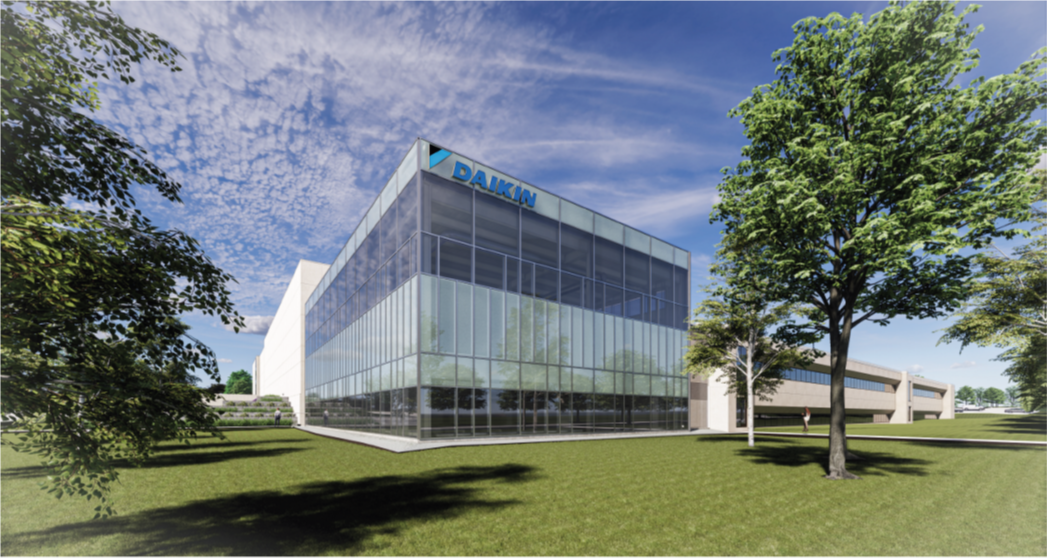
Daikin Applied is investing $163 million in a 71,000-sf advanced R&D lab in Plymouth, MN, featuring nine specialized test cells to validate next-generation HVAC technologies under extreme conditions and support both data center and traditional cooling development. Image: Courtesy of Daikin Applied
As hyperscale data centers, AI workloads, and electrification continue to push HVAC systems into uncharted territory, the environments used to test those systems must evolve just as quickly. At its Plymouth, MN headquarters, Daikin Applied is doing exactly that—investing $163 million in a new, 71,000-sf advanced R&D test laboratory designed to validate next-generation cooling technologies under some of the most demanding conditions the industry now faces.
The facility, now in phased commissioning with full completion planned for 2027, centers on nine highly specialized test cells capable of replicating the operating extremes associated with modern hyperscale data centers while still supporting traditional HVAC and heat pump development. The result is a lab designed not only to test equipment, but to future-proof product development itself.
Defining performance goals early
From the outset, the project team recognized that incremental upgrades to existing test infrastructure would not be enough. “During the concept phase, our primary goal was to address gaps in existing lab capabilities so we could better support future product development and meet evolving market requirements for business growth,” says Trevor Bailey, vice president of engineering, Daikin Applied Americas. That assessment quickly revealed the need for test environments that could handle far greater variability and intensity than before.
The nine test cells were envisioned to support a wide range of equipment—from chillers and rooftop units to emerging heat pump technologies—while maintaining tight control over conditions. “The design vision expanded to include multiple types of test cells capable of evaluating a broad range of equipment, from chillers to rooftop units to heat pump technology, under tightly controlled and highly variable operating conditions,” Bailey notes.
To achieve this, the lab was designed with “significantly greater cooling capacity, the ability to achieve extreme temperature and humidity ranges and precise control of airflow and waterflow rates to ensure accurate, repeatable testing.” Redundancy and safety were also foundational, enabling continuous operation while protecting both personnel and equipment. These decisions allow the facility to “replicate the operating extremes common in applications like hyperscale data centers,” validating products under conditions customers increasingly expect as standard.
One envelope, many use cases
While hyperscale data center cooling has distinct requirements, Daikin Applied opted against creating entirely separate test environments. Instead, flexibility became the unifying strategy. “Although hyperscale data center cooling demands differ from traditional HVAC needs, the variations are not so significant as to warrant entirely separate test cell designs,” Bailey says.
Each test cell was tailored to its anticipated use case, but within a shared, high-performance framework that supports both established and emerging technologies. That approach was shaped through close collaboration between Daikin’s Test Engineering group and external design partners, informed by years of experience with earlier test facilities.
Importantly, the design did not start from a blank slate. “Lessons learned from past challenges were incorporated from the start,” allowing known issues to be resolved proactively and improving reliability and efficiency across the board. A modular design strategy further streamlined construction while preserving adaptability—an approach that allows the facility to evolve as testing protocols and product demands change over time.
When HVAC is both the tool and the subject
Designing a lab where HVAC systems are simultaneously the building’s backbone and the subject of testing presents unique challenges. Cross-interference between building systems and equipment under test can compromise data quality, so isolation and control were paramount.
“A key priority was reducing any potential cross-interference between the process equipment and the units under test, which can compromise accuracy and repeatability,” Bailey says. Where possible, dedicated process equipment was assigned to individual test cells, resulting in cleaner datasets and more stable conditions.
Airflow distribution was another focus area. The lab incorporates enhanced airflow strategies to create uniform, controllable environments, supported by advanced measurement instrumentation to reduce uncertainty. Built-in redundancy and enhanced safety systems further reinforce reliability during complex test scenarios, creating what the team described as “a more robust, precise and dependable testing infrastructure capable of supporting the next generation of product development.”
Planning for what comes next
With technologies and market demands evolving rapidly, the lab’s mechanical and electrical infrastructure was designed to grow without disruption. “Scalability was built into the facility design from the beginning,” Bailey says, emphasizing modular utilities, pre-installed capacity, and segmented controls architecture that allow targeted upgrades without taking the entire facility offline.
Phased commissioning plays a critical role in that strategy. By validating systems incrementally, the project team can refine performance as new requirements emerge—reducing risk while ensuring alignment with future needs. This deliberate approach creates a lab that adapts alongside technological shifts rather than reacting to them after the fact.
Bridging R&D and real-world production
Beyond extreme conditions, the lab is designed to reflect how equipment actually performs once it leaves the factory. “The laboratory was designed to replicate real-world operating conditions, ensuring that test results accurately reflect the performance and quality customers can expect in the field,” Bailey says.
Cross-functional collaboration between R&D, manufacturing, and facilities teams was integral early in the process. Engineers use data from across the organization to develop comprehensive test plans that account for variations in operating conditions, configurations, and even manufacturing constraints. In this way, the lab serves as the final validation stage—confirming reliability and consistency before products reach customers.
Balancing safety, cost, and capability
Reproducing extreme thermal loads and high-density equipment scenarios safely—and cost-effectively—was one of the project’s most complex challenges. “The primary challenge throughout the concept phase was determining a design approach that delivered the necessary safety and test capabilities while still remaining cost-effective,” Bailey says.
Multiple design value workshops brought stakeholders together to assess alternatives, weigh tradeoffs, and validate assumptions. Those collaborative sessions proved instrumental in refining the approach and establishing a clear design definition for the next project phase—demonstrating the value of early, structured decision-making in high-investment lab projects.
A forward-looking framework for lab planners
For lab planners and end users designing advanced facilities, it is important to anticipate both business and industry trends. “This requires establishing clear, detailed requirements upfront, from testing capabilities to workflow efficiencies and beyond,” Bailey notes.
Flexibility built into the design from the outset allows labs to accommodate new technologies, expanded protocols, and evolving expectations, supporting long-term usability and operational efficiency.
By combining careful planning, cross-disciplinary collaboration, and adaptable infrastructure, the Plymouth test lab demonstrates how complex testing environments can be designed to support a wide range of current and future research needs.