
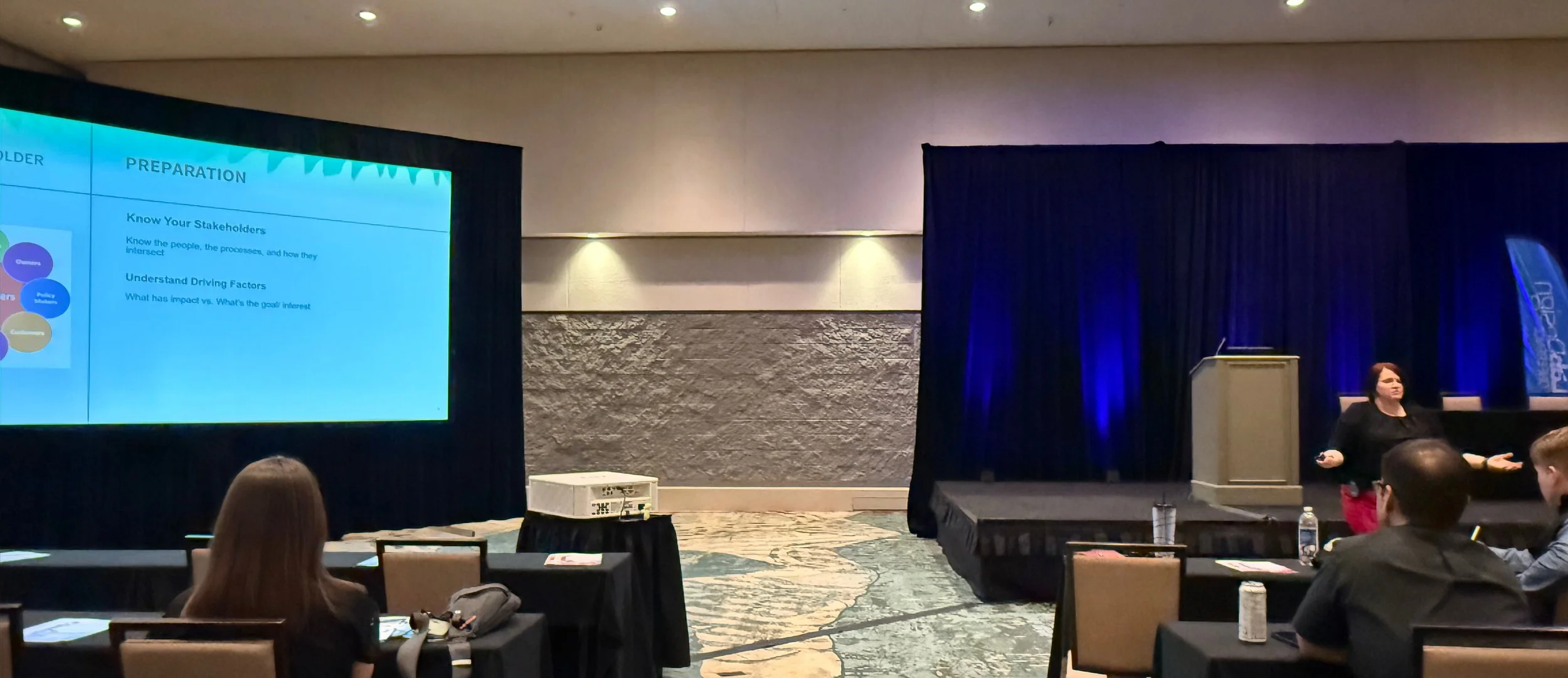
April Day, senior director of clinical pathology at Geisinger, discusses the importance of engaging laboratory stakeholders early—well before a project officially begins—during her 2026 Lab Design Conference presentation, “Pre-gaming With Your Stakeholders.”
A successful laboratory project does not begin when the project is approved—or even when the first planning meeting is scheduled. According to April Day, senior director of clinical pathology at Geisinger, the most important work often happens long before a project officially exists.
During her presentation, “Pre-gaming With Your Stakeholders,” at the 2026 Lab Design Conference in Orlando, FL, Day encouraged laboratory leaders, architects, planners, facilities teams, and other stakeholders to start building relationships and gathering information well in advance of a renovation, relocation, or new construction project.
“When do you think your pregame begins?” Day asked attendees. Her answer: “When you decide to move.”
In reality, she argued, the pregame starts much earlier. “It starts today,” she told the audience, emphasizing the value of learning from colleagues and other professionals before a project is underway.
Build the case before you need it
For laboratory leaders, Day’s first recommendation is to understand the financial realities surrounding their facilities. That includes knowing what the organization spends per square foot, how laboratory construction costs compare with other clinical spaces, and how much money has been spent renovating existing laboratories to accommodate new equipment.
That historical information can become powerful evidence when requesting additional space.
Day also recommends building relationships with facilities personnel. Facilities teams can provide valuable insight into existing building conditions, including HVAC capacity, drainage problems, sprinkler coverage, and underutilized spaces that might offer alternatives to renovating an existing laboratory.
In one example, Day discovered an old operating room that had sat unused for years. After walking the space with facilities personnel, she realized it could accommodate a large, open laboratory layout.
“You have to know to pitch that as an idea over a renovation,” she advised.
Executive leadership is another critical stakeholder group. Laboratory leaders should understand the organization’s strategic priorities, future plans, and concerns—and then connect laboratory needs to those priorities.
Rather than simply asking for more square footage, Day recommends framing each request around the problem it will solve for the organization.
“The problem you’re solving is, ‘What have we not delivered well on?’” she said.
That shift can help laboratory projects compete more effectively for resources because the laboratory becomes part of a larger organizational solution rather than an isolated capital expense.
Look beyond the laboratory
Day also encouraged attendees to engage service lines, frontline staff, quality teams, and other stakeholders before developing a project plan. For service lines, that means asking where they expect their operations to be in five or 10 years, what the laboratory could do better, and what obstacles the laboratory currently creates for their workflows.
The goal is not necessarily to promise stakeholders everything they request. Instead, Day recommends asking what problems they want the laboratory to solve.
“Don't ask that question,” she said about asking frontline users what they want. “The question you’re asking is, ‘What issues do you want us to solve for you?’”
This approach can also improve communication throughout the design process. Rather than promising a specific feature, laboratory leaders can explain how the final design addresses concerns raised by users.
Day emphasized that this research should extend beyond the laboratory’s walls. Regulatory findings from previous years, quality events, infrastructure failures, organizational performance indicators, and service-line needs can all reveal issues that a new facility should address.
Make the equipment list truly comprehensive
One of Day’s strongest recommendations for laboratory operations teams is to develop a comprehensive equipment list before a project begins. And “comprehensive,” she says, means more than listing the major analyzers.
The list should include manufacturers, item numbers, quantities, dimensions, heat output, noise output, electrical requirements, ventilation clearances, emergency-power requirements, and other special requirements. It should also distinguish between existing and new equipment and identify IT ports and requirements. Even seemingly minor equipment should be included, from centrifuges and vortexers to heat blocks and lamps.
“The more comprehensive that is, the less gaps you’re going to find in your planning,” Day said.
For planners and designers, that information can have significant downstream implications. Heat output affects HVAC requirements. Emergency-power needs affect electrical planning. Equipment dimensions influence casework and clearances. IT requirements can affect network planning and security reviews.
The list also needs to account for the transition period—not just the final laboratory. Day noted that existing and new analyzers may need to operate side by side for months during validation. That means a laboratory could temporarily require more electrical capacity, water, IT connections, and physical space than it will need once the project is complete.
“If you have everything for the new lab, it’s going to work. But they do not have enough power and the panel to have both the new and the old running at the same time,” Day said.
Ask “what if?” before problems occur
Day also encouraged project teams to use scenario-based questions and repeatedly probe potential failure points. What happens if an analyzer fails? Is there redundancy? What happens during generator testing? Is there sufficient DI water capacity? What happens if an equipment delivery is delayed? What if a service line changes its testing needs?
These questions can expose infrastructure or operational requirements that might otherwise remain hidden until construction—or worse, after occupancy. Day shared an example in which a new rapid-response laboratory needed additional testing after a service-line change. The resulting need for a new analyzer required additional space and delayed the opening. Planning for such possibilities in advance can make the difference between a flexible laboratory and one that immediately requires another renovation.
The same principle applies to regulatory requirements, acoustics, ceiling heights, and HVAC. Day described a previous project in which noise testing failed after the laboratory opened, requiring ceiling tiles to be replaced in an active lab. In another case, a ceiling was lowered to accommodate ductwork, ultimately preventing a planned hood and bench combination from fitting.
For Day, these experiences reinforced the importance of continuous communication among stakeholders.
“Make sure you’re touching base as the project continues with the architect, and ask if there have been any changes or modifications,” she said.
Treat flexibility as a planning requirement
Perhaps the broader lesson from Day’s presentation is that laboratory flexibility cannot simply mean leaving empty space on a floor plan. It requires anticipating how equipment, services, regulations, technology, and organizational priorities will change.
That includes deliberately planning for equipment staging and validation. Day noted that laboratories will inevitably need to validate new analyzers, yet many projects fail to provide a dedicated location for that work.
“Why not have that footprint planned?” she asked.
For lab planners and architects, that means considering not only how a laboratory will operate on day one, but also how it will evolve during the first several years of operation. For laboratory leaders, meanwhile, it means entering the planning process prepared to demonstrate why each requirement matters.
Day summarized her approach by encouraging laboratory leaders to connect every request to a specific organizational need: improved service, better workflow, regulatory compliance, reduced staffing requirements, or another measurable outcome.
“This isn’t a wish list. This is, ‘I’ve done my homework,’” she said.
By starting the stakeholder conversation early, documenting lessons learned, understanding organizational priorities, and asking difficult “what if?” questions before they become real problems, project teams can make better-informed decisions and build laboratories that are better equipped for what comes next.
The best time to prepare for your next laboratory project may be long before the project officially begins. At the 2027 Lab Design Conference, May 10-13 in Dallas, TX, architects, engineers, laboratory owners, facility managers, and researchers will share practical lessons on stakeholder engagement, planning for change, coordinating equipment and infrastructure, and identifying potential problems before they become costly surprises.