
Shared Equipment Zones: The "Town Square" Concept
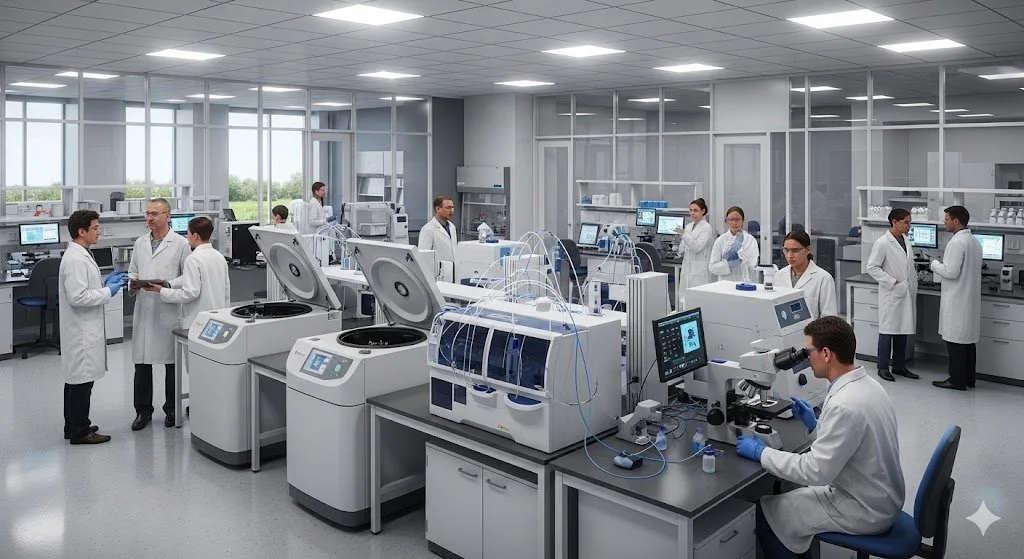
The "Town Square" concept centralizes expensive analytical assets into highly visible, shared core facilities, driving both capital efficiency and interdisciplinary collaboration. | Credit: Gemini (2026)
The architectural shift from "mine" to "ours"
Why buy five microscopes when one will do? The architectural shift from "mine" to "ours" in modern laboratory design is fundamentally reshaping how research facilities are funded and constructed. In traditional, legacy laboratories, the culture of private equipment ownership created vast inefficiencies. Every principal investigator demanded their own ultracentrifuge, flow cytometer, or confocal microscope, resulting in duplicated capital expenditures, wasted floor space, and high-end machines that sat idle for 80% of their operational lifespan.
To correct this immense financial and spatial drain, modern architects are embracing Lean lab design interventions by creating dedicated shared equipment zones. Often referred to architecturally as the "town square," these centralized hubs extract high-cost, low-utilization instruments from private, siloed labs and consolidate them into highly visible, easily accessible core facilities.
This strategy goes far beyond simple cost-savings. Amenity sharing acts as a physical catalyst for scientific cross-pollination. When researchers from disparate disciplines are forced to converge in a common equipment corridor, the architecture inherently drives spontaneous interactions, breaking down academic barriers and fostering a truly collaborative research ecosystem.
Key Takeaways
Capital Efficiency: Centralizing expensive analytical instruments eliminates redundant purchasing, drastically reducing overall facility capital expenditures.
Core Facility Layout: Designing highly visible, glass-walled equipment hubs acts as a central "town square," physically drawing researchers out of isolated private labs.
Amenity Sharing: Forcing scientists to converge in shared analytical corridors fosters spontaneous interdisciplinary collaboration and casual knowledge transfer.
Infrastructure Optimization: Consolidating specialized MEP (mechanical, electrical, plumbing) requirements into a single, highly engineered zone reduces building-wide construction costs.
How do shared equipment zones drive capital efficiency?
The financial argument for shared equipment zones is undeniable. High-end analytical instrumentation represents a massive percentage of a new laboratory's startup cost. When these assets are decentralized, utilization rates frequently plummet below 20%. By establishing a centralized equipment corridor, institutions can purchase one top-of-the-line instrument instead of three mid-tier models, ensuring the asset is utilized closer to its maximum daily capacity.
This capital efficiency extends directly into architectural construction costs. High-end equipment often dictates highly specialized, expensive infrastructure that should not be replicated across an entire building. A centralized approach allows engineers to consolidate these heavy utilities:
Vibration Isolation: Pouring specialized, vibration-dampening concrete slabs only in the core facility rather than across the entire floorplate.
High-Voltage Power: Pulling expensive 480V three-phase electrical lines only to the centralized centrifuge room.
Hazardous Exhaust: Installing dedicated, hard-ducted exhaust systems for mass spectrometers in a single, easily maintained utility shaft.
Chilled Water Loops: Routing process-chilled water to a dense equipment zone rather than plumbing the entire building for dispersed high-heat loads.
By isolating these intense MEP requirements into a dedicated core facility layout, the surrounding generic wet labs can be designed with lighter, more flexible, and significantly cheaper baseline utilities.
Why is the "Town Square" vital for scientific collaboration?
Beyond the balance sheet, the "town square" concept is fundamentally a behavioral intervention engineered through architecture. In siloed facilities, scientists can go weeks without interacting with colleagues outside their immediate discipline. Shared equipment zones intentionally disrupt this isolation by acting as a physical magnet, drawing researchers out of their specialized wet labs and into a common, neutral territory.
To maximize this collaborative effect, planners must position the equipment corridor at the heart of the facility. Successful "town square" layouts typically incorporate several key architectural strategies:
Strategic Adjacencies: Locating the shared zone immediately adjacent to high-traffic areas like primary break rooms, central staircases, or main write-up spaces.
Visual Transparency: Utilizing extensive floor-to-ceiling glass partitions so that the scientific activity within the core is highly visible to passing traffic.
Casual Collision Zones: Integrating soft seating, whiteboard walls, and coffee stations directly outside the equipment rooms to capture scientists waiting for assays to finish.
Acoustic Management: Implementing sound-absorbing ceiling baffles and double-glazed glass to ensure the noise of heavy equipment does not disrupt the adjacent collaborative spaces.
"Science on display" not only helps researchers see what tools are available, but it also demystifies the work of their peers. The casual conversation that happens while two scientists wait for a shared centrifuge to spin down frequently sparks the interdisciplinary partnerships that drive modern scientific breakthroughs.
Comparing Lab Models: Siloed Ownership vs. The Town Square
Asset Utilization: Siloed labs typically see 15–25% utilization of expensive analytical gear. The Town Square model drives utilization up to 70–85% through centralized scheduling and shared access.
Infrastructure Cost: Siloed layouts require heavy, specialized MEP infrastructure distributed redundantly across the entire floorplate. The Town Square concentrates heavy MEP into a single, cost-effective core zone.
Space Allocation: Private ownership forces individual labs to allocate 20-30% of their bench space to bulky instruments. Shared zones free up this private square footage for active, dedicated bench science.
Collaborative Frequency: Siloed labs create deep physical and social barriers between research groups. Shared equipment corridors mandate physical convergence, resulting in high rates of spontaneous interdisciplinary interaction.
Expert FAQ: Shared Lab Equipment Zones
Q: How do we resolve scheduling conflicts in a shared equipment zone?
A: Effective amenity sharing relies on robust digital infrastructure. Facilities must implement centralized laboratory information management systems (LIMS) or specialized scheduling software. This allows researchers to book precise time slots seamlessly from their desks, preventing physical bottlenecks and frustrating wait times in the equipment corridor.
Q: Won't centralizing equipment increase the distance scientists have to walk?
A: Yes, which is why the core facility layout must be centrally located. While it adds minor transit time compared to having the instrument directly at the bench, this is an acceptable, planned trade-off. The massive gains in capital efficiency, reduced maintenance burdens, and the collaborative benefits of the "town square" far outweigh the extra steps.
Q: Who is responsible for maintaining equipment in a shared zone?
A: Transitioning to a shared model requires hiring dedicated core facility managers. Instead of relying on individual post-docs to calibrate and maintain complex machines, a centralized staff ensures that all equipment in the shared zone is expertly serviced, fully operational, and compliant with safety regulations at all times.
References & Further Reading
Watch, D. Building Type Basics for Research Laboratories. 2nd ed., John Wiley & Sons, 2008.
National Institutes of Health (NIH). Design Requirements Manual (DRM). Office of Research Facilities, 2020.
Whole Building Design Guide (WBDG). Research Laboratory. National Institute of Building Sciences, 2023.
