
Glasswash & Autoclave Logistics: The Dirty-to-Clean Flow
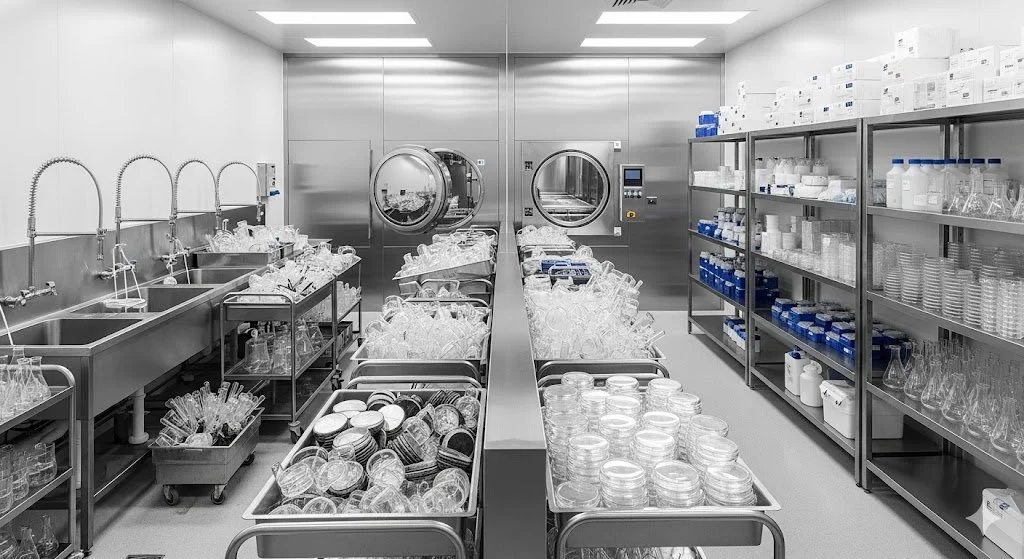
Sterilization center design relies on a strict, unidirectional dirty-to-clean flow, utilizing pass-through autoclaves built directly into the physical partition to separate zones. | Credit: Gemini (2026)
How physical architecture guarantees sterile labware
A single contaminated beaker can ruin months of research. While advanced robotics and sequencers get the spotlight, the fundamental backbone of any reproducible science is absolute sterility. When facilities rely on distributed, under-bench dishwashers and local sinks, they introduce massive variability and cross-contamination risks into their processes. Clean and dirty glassware end up sharing the same bench space, creating an invisible, constant threat to assay integrity.
To correct this, architects must embrace Lean lab design by centralizing decontamination. The cornerstone of a modern sterilization center design is the implementation of a rigorous, physically enforced dirty-clean flow. This prevents soiled glassware from ever crossing paths with sterilized, ready-to-use equipment, ensuring a flawless glasswash workflow.
Translating this into architectural action requires dividing the utility core into completely segregated zones. By utilizing massive pass-through autoclaves and automated tunnel washers built directly into the dividing walls, facility managers can physically enforce a one-way progression of materials, removing human error from the sterilization equation entirely.
Key Takeaways
Unidirectional Routing: Enforcing a strict one-way path from the "dirty" receiving vestibule through the wash stations and into the "clean" autoclave staging area.
Pass-Through Architecture: Utilizing dual-door autoclaves built directly into physical partitions to serve as the absolute barrier between contaminated and sterile zones.
Autoclave Throughput: Properly sizing steam sterilizers and coordinating wash cycles to prevent physical and temporal bottlenecking at the barrier wall.
Utility Density: Planning for the massive mechanical, electrical, and plumbing (MEP) requirements of a centralized glasswash core, including clean steam generators and high-capacity floor drains.
How a dirty clean flow prevents cross-contamination
In a high-throughput laboratory, cross-contamination is an architectural failure before it is a human failure. A proper dirty clean flow requires physically dividing a single functional department into two strictly separated rooms: the decontamination (dirty) side and the sterile staging (clean) side.
On the dirty side, technicians receive carts of used labware. This room contains the deep soaking sinks, sonicators, and the loading sides of the automated glasswashers. The clean side contains the unloading doors of the washers, drying ovens, and sterile storage racks. The critical architectural feature is that personnel and materials cannot physically loop backward.
This physical barrier is reinforced by HVAC engineering. The dirty side must be maintained under negative air pressure relative to the clean side. If a door is opened, clean air sweeps into the dirty room, ensuring that any aerosolized biological contaminants or chemical vapors generated during the scrubbing process are trapped and exhausted away from the sterile inventory.
Why sterilization center design relies on pass-through autoclaves
The ultimate gatekeeper in any glasswash workflow is the autoclave. Traditional, single-door autoclaves are an inherent risk in a high-volume setting because items must be loaded and unloaded from the exact same physical space, breaking the chain of custody. A scientist might accidentally place a tray of unsterilized media next to a tray of freshly sterilized flasks, leading to immediate contamination.
Modern sterilization center design solves this by utilizing pass-through (dual-door) autoclaves. These massive, jacketed stainless steel units are mounted directly inside the physical partition wall separating the dirty and clean rooms.
The operational logic is physically interlocked. The "dirty" door locks when the cycle begins, and the "clean" door on the opposite side of the wall cannot be opened until the machine's sensors confirm that the exact time, temperature, and pressure parameters for absolute sterilization have been met. This mechanically guarantees that nothing enters the clean room without undergoing a validated sterilization cycle.
Comparing Glasswash Logistics: Local Sinks vs. Centralized Sterilization
Contamination Risk: Local sinks mix dirty and clean items on the same benchtop, relying on human diligence. Centralized sterilization uses physical barrier walls and interlocked doors to guarantee separation.
Autoclave Throughput: Local, benchtop autoclaves handle minimal volume and create workflow bottlenecks. Centralized bulk pass-through sterilizers process massive cart-sized loads simultaneously, drastically increasing throughput.
Utility Efficiency: Dispersing washing equipment requires plumbing, floor drains, RO/DI water, and exhaust across the entire building. Centralization condenses these heavy, expensive MEP costs into a single, optimized utility core.
Labor Utilization: Scientists waste hours manually washing beakers at local sinks. Centralized facilities utilize dedicated logistics technicians and automated tunnel washers, keeping highly paid scientists focused on research at the bench.
Expert FAQ: Glasswash Facility Design
Q: Can we retrofit a pass-through autoclave into an existing wall?
A: It is structurally complex but possible. It requires cutting the concrete slab to support the immense weight of the unit, modifying the wall to act as an airtight vapor seal, and pulling substantial new utilities—often including dedicated "clean steam" generators and high-capacity floor drains—to the exact location.
Q: How do we manage the heat generated by a high-volume glasswash workflow?
A: Centralized wash centers and massive autoclaves generate extreme sensible and latent heat loads. Facility engineers must design specialized HVAC zones with high air-change rates and dedicated stainless steel exhaust canopies directly over the autoclave doors to capture the blast of steam upon opening.
Q: What type of water is required for a sterilization center design?
A: Standard municipal tap water will leave mineral deposits on glassware and rapidly destroy autoclave boilers with scale buildup. Facilities must route high-capacity Reverse Osmosis/Deionized (RO/DI) water lines to the final rinse stages of the glasswashers and utilize pure "clean steam" (generated from RO/DI water) for the autoclaves to prevent chemical contamination of the labware.
References and Further Reading
National Institutes of Health (NIH). Design Requirements Manual (DRM). Office of Research Facilities, 2020.
Centers for Disease Control and Prevention (CDC). Biosafety in Microbiological and Biomedical Laboratories (BMBL). 6th ed., U.S. Department of Health and Human Services, 2020.
American Society of Heating, Refrigerating and Air-Conditioning Engineers (ASHRAE). Laboratory Design Guide: Planning and Operation of Laboratory HVAC Systems, 2nd ed., ASHRAE, 2015.
World Health Organization (WHO). Laboratory Biosafety Manual. 4th ed., WHO, 2020.
