
Point-of-Use Inventory: Eliminating the Central Stockroom
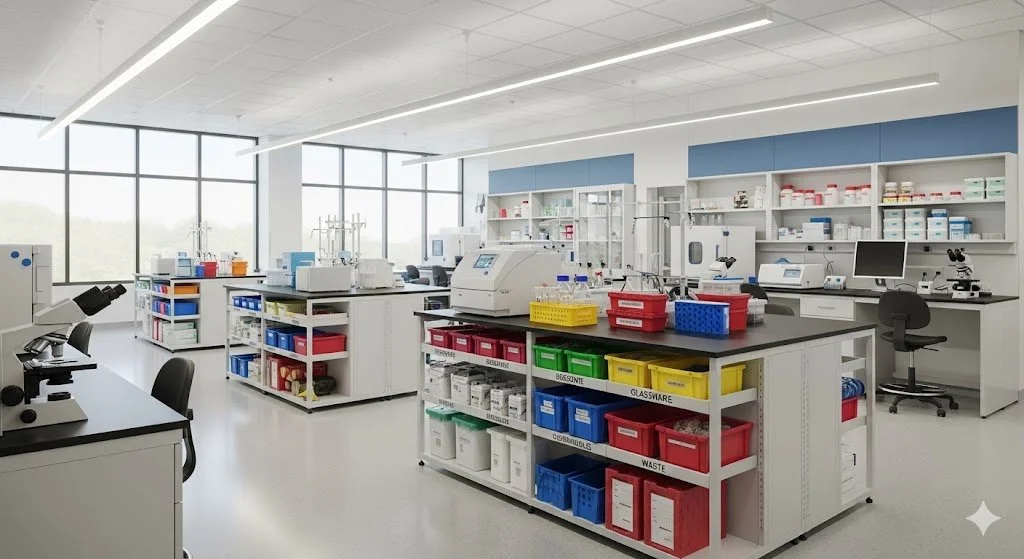
Decentralized "supermarket" shelving at the end of workstations brings critical inventory directly to the scientist, eliminating the need for a central stockroom. | Credit: Gemini (2026)
The central stockroom is a black hole for laboratory efficiency
In traditional laboratory layouts, facility planners dedicate massive square footage to a centralized supply room. Scientists are forced to leave their benches, walk down long corridors, and hunt through deep shelving units just to retrieve a box of pipette tips or a sleeve of petri dishes. This outdated model of inventory distribution creates severe workflow bottlenecks and encourages the covert hoarding of supplies at individual workstations.
To eliminate this invisible drag on scientific throughput, architects must embrace Lean lab design interventions that completely rethink spatial allocation. The architectural solution is the implementation of high-density point-of-use storage. By designing modular "supermarket" shelving at the end of each bench line, facility managers can decentralize inventory, ensuring that researchers have immediate access to a rigorously managed, limited supply of consumables exactly where the science takes place.
This paradigm shift forces laboratories to physically decouple bulk receiving from daily consumption. Instead of scientists acting as highly paid inventory clerks, a dedicated logistics team manages the flow of materials to the bench, creating a seamless, uninterrupted environment for research and discovery.
Key Takeaways
Point of Use Storage: Shifting from centralized stockrooms to localized, bench-adjacent "supermarkets" to eliminate the non-value-added transit time of gathering daily supplies.
Lab Kanban System: Implementing a visually managed, two-bin replenishment strategy that prevents both critical stockouts and localized benchtop hoarding.
Inventory Distribution: Decoupling bulk receiving from daily consumption by establishing a dedicated logistics workflow managed by facility support staff, not highly trained scientists.
Lab Shelving Design: Utilizing gravity-fed racks, mobile carts, and highly adjustable shelving to adapt quickly to changing assay requirements without requiring permanent casework modifications.
How point of use storage transforms inventory distribution
Traditional centralized storage acts as a warehouse, completely disconnected from the active workflow. Point-of-use storage fundamentally alters inventory distribution by treating the laboratory bench as an active production line. Supplies are located within arm's reach, minimizing motion waste. When a facility transitions to this decentralized model, the architectural footprint of the "stockroom" shrinks dramatically, freeing up expensive, highly ventilated square footage for revenue-generating scientific instrumentation.
Rather than scientists interrupting their assays to hunt for materials, dedicated materials management staff restock the localized bench-end "supermarkets" during off-peak hours. This allows highly compensated researchers to remain completely focused on the science. Architecturally, this requires wide enough aisles for logistics carts to maneuver without disrupting the primary work zones of the laboratory.
The success of this distribution model relies heavily on standardization. If every bench requires entirely custom supplies, point-of-use storage becomes difficult to manage. Planners must work with scientific teams to standardize core consumables, ensuring that the modular supermarkets can service multiple different workflows efficiently.
Implementing a lab kanban system for seamless restocking
A lab kanban system is a visual cueing mechanism adapted directly from lean manufacturing principles. It relies on a "two-bin" localized storage method designed to eliminate the guesswork of inventory management. When a scientist empties the primary bin of reagents or tips, they place the empty bin (or its attached Kanban card) into a designated collection chute at the end of the bench. The secondary backup bin is immediately pulled forward to ensure zero downtime.
The facility logistics team collects these visual triggers during routine sweeps, pulling replacement stock from a much smaller, off-site bulk receiving area. This creates a "pull" system based entirely on actual daily consumption, rather than a "push" system based on arbitrary weekly ordering schedules.
By physically limiting the storage space at the bench to exactly two bins per consumable, a Kanban system prevents the chronic problem of benchtop hoarding. Scientists learn to trust the system because they never experience a stockout, and the laboratory remains clean, organized, and compliant with 5S standards.
Optimizing lab shelving design for decentralized supplies
Successfully implementing a decentralized model requires specialized lab shelving design. Standard flat, deep shelves are architectural failures for point-of-use inventory; they allow older items to be pushed to the back, hidden from view, and eventually expire. Modern point-of-use architectures favor angled, gravity-fed flow racks that automatically rotate stock, enforcing a strict First-In, First-Out (FIFO) consumption model.
Architects must integrate these robust storage structures directly into the modular casework framing or the overhead service carriers. The shelving must be highly visible to support the Kanban visual cues, easily sanitized to meet laboratory hygiene standards, and ideally mounted on heavy-duty locking casters.
Mobile shelving allows the entire "supermarket" module to be rolled away during deep cleaning or rapidly swapped out when an assay changes. By keeping the storage dynamic, the laboratory maintains the ultimate flexibility to adapt to future scientific demands without requiring costly mechanical, electrical, or plumbing (MEP) renovations.
Comparing Inventory Strategies: Central Stockroom vs. Point-of-Use Storage
Space Allocation: Central stockrooms consume massive, contiguous blocks of prime laboratory real estate. Point-of-use storage distributes this footprint efficiently into the unused vertical space at the ends of existing bench lines.
Scientist Transit Time: Centralized systems force scientists to walk hundreds of feet per shift to gather basic materials. Decentralized systems reduce retrieval travel time to nearly zero.
Inventory Visibility: Central rooms obscure actual consumption rates and encourage hidden benchtop hoarding. A lab Kanban system provides instant visual confirmation of exactly what needs to be restocked.
Restocking Logistics: Centralized models often rely on scientists to self-report low stock, leading to emergency orders and stockouts. Point-of-use models rely on dedicated support staff reacting to visual Kanban triggers for seamless daily replenishment.
Expert FAQ: Decentralized Lab Storage
Q: Does point-of-use storage work for hazardous or temperature-sensitive chemicals?
A: Yes, but with strict architectural modifications. Decentralized storage for flammables requires under-bench, fire-rated cabinets tied directly into the facility exhaust system. Temperature-sensitive reagents utilize small, benchtop point-of-use refrigerators rather than massive centralized cold rooms, ensuring rapid access without breaking the cold chain.
Q: How do we prevent scientists from bypassing the Kanban cards and hoarding supplies?
A: Strict adherence to physical constraints is the most effective method. If the lab shelving design only physically accommodates exactly two bins per item, it is impossible for a scientist to hoard ten boxes without creating obvious, visible clutter that immediately violates the facility's 5S protocols.
Q: Will eliminating the central stockroom reduce our overall storage capacity?
A: It dramatically reduces the volume of inventory held within the high-cost, highly ventilated active lab footprint. Bulk surplus is shifted to a low-cost, non-ventilated warehouse or receiving dock space, while only a tightly controlled 3- to 5-day active supply is maintained at the point of use.
References and Further Reading
Womack, J. P., & Jones, D. T. Lean Thinking: Banish Waste and Create Wealth in Your Corporation. Free Press, 2003.
Yerian, L. M., et al. "A Collaborative Approach to Lean Laboratory Workstation Design Reduces Wasted Technologist Travel." American Journal of Clinical Pathology, vol. 138, no. 2, 2012, pp. 273-280.
National Institutes of Health (NIH). Design Requirements Manual (DRM). Office of Research Facilities, 2020.
Clinical and Laboratory Standards Institute (CLSI). QMS04: Laboratory Design; Approved Guideline. 3rd ed., CLSI, 2016.
