
Rapid Response, Lasting Asset: LSU Health’s EVT Wins Excellence in Small Project Design
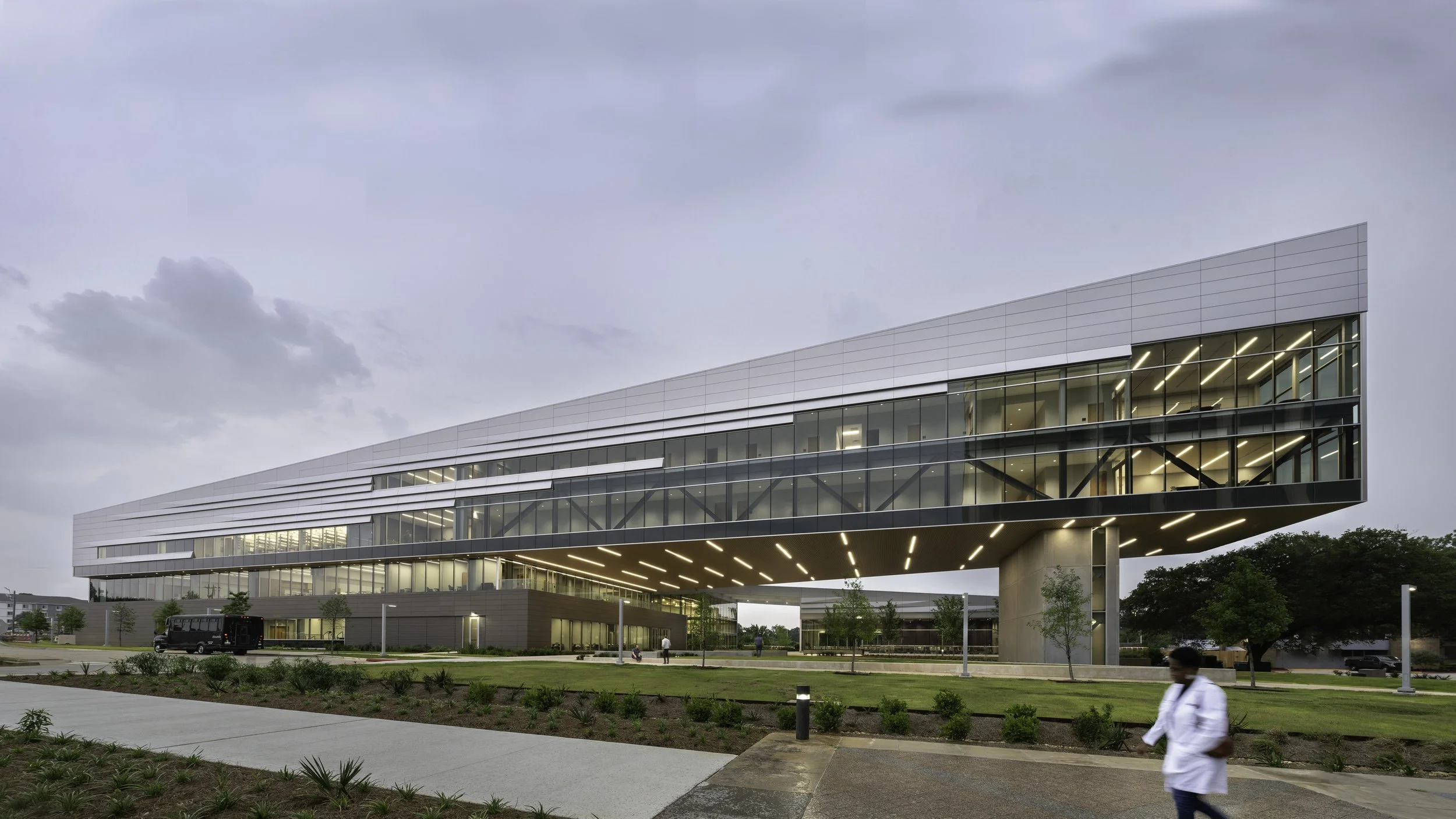
Exterior view of the LSU Health Shreveport Center for Medical Education and Wellness, highlighting the EVT floor. Image: Corey Gaffer Photography LLC
The LSU Health Shreveport Center for Emerging Viral Threats stands as a compelling example of how strategic design thinking, adaptive reuse, and disciplined cost control can converge to deliver high-performance laboratory environments under tight constraints. Developed in response to the urgent demands of the COVID-19 pandemic, the Emerging Viral Threats (EVT) laboratory was not part of the original program for LSU Health Shreveport’s Center for Medical Education and Wellness. Instead, it was introduced after the larger project was already underway, requiring the team to integrate nearly 20,000 square feet of highly specialized lab space without delaying the overall schedule.
This constraint ultimately became a defining advantage. By leveraging approximately 50,000 square feet of shelled space within the base building, the team avoided the cost and time associated with new construction. The result was a high-performance laboratory delivered at $884 per square foot—an impressive achievement given the complexity of BSL-2 and BSL-3 environments.
For demonstrating that impactful, future-ready lab spaces are not solely defined by scale or budget, but by how effectively those resources are deployed, the LSU Health Shreveport Center for Emerging Viral Threats was recognized with the Excellence in Small Project Design prize in the 2026 Design Excellence Awards. The project was submitted to the competition jointly by Perkins&Will (architect), Coleman Partners Architects (architect), and WSP (MEP engineer). The project team also included The Lemoine Company, LLC (general contractor), Aillet, Fenner, Jolly and McClelland (structural engineer), and EMA Engineers (base building MEP engineer).
Perkins&Will was honored at the 2026 Lab Design Conference in Orlando, FL on May 12, where they presented a short overview of the project.
Making the most of every square foot
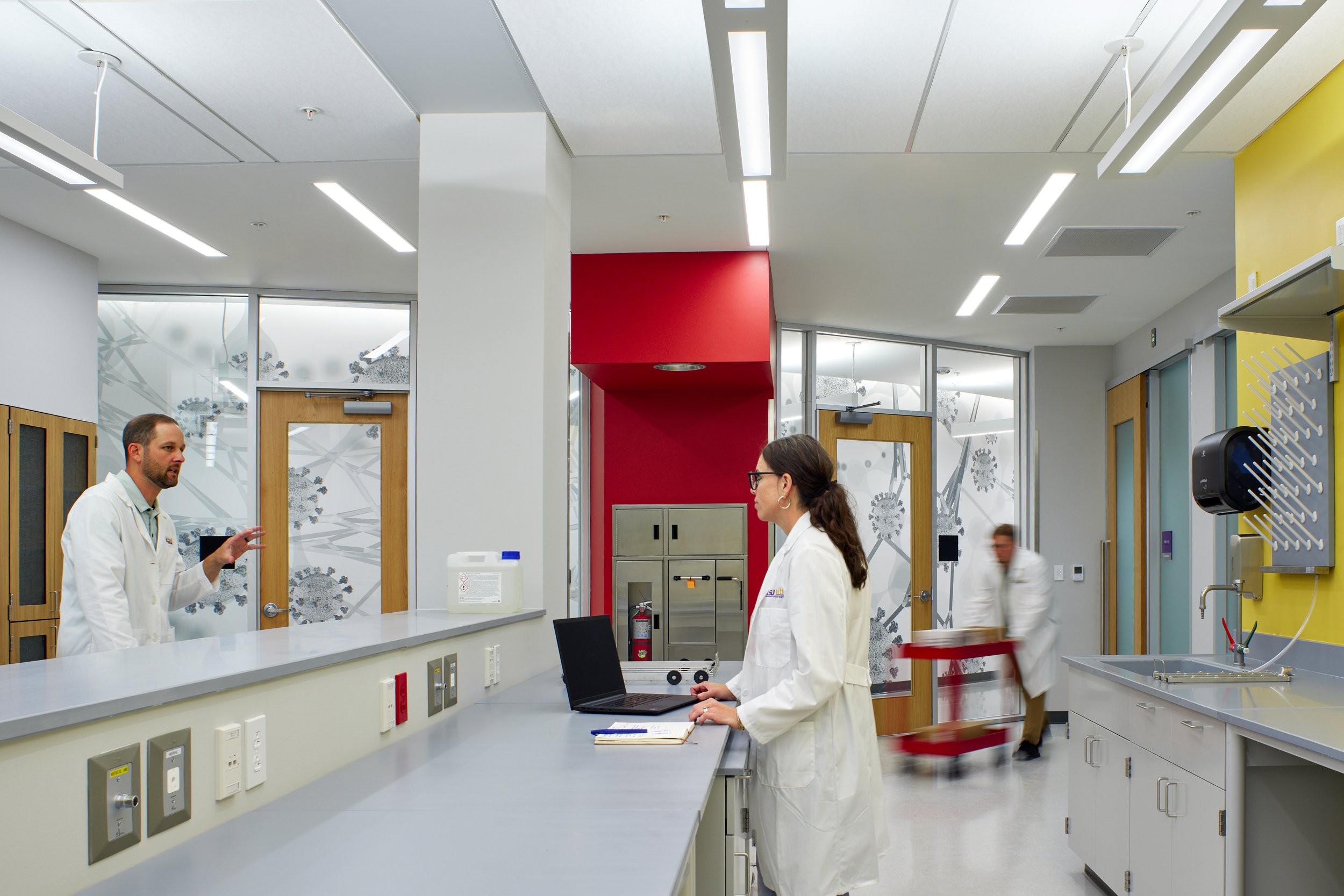
Interior view of the diagnostics lab showing work areas. Image: Corey Gaffer Photography LLC
At the heart of the project’s success is its efficient use of space, particularly within the biosafety laboratories. The EVT includes 3,588 sf of BSL-3 space and 8,850 sf of BSL-2 space, all carefully arranged within a constrained and unconventional floor plate.
Rather than imposing a standard lab layout, the design team embraced the building’s geometry. A curved boundary—created by a two-story active learning classroom below—became the basis for a circular circulation spine. This strategy organizes the lab into a cohesive loop, connecting offices, support spaces, and lab environments while minimizing wasted space on redundant corridors.
“Locating the Emerging Viral Threats Lab (EVT) program within the LSU Shreveport Health Science Center strengthens integration of patient care, education, and research by aligning EVT with core clinical departments, medical trainees, and academic governance. This structure enhances care quality through multidisciplinary collaboration and standardized protocols, builds a strong pipeline for physician training and recruitment, expands access to research infrastructure and grant opportunities, and elevates LSU’s academic reputation as a leader in advanced, high-acuity care,” says Andrew Brown, AIA, managing principal with Perkins&Will. “It also provides clearer leadership, sustainable growth, and mission alignment, ensuring EVT advances clinical excellence while supporting LSU’s commitments to education, innovation, and public service.”
The result is a highly efficient layout that maximizes usable area while maintaining clarity in circulation—an essential feature in complex laboratory environments.
“Integrating the EVT Lab into the context of the Center for Medical Education and Wellness midstream of the design process posed several interesting challenges,” says Brown. “The design team studied several possible locations for the new, 18,000 sf space that could offer proximity to service functions, isolation from other building occupancies, and adjacency to key building systems. The building’s unique wedge shape ultimately aided in a solution to place the EVT Lab in an area a couple floors directly above the loading dock and with gradually increasing roof height. The result is a containment lab positioned directly below critical mechanical penthouse space with direct access via service elevator down to the receipt and dock zone.”
Layering safety within an active building
One of the project’s most notable achievements is its ability to embed high-containment laboratory space within a fully occupied academic facility. The EVT lab sits alongside classrooms, fitness areas, and public gathering spaces, requiring a carefully calibrated approach to safety and access.
The design employs a “gradient” strategy, organizing spaces from public to increasingly secure zones. Users move from open circulation areas into controlled entry points, then into administrative and support spaces, and finally into the high-containment lab environments.
Within this hierarchy, the BSL-3 labs are positioned deep within the footprint, buffered by lower-risk areas and multiple layers of access control. The suite includes six controlled access points, dedicated change and decontamination zones, and one-way circulation paths, all of which reduce the risk of cross-contamination.
This layered approach allows the facility to maintain rigorous biosafety standards without disrupting the daily flow of the surrounding building.
Building within constraints
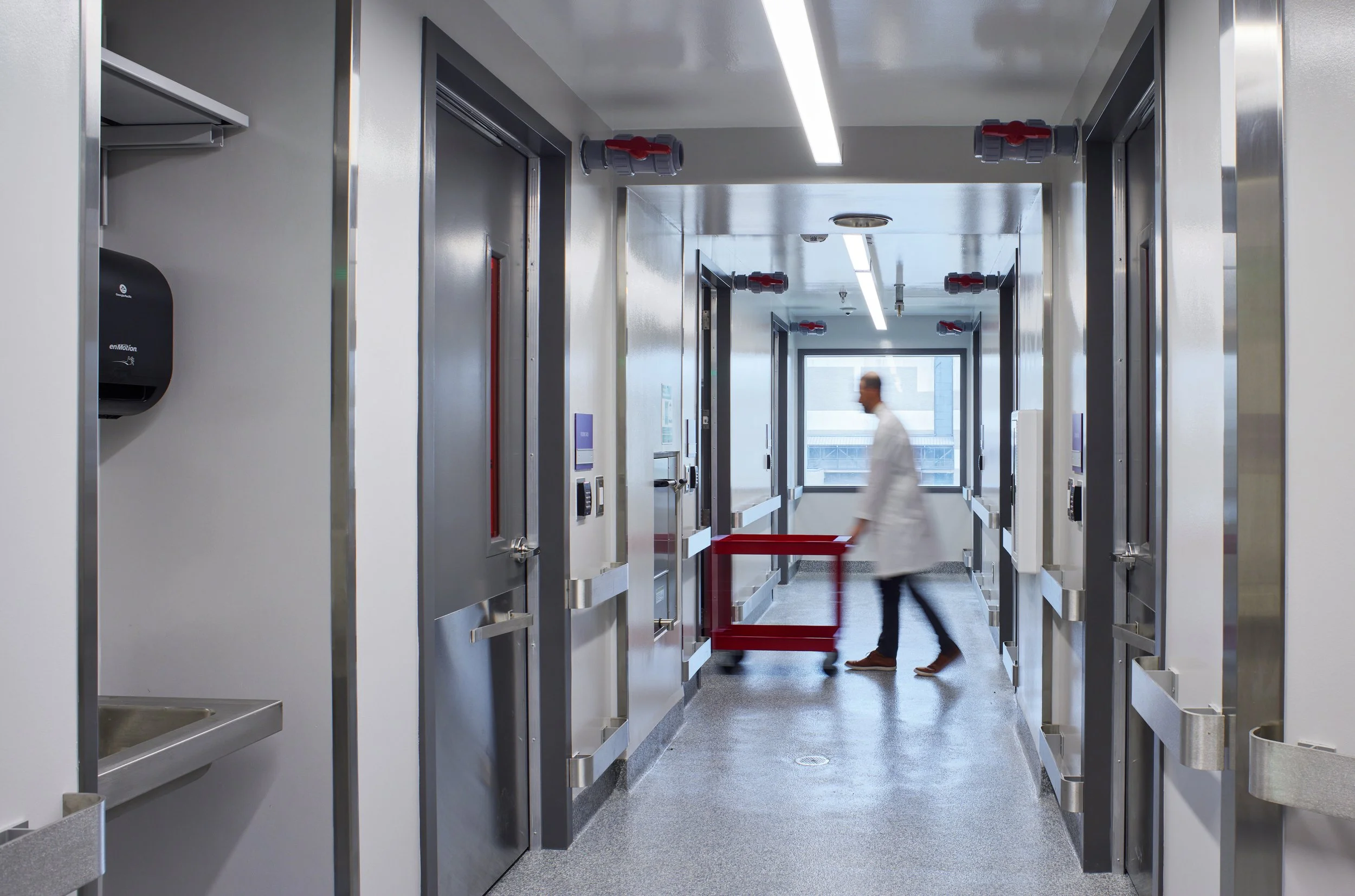
Corridor leading to laboratory support spaces, within the EVT environment. Image: Corey Gaffer Photography LLC
Constructing a high-containment lab within an already active facility posed significant logistical and engineering challenges. Located on the third floor, the EVT lab required precise coordination to integrate complex MEP systems—such as HEPA filtration, redundant exhaust, and specialized decontamination—within limited space and without interrupting ongoing operations.
The design team addressed this by aligning the lab vertically with key building infrastructure and utilizing a dedicated penthouse for service access. This approach enabled critical systems to be installed efficiently while preserving valuable floor space within the lab.
The ability to execute this level of integration without impacting the broader construction timeline was a key factor in maintaining budget control and avoiding cost escalation.
“The most critical component to this project for the State of Louisiana was time,” notes Brown. “By quickly incorporating the EVT Lab into the existing design project, this containment lab materialized at pace a full ground up project scope could not achieve. Our planning team worked closely with end users, campus representatives, construction partners, and administration to effectively gain a 12-month head start on delivering this dynamic lab facility for critical diagnostics and research functions.”
Flexibility built in
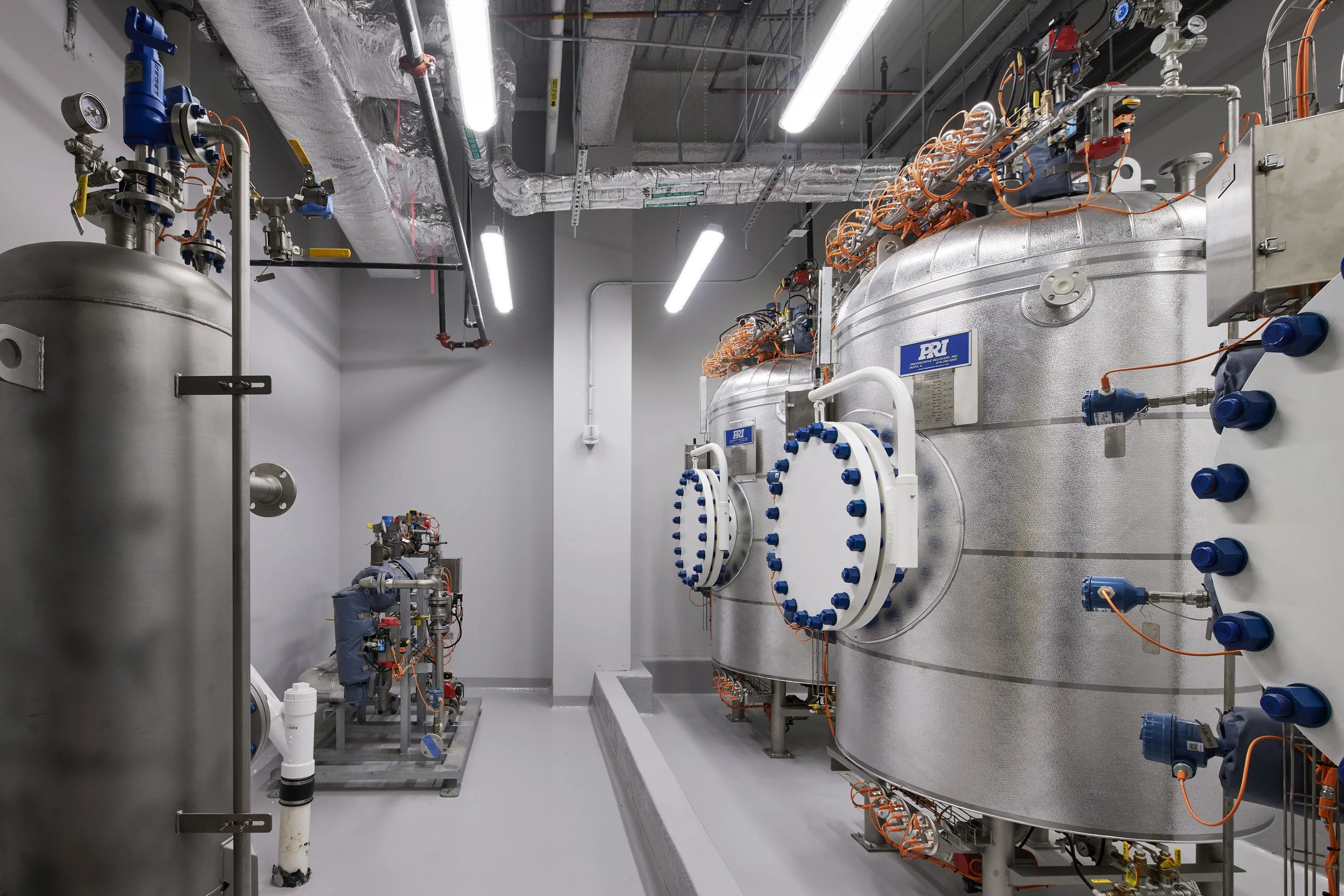
Interior view of a mechanical room. Image: Corey Gaffer Photography LLC
Flexibility is another defining feature of the EVT lab. Designed to support both diagnostics and research, the facility can shift between BSL-2 and BSL-3 operations as needed.
This adaptability is enabled by standardized lab modules, multi-use utilities, and accessible infrastructure. Spaces can be repurposed with minimal disruption, allowing the lab to respond quickly to emerging health threats or evolving research priorities.
Importantly, the ability to operate at BSL-2 when full containment is not required offers significant cost savings. Systems such as HEPA filtration can be adjusted or temporarily removed, reducing energy use and maintenance demands while maintaining readiness for higher-level operations.
Enhancing the user experience
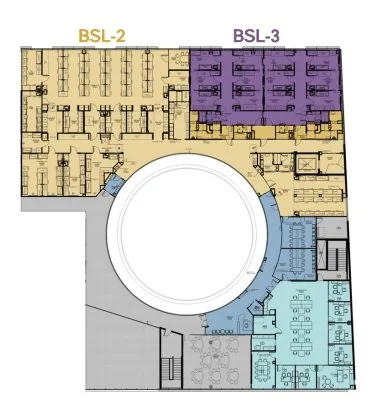
Diagram showing the layered security path to BSL-2 and BSL-3 labs. Image: Perkins&Will
Despite its technical complexity, the EVT lab is designed with occupant well-being in mind. Access to daylight, visual transparency, and proximity to campus amenities help create a more engaging and supportive environment for researchers and staff.
Even within the BSL-3 suite—where isolation is typically the norm—carefully integrated windows provide natural light and a connection to exterior conditions. This attention to user experience reflects a broader shift in lab design, where performance and wellness are increasingly seen as complementary goals.
The LSU Health Shreveport Center for Emerging Viral Threats illustrates how thoughtful design can transform constraints into opportunities. By repurposing existing space, optimizing layout efficiency, and integrating complex systems within a compact footprint, the project team delivered a facility that meets the highest safety and performance standards—without exceeding its budget.
“It is increasingly common for the owner to present the design team with a set of key programmatic objectives and a budget and require the planning and design solutions to align these two. For the EVT Lab, our team leaned on benchmark data, regulatory requirements, and historical knowledge, and end user input to analyze cost models for the various systems of the high-containment,” says Brown.
“This project adopts a multi‑modal ABSL‑2/ABSL‑3 design to control construction costs while preserving full biosafety capability and future flexibility. By building a shared containment infrastructure—structural envelope, exhaust pathways, mechanical capacity, and service zones—capable of supporting ABSL‑3 standards, individual spaces can operate efficiently at ABSL‑2 and be elevated to ABSL‑3 through controlled ventilation, access, and operational protocols rather than permanent duplication of high‑cost systems. This approach limits the footprint of continuously operating ABSL‑3 environments, reduces initial capital and lifecycle operating costs, and enables rapid adaptation to evolving emerging viral threat research needs without disruptive renovations, aligning fiscal responsibility with LSU’s mission of responsive, high‑impact biomedical research.”
Its recognition for Excellence in Small Project Design underscores a key lesson for the industry: impactful laboratory environments are not defined by scale, but by the intelligence of their design.