
Morgan State University Expands Research Infrastructure With Advanced Labs

New microelectronics and molecular biology laboratories at Morgan State University will expand the university’s research capabilities in semiconductor innovation, biomedical science, and interdisciplinary applied research. Photo: Courtesy of Morgan State University
Morgan State University in Baltimore, MD is advancing its research infrastructure through investments in two next-generation laboratory environments: a new microelectronics cleanroom facility and a state-of-the-art Molecular Biology Research Laboratory. Backed by nearly $9 million in federal funding from the National Institute of Standards and Technology (NIST), the projects are designed to strengthen Morgan’s position as a national leader in applied research while supporting the university’s strategic pursuit of Carnegie R1 status.
The initiatives reflect a broader transformation underway at Morgan, where research infrastructure is being intentionally developed to support interdisciplinary collaboration, workforce development, translational innovation, and increased external partnerships. The projects offer a compelling example of how academic institutions are rethinking laboratory design to balance flexibility, technical sophistication, user engagement, and long-term scalability.
Creating a physical hub for semiconductor innovation
At the center of Morgan’s microelectronics expansion is a planned 4,000-sf cleanroom facility within the University’s Center for Education and Research in Microelectronics, located in the Mitchell Engineering Building.
The Center, established in 2023, supports research into the design, fabrication, and application of microelectronic devices that power technologies ranging from medical imaging systems and smartphones to robotics and advanced sensing systems. The new cleanroom will significantly expand the university’s ability to conduct hands-on semiconductor fabrication and advanced materials research.
“The microelectronics cleanroom represents a design to meet a blend of requirements,” says Michael Spencer, PhD, department chair, professor, department of electrical and computer engineering at Morgan. “On the one hand, teaching students the basics of semiconductor fabrication technology (Si-based). And on the other, a multidisciplinary user facility to support the advances in quantum, bioelectronics and advanced materials.”
The facility is being designed not only as a research environment, but also as a visible centerpiece for Morgan’s growing semiconductor ecosystem. Earlier reports from the University describe the cleanroom as a future “showpiece,” intended to make the university’s microelectronics research physically tangible and accessible to students, collaborators, and prospective partners.
A major distinguishing feature of the lab will be its focus on advanced materials research. According to Spencer, the facility will include specialized growth capabilities supporting III-nitride materials and diamond-based technologies, both of which are increasingly important in high-performance electronics, quantum applications, and next-generation sensing devices.
“Our lab has a strong focus on advanced materials,” Spencer says. “We will have a unique growth capability for the III-nitrides as well as diamond.”
The cleanroom is also being planned with long-term flexibility in mind, allowing the facility to accommodate future upgrades, emerging fabrication technologies, and evolving research priorities as the program expands.
“In the future, if funding becomes available, we will focus on building a unique suite of tools for the fabrication of quantum devices,” Spencer adds.
Flexibility through technology integration
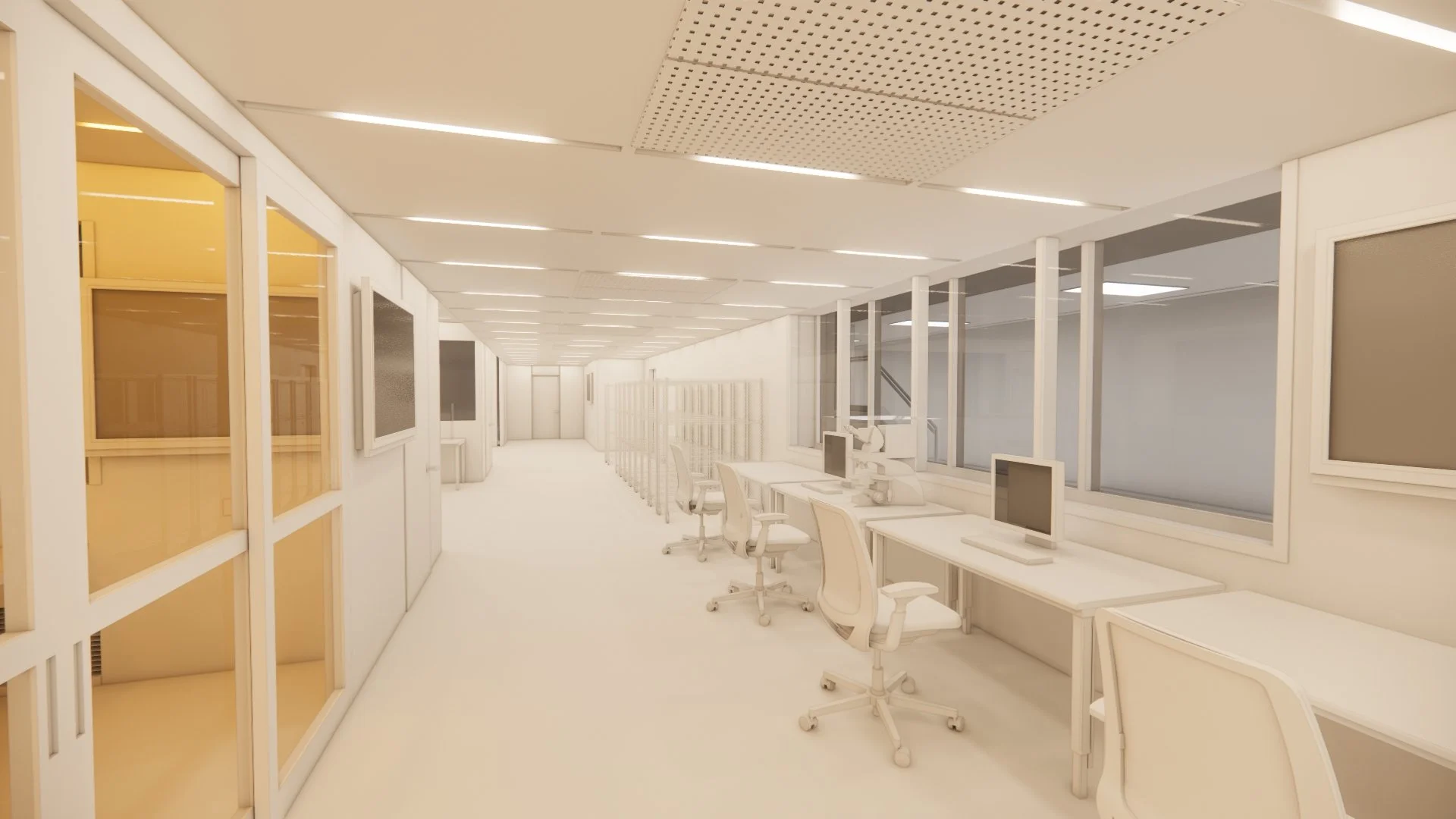
Morgan State University is incorporating AI, machine learning, and digital twin technologies into its new microelectronics cleanroom to support advanced semiconductor research, technology integration, and hands-on student learning. Photo: Courtesy of Morgan State University
Although semiconductor fabrication fundamentals have remained relatively stable over the last two decades, the tools and computational systems supporting fabrication workflows have evolved rapidly. Morgan’s design strategy reflects this reality by emphasizing technological adaptability and integration.
“Basic unit cell fabrication technology has not fundamentally changed over the last 20 years,” Spencer says. “However, there has been an incredible innovation in fabrication tools.”
The university is exploring the integration of artificial intelligence, machine learning, and digital twin modeling into both the operation and educational mission of the cleanroom environment. These technologies are expected to influence equipment planning, infrastructure requirements, and long-term operational strategies.
“As our lab is coming up, we will do our best to integrate the best features of AI, machine learning and digital twin modelling,” Spencer says.
Digital twins, in particular, are expected to play an increasingly important role in semiconductor manufacturing nationally. Morgan’s participation in the Semiconductor Research Corporation roadmap and its emerging partnership with the Smart USA Institute are helping shape the University’s approach to incorporating those tools into education and research.
“The challenge now is to find a way to introduce digital twins as an educational experience,” Spencer says. “This effort itself is a challenge because the data underlying digital twins is often, if not always, proprietary.”
Collaborative planning and user-centered design
Both laboratory projects are being shaped through collaborative planning processes that actively engage faculty, researchers, students, and institutional partners during early design phases.
For the cleanroom project, Morgan is leveraging its longstanding relationship with the Cornell Nanofabrication Facility to inform design decisions and operational planning.
“We are doing our best to incorporate multiple stakeholders’ options at various design phases,” Spencer says. “We are also taking advantage of our long-term relationship with the Cornell Nanofabrication Facility to leverage their experiences.”
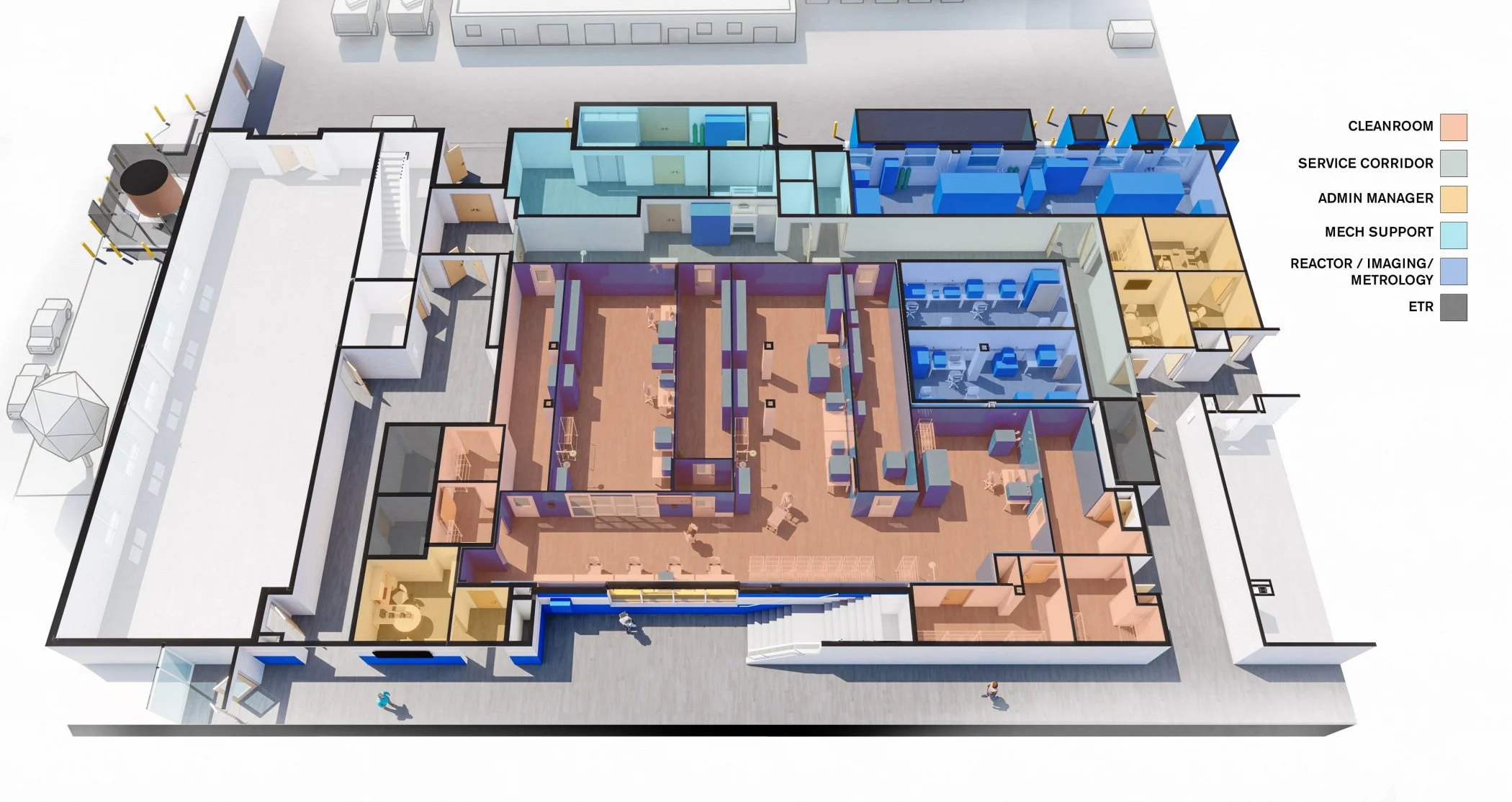
A 3D rendering of the Mitchell Engineering Building of Morgan’s School of Engineering. Photo: Courtesy of Morgan State University
The university’s planning approach also reflects the realities of designing technically sophisticated research environments within constrained footprints and evolving budgets.
“Every decision is interactive, with the most important consideration being safety,” Spencer says. “We are space-limited, and so many hard decisions on technology integration need to be made.”
To address these complexities, Morgan assembled a multidisciplinary design and consulting team focused on balancing workflow efficiency, safety, infrastructure performance, and user experience.
“We have a strong design team, utilizing many consultants and, when appropriate, the experiences of Cornell,” Spencer says.
A centralized model for molecular biology research
While the cleanroom project focuses on semiconductor innovation, Morgan’s new Molecular Biology Research Laboratory will support another rapidly growing area of institutional research strength: biomedical and public health research.
The facility will support investigators across Morgan’s School of Computer, Mathematical and Natural Sciences and provide expanded capabilities for programs focused on cancer therapeutics, wastewater-based epidemiology, health disparities, and translational biomedical research.
Unlike traditional faculty-assigned academic labs, the new facility is envisioned as a centralized, multi-user core laboratory designed around shared instrumentation and collaborative access.
“The Molecular Biology Research Laboratory will be designed as an integrated suite that meets the highest standards for fundamental research while supporting translational Research and Development (R&D),” says Paul B. Tchounwou, PhD, ScD, dean of the School of Computer, Mathematical, and Natural Sciences at Morgan State University and an accomplished biomedical research scientist.
The lab will incorporate modular wet-lab workspaces, specialized genomics suites, mammalian cell culture areas, ISO-compliant clean-air workstations, UV sterilization systems, and advanced analytical instrumentation suites strategically positioned to minimize vibration and traffic disruption in sterile environments.
Flexibility is a foundational design principle throughout the facility.
“The laboratory will feature overhead utility distribution systems for power and services, allowing rapid reconfiguration of workspaces,” Tchounwou says. “Movable benches and adaptable layouts will enable the integration of new instruments as research needs evolve. Standard instrumentation will be housed in enclosed areas near the front of the laboratory, while clean and sterile workspaces will be located toward the rear. A central instrumentation zone will provide sufficient space for multiple major instruments, ensuring both accessibility and scalability.”
Planning for shared access and operational efficiency
Because the Molecular Biology Research Laboratory will serve a broad research community, operational planning is closely tied to spatial design decisions.
The facility will incorporate a Laboratory Information Management System (LIMS) to support scheduling, workflow management, sample tracking, equipment usage monitoring, and data integrity. Clearly defined zones for sample receipt, storage, PPE donning, and clean operations are also being incorporated into the conceptual plans.
“Workflow optimization, safety, and user experience are central to the design,” Tchounwou says. “A LIMS will support scheduling, sample tracking, and workflow management. Storage systems, including freezers and refrigerators, will be equipped with real-time monitoring and backup capacity. Safety protocols will include comprehensive material assessments and the establishment of restricted substance guidelines. Controlled entry points will ensure proper PPE use and user logging. Given the multi-user nature of the facility, protocols will be implemented to track equipment usage and ensure consistent decontamination practices. These plans will be refined through consultation with faculty and users.”
Morgan is also using a structured engagement process to gather feedback from its growing life sciences research community.
“Input will be gathered through a structured and inclusive engagement process,” Tchounwou says. “Currently, 28 faculty members are actively involved in molecular biology-related research and education, and three core facilities support life sciences research across campus. An existing online platform that catalogs equipment and services—currently used by over 120 researchers—will be leveraged to solicit feedback on design concepts and evolving needs. In addition, campus-wide communications will be used to engage the broader research community and ensure comprehensive input.”
The planning process is expected to help ensure equitable access and balanced resource allocation across user groups ranging from undergraduate students to faculty investigators and postdoctoral researchers.
Advancing Morgan’s national research profile
Collectively, the two laboratory projects represent more than infrastructure upgrades. They are strategic investments intended to expand Morgan’s research productivity, workforce development capacity, and national competitiveness.
The facilities are expected to strengthen industry partnerships, support commercialization opportunities, attract additional external funding, and increase graduate research activity across multiple disciplines.
“Building on prior investments from NIH and NSF, the proposed facility will enable a transition from foundational research to translational R&D. Support from NIST will catalyze innovation, facilitating the development of new technologies, products, and industry partnerships,” Tchounwou says. “The facility will enhance ongoing research in areas such as cancer therapeutics, including small molecules, natural products, and advanced formulations. It will also expand capabilities in biologics, including nucleic acids, proteins, and cell-based therapies. By increasing research productivity, intellectual property generation, and external funding, the facility will contribute significantly to Morgan State’s R1 aspirations while strengthening graduate research training and doctoral scholar production.”
For Morgan, the projects also reinforce a broader institutional goal: creating research environments capable of attracting the next generation of scientists, engineers, and innovators while addressing nationally significant technological and health challenges through applied, interdisciplinary research.