
Modernizing a Cleanroom for Next-Gen Semiconductor Research
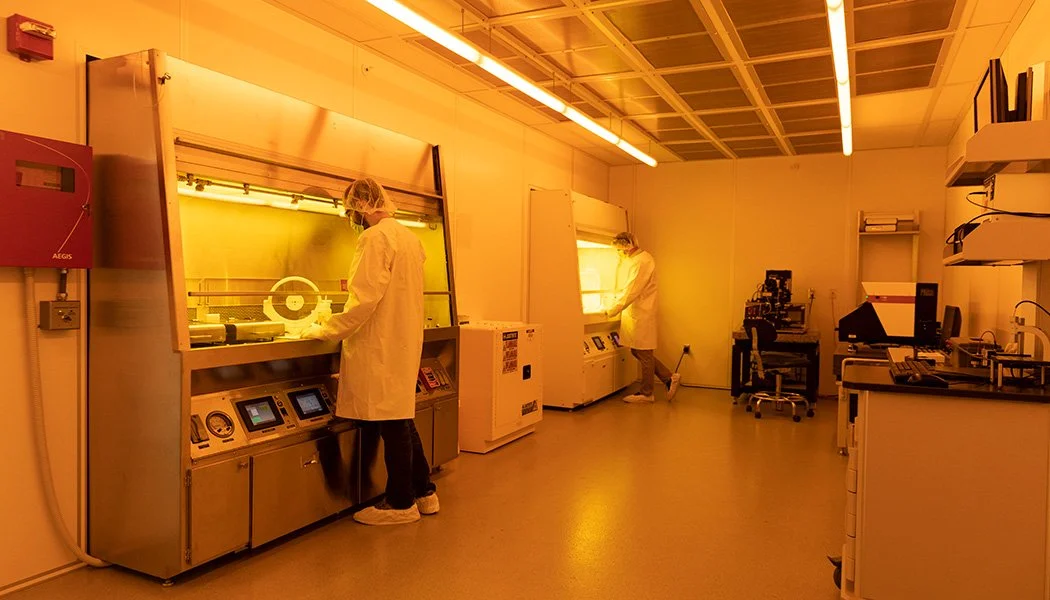
Binghamton University's newly modernized Nanofabrication Laboratory cleanroom provides students and researchers with hands-on access to advanced semiconductor fabrication and microelectronics packaging technologies while supporting next-generation research and workforce development. Image: Jonathan Cohen
As semiconductor manufacturing continues its rapid expansion across the US, universities are under increasing pressure to prepare the next generation of engineers, researchers, and technicians with practical, hands-on experience. At Binghamton University's Innovative Technologies Complex, a newly modernized cleanroom and microelectronic packaging research facility is helping meet that challenge by providing students with access to industry-relevant fabrication technologies while supporting advanced research.
The upgraded facility, part of the University's Nanofabrication Laboratory (NLAB), officially opened this summer and is expected to train more than 100 students annually while supporting research in semiconductor manufacturing and microelectronics packaging. Federal funding helped equip the facility with advanced fabrication and packaging tools that allow students to gain experience with processes such as sputtering, electron-beam evaporation, and wire bonding.
While ribbon cuttings often focus on new buildings, the real story behind Binghamton's project is one of modernization rather than new construction—a challenge familiar to many research institutions seeking to extend the life of existing laboratory infrastructure.
Modernizing instead of starting from scratch
Rather than constructing a new cleanroom, Binghamton University chose to transform its existing facility into a more capable research environment.
“This is not a newly constructed cleanroom, but a major modernization of the existing facility,” explains Vinayak Bhat, cleanroom manager for the Nanofabrication Laboratory. “Aging tools are being replaced with state-of-the-art equipment offering advanced fabrication, characterization, and packaging capabilities. The priorities are to strengthen research, improve reliability and safety, and expand hands-on training for students and researchers.”
That decision reflects a growing trend among universities that already possess expensive cleanroom infrastructure but must continually update equipment and supporting systems to remain competitive. Modern semiconductor research depends not only on sophisticated process equipment but also on the building infrastructure that supports it.
Replacing tools within an operational cleanroom introduces complexities that differ significantly from designing a new facility. Existing utility systems, structural constraints, equipment access routes, and ongoing research activities all influence how modernization projects are planned and executed.
Designing around specialized infrastructure
Unlike conventional laboratory renovations, cleanroom upgrades require careful coordination between equipment requirements and building systems. Every process tool brings its own infrastructure demands, often requiring modifications well beyond the equipment footprint itself.
According to Bhat, “The main challenge is integrating advanced equipment into an existing cleanroom and utility infrastructure.” Each new system must be evaluated for “power, gases, cooling water, exhaust, vacuum, compressed air, and environmental stability.” Existing utilities, layouts, and safety systems are then modified as needed to accommodate each installation.
This infrastructure-first approach allows designers and engineers to determine whether existing building systems can support new technologies before installation begins. It also minimizes unexpected conflicts during construction and commissioning.
The project required balancing multiple engineering considerations simultaneously, including environmental stability, equipment compatibility, utility capacity, maintenance access, and long-term operational reliability.
Supporting research while training future engineers
One of the facility's defining characteristics is its dual mission. Unlike many research cleanrooms that primarily serve faculty investigators, Binghamton's upgraded laboratory was intentionally designed to support both cutting-edge research and workforce development.
“The upgraded facility supports advanced research while remaining accessible for supervised student training,” Bhat says. “New tools provide automated, repeatable processes, while structured training, standard operating procedures, and user qualification preserve safety and process control. Students gain practical experience on equipment comparable to that used in modern research and industry.”
That educational mission influenced operational planning as much as physical design. Standardized operating procedures, qualification requirements, and carefully managed access help maintain the environmental controls required for semiconductor fabrication while allowing students to develop practical manufacturing skills.
The University plans to further strengthen this workforce pipeline through a new Intro to NanoFab course, giving students structured exposure to semiconductor manufacturing processes before entering industry.
Collaboration beyond the design team
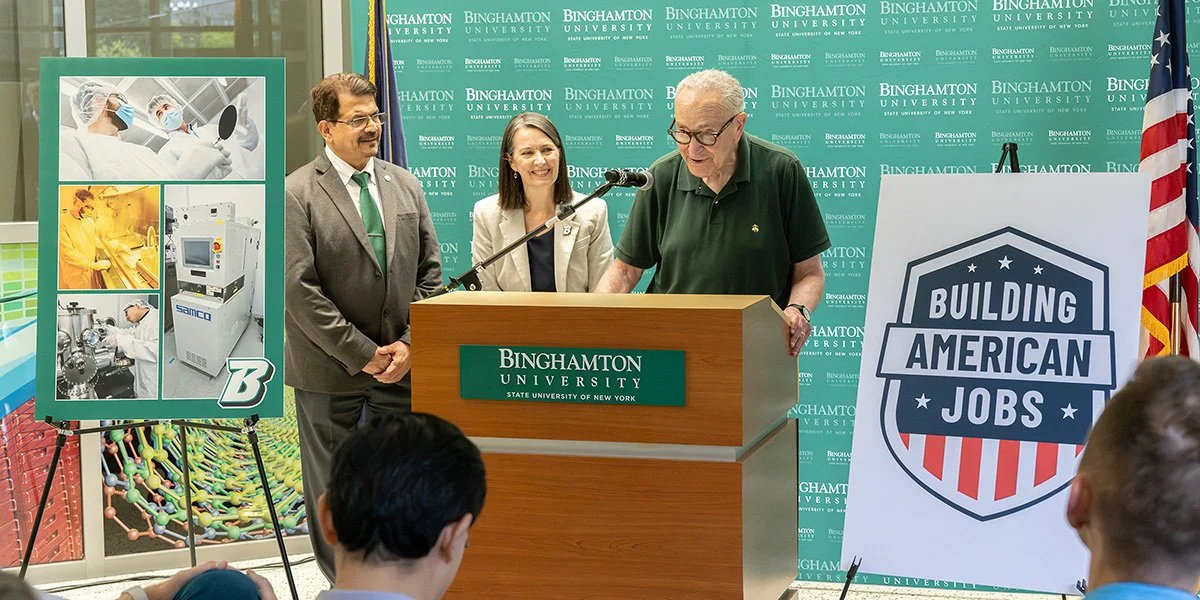
Pictured from left: Watson College of Engineering and Applied Science Dean Atul Kelkar, Binghamton University President Anne D’Alleva, and US Senator Chuck Schumer at a ribbon-cutting ceremony for a new state-of-the-art cleanroom and microelectronic packaging research facility at the University's Innovative Technologies Complex, July 2, 2026. Aided by $1 million in federal funding secured by Schumer, the facility will help students learn the fundamentals of the semiconductor manufacturing process and prepare a workforce to fill critical microelectronics manufacturing jobs. Image: Jonathan Cohen.
Modern laboratory projects increasingly rely on collaboration among a broad range of stakeholders, particularly when renovations involve highly specialized research infrastructure.
At Binghamton, faculty members and researchers defined the scientific capabilities needed both today and in the future. Cleanroom staff, Facilities Management, Environmental Health and Safety personnel, engineers, and equipment vendors worked together to evaluate installation requirements, laboratory workflows, utility demands, and safety considerations.
“Faculty and researchers identified the scientific capabilities and equipment needed for current and future projects,” Bhat explains. “Cleanroom staff, facilities management, environmental health and safety, engineers, and vendors evaluated installation, utility, workflow, and safety requirements. This collaboration helped ensure that each new tool could be integrated effectively into the existing facility.”
This type of multidisciplinary coordination is particularly important in cleanroom environments, where a single equipment installation can affect airflow patterns, utility distribution, maintenance access, and operational safety throughout the facility.
Planning for future technology
Semiconductor manufacturing technologies evolve rapidly, making flexibility a critical design objective. Rather than simply replacing obsolete equipment, the project team evaluated each installation with future growth in mind. Utility systems and equipment locations were upgraded where practical to accommodate future process tools and changing research priorities.
Bhat notes that each tool was reviewed for “electrical power, exhaust, cooling, gases, vacuum, compressed air, floor space, and service access.” He adds that replacing aging equipment improves “reliability, automation, process control, and long-term capability.”
Designing flexibility into utility infrastructure allows universities to adapt more easily as research priorities shift, reducing the cost and disruption associated with future equipment upgrades.
Working within an existing research facility also highlighted several practical lessons applicable to similar modernization efforts.
“The main challenge is installing advanced equipment within the space and utility limitations of the existing Nanofabrication Laboratory,” Bhat says. “Utility capacity, equipment dimensions, delivery routes, service clearances, and ongoing laboratory operations must all be considered.” He adds that “a key lesson is to verify actual site conditions and utility capacity before finalizing installation plans.”
Looking back on the project, Bhat believes successful cleanroom modernization begins with evaluating the facility as an integrated system rather than replacing individual pieces of equipment one at a time.
“A successful modernization requires evaluating the entire facility rather than replacing equipment individually,” he says. “Early coordination among researchers, facility staff, safety personnel, engineers, and vendors is essential. Careful planning for utilities, equipment access, maintenance, training, and future expansion has the greatest impact on successful installation and long-term operation.”
As universities nationwide expand semiconductor research and workforce development initiatives, Binghamton University's experience demonstrates that thoughtful modernization can deliver many of the benefits of a new cleanroom while leveraging existing infrastructure. By integrating advanced equipment, upgrading supporting utilities, and engaging stakeholders throughout the planning process, the university has created a flexible facility capable of supporting both today's research priorities and tomorrow's manufacturing workforce.