
Net-Zero Lab Design: A Guide to Decarbonization and Energy Efficiency
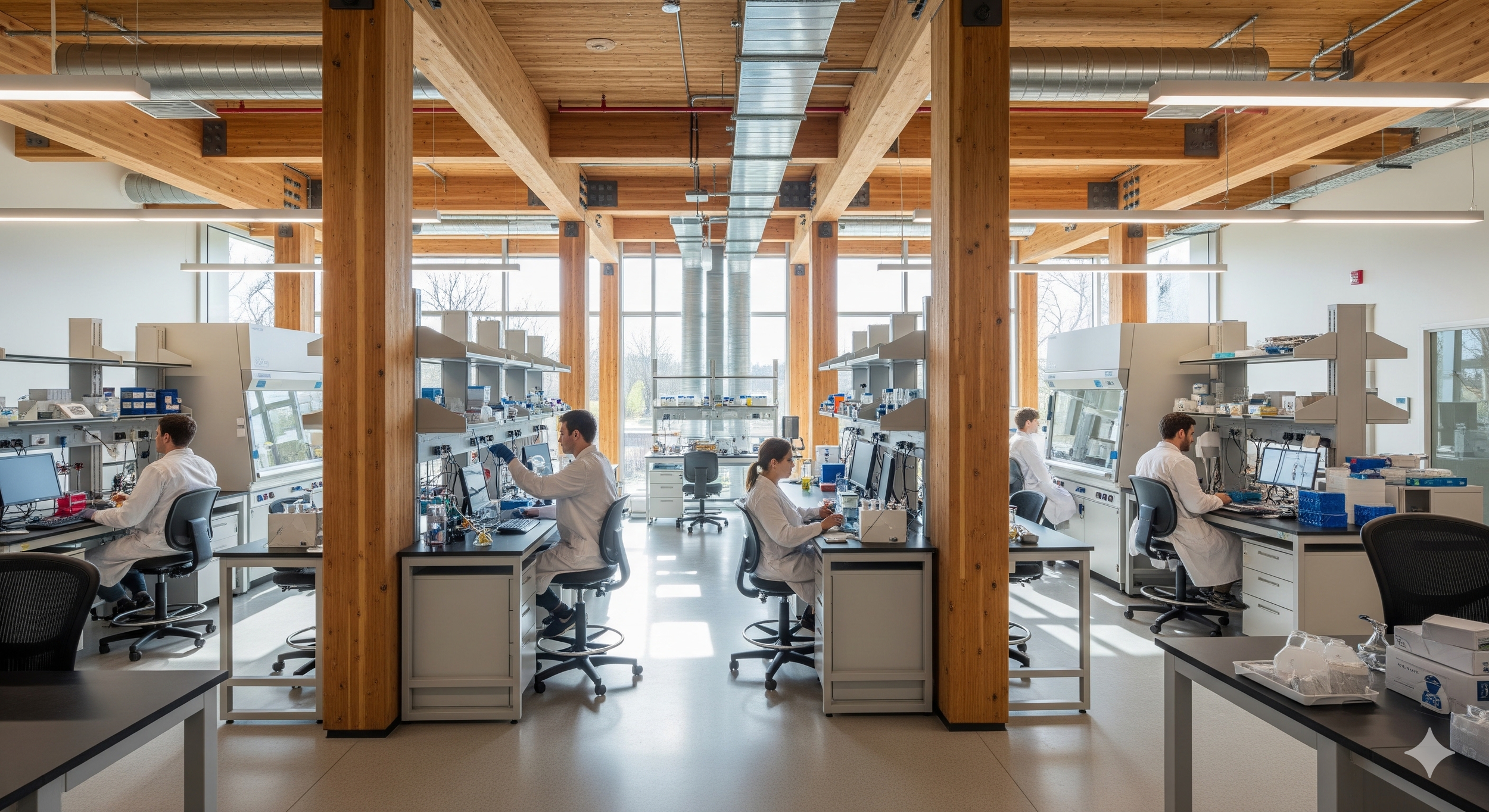
Labs are energy hogs. With new SEC carbon disclosure rules looming, Net-Zero is no longer optional.
Credit: Gemini (2026)
Introduction: the carbon cost of discovery
Science has a heavy footprint. According to the International Institute for Sustainable Laboratories (I2SL), research facilities can consume three to ten times more energy than a typical commercial office building. For decades, this excess was accepted as the "cost of doing business" to ensure safety and containment.
However, the regulatory and financial landscape has shifted. With the Securities and Exchange Commission (SEC) proposing strict climate disclosure rules (Scope 1, 2, and 3 emissions) and local municipalities enacting gas bans (like Local Law 97 in New York or Title 24 in California), net-zero lab design has moved from a "nice-to-have" to a compliance necessity. For the lab architect and lab planner, the challenge is to design high-performance facilities that support carbon-neutral science without compromising safety.
The energy intensity problem
The primary culprit in laboratory energy consumption is ventilation. Unlike offices that recirculate air, labs typically require 100 percent outside air (single-pass air) to prevent the accumulation of hazardous fumes.
The Stat: HVAC systems account for 60 to 80 percent of a laboratory's total energy use. The Challenge: conditioning freezing winter air or humid summer air only to exhaust it immediately through a fume hood stack is thermally inefficient.
Strategies for net-zero lab design
Achieving Net Zero—defined as a building that produces as much energy as it consumes over a year—requires a two-pronged approach: deep efficiency (load reduction) followed by renewable generation.
1. Attacking air change rates (ACH)
The most effective lever for lab energy efficiency is optimizing Air Changes per Hour (ACH). Historically, labs operated at a static six to ten ACH, running fans at full speed 24/7, even when the lab was empty.
The Solution: Demand-Controlled Ventilation (DCV). By installing air quality sensors that sniff for VOCs, particulates, and CO2, the building management system (BMS) can reduce airflow to two ACH during unoccupied or "clean" periods, ramping up only when a spill or contamination is detected. This strategy alone can reduce HVAC energy consumption by up to 40 percent.
2. High-performance fume hoods
Fume hoods are the "energy hogs" within the energy hog. A single standard constant-volume fume hood can consume as much energy annually as three American homes.
The Solution:
Variable Air Volume (VAV) Hoods: These reduce exhaust volume when the sash is closed.
Auto-Closing Sashes: Technology that automatically lowers the sash when the operator steps away.
Filtered (Ductless) Hoods: Where appropriate, these recirculate air through carbon filters, eliminating the need for conditioned makeup air entirely.
3. Energy recovery systems
In a Net Zero facility, throwing away exhaust air is throwing away money. Net-zero lab design mandates aggressive energy recovery.
The Solution:
Enthalpy Wheels: These transfer both heat and moisture from the exhaust airstream to the supply airstream.
Run-Around Loops: For labs where cross-contamination is a concern (preventing exhaust air from mixing with supply), hydronic run-around coils capture thermal energy from the exhaust and pipe it to the supply handler, keeping the air streams physically separated.
Electrification: killing the boiler
To achieve true carbon-neutral science, facilities must eliminate on-site fossil fuel combustion. This means retiring the natural gas steam boiler.
The Heat Pump Revolution: Modern lab designs utilize industrial-scale heat pumps and heat recovery chillers. These systems move heat rather than generating it. By capturing waste heat from the facility's cooling loop (servers, freezers, and process cooling) and stepping it up to generate hot water, labs can electrify their heating demands.
The Limitation: In extremely cold climates, electric resistance heating or limited backup boilers may still be required for peak winter loads, but the primary baseload is handled electrically.
Embodied carbon: the hidden footprint
While operational carbon (energy use) gets the headlines, embodied carbon—the emissions associated with building materials—is critical. Labs are heavy buildings, often requiring stiff concrete structures for vibration control.
Strategies for reduction:
Mass Timber: Using cross-laminated timber (CLT) instead of steel/concrete where code permits.
Low-Carbon Concrete: Specifying mixes with high fly ash or slag content to reduce cement usage.
Adaptive Reuse: The most sustainable building is the one that already exists. Converting office stock to lab space saves the massive carbon cost of a new structure.
Real-world benchmarks
The trajectory for sustainable laboratory performance is aggressive.
Standard Lab EUI: A typical older lab has an Energy Use Intensity (EUI) of 300 to 500 kBtu/sf/yr.
High-Performance Target: New designs aim for an EUI of 100 to 150 kBtu/sf/yr.
The Net-Zero Goal: To make on-site solar or off-site renewable procurement feasible, the EUI usually needs to drop below 100 kBtu/sf/yr.
Conclusion: the new standard of care
Designing a net-zero lab is no longer a theoretical exercise. With the convergence of sensor technology, heat pump efficiency, and regulatory pressure, it is becoming the standard of care. It is no longer acceptable to design a facility that relies on fossil fuels for heating or wastes conditioned air through inefficient ventilation.
For the lab architect, the goal is to view the facility not just as a container for science, but as an active participant in the global experiment to decarbonize our future. These buildings will stand for fifty years; the decisions made in the schematic design phase today will dictate their carbon legacy for decades. By embracing these strategies, we ensure that the cure for the next global health crisis doesn't come at the cost of the planet's health.
Frequently asked questions (FAQ)
Can a wet lab actually be Net Zero?
Yes, but it is challenging. It usually requires a combination of aggressive load reduction (DCV, heat recovery) and significant renewable energy generation (often requiring solar arrays larger than the building footprint or off-site power purchase agreements).
What is the "Shut the Sash" campaign?
This is a behavioral program used by universities like Harvard and MIT. It encourages researchers to close fume hood sashes when not working. It costs nothing to implement but can result in massive energy savings by allowing VAV systems to throttle down.
Do Net-Zero labs cost more to build?
Typically, yes. There is an estimated premium of five to ten percent for high-performance mechanical systems and glazing. However, the operational savings often generate a payback period of seven to ten years, and that timeline is shortening as energy prices rise.
