
Fostering Interdisciplinary Research: How Flexible Design Unlocks the Future of Science
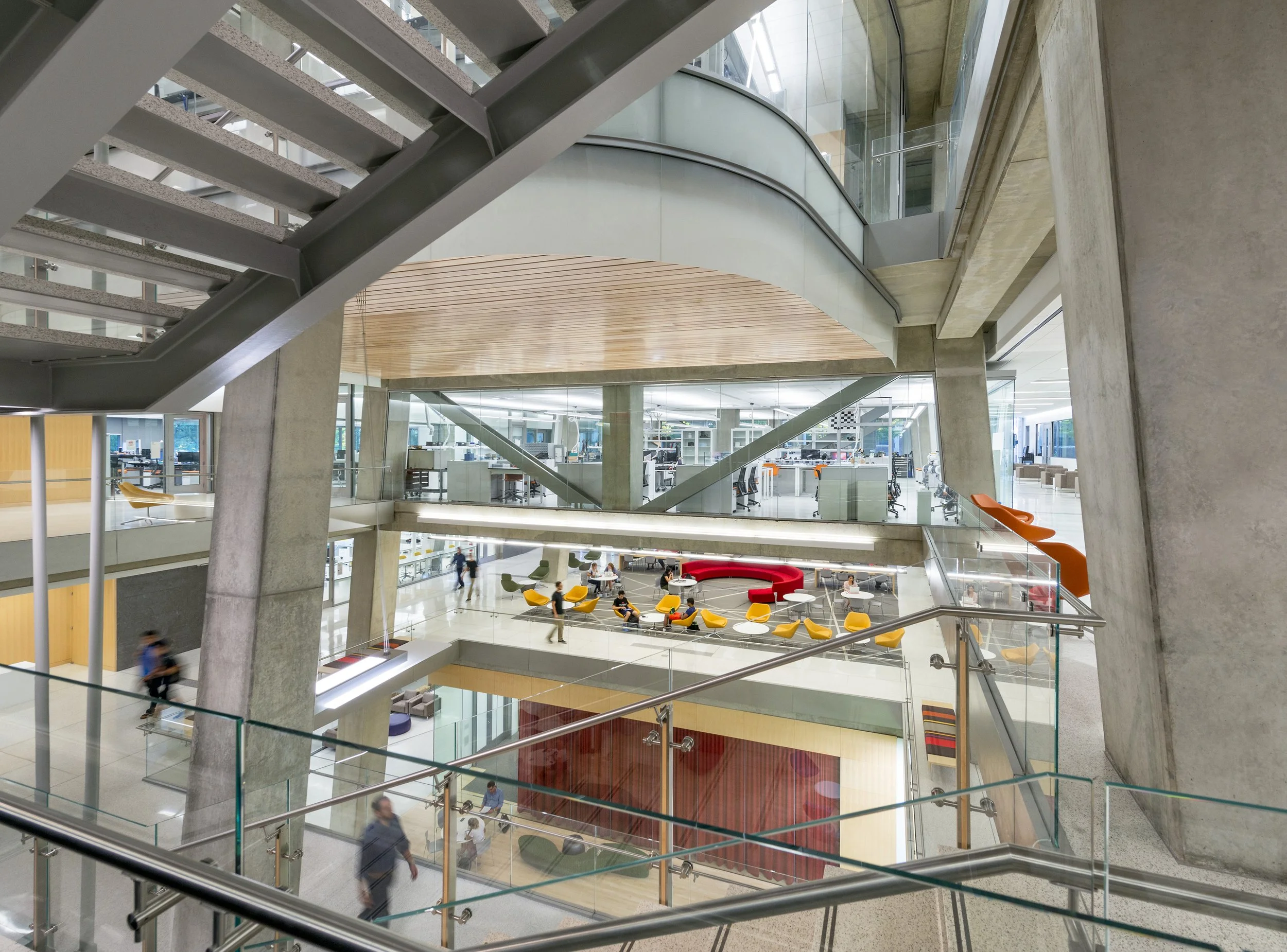
At George Washington University’s Science and Engineering Hall, modular and flexible lab design enabled a successful transition from teaching to R1 research while also accommodating evolving work patterns shaped by the pandemic, underscoring the importance of planning laboratory infrastructure for long-term adaptability rather than immediate needs. © Judy Davis, Architectural Photographer
Science is no longer confined to traditional silos like biology, chemistry, or physics. The challenges researchers face today—from combating climate change to advancing artificial intelligence—require a level of collaboration and integration that traditional departmental structures were never designed to support. The very nature of scientific discovery is evolving, and the spaces where this discovery happens must evolve with it.
Enter the era of interdisciplinary research—a dynamic, boundary-crossing approach that combines diverse perspectives to tackle the world’s most pressing problems.
For architects, engineers, and institutions, this shift is not just an academic curiosity but a pressing design challenge. How do we create laboratories that foster collaboration, adapt to new technologies, and stand the test of time?
The answer lies in flexibility, modularity, and sustainability. As science evolves, so too must the environments that enable discovery. Yet, traditional academic structures often struggle to keep pace with the demands of modern research. This challenge is particularly pronounced in fostering interdisciplinary collaboration, where breaking down barriers becomes essential.
Breaking down barriers: the challenge of interdisciplinary research
Interdisciplinary research is both a necessity and a challenge. Modern scientific problems—developing quantum computing technologies or understanding complex biological systems—demand expertise from multiple fields. Yet, most academic institutions are still organized around rigid departmental frameworks. These silos can hinder collaboration, creating friction in how researchers, departments, and even deans interact. One solution has been the rise of interdisciplinary centers, which aggregate talent from various departments under one roof. These spaces are not just buildings, but ecosystems designed to facilitate convergence.
Open environments, like the award-winning Wisconsin Institutes for Discovery at the University of Wisconsin–Madison designed by Ballinger, allow researchers from wet and dry labs to connect visually and intellectually. These spaces become crucibles of innovation by breaking down physical and organizational walls. However, creating such ecosystems is not straightforward. Cultural and logistical hurdles remain, particularly when institutions attempt to integrate research with education. The growing demand for undergraduate research experience adds another layer of complexity. Designing spaces that balance the needs of professional researchers and students is no small feat, but it’s a critical step in advancing interdisciplinary science. Creating spaces that encourage collaboration is only the first step. Equally important is ensuring these spaces can adapt over time, evolving alongside the ever-changing scientific inquiry and technological advancement needs.
Designing for flexibility: spaces that evolve with science
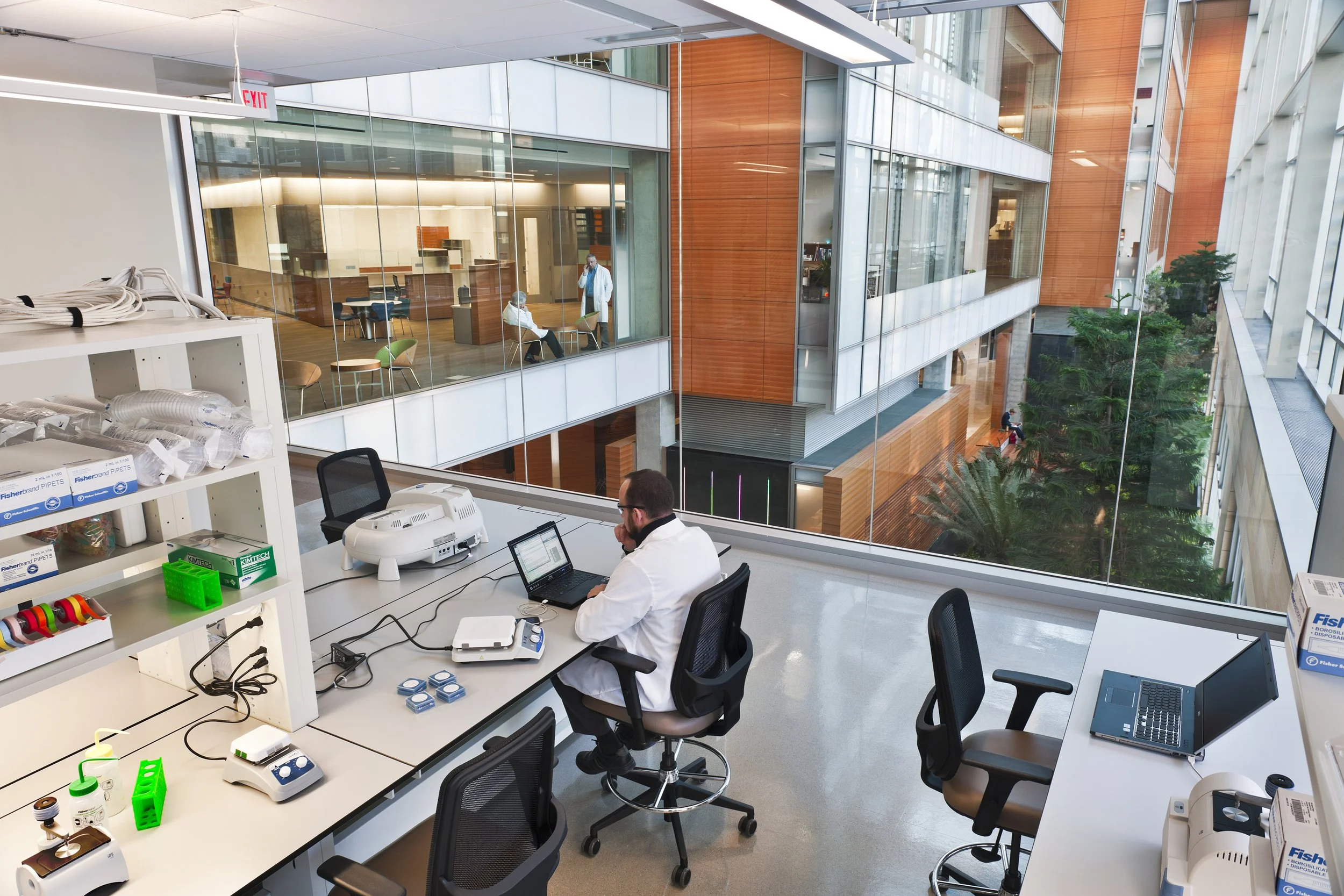
Open, collaborative lab environments—such as the Wisconsin Institutes for Discovery at the University of Wisconsin–Madison—can foster interdisciplinary innovation by connecting wet and dry research, but they also require careful design to balance research and educational needs while remaining adaptable as scientific practices and technologies evolve. Image: Tom Crane
Flexibility is the cornerstone of any future-ready laboratory. Unlike the rigid, single-purpose labs of the past, today’s research facilities must accommodate unpredictable shifts in teaching, research, and technology. For example, computational or dry researchers may thrive in open, collaborative environments, while wet-lab scientists require highly specialized spaces for hands-on experiments.
The University of Maryland’s A. James Clark Hall “loft-lab” design offers a model of flexibility. By placing cores at either end of a 300-foot-long building, the design creates a vast, unobstructed space that can be easily reconfigured. Utilities are strategically placed overhead, allowing layouts to adapt without costly renovations. This approach ensures the building can accommodate new research modalities over its 50+-year lifespan, from shifting lab-to-support space ratios to adding advanced equipment for emerging fields.
At George Washington University’s Science and Engineering Hall, a similar emphasis on modularity allowed the institution to transition from a teaching focus to a research-intensive (R1) facility. Using a flexible lab casework chassis, spaces designed initially for teaching could be transformed into cutting-edge research labs. This foresight—planning for future needs rather than current constraints—is essential for creating adaptable, long-term infrastructure. Flexibility in design is not only about anticipating scientific advancements—it must also account for shifts in how and where work gets done. The pandemic reshaped research dynamics, presenting new challenges and opportunities for laboratory design.
Rethinking research in a post-pandemic world
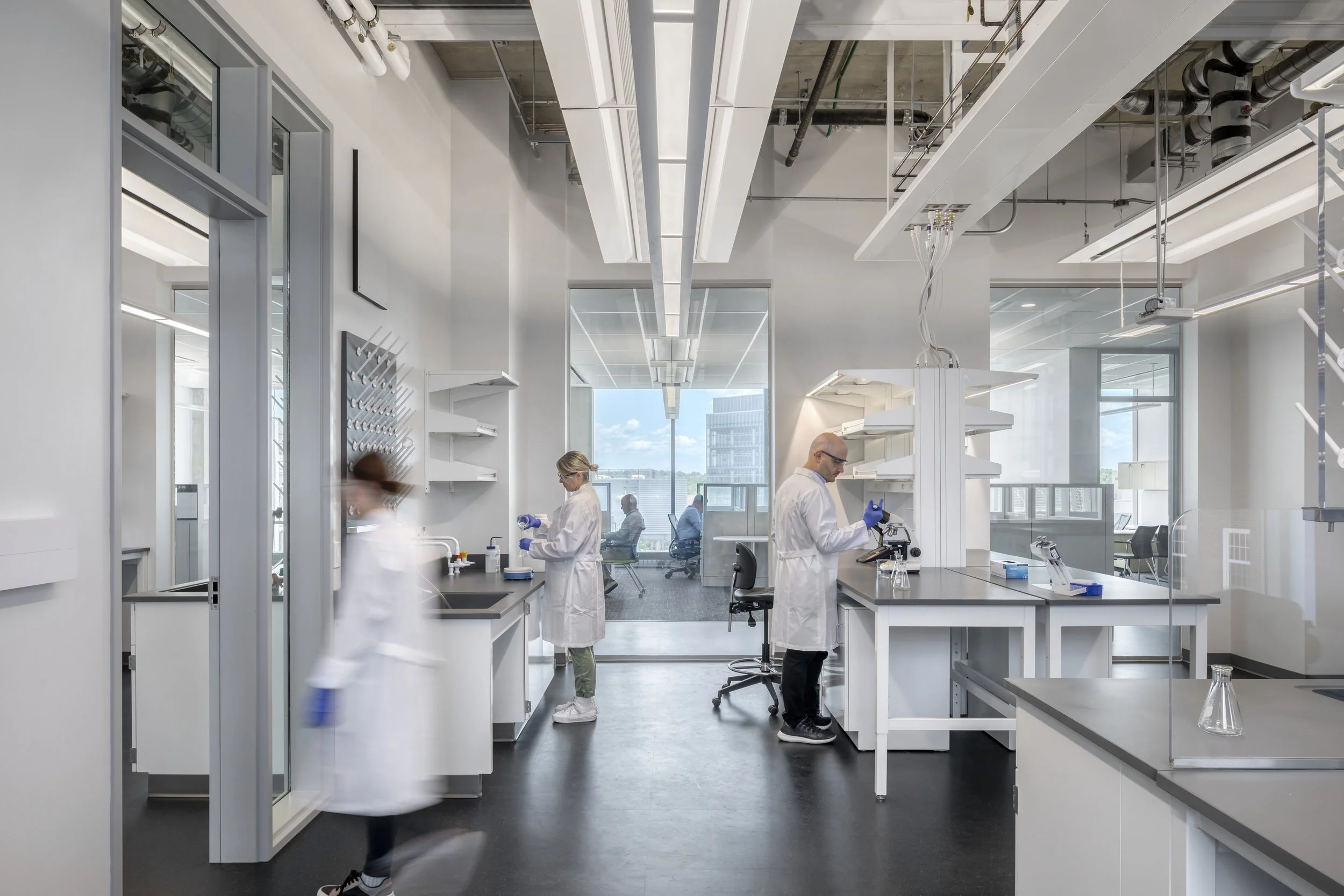
The University of Maryland’s A. James Clark Hall demonstrates how a “loft-lab” design with unobstructed floor plates and overhead utilities can support long-term flexibility, allowing laboratory spaces to be reconfigured over decades to accommodate evolving research needs and technologies. Image: James Ewing
The pandemic has permanently reshaped the social dynamics of research. While computational scientists have proven they can work effectively from home, wet lab researchers continue to require on-site facilities. This divergence creates unique challenges for lab design. How do we ensure collaboration between physically present researchers and those who are not? How do we avoid overinvesting in spaces that may go underutilized?
The solution is to create flexible, hybrid environments. Large, open labs can be paired with more minor, segregated areas that cater to different needs. Visual connectivity between spaces fosters interaction, while modular layouts allow for easy adaptation as research priorities evolve. The goal is not to force collaboration but to make it as seamless and natural as possible, even in a post-pandemic world where workstyles vary widely. While addressing the needs of today’s researchers is critical, the laboratories of tomorrow must also support cutting-edge fields like quantum science, which bring their unique challenges and possibilities.
Meeting the demands of the future: quantum science and beyond
Few fields highlight the challenges of laboratory design more than quantum science. This emerging discipline, which promises breakthroughs in AI, robotics, and computational speed, demands high performance environments with near-zero vibration, temperature variance, noise, or light. Such requirements are not just expensive—they’re transformative, reshaping how architects and engineers think about space.
At the University of Maryland, designers are incorporating basement spaces into new buildings to take advantage of ground-level vibration resistance. By distributing quantum science labs across multiple buildings, such as engineering and chemistry facilities, researchers in quantum chemistry and mechanics can collaborate easily with other disciplines in the same building. This approach saves money and integrates quantum science into the broader research ecosystem. Future-ready laboratories must also align with a wider global imperative: sustainability. Balancing high-tech research demands with environmental responsibility is no longer optional—it’s essential.
Sustainability: balancing high-tech demands with climate goals
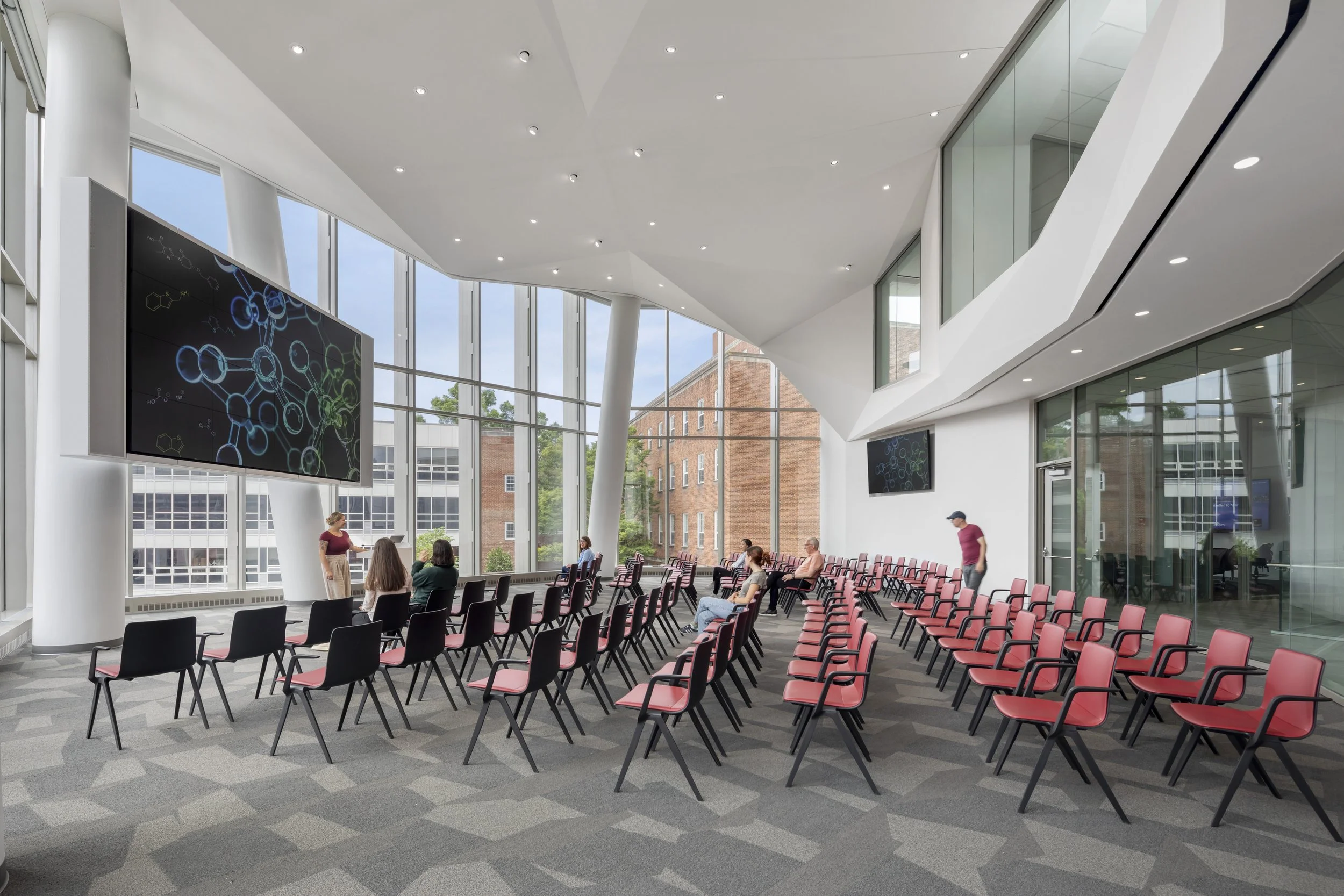
As sustainability becomes a core requirement for research institutions, high-intensity laboratories are increasingly using strategies such as dynamic ventilation control and extended commissioning periods to reduce energy use and improve performance while still meeting stringent environmental and operational demands. Image: James Ewing
Sustainability is no longer a “nice-to-have” for research institutions—it’s a mandate. High-intensity labs, with their energy-hungry equipment and strict environmental controls, pose unique challenges for institutions striving to meet net-zero carbon goals. However, with the right strategies, even these demanding facilities can become models of eco-friendly design. One promising approach is dynamic energy management. For example, labs can be designed to adjust air changes based on usage—ramping up when experiments are in progress and scaling down during downtime. This simple yet effective strategy drastically reduces energy waste. Institutions like the University of Maryland have also adopted a “soft opening” policy, scheduling ample time before building occupancy to complete commissioning and optimize building performance.
Flexibility also plays a role in sustainability. Designing infrastructure with room for future expansion—such as leaving space for additional air handlers or exhaust systems—ensures buildings can adapt to new energy-saving technologies without significant overhauls. Institutions can align their climate goals with their research needs by planning for the long term.
Key insights for designing future-ready labs
To design laboratories that enable groundbreaking research while adapting to evolving scientific and social contexts, architects and planners must:
Minimize vibrations: Leverage ground-level spaces for vibration-sensitive research and intensive shared cores such as imaging.
Optimize visual connectivity: Open environments that allow researchers to see other disciplines at work foster collaboration and innovation.
Embrace modular planning: Modular infrastructure allows spaces to evolve from teaching to research labs, as demonstrated in George Washington University’s transition to an R1 research institution.
Future-proof infrastructure: Design systems with future expansions in mind, such as easily adding extra air handling and exhaust system capacity without intensive change.
Prioritize energy efficiency: Smart energy systems that adapt to operational needs are essential for reducing carbon footprints.
Building for collaboration and resilience
The future of science demands laboratories as dynamic and interdisciplinary as the research they support. To meet this challenge, architects and institutions must prioritize flexible environments, modular planning, and energy efficiency. Whether designing for quantum science or fostering collaboration between computational and wet-lab researchers, the key is to create spaces that inspire innovation while remaining adaptable to change. By embracing these principles, we can transform research facilities into discovery engines capable of tackling tomorrow’s complex, interdisciplinary problems. Flexible design is the key to modern collaboration and the foundation for a sustainable, resilient, and innovative scientific future.