
Engineering a CLIA-Ready Lab for Next-Gen Cancer Testing
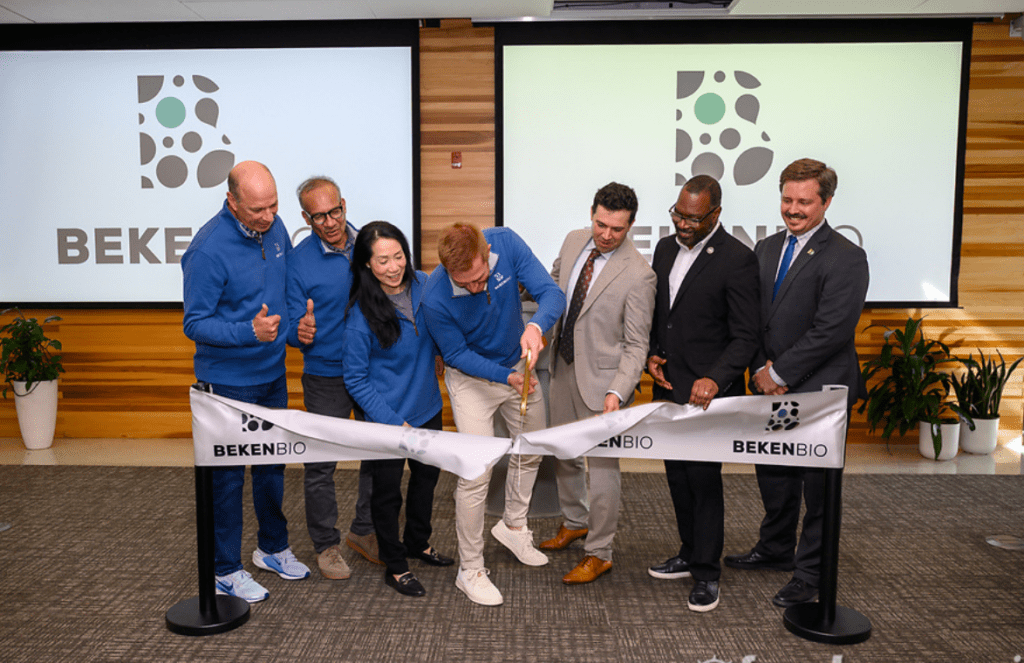
Beken Bio’s newly opened laboratory at the New Orleans BioInnovation Center highlights a design approach that prioritizes workflow, flexibility, and staff collaboration as the company advances its blood-based ovarian cancer detection program. Image: Courtesy of New Orleans BioInnovation Center
Beken Bio’s newly opened laboratory at the New Orleans BioInnovation Center marks more than a geographic expansion—it represents a carefully considered approach to clinical lab design, where workflow, flexibility, and staff collaboration take precedence over traditional buildout strategies.
The facility will serve as the company’s primary site for clinical and operational activities as it advances a blood-based test aimed at detecting ovarian cancer at earlier stages.
With Clinical Laboratory Improvement Amendments (CLIA) certification as a near-term goal, the lab has been designed from the ground up—or, more precisely, from within an existing infrastructure—to meet the rigorous demands of clinical testing while maintaining adaptability as the assay evolves.
Within this framework, the Beken Bio facility reflects a broader shift toward more agile, process-driven laboratory design for emerging diagnostics. Rather than separating research, development, and clinical execution into distinct silos, the space is intentionally structured to blur those boundaries, enabling assay development, validation, and operational refinement to occur in parallel. For a blood-based ovarian cancer test dependent on highly sensitive detection of extracellular vesicles, this integrated approach helps ensure that scientific rigor and real-world clinical performance evolve together within the same controlled environment.
Designing around the workflow
Rather than pursuing a conventional ground-up construction, Beken Bio made the deliberate decision to embed its lab within an incubator environment. This choice allowed the team to shift focus away from base building concerns and toward the nuances of assay performance and operational efficiency.
“At a high level, our priority was to create a CLIA-ready environment that supports high-sensitivity blood-based testing, while still giving us flexibility as the assay continues to evolve,” says San San Ng, PhD, MLS (ASCP), chief of laboratory operations.
Central to that priority was minimizing variability—particularly in the early stages of sample handling. Because the company’s platform detects extracellular vesicles (EVs) from plasma, even small inconsistencies can have downstream effects on test performance.
“Even small inconsistencies at that stage can have a downstream impact on performance,” Ng notes.
By leveraging the existing infrastructure at the BioInnovation Center—such as hoods, workbenches, and utilities—the team was able to bypass a lengthy construction phase and instead concentrate on optimizing workflows and process controls. “This allowed us to focus our efforts on workflow optimization, process control, and assay-specific requirements—areas that are ultimately more critical to clinical performance than the physical shell of the lab,” she says.
Flexibility over fixed design
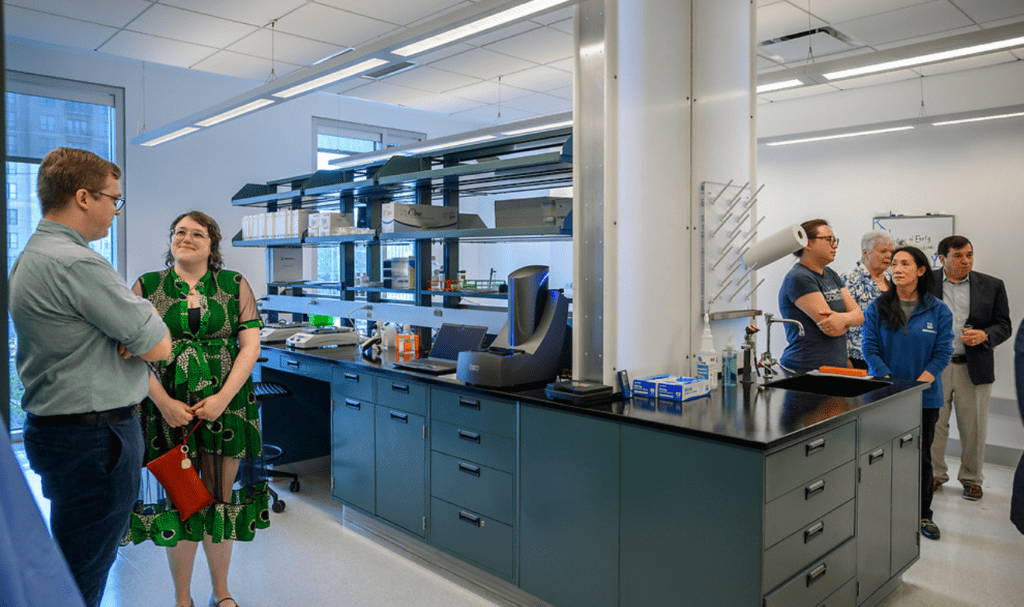
Beken Bio’s laboratory within the New Orleans BioInnovation Center leverages an incubator environment to prioritize CLIA-ready assay performance, workflow optimization, and reduced variability in high-sensitivity blood-based testing. Image: Courtesy of New Orleans BioInnovation Center
Working within an incubator also influenced the lab’s architectural philosophy. Rather than investing heavily in fixed elements, the team prioritized modularity and adaptability—key considerations for a diagnostic platform still in validation.
“Instead of investing in fixed architectural elements, we focused on flexibility,” Ng says. “This involved designing modular workflows and being thoughtful about equipment placement to support a natural, linear progression from sample intake through analysis.”
This linear workflow design is particularly important as sample volumes increase. By anticipating future scaling needs, the lab can expand capacity without requiring significant reconfiguration—a critical advantage for a growing biotech company moving toward commercialization.
Staff-driven design decisions
A defining feature of the project was the early and continuous involvement of laboratory staff in the design process. Rather than treating design as a top-down exercise, Beken Bio adopted an operations-driven approach that integrated input from scientists, clinicians, and quality personnel.
“This was very much an operations-driven and collaborative process from the beginning,” Ng says. “As a small team, our scientists have all been closely involved in the R&D of the assay, so they brought a deep understanding of how the workflow needs to function in practice.”
That hands-on expertise proved invaluable in shaping the lab’s layout and processes. The team mapped the entire sample journey—from receipt through result generation—and used that framework to guide design decisions.
“We worked closely across both the R&D and clinical sides of the team to map out the full sample journey, from receipt through result generation, and used that to guide layout and workflow decisions,” she adds.
This integrated approach also allows the company to refine its assay and operational workflow simultaneously. “The benefit of this integrated approach is that we’re able to refine both the assay and the operational workflow in parallel within the clinical lab environment,” Ng says, “which helps ensure the process is both practical and scalable as we move forward.”
Lessons in quality and collaboration
The design reflects not only the needs of the current assay but also lessons learned from previous lab builds. Chief among these is the importance of designing around workflow rather than space.
“One of the most important is the need to design around workflow first, not space,” Ng says. “If the workflow is inefficient, no amount of square footage or equipment can fix it later.”
Equally critical was embedding quality and regulatory considerations from the outset. By integrating documentation practices, process controls, and validation readiness into the lab’s foundation, the team avoided the need for costly retrofits later.
Another key takeaway was the value of cross-functional collaboration. “We’ve found that the most successful lab environments are built collaboratively,” Ng says. “When R&D, clinical, and quality teams are aligned from the start, you avoid downstream inefficiencies that are much harder to fix later.”
Balancing speed and control
While incubator environments offer speed and flexibility, they also present challenges—particularly when it comes to maintaining the level of control required for clinical testing.
“The biggest challenge is balancing flexibility with the level of control needed for clinical work,” Ng says.
To address this, the team implemented clear standard operating procedures (SOPs), defined acceptable equipment ranges, and designed workflows that minimize reliance on shared resources when precision is critical. “That approach has allowed us to maintain clinical-grade standards while still benefiting from the speed and flexibility of the incubator setting,” she says.
Positioned for growth
As Beken Bio moves toward clinical validation and commercialization, the lab stands as a model of intentional, workflow-centric design. By prioritizing flexibility, embedding quality early, and involving staff at every stage, the company has created a space that supports both immediate operational needs and long-term scalability.
“Taking that approach has allowed us to move efficiently without compromising on quality,” Ng says. “It also puts us in a much stronger position as we transition into clinical validation and, ultimately, commercialization.”
In a sector where speed to market is critical but precision is paramount, Beken Bio’s New Orleans lab demonstrates how thoughtful design can bridge the gap—turning a shared incubator space into a high-performance clinical environment poised to advance early cancer detection.